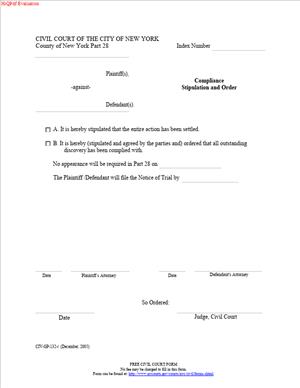
CIV-GP-132-i- Compliance Stipulation and Order
Fill out nowJurisdiction: Country: United States | Province or State: New York
The CIV-GP-132-i- Compliance Stipulation and Order is a court form used in New York City civil cases to document an agreement about compliance. It records what the parties agree to do and how the court adopts that agreement as an order.
You usually encounter this document when a case has reached a point where specific actions are required. Those actions might relate to discovery, inspections, repairs, payments, or other case-related obligations.
This form matters because it turns a negotiated understanding into a court-recognized order. Once signed and entered, it creates clear expectations and a written record of compliance terms.
People often use this form when they want structure and clarity without continuing to argue every detail in court. It helps move a case forward by setting concrete obligations and timelines.
If you are self-represented, this document can feel technical. Understanding its purpose and structure makes the completion process more manageable and reduces confusion at filing time.
What is CIV-GP-132-i- Compliance Stipulation and Order?
Clear definition
The CIV-GP-132-i- Compliance Stipulation and Order is a written agreement between parties in a civil case that addresses compliance with certain requirements. It is presented to the court for approval and signature.
The form combines two elements. A stipulation reflects what the parties agree to. An order reflects the court’s acceptance of that agreement and its authority over enforcement.
Once completed and signed by the judge, the document becomes part of the court record. It shows what actions are required, by whom, and within what timeframes.
Who typically uses this form/document?
This document is commonly used by parties involved in civil cases in the Civil Court of the City of New York. That includes plaintiffs, defendants, petitioners, and respondents, depending on the case type.
Self-represented individuals often encounter this form when working directly with the other side to resolve compliance issues. Attorneys also use it when formalizing negotiated terms.
Court staff may reference this document to understand what the parties agreed to and what the court ordered. Judges rely on it to track compliance and next steps in the case.
Why you might need this form/document
You might need this form when there is a disagreement or delay about completing required actions in a case. The document provides a structured way to confirm expectations.
It is also used when the court wants a clear written plan for compliance rather than ongoing verbal discussions. The form captures details that might otherwise be unclear.
For many people, this document becomes necessary when deadlines are missed or when additional time or conditions are being agreed upon. It creates a reset point with defined terms.
Typical real-life scenarios
- In one common scenario, parties disagree about whether certain documents were provided. They use the form to agree on what remains outstanding and when it will be delivered.
- In another situation, a case involves required repairs or inspections. The form records when access will be provided and when the work will be completed.
- Sometimes a party needs extra time to comply with a prior court directive. The agreement outlines the extended deadline and any conditions tied to that extension.
- In other cases, the parties resolve multiple small compliance issues at once. The form bundles those agreements into one clear, court-approved order.
When would you use CIV-GP-132-i- Compliance Stipulation and Order?
This form is used during an active civil case, not before a case starts. It typically appears after the court has already issued instructions or deadlines.
You may encounter it during conferences, motion practice, or compliance parts of the court calendar. It is often discussed when the judge asks whether the parties can agree on next steps.
Parties use this document when they want to avoid repeated court appearances over the same compliance issue. By setting clear terms, it reduces uncertainty.
Different roles may rely on the form for different reasons. One party may want assurance that an obligation will be completed. Another may want documentation of agreed timing or conditions.
Legal characteristics of CIV-GP-132-i- Compliance Stipulation and Order
This document has legal effect because it is signed by the parties and adopted by the court. Its structure reflects both private agreement and judicial authority.
For it to be effective, the form must clearly state the agreed terms. Vague language or missing details commonly create problems later.
Rejection or delay can occur if the required sections are incomplete or inconsistent. Illegible writing, unclear dates, or missing signatures often cause issues.
There can be differences in how courts handle these forms. Procedures may vary by courtroom or case type, even within the same jurisdiction.
The document does not resolve the entire case unless it explicitly says so. It addresses compliance issues only, not final outcomes, unless clearly stated.
Is it legally binding?
When the court signs the document, it generally becomes binding as a court order. The binding effect comes from the judge’s approval, not just the parties’ agreement.
The stipulation portion reflects consent. The order portion reflects the court’s authority. Together, they create enforceable obligations.
If the court does not sign or enter the document, it may remain a private agreement without court enforcement. The judge’s signature is a key factor.
How to fill out CIV-GP-132-i- Compliance Stipulation and Order
Step 1 – Case caption information
You begin by reviewing the case caption at the top of the form. This section identifies the court, the parties, and the index or docket number.
Accuracy matters here because the caption connects the document to the correct case. Any mismatch can cause confusion in the court file.
Step 2 – Identifying the parties to the stipulation
This step involves listing who is entering into the stipulation. It clarifies whether all parties or only certain parties are included.
Clear identification helps the court understand who is bound by the agreement. It also avoids disputes about responsibility later.
Step 3 – Stating the purpose of the stipulation
In this section, you describe what compliance issue the stipulation addresses. The language is usually straightforward and factual.
This explanation gives context to the court. It shows why the document is being submitted and what problem it is meant to address.
Step 4 – Detailing specific compliance actions
Here, the form sets out the actions that must be taken. This might include producing documents, allowing access, or completing other tasks.
Each action is usually described separately. Specificity reduces misunderstandings about what is expected.
Step 5 – Including deadlines and timeframes
This step focuses on when each action will occur. Dates or time periods are typically stated clearly.
Timelines are central to compliance orders. They allow the court to track progress and address delays if they arise.
Step 6 – Addressing conditions or limitations
Sometimes compliance depends on certain conditions. This section explains those conditions in plain terms.
Including these details helps prevent disputes about whether an obligation was triggered or excused.
Step 7 – Referencing prior orders or conferences
If the stipulation relates to earlier court activity, that connection is often noted here. This creates continuity in the case record.
The reference helps the judge see how the agreement fits into the broader case history.
Step 8 – Consequences of non-compliance
Many forms include language about what happens if the terms are not followed. This section outlines those consequences at a general level.
The purpose is to emphasize the importance of compliance. It also informs the parties of potential next steps.
Step 9 – Signature lines for parties
This part of the form includes spaces for signatures. It shows that the parties agree to the stated terms.
Signatures confirm consent and reduce later disputes about whether the agreement was accepted.
Step 10 – Judge’s signature and date
The final step is reserved for the court. The judge’s signature and date turn the stipulation into an order.
Once signed, the document becomes part of the official case record and governs the listed compliance obligations.
Legal terms you might encounter in CIV-GP-132-i- Compliance Stipulation and Order
- Stipulation: A stipulation is a written agreement between the parties. In this form, it captures what you and the other side agree to do to fix or complete compliance issues. It reflects consent, not a ruling, until the judge signs.
- Order: An order is a directive from the court. When the judge signs this document, the agreed terms become enforceable. The order portion is what gives the agreement legal weight.
- Compliance: Compliance means carrying out required actions. In this document, it refers to specific tasks like producing items, granting access, or completing steps by set dates. The form records exactly what counts as compliance.
- Party: A party is any person or entity involved in the case. This includes plaintiffs, defendants, petitioners, or respondents listed in the caption. Only named parties who sign are bound by the stipulation.
- Caption: The caption is the case-identifying block at the top of the form. It includes the court name, case title, and index or docket number. Courts use it to file and track the document correctly.
- Effective Date: The effective date is when the obligations start. Sometimes it is the date of the judge’s signature; other times, the form states a specific date. Deadlines usually run from this point.
- Deadline: A deadline is the last date to complete an action. In this form, deadlines should be precise. Courts expect clear dates, not open-ended language.
- Non-Compliance: Non-compliance means failing to do what the order requires. The form may note consequences or next steps if a party does not meet the terms. This signals seriousness to the court.
- So-Ordered: “So-ordered” indicates the judge approved the stipulation. It is often written or stamped near the signature. Without this, the document may not function as an order.
FAQs
How do I know when this form becomes effective?
Look for the judge’s signature and date. If the form lists a specific effective date, use that date. If it does not, obligations usually begin when the judge signs and the order is entered.
Do all parties have to sign this document?
Check the signature section to see who is listed. Only the parties who sign agree to the terms. If a party is missing, the court may not treat the agreement as complete.
Can someone sign on behalf of a party?
Confirm whether the signer has authority. The form often includes a line showing the signer’s role. If authority is unclear, the court may question the validity of the agreement.
What if the names on this document don’t exactly match the case caption?
Compare every name to the caption at the top. Differences in spelling or party labels can cause filing problems. Correct matches help ensure the order applies to the right people.
Do I need to attach anything to this form?
Read the body carefully to see if it references attachments. If it mentions schedules, lists, or prior orders, include them. Missing attachments can make the terms unclear.
What happens to the public court record after this is filed?
Once signed and entered, the document becomes part of the case file. It shows the agreed compliance steps and deadlines. Future court reviews will rely on what is written here.
What if we agree to change a deadline after signing?
Changes usually need to be documented. Verbal agreements are hard to prove. Updated terms are typically put into a new written agreement for the court.
How many times can this form be used in one case?
There is no fixed limit. The CIV-GP-132-i- Compliance Stipulation and Order may be used whenever parties need to formalize compliance terms during the case. Each one should clearly state what it covers.
Checklist: Before, During, and After CIV-GP-132-i- Compliance Stipulation and Order
Before
- Review the entire case file to confirm what compliance issues remain.
- Verify the correct caption and index or docket number.
- Confirm who the parties are and who must sign.
- Decide on specific actions and realistic deadlines.
- Check for prior orders that affect the agreement.
- Gather any documents that will be referenced or attached.
- Make sure names and roles are consistent throughout.
- Plan how and when the document will be submitted.
During
- Write each compliance obligation clearly and separately.
- Use exact dates instead of vague timeframes.
- State any conditions that affect performance.
- Confirm that the consequences language matches the agreement.
- Review the document line by line for accuracy.
- Obtain all required signatures in the correct places.
- Leave the judge’s signature section blank.
- Make copies before submission.
After
- Confirm the document was accepted and entered by the court.
- Check that the judge signed and dated the order.
- Calendar all deadlines listed in the document.
- Keep a clean copy of your case records.
- Follow through on each required action.
- Document your compliance with notes or receipts.
- Monitor whether the other party complies.
- Be ready to reference the order if issues arise.
Common mistakes to avoid with CIV-GP-132-i- Compliance Stipulation and Order
- Mistake: Leaving deadlines vague, because parties rush drafting, which leads to confusion and missed dates, so always include clear calendar dates.
- Mistake: Using names that do not match the caption, because of nicknames or abbreviations, which can cause filing delays, so double-check the exact spelling.
- Mistake: Forgetting a party’s signature, because not everyone was present, which can invalidate the agreement, so confirm all required signers.
- Mistake: Assuming the agreement is effective without a judge’s signature, because it feels complete, which leaves it unenforceable, so confirm it is so-ordered.
- Mistake: Referencing attachments that are not included, because they were overlooked, which creates ambiguity, so attach everything mentioned.
- Mistake: Combining multiple obligations into one sentence, because it seems efficient, which makes enforcement harder, so separate each action clearly.
- Mistake: Failing to keep copies, because filing feels final, which complicates proof later, so store stamped versions safely.
What to do after filling out CIV-GP-132-i- Compliance Stipulation and Order
Once the document is complete, your focus shifts to submission and follow-through. This is where many self-represented people lose momentum. Staying organized here saves time later.
- Step 1: Make at least two copies of the completed document for your records.
- Step 2: Submit the document using the method required by the court handling your case.
- Step 3: Confirm that the court accepted the filing and that it appears on the case record.
- Step 4: Wait for confirmation that the judge has signed the document.
- Step 5: Obtain a copy showing the judge’s signature.
- Step 6: Read the signed version carefully to confirm no changes were made.
- Step 7: Enter every deadline into a calendar with reminders.
- Step 8: Gather tools or documents needed to meet each obligation.
- Step 9: Complete each task early when possible and keep proof.
- Step 10: Update your personal case file with notes about compliance.
- Step 11: Prepare to show proof if the court or other party asks.
- Step 12: Review the document again after compliance to confirm nothing remains outstanding.
Following these steps helps you treat the document as a working tool, not just paperwork. Courts expect you to rely on what is written. Clear records make that possible.
Disclaimer: This guide is provided for informational purposes only and is not intended as legal advice. You should consult a legal professional.