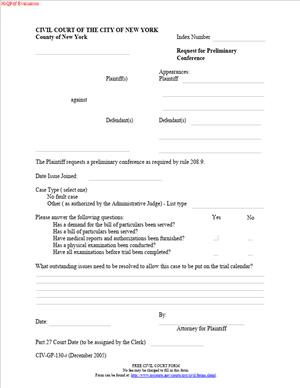
CIV-GP-130 – Request for Preliminary Conference
Fill out nowJurisdiction: Country: United States | Province or State: New York
CIV-GP-130 – Request for Preliminary Conference is a court form used to ask the court to schedule an early case management meeting. This document helps move a civil case forward in an organized way. It signals that a case is ready for structured oversight by the court.
If you are representing yourself, this form can feel procedural and unclear. Many people encounter it after papers are filed but before meaningful progress happens. Understanding its purpose can reduce confusion before you start filling in names, dates, and case details.
This form matters because it affects timing. A preliminary conference often sets deadlines, expectations, and communication rules. Those early decisions can shape how the rest of the case unfolds.
You do not need to master court rules to understand this document. You only need to know what information it asks for and what the request is meant to trigger. This guide focuses on those practical points.
The goal here is to help you approach the form calmly. By the time you reach the signature line, you should know why each section exists and how it fits into the larger court process.
What is CIV-GP-130 – Request for Preliminary Conference?
Clear definition
CIV-GP-130 – Request for Preliminary Conference is a written request asking the civil court to hold a preliminary conference in an existing case. A preliminary conference is an early meeting, usually involving the judge and the parties. It focuses on managing the case rather than deciding who wins.
The form does not present arguments or evidence. Instead, it alerts the court that the case is ready for initial supervision. The court uses this stage to understand the issues, the parties, and the procedural posture.
This document is administrative in nature. It helps the court organize its docket and set a roadmap for the case. It is not a trial request or a motion for a ruling.
Once submitted and processed, the court may issue an order scheduling the conference. That order typically includes the date, time, and format of the conference.
Who typically uses this form/document?
This form is commonly used by parties in civil cases pending in the Civil Court of the City of New York. It may be completed by someone represented by an attorney or by a self-represented litigant.
Plaintiffs often initiate the request, especially after the case has been started and basic filings are complete. Defendants may also use it in situations where the case has stalled or needs court direction.
Self-represented people use this form when they want the court to actively manage the case. It provides a formal way to prompt the next procedural step without filing substantive motions.
Court clerks and judges expect this form to be used in appropriate cases. It fits into a routine case management process rather than an exceptional request.
Why you might need this form/document
You might need this form when a case is pending but not moving forward. Early court involvement can clarify deadlines and expectations. That structure can be helpful when communication between parties is limited or strained.
The preliminary conference often addresses discovery, scheduling, and procedural issues. Without it, parties may be unsure about timing or next steps. This form is a way to ask the court to step in early.
In some cases, the court requires a preliminary conference before certain actions occur. Filing this document can be part of meeting those procedural requirements.
For self-represented litigants, this form can create a predictable framework. Knowing when the conference will happen can make preparation feel more manageable.
Typical real-life scenarios
A tenant files a civil claim related to a dispute with a landlord. After initial papers are exchanged, nothing else happens. The tenant files this form to request a preliminary conference so the court can set deadlines.
A small business owner is sued and responds to the complaint. Months pass without clear direction. The business owner uses this document to ask the court to organize the case early.
Two neighbors are involved in a property-related civil dispute. Both are representing themselves. One party files the form so a judge can clarify what information needs to be exchanged.
A consumer files a civil case involving a service dispute. After service is completed, the case sits idle. The form is submitted to prompt court scheduling and oversight.
When would you use CIV-GP-130 – Request for Preliminary Conference?
This form is used after a civil case has already been started. It is not used to begin a lawsuit. It comes into play once the court has a case number and the parties are identified.
People commonly use it when the case reaches a point where planning is needed. That may be after answers are filed or after initial procedural steps are complete. Timing often depends on how quickly the case progresses.
It is also used when parties want court guidance early. This can happen when the issues are complex or when communication between parties is difficult.
In multi-party cases, a preliminary conference can help coordinate schedules and responsibilities. The form serves as a signal that coordination is needed.
Self-represented litigants may use it when they are unsure what comes next. The request allows the court to set the next phase without requiring detailed legal arguments.
Legal characteristics of CIV-GP-130 – Request for Preliminary Conference
This document is effective when it is complete, accurate, and properly submitted to the court. Courts generally look for correct case information, party names, and clear identification of the request. Missing or inconsistent information can delay processing.
Common problems include incorrect case numbers, mismatched party names, or missing signatures. These issues can cause the court to return the form or ignore the request until corrected.
The form does not decide any legal issues. It does not grant relief or impose penalties. Its function is procedural, not substantive.
Procedures and expectations can vary by court location and case type. While the general purpose is consistent, details like timing or format of the conference may differ.
This document does not replace other filings. It does not serve as a complaint, an answer, or a motion. It works alongside those documents as part of case management.
Is it legally binding?
The form itself is not legally binding in the way a contract or court order is. Filing it does not create obligations between the parties by itself.
However, if the court issues an order in response to the request, that order may carry legal effect. Orders scheduling conferences or setting deadlines typically require compliance.
The significance comes from what follows the submission. The request triggers court action, and the resulting directives may have consequences if ignored.
Understanding this distinction helps clarify why accuracy matters. The form opens the door to binding instructions, even though it is not binding on its own.
How to fill out CIV-GP-130 – Request for Preliminary Conference
Step 1 – Review the caption and case information
Start by looking at the top section of the form. This area identifies the court, the parties, and the case number. The information must match existing court records to avoid confusion.
Step 2 – Confirm party names and roles
Check that all parties are listed exactly as they appear in the case. Pay attention to spelling and order. This helps the court connect the request to the correct file.
Step 3 – Identify the nature of the request
Locate the section where the request for a preliminary conference is stated. This part explains why the form is being filed. Read it carefully so you understand what the court is being asked to do.
Step 4 – Complete contact and appearance details
Fill in any sections asking for contact information. This allows the court to send notices and orders. Clear contact details reduce the risk of missed communications.
Step 5 – Review procedural checkboxes or statements
Some versions of the form include statements about the case status. These help the court assess readiness. Read each statement before marking anything to ensure accuracy.
Step 6 – Sign and date the form
The signature confirms that the information provided is accurate to your knowledge. Dating the form shows when the request was made. Unsigned forms are often rejected or delayed.
Step 7 – Make copies for your records
Before submission, consider keeping a copy for yourself. Having a record helps you track what was filed and when. It can be useful if questions arise later.
Step 8 – Submit the form according to court procedures
The final step is submitting the completed form to the court. Submission methods vary, but the goal is to ensure the court receives and processes the request. Once submitted, the court decides how to schedule the preliminary conference.
Legal terms you might encounter in CIV-GP-130 – Request for Preliminary Conference
- Preliminary Conference: This is an early meeting scheduled by the court to manage how the case will move forward. In this form, you are asking the court to set that meeting. The focus is on organization, timing, and expectations, not deciding the outcome.
- Caption: The caption is the block at the top that lists the court, the parties, and the case number. On this form, the caption must match the existing case exactly. Even small differences can cause delays.
- Index Number: This is the court’s tracking number for your case. You enter it so the clerk can connect the request to the right file. Using the wrong number can send your request to the wrong place.
- Party: A party is anyone formally involved in the case, such as a plaintiff or defendant. The form relies on accurate party identification. Names must appear exactly as they do in prior filings.
- Self-Represented Litigant: This means you are handling the case without a lawyer. The form is designed to be usable by people in this position. Your status does not change the importance of accuracy.
- Service: Service refers to how legal papers are delivered to other parties. Some courts expect confirmation that service requirements are met before scheduling conferences. This form may assume service has already occurred.
- Docket: The docket is the court’s internal list of everything filed in the case. When you submit this form, it becomes part of that record. Judges rely on the docket to see what has happened so far.
- Order: An order is a written instruction from the judge. Filing this form may result in an order scheduling the preliminary conference. Orders usually include dates and required actions.
- Filing: Filing is the act of officially submitting the form to the court. A form is not effective until it is accepted for filing. Submission methods depend on court procedures.
FAQs
Do I have to file CIV-GP-130 – Request for Preliminary Conference, or will the court schedule one automatically?
Some courts schedule conferences on their own, but others wait for a request. This document is how you tell the court that your case is ready for early management. If you are unsure whether a conference is automatic, checking the case history helps you decide whether to file.
What information on this form must exactly match the court’s records?
The case name, party names, and index number must match what is already on file. This document is linked to the case through those details. If they differ, the clerk may not connect your request to the correct case.
Where do I find the index number to enter on this form?
You can find the index number on prior court papers, notices from the clerk, or receipts from earlier filings. This document does not create a new number. It relies on the existing one.
Who is allowed to sign this document?
The signer must be a party to the case or someone authorized to act for that party. By signing, you confirm the information you entered is accurate. An unsigned form is usually not processed.
Does filing this form change what appears on the public case record?
Yes, it adds an entry showing that a request for a preliminary conference was filed. It does not add facts about the dispute itself. The public record simply reflects that you asked for court scheduling.
Do I need to attach any other papers to this form?
This document usually stands on its own. Unless the court specifically asks for attachments, you typically do not include evidence or arguments. Adding extra papers can slow processing.
What happens if the other party disagrees with holding a conference?
This document does not require the other party’s agreement. The court decides whether to schedule the conference. Any objections are usually addressed later, not at the filing stage.
How will I know if the court accepted this form and scheduled the conference?
After filing, you should receive a notice or order from the court. That notice lists the date, time, and format of the conference. Keep watching your mail and case record for updates.
Checklist: Before, During, and After CIV-GP-130 – Request for Preliminary Conference
Before
- Confirm the case is already filed and active.
- Locate the exact index number from prior papers.
- Check spelling and order of all party names.
- Review the form to understand every section.
- Decide who will sign the document.
- Verify your current mailing address and contact details.
- Make a draft copy to review before finalizing.
During
- Fill in the caption exactly as shown on court records.
- Enter the index number carefully, digit by digit.
- Complete every required field without guessing.
- Read any statements or checkboxes before marking them.
- Sign and date the form in the correct place.
- Make at least one copy for your records.
- Keep the original clean and readable.
After
- Submit the form using the court’s accepted method.
- Confirm that the filing was received or accepted.
- Note the filing date in your personal case log.
- Watch for mail or notices from the court.
- Calendar any conference date once scheduled.
- Prepare questions or documents for the conference.
- Bring copies of the filed form to the conference.
Common mistakes to avoid with CIV-GP-130 – Request for Preliminary Conference
- Mistake: Using a shortened or altered party name because it seems clearer, which happens when people rely on memory; the court may not match the case correctly, so do not forget to copy names exactly from prior filings.
- Mistake: Entering the wrong index number because older paperwork is confusing; this can misfile the request, so do not forget to verify the number from the most recent court document.
- Mistake: Leaving sections blank because they seem optional; clerks may reject incomplete forms, so do not forget to fill every required line.
- Mistake: Forgetting to sign the form due to focusing on details; unsigned documents are often returned, so do not forget to check for a signature before filing.
- Mistake: Filing too early, before service or responses are complete, which happens from impatience; the court may delay action, so do not forget to confirm the case is procedurally ready.
- Mistake: Assuming the conference is scheduled immediately after filing; delays are common, so do not forget to monitor notices and the case record.
- Mistake: Not keeping a copy of what you filed because it seems routine; this makes follow-up harder, so do not forget to save a copy for yourself.
- Mistake: Adding arguments or evidence to the form out of concern; this can confuse its purpose, so do not forget it is only a request for scheduling.
What to do after filling out CIV-GP-130 – Request for Preliminary Conference
Once the form is complete, your focus shifts from writing to tracking. The court process often moves quietly, and it is easy to miss updates if you are not organized. Treat this filing as the start of a new phase in your case.
Make sure you know how you submitted the form and how the court communicates with you. Some notices arrive by mail. Others may appear in the case record. Missing a notice can mean missing a required appearance.
You should also start preparing for the preliminary conference itself. The meeting is usually short, but it matters. Judges often expect you to know the basics of your case and what you need next.
- Step 1: Make at least two copies of the completed form and keep them in your case file.
- Step 2: Submit the original using the court’s required method.
- Step 3: Record the filing date and method in your personal notes.
- Step 4: Check for confirmation that the filing was accepted.
- Step 5: Monitor mail and case updates for a scheduling order.
- Step 6: Add the conference date to your calendar as soon as you receive it.
- Step 7: Review the case file to understand what has already been filed.
- Step 8: Write down questions or issues you want to raise at the conference.
- Step 9: Gather any documents the judge may ask about, even if not required.
- Step 10: Bring copies of key papers to the conference for reference.
Staying organized after filing helps you feel more in control. The form opens the door to court guidance. Your preparation determines how useful that guidance will be.
Disclaimer: This guide is provided for informational purposes only and is not intended as legal advice. You should consult a legal professional.