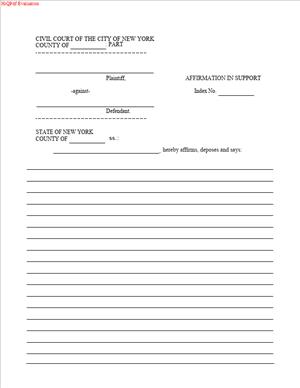
CIV-GP-121-i – Affirmation in Support
Fill out nowJurisdiction: Country: United States | Province or State: New York
What is a CIV-GP-121-i – Affirmation in Support?
The CIV-GP-121-i is the Civil Court of the City of New York’s standard “Affirmation in Support” form. You use it to present sworn factual statements and legal reasons in support of a request you are making to the court. It is part of your motion papers or Order to Show Cause package, not a standalone filing by itself.
An “affirmation” is a sworn statement made under penalty of perjury. In New York practice, attorneys commonly use affirmations instead of affidavits. An affidavit is sworn before a notary. An attorney’s affirmation is not notarized but carries the same weight in court. If you are self-represented, you typically use an affidavit rather than this attorney affirmation form, unless the court directs otherwise.
Who typically uses this form?
Attorneys representing plaintiffs or defendants in Civil Court matters use it. That includes counsel for individuals, small businesses, consumer creditors and debtors, insurers, and commercial litigants. It is also used in the Housing Part and Commercial Small Claims Part when the rules call for motion papers supported by sworn factual statements from counsel.
Why would you need this form?
You need it any time you ask the court to do something that requires proof of facts and a legal basis. The Affirmation in Support explains what you want, the facts that justify it, and the law that allows it. It organizes your evidence and requests into a clear, sworn statement so the judge can decide.
Typical usage scenarios
You move for a default judgment after the other side fails to answer or appear. Your affirmation lays out service, the default, and the basis for damages.
- You move to vacate a default after your client missed a court date. Your affirmation explains the reasons for the absence and the merits of the defense.
- You move to compel discovery or for sanctions. Your affirmation details the discovery demands, the missed deadlines, and your good faith efforts to resolve the dispute.
- You seek a stay, extension of time, or other scheduling relief. Your affirmation explains the need, the prejudice, and the proposed timetable.
- You file an Order to Show Cause for emergency relief. Your affirmation shows why immediate relief is needed and what harm will occur without it.
- You move to dismiss or for summary judgment. Your affirmation frames the record, attaches exhibits, and presents the legal grounds.
The form structures your presentation so your facts, exhibits, and requests are easy to follow. The judge will review your affirmation alongside your notice of motion or Order to Show Cause and any memorandum of law.
When Would You Use a CIV-GP-121-i – Affirmation in Support?
You use this form whenever you need to support a request with sworn facts, especially on motion practice. Think of it as the factual and procedural backbone of your request. It explains who the parties are, what the case is about, what has happened so far, and why the relief you seek is proper.
Attorneys for plaintiffs use the form to show entitlement to a judgment based on contract, account stated, or services rendered. They explain how the claim arose, attach the contract and invoices, and detail the defendant’s nonpayment. They also address service and default issues when necessary.
Attorneys for defendants use the form to oppose or to seek relief from default or deadlines. They set out the reasons for noncompliance, attach proof of efforts to respond, and explain the defense’s merits. They may also use it to seek dismissal based on jurisdictional defects, documentary evidence, or statute of limitations.
Landlords and tenants represented by counsel use the form in Housing Part matters when motion practice is required. For example, a landlord’s attorney may move to restore a case to the calendar and stay execution of a warrant pending correction of a clerical error. A tenant’s attorney may file an Order to Show Cause seeking a stay based on a pending rental assistance approval. The affirmation explains the facts and urgency and attaches supporting proof.
Small business owners and vendors represented by counsel use it to support claims for unpaid goods, services, or commercial leases. The affirmation will include the contract, delivery confirmations, and account statements, and will explain how damages were calculated. If a defendant fails to answer, the affirmation supports a default judgment request with documentation of service and default.
Insurers and their counsel use the form to seek dismissal of subrogation or no-fault claims, move for summary judgment, or compel compliance with discovery. The affirmation organizes policy language, claim records, and deposition excerpts to support the relief sought.
You also use this form if you file an Order to Show Cause. In that context, the affirmation needs to explain why immediate relief is necessary, what notice you gave the other side, and what temporary restraints you are asking the court to issue pending the hearing. You should attach proof of notice, like an email or letter, or explain why the notice should be excused.
In short, use the CIV-GP-121-i anytime the Civil Court requires a sworn factual submission from counsel to decide a request.
Legal Characteristics of the CIV-GP-121-i – Affirmation in Support
Is it legally binding?
Yes. An attorney’s affirmation is a sworn statement under penalty of perjury. The judge can rely on the facts stated in it to decide motions. False statements can result in sanctions, referral to disciplinary authorities, and possible perjury charges. The form contains the affirmation language so that your signature carries legal weight.
What ensures enforceability?
Proper form, personal knowledge, or a clear basis for the statements, and supporting exhibits. Your affirmation must include the case caption, the court name, the county, the index or docket number, and the title of the paper. It must identify you, your role as counsel, and the party you represent. It must affirm that the statements are true. The facts should be based on personal knowledge or on your review of business records, court filings, or client documentation, which you identify. Exhibits must be legible and labeled. The relief requested must be clear and specific. These elements allow the court to evaluate credibility and relevance.
An affirmation supports but does not replace legal argument. If your request involves legal analysis, file a memorandum of law. Your affirmation can include brief legal points, but use it primarily to present facts and exhibits. When you cite legal standards in the affirmation, do so succinctly and tie them to the facts you present.
General legal considerations
- Attorney vs. non-attorney statements. Lawyers can submit affirmations in New York courts. Self-represented litigants generally file affidavits sworn before a notary. If you are not an attorney, confirm what your judge requires before using this form.
- Personal knowledge and hearsay. Stick to facts you know or can attest to through records you reviewed. Identify the source of your knowledge. Avoid pure speculation. You may summarize records or business practices if you attach the underlying documents.
- Completeness and candor. Disclose prior relevant orders, adjournments, defaults, or settlement discussions as needed to give full context. Address weaknesses. Judges expect a full and fair presentation.
- Confidentiality and redaction. Do not include full Social Security numbers, full bank account numbers, or other sensitive data. Redact as required and use only what the judge needs to decide the motion.
- Attachments and authentication. Attach contracts, invoices, correspondence, ledger histories, email chains, prior court orders, and affidavits necessary to substantiate your factual statements. Label each exhibit and refer to it in the text.
- Service and timing. An affirmation supports a motion. Comply with applicable notice periods and filing procedures. Serve your papers on time and file proof of service separately.
When these conditions are met, the court can consider your affirmation as competent support for the relief you seek.
How to Fill Out a CIV-GP-121-i – Affirmation in Support
Follow these steps so your submission is complete, clear, and persuasive.
1) Complete the caption
- Court and county. Enter “Civil Court of the City of New York” and the proper county (e.g., Bronx, Kings, New York, Queens, Richmond).
- Case title. List the parties exactly as they appear in the summons or prior pleadings.
- Index or docket number. Use the number assigned by the clerk.
- Part and judge (if assigned). Add the part and judge if your case is already assigned.
- Document title. Use a descriptive title: “Affirmation in Support of Motion to Compel Discovery” or “Affirmation in Support of Order to Show Cause.”
2) Identify the affirmant and party
- Your name and role. State your full name and that you are an attorney admitted in New York.
- Your firm and address. Include your firm name, address, phone, and email.
- Representation. Identify the party you represent (plaintiff, defendant, petitioner, respondent).
- Basis of knowledge. State that you make the affirmation based on personal knowledge and review of the file and records.
Sample opening sentence:
“I, [Name], an attorney admitted to practice in New York, affirm under penalty of perjury as follows.”
3) State the relief you seek
- Lead with your request. Be precise and specific. Example: “Plaintiff moves for an order compelling defendant to provide complete responses to Plaintiff’s First Demand for Documents within 20 days.”
- List each item of relief in a short paragraph. If you seek alternative relief, say so.
4) Provide procedural history
- Summarize key milestones. Include filing and service dates, appearance history, prior motions, and orders.
- Identify current deadlines and compliance. Note any scheduling orders or dates already set by the court.
- Keep this concise. Two to five paragraphs usually suffice.
5) Present relevant facts
- Use numbered paragraphs. Number each fact paragraph for clarity and ease of reference.
- Stick to relevant facts. Focus on facts that support the requested relief.
- Connect facts to exhibits. When you mention a document, reference it as “Exhibit A,” “Exhibit B,” etc.
- Avoid speculation. Do not state conclusions without supporting documents or a clear basis.
Examples:
- “On March 15, 2024, defendant received plaintiff’s invoice no. 1032 for $8,750 (Exhibit B).”
- “Defendant failed to respond to plaintiff’s document demand served on May 10, 2024 (Exhibit C).”
6) Attach and label exhibits
- Prepare clean copies. Ensure all exhibits are legible and complete.
- Create an exhibit index. Label each exhibit with a letter and a short description.
- Authenticate briefly in the text. State what each exhibit is and how you obtained it.
- Use tabs if submitting hard copies. Judges appreciate easy navigation.
Common exhibits:
- Contracts, leases, and amendments.
- Invoices, statements, and account histories.
- Emails and letters documenting notice and follow-up.
- Proof of service and prior court orders.
- Discovery demands and responses.
7) Explain the legal basis
- State the standard. Identify the rule or standard that supports your request in simple terms.
- Apply the facts. Connect the standard to your facts and exhibits.
- Keep the argument lean. Save detailed legal analysis for your memorandum of law if needed.
Example:
“The court may compel disclosure when a party fails to respond. Defendant has not answered plaintiff’s demand despite follow-up letters and a meet-and-confer effort (Exhibits D and E). An order compelling production within 20 days is warranted.”
8) Address notice and meet-and-confer
- For discovery motions. Describe your good-faith efforts to resolve the issue before moving. Reference dates and attach correspondence.
- For Orders to Show Cause. Explain what notice you provided to the other side, by what method, and when. If you seek temporary relief without notice, explain why notice should be excused.
9) Show urgency when asking for immediate relief
- Identify the harm. Explain what harm will occur without immediate court action.
- Explain why regular motion timing is inadequate. Provide concrete reasons and dates.
- Tailor temporary relief. Ask for a narrowly tailored stay or interim relief that preserves the status quo.
10) State the proposed order or schedule
- Offer clear terms. Suggest concrete deadlines or the specific injunction terms you seek.
- Include a proposed order if required. Some parts prefer an attached proposed order with blanks for dates.
- Avoid ambiguity. Use clear timeframes and conditions.
11) Add the affirmation statement and signature
- Use the required affirmation language. Include a line such as:
“I affirm under penalty of perjury that the foregoing is true.”
- Date and sign. Include your signature, printed name, law firm, address, phone, and email.
- No notary is needed for an attorney’s affirmation. If you are not an attorney, use an affidavit unless the court allows otherwise.
12) Prepare the motion package
- Assemble in order. Place the Notice of Motion or Order to Show Cause first, then your Affirmation in Support, then the exhibits, then any memorandum of law.
- Paginate and bookmark. If filing electronically, bookmark exhibits and paginate the PDF.
- Proof of service. Arrange for proper service and prepare an affidavit of service. File it as required.
13) Filing and service timing
- Select a return or hearing date. Coordinate with the clerk’s instructions for motion calendars and lead times.
- Count days for service. Provide the required notice period before the return date.
- Serve all parties. Use a permitted method and serve at the correct addresses. Include attorneys of record and self-represented parties.
- File your papers. File with the appropriate county clerk’s office or e-file if the case is in an authorized e-filing program. Follow local part rules about courtesy copies.
14) Practical drafting tips
- Keep sentences short and direct. Judges read quickly and value clarity.
- Use headings. Add short headings like “Background,” “Default and Prejudice,” or “Discovery History.”
- Do the math. Show how you calculate damages and interest. Attach a spreadsheet if needed.
- Anticipate objections. Address likely arguments from the other side.
- Be candid about defects. If service issues or delays occurred, explain them and propose a cure.
- Redact sensitive data. Use initials for non-parties and redact personal identifiers.
15) Common mistakes to avoid
- Missing or incorrect caption details. Double-check county, index number, and party names.
- Unsupported assertions. Attach documents for each key factual claim.
- Overbroad requests. Ask only for what you need to resolve the issue.
- Ignoring prior orders. Acknowledge and align your request with existing scheduling orders.
- Late service. Build in enough time so the court can reach your request on the merits.
16) Sample structure to mirror
- Introduction and relief sought.
- Procedural history.
- Factual background tied to exhibits.
- Legal basis and application to facts.
- Notice or meet-and-confer statement.
- Proposed order terms and deadlines.
- Affirmation statement and signature block.
- Exhibit list.
17) Parties, clauses, signatures, and schedules
- Parties. List parties exactly as captioned. Identify your client’s role in the case and in the transaction or event at issue.
- Clauses and requests. Break requests into numbered paragraphs. Each paragraph should seek one item of relief and refer to the facts supporting it.
- Signatures. Sign above your printed name. Include the affirmation language and the date. If another attorney submits a supporting affirmation, include theirs too.
- Schedules and exhibits. Create a clear exhibit schedule. For complex requests, attach schedules itemizing amounts, dates, and documents. Use consistent labels that match the text.
18) Real-world examples
- Default judgment in a goods-sold case. You attach the purchase order, delivery proof, invoices, and an account statement. Your affirmation narrates the sale, the delivery, the nonpayment, and the default. You calculate interest from the invoice date.
- Motion to compel discovery. You attach your demand, the deficient responses, and your follow-up emails. Your affirmation shows the timeline and prejudice. You propose a 20-day deadline and a compliance conference.
- Order to Show Cause to stay enforcement. You attach proof of payment arrangements, bank records, or pending assistance approval. Your affirmation explains the urgent harm and proposes a short stay pending a prompt hearing.
- Motion to vacate default. You attach a doctor’s note or travel records showing the reason for missing court, plus an answer with defenses. Your affirmation shows a reasonable excuse and a potentially meritorious defense.
Using the CIV-GP-121-i form keeps your request organized, sworn, and ready for judicial review. If you focus on clear facts, proper exhibits, and specific relief, your affirmation will give the court what it needs to decide your motion.
Legal Terms You Might Encounter
- An affirmation is a written, sworn statement. You sign it to confirm that the facts are true. On this form, your affirmation supports a request you want the court to grant.
- The affiant is the person who makes the statement. If you complete this form, you are the affiant. Your name must match the caption.
- Personal knowledge means you saw, did, or received the things you describe. This form expects facts from your direct experience. Avoid guesswork or secondhand statements.
- The caption is the case heading at the top of the form. It lists the court, parties, and case number. It must match your other case papers exactly.
- The index number or docket number identifies your case. You must include it on this form. Leave it blank only if the court gave other instructions.
- A motion is a written request asking the judge for specific relief. Your Affirmation in Support gives the facts behind your motion. The judge reads it to understand your position.
- Relief sought means the result you want the court to order. State it clearly in your motion papers. Your affirmation should explain why that relief is proper.
- Exhibits are documents, images, or records that support your facts. Mark each exhibit with a letter or number. Refer to each exhibit in your affirmation.
- Service means delivering your papers to the other side. You usually cannot serve them yourself. Use the court’s approved methods and keep proof of service.
- Perjury is lying in a sworn statement. An affirmation is made under penalty of perjury. Be accurate and honest in every paragraph.
FAQs
Do I need to notarize an Affirmation in Support?
An affirmation is a sworn statement without notarization in some situations. Some people may use an affirmation, while others must use an affidavit. An affidavit is notarized. If you are unsure which is allowed for you, check the court’s rules for your role. When in doubt, use a notarized affidavit instead.
Can I use this form if I am self-represented?
You can complete a sworn support statement. Whether you use an affirmation or an affidavit depends on court rules. Many self-represented litigants use a notarized affidavit instead. If rules allow you to affirm, this form fits that use. If not, prepare an affidavit with identical facts.
What should I include in my Affirmation in Support?
Include only facts within your personal knowledge. State what happened, when, where, and who was involved. Attach exhibits that prove each important fact. Number your paragraphs. Keep your tone neutral and specific. End with a clear statement of truth under penalty of perjury.
Do I need to attach exhibits?
Attach exhibits when they help the judge verify a fact. Examples include contracts, emails, invoices, photos, or letters. Mark each exhibit clearly. Refer to each exhibit in the text by its label. Do not attach originals. Use clean, readable copies.
How long can my affirmation be?
There is no strict length, but be concise. Judges favor clear, focused papers. Use short, numbered paragraphs. Cover only relevant facts. Omit repetition. Attach exhibits instead of quoting long documents.
When do I file an Affirmation in Support?
You file it with your motion or with an order to show cause. Some courts require filing by a specific deadline. If there is a return date, count back to set your filing date. Build in time for service and any mailing days.
How do I serve the Affirmation in Support?
Serve it with all supporting papers. Use the service method allowed for your case. The server should complete a proof of service. File the proof with the court. Keep copies for your records.
What if I discover an error after filing?
If the error is small, you can correct it in a new affirmation. If it affects the outcome, consider asking the court to accept a corrected version. Serve the corrected papers again. Explain the correction plainly and cite the paragraph numbers.
Checklist: Before, During, and After the CIV-GP-121-i – Affirmation in Support
Before signing
Case details
- Full caption as it appears on prior filings.
- Correct index or docket number.
- Judge or part, if assigned.
Motion basics
- What relief do you seek, and why do you need it?
- The rule or order that permits your request.
- The hearing or return date, if set.
Facts and proof
- A timeline of relevant events with dates and names.
- Key documents as exhibits, labeled and legible.
- Any prior orders or stipulations in the case.
- Communications to or from the other side.
Service logistics
- Names and addresses for all parties or counsel.
- The approved method of service for this filing.
- A person who can serve and prepare proof of service.
Formatting
- Numbered paragraphs.
- Page numbers and exhibit tabs.
- Space for your signature and date.
Practical prep
- A quiet time to review and sign.
- Access to a copier or scanner.
- A plan to file within the deadline.
During signing
Confirm identity and role
- Your full legal name matches the caption.
- Your role in the case is correct.
Verify facts
- Each statement is based on personal knowledge.
- Dates, amounts, and names are accurate.
- References to exhibits match the labels.
Check structure
- Clear introduction explaining your purpose.
- Chronological facts in numbered paragraphs.
- A closing statement under penalty of perjury.
Cross-check the caption
- The court is the Civil Court of the City of New York.
- The county or location is correct for your case.
- Parties’ names are spelled exactly as filed.
Review attachments
- Exhibits are complete and readable.
- Sensitive data is redacted where needed.
- Exhibit letters or numbers appear on each page.
Final review
- Signature and date on the correct page.
- Contact information is current.
- Extra copies are ready for filing and service.
After signing
Assemble your packet
- Notice of Motion or Order to Show Cause.
- CIV-GP-121-i – Affirmation in Support.
- Memorandum of law, if any.
- Exhibits with an index or cover page.
- Proposed order, if appropriate.
File with the court
- File before the deadline.
- Pay any filing fee if required.
- Obtain a stamped copy or receipt.
Serve all parties
- Use the approved method of service.
- Meet service deadlines tied to the return date.
- Complete and file proof of service.
Track deadlines
- Note when opposition is due.
- Note when your reply is due, if allowed.
- Calendar the hearing or submission date.
Keep records
- Save a full copy of what you filed and served.
- Store proofs of service and receipts.
- Keep digital backups in a secure location.
Prepare for the hearing
- Bring the filed papers and exhibits.
- Prepare a short outline of key points.
- Be ready to answer the judge’s questions.
Common Mistakes to Avoid CIV-GP-121-i – Affirmation in Support
- Don’t forget to use personal knowledge. Writing about what someone else told you weakens your papers. The court may ignore hearsay. Stick to what you saw, did, or received.
- Don’t mismatch the caption or case number. A wrong caption can delay your motion. It can lead to rejection by the clerk. Copy the caption from your most recent order or stipulation.
- Don’t skip exhibits or leave them unlabeled. Unsupported claims carry little weight. Unlabeled documents confuse the court. Label each exhibit and cite it in the text.
- Don’t miss service or filing deadlines. Late papers can be disregarded. Your motion may be adjourned or denied. Work backward from the return date to plan service.
- Don’t include arguments without facts. A judge cannot grant relief on arguments alone. Tie each legal point to a specific fact. Use the affirmation to prove those facts.
What to Do After Filling Out the Form CIV-GP-121-i – Affirmation in Support
- Assemble your motion package. Place the Notice of Motion or Order to Show Cause first. Follow with the CIV-GP-121-i – Affirmation in Support. Add your memorandum of law if you have one. Attach exhibits in order, with an index. Include a proposed order if it helps the court.
- File the package with the Civil Court of the City of New York. Use the filing method the court allows for your case. File early to avoid last-minute problems. Ask the clerk to stamp your copy or provide a receipt.
- Serve all parties with the full set. Use the method the rules allow. Personal service, mail, or other methods may apply. You usually cannot serve the papers yourself. Have a server complete a proof of service.
- File the proof of service. The court needs proof to move your motion. Without it, the judge may not consider your papers. File it as soon as service is complete.
- Calendar the response dates. Note the deadline for opposition. Note your reply deadline if permitted. Prepare a short reply affirmation if allowed and needed.
- Prepare for the court date. Bring the filed papers, proof of service, and exhibits. Organize a concise outline of the timeline and key exhibits. Be ready to explain why each fact supports the relief you want.
- Handle corrections or updates quickly. If you must correct a material error, prepare a corrected affirmation. Serve it at all parties. Ask the court to accept it, if required. Explain the change clearly and cite paragraph numbers.
- Monitor the court’s decision. The court may rule on submission or after argument. Watch for an order or decision. Once issued, follow the order’s instructions promptly.
- If your motion is granted in part or denied, plan next steps. You may need to comply with new deadlines. You may also seek other relief later. Keep your file organized for future filings.
- If the case settles, notify the court. Withdraw pending motions if appropriate. Confirm settlement terms in writing. File any required stipulations.
- Keep complete records. Store your affirmation, exhibits, proofs, and orders. Save both paper and digital copies. Accurate records help with appeals or future motions.
Disclaimer: This guide is provided for informational purposes only and is not intended as legal advice. You should consult a legal professional.