CN 12305 – Pretrial Intervention Program Application
Fill out nowJurisdiction: Country: United States | Province or State: New Jersey
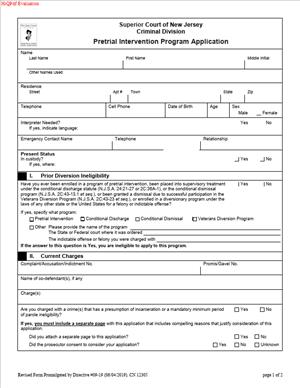
The CN 12305 – Pretrial Intervention Program Application is a court form used in the Superior Court of New Jersey, Criminal Division. It allows a defendant to apply for entry into the Pretrial Intervention (PTI) Program. This program offers an alternative to traditional prosecution in certain criminal cases.
If you are filling out the CN 12305 – Pretrial Intervention Program Application, you are likely facing criminal charges and exploring options that may allow you to avoid a conviction. The form gathers detailed information about you, your background, and the circumstances of your case.
This document matters because it can affect how your case moves forward. Acceptance into PTI may result in supervision instead of prosecution. Successful completion of the program can lead to dismissal of charges in many situations.
The form requires careful, accurate completion. It asks for personal history, employment details, education, financial information, and prior involvement with the legal system. The information you provide helps the Criminal Division evaluate whether you are a suitable candidate for the program.
Understanding what this application does, and what it does not do, will help you approach it with clarity and confidence.
What is CN 12305 – Pretrial Intervention Program Application?
Clear definition
The CN 12305 – Pretrial Intervention Program Application is an official court document used to request admission into New Jersey’s Pretrial Intervention Program. It is a formal written request submitted to the Criminal Division of the Superior Court.
The form collects background information about you and details about the charges filed against you. It also requires disclosures about prior arrests, prior convictions, and other legal matters. The purpose is to help court staff and prosecutors assess eligibility and suitability for PTI.
This application is part of a structured review process. Submitting the document does not automatically place you in the program. It begins the evaluation process.
Who typically uses this form?
You would use this form if you are a defendant in a criminal case pending in the Superior Court of New Jersey and you want to be considered for PTI. Most applicants are individuals charged with indictable offenses.
First-time offenders often consider this option. Individuals with limited or no prior criminal history may seek PTI as a way to resolve their case without going through a full prosecution.
Defense attorneys often help clients complete the form. However, self-represented defendants may also fill it out themselves. In either situation, the information comes directly from you.
The Criminal Division staff, PTI director, and prosecutor review the completed application as part of their decision-making process.
Why might you need this form?
You may need this form if you want to request an alternative to traditional prosecution. PTI focuses on supervision and rehabilitation rather than punishment through conviction.
For some defendants, PTI offers a structured opportunity to address underlying issues. These may include substance use, financial stress, or other personal challenges connected to the offense.
The application is necessary because the court will not consider you for PTI without a formal request. The document creates an official record of your request and provides the background information required for review.
Without submitting the form, your case generally continues along the standard criminal court process.
Typical real-life scenarios
You are charged with a non-violent indictable offense and have no prior criminal convictions. Your case is pending in Superior Court, and you want to explore options that may prevent a permanent criminal record. You complete the application to request consideration for PTI.
You are accused of a financial-related offense connected to a difficult period in your life. You believe supervision and restitution would address the situation more effectively than prosecution. The application allows you to present your background and circumstances.
You are a college student facing your first criminal charge. You are concerned about long-term consequences for employment and education. The PTI application gives you a chance to explain your history and current goals.
You have been indicted and your case is moving forward. Your attorney discusses diversion programs with you. As part of that process, you complete the required form so the Criminal Division can evaluate whether PTI is appropriate in your situation.
When would you use CN 12305 – Pretrial Intervention Program Application?
You use this form after criminal charges have been filed against you in the Superior Court, and you want to apply for PTI. It is typically completed early in the case, often before trial preparation begins.
In many situations, the application is submitted after indictment but before the case proceeds to trial. Timing can matter because PTI is designed as an alternative to prosecution, not as a last-minute request after the trial has started.
You may also use this form when directed by your attorney or when the court informs you that you are eligible to apply. Court staff may provide instructions about deadlines and submission procedures.
The application is used by defendants. The review process involves the PTI director, Criminal Division staff, and the prosecutor. The judge may also be involved if there is a dispute about admission.
If you are representing yourself, you would use this form to formally communicate your request for PTI to the court. It serves as your written presentation of personal history and relevant facts.
Legal characteristics of CN 12305 – Pretrial Intervention Program Application
The CN 12305 – Pretrial Intervention Program Application is an official court document. It becomes part of your criminal case file once submitted. The information you provide is used in evaluating your eligibility and suitability for PTI.
For the form to be effective, it must be complete and accurate. Missing sections, inconsistent answers, or incomplete disclosures can delay review. In some cases, incomplete information may result in rejection of the application.
Accuracy is critical. The form typically requires you to certify that the information is true. Providing false or misleading information can create additional legal problems and may affect how your application is viewed.
The application does not guarantee admission into PTI. Acceptance depends on multiple factors, including the nature of the offense, your prior record, and other considerations assessed by the prosecutor and PTI director.
Eligibility criteria can vary depending on the type of offense. Certain offenses may be excluded from PTI or require additional approvals. The review process considers both statutory factors and case-specific details.
The form does not resolve your charges by itself. It is only a request. The case remains active unless and until you are formally admitted into PTI and complete the program successfully.
Is it legally binding?
- The application itself is not a contract that places you into PTI. It is a formal request for consideration. Submitting it does not create a binding agreement between you and the court.
- However, the information you provide can have legal significance. You are generally required to certify that your answers are truthful. That certification carries weight because it is part of a court filing.
- If you are accepted into PTI, you may later sign additional documents outlining the conditions of supervision. Those later documents often contain binding terms. The initial application is part of the path toward that potential agreement.
- In short, the application is a legally recognized filing within your criminal case. It is not, by itself, the agreement that governs PTI participation.
How to fill out CN 12305 – Pretrial Intervention Program Application
Step 1 – Review the entire form before writing anything
Read the full CN 12305 – Pretrial Intervention Program Application from beginning to end. This helps you understand what information is required and how detailed your answers must be. Pay attention to sections that request supporting information or additional pages.
By reviewing first, you reduce the chance of inconsistent answers. You also prepare yourself to gather documents or details you may need, such as employment dates or prior case information.
Step 2 – Complete your personal identification information
Fill in your full legal name exactly as it appears on court records. Provide your current address, contact information, and any other identifying details requested.
Make sure this information matches the court’s records. Differences in spelling or address can cause confusion in your file. If you have recently moved, provide the most accurate current address and follow any instructions for prior addresses.
Step 3 – Provide details about the current charges
Enter the information about your pending case as requested. This may include the indictment number, complaint number, or charges listed against you.
Copy this information carefully from official court documents. Avoid summarizing or changing the wording of the charges. The form is asking for specific legal details tied to your case.
Step 4 – Disclose prior criminal history
Answer all questions about prior arrests, charges, and convictions. Include matters that were dismissed if the form asks for them. Provide dates, locations, and outcomes if known.
Be thorough and accurate. Omitting prior cases can create problems during the review process. The court and prosecutor typically have access to criminal history records.
If you do not remember exact dates, provide your best estimate and indicate that it is an estimate if the form allows explanation. Clarity is more helpful than leaving a blank space.
Step 5 – Describe your educational background
List your highest level of education completed. Include the names of schools and degrees earned if requested. If you are currently enrolled in a program, indicate that status clearly.
This information helps evaluators understand your background and current circumstances. It may also be relevant to supervision planning if you are admitted into PTI.
Step 6 – Provide employment and financial information
Fill in your employment history, including current employer, job title, and length of employment. If you are unemployed, indicate that clearly and provide any recent work history requested.
The form may ask about income, expenses, or financial obligations. Provide accurate figures based on your current situation. This information can be relevant if restitution, fees, or supervision conditions are considered.
Consistency matters. Your employment and financial details should align with other parts of the application.
Step 7 – Answer questions about substance use or treatment history
Some versions of the CN 12305 – Pretrial Intervention Program Application ask about alcohol or drug use, counseling, or prior treatment. Answer these questions honestly and fully.
If you have participated in counseling or treatment programs, include dates and types of services if requested. This information may be considered in assessing suitability for PTI and in shaping any supervision conditions.
Provide factual information without minimizing or exaggerating. Clear, direct answers are easier to evaluate.
Step 8 – Provide a personal statement if required
The form may include space for you to explain the circumstances of the offense or provide additional background. Use this section to present relevant context about your situation.
Focus on facts and personal history that relate to your application. Keep your explanation organized and direct. Avoid repeating information already provided elsewhere unless clarification is necessary.
This section allows you to present a fuller picture of your background and current goals.
Step 9 – Review all answers for completeness and accuracy
Before signing, read the entire completed application carefully. Check for blank sections, inconsistent dates, and spelling errors in names or case numbers.
Confirm that every required question has an answer. If a question does not apply, follow the form’s instructions on how to indicate that.
A careful review reduces delays and avoids unnecessary follow-up requests from court staff.
Step 10 – Sign and date the application where indicated
Sign your name exactly as instructed on the form. Include the date of signing. Your signature typically confirms that the information provided is true and complete to the best of your knowledge.
Do not sign until you have reviewed the entire document. Once signed, the application becomes a formal submission in your criminal case.
After signing, follow the court’s instructions for submission to the Criminal Division.
Legal terms you might encounter in CN 12305 – Pretrial Intervention Program Application
- Pretrial Intervention (PTI): A diversion program that allows eligible defendants to avoid traditional prosecution. If accepted, you complete supervision and program conditions instead of going through a full criminal trial. Successful completion can lead to dismissal of charges.
- Diversion: A process that moves your case out of the standard court track and into a supervised program. On this form, you are asking the court to consider you for diversion based on your background and circumstances. Diversion focuses on rehabilitation rather than punishment.
- Prosecutor’s Consent: Approval from the prosecuting authority for your entry into the program. In many cases, the prosecutor reviews your application and makes a recommendation. Your answers on this form help inform that decision.
- Criminal Complaint or Indictment: The formal charging document in your case. You must accurately list the charges exactly as they appear in court records. The court uses this information to match your application to your case file.
- Supervision Period: The length of time you would be monitored if admitted into the program. This can include reporting requirements, counseling, testing, or other conditions. Your financial and personal disclosures help determine appropriate supervision terms.
- Conditions of Participation: Specific requirements you must follow if accepted. These may include counseling, restitution, community service, or substance testing. The form gathers information to assess what conditions may apply to you.
- Restitution: Money you may be required to pay to a victim for losses related to the offense. If restitution applies in your case, you may need to disclose your financial situation so the court can evaluate your ability to pay.
- Prior Record: Your criminal history, including arrests, convictions, or prior diversion programs. The application asks for full disclosure. Incomplete or inaccurate reporting can affect eligibility.
- Verification: A signed statement confirming that the information you provided is true and complete. By signing, you acknowledge that false statements can have consequences, including denial from the program.
- Eligibility Criteria: The standards used to determine whether you qualify for the program. These factors often include the nature of the offense, prior record, and personal background. Your responses throughout the application are evaluated against these criteria.
FAQs
Do I need to complete every section of CN 12305 – Pretrial Intervention Program Application?
Yes. You should answer every question unless the form clearly instructs you to skip a section. If something does not apply to you, write “N/A” instead of leaving it blank. Blank spaces can delay review because the court or prosecutor may think you overlooked the question.
What if I do not remember exact dates for prior arrests or employment?
Provide your best estimate and clearly indicate that it is approximate. Do not guess wildly. You can review court records, background checks, or prior paperwork to confirm dates before submitting this form. Accuracy matters because the information will be compared to official records.
Do I need to attach additional documents to this document?
Some sections may require supporting documents, such as proof of employment, school enrollment, or treatment completion. Read each instruction carefully. If attachments are requested, label them clearly and keep copies for your records so you can confirm what you submitted.
Who reviews my answers after I submit the form?
Your application is typically reviewed by program staff and the prosecutor’s office. They compare your answers with court records and may verify employment or treatment information. The judge ultimately decides whether to admit you based on recommendations and eligibility factors.
What happens if I make a mistake after submitting CN 12305 – Pretrial Intervention Program Application?
Act quickly. Contact the appropriate court office to ask how to correct or supplement your application. Do not ignore the error. Providing corrected information promptly shows good faith and can prevent misunderstandings.
Will the information I provide become part of the public record?
Your application becomes part of your court file. Access to criminal case files varies, but you should assume your statements may be reviewed by court officials and attorneys involved in your case. Answer honestly and carefully.
Do I need a lawyer to complete this form?
You can complete this document on your own, especially if you are self-represented. However, if you have questions about how your answers may affect eligibility, you may choose to consult a qualified attorney before submitting them.
How will I know if my application is accepted?
You will receive notice from the court or your attorney about the decision. If accepted, you will be given written conditions and supervision terms. If denied, the case continues in the regular court process unless further review is requested.
Checklist: Before, During, and After CN 12305 – Pretrial Intervention Program Application
Before
- Review the full application and instructions from start to finish.
- Gather court documents listing your exact charges and case number.
- Obtain a copy of your criminal history, if available.
- Collect employment records, pay stubs, or school enrollment proof.
- Prepare documentation of any counseling or treatment programs completed.
- Write down a timeline of prior arrests, convictions, and employment history.
- Confirm your current contact information is accurate and up to date.
During
- Print clearly or type responses if permitted.
- Answer every question fully, using “N/A” where appropriate.
- Match names, dates, and charges exactly to court records.
- Double-check case numbers and docket information.
- Provide honest and complete disclosures about prior history.
- Attach the required documents and label them clearly.
- Review your financial information for accuracy before listing income or expenses.
- Read the certification statement carefully before signing.
After
- Make at least one complete copy of the signed application.
- Confirm that all attachments are included in your copy.
- Submit the application according to court instructions.
- Note the date and method of submission for your records.
- Monitor mail and email for court correspondence.
- Respond promptly to any requests for additional information.
- Keep a file with all related paperwork and notices.
- Update your contact information with the court if it changes.
Common mistakes to avoid with CN 12305 – Pretrial Intervention Program Application
- Mistake: Leaving blanks in sections because you think they do not apply, which often happens when applicants rush, leading to delays or requests for clarification; do not forget to write “N/A” where appropriate.
- Mistake: Providing incomplete criminal history due to embarrassment or confusion, which can be discovered during review and harm credibility; do not forget to disclose all prior arrests and diversion programs.
- Mistake: Listing charges inaccurately because you rely on memory instead of official documents, which may cause mismatches with court records; do not forget to copy charges exactly as written.
- Mistake: Forgetting to attach required supporting documents because instructions were skimmed, which can stall processing; do not forget to review the checklist and include labeled copies.
- Mistake: Signing without reading the certification statement, often due to haste, which means you may not realize you are affirming accuracy under penalty; do not forget to review every page before signing.
- Mistake: Failing to keep a copy of the completed application, which makes it harder to respond to follow-up questions; do not forget to retain a full copy for your records.
- Mistake: Not updating contact information after submission, which can result in missed notices and deadlines; do not forget to inform the court promptly of any changes.
- Mistake: Submitting the form late because of poor planning, which may affect eligibility or scheduling; do not forget to confirm deadlines and allow time for gathering documents.
What to do after filling out CN 12305 – Pretrial Intervention Program Application
Once you complete the form, pause before submitting it. Read every page again slowly. Confirm that your name, case number, and contact details are correct on each section where required. Small clerical errors can cause processing delays.
Make organized copies. Keep one complete copy for yourself, including all attachments. If possible, scan a digital copy and store it securely so you can access it quickly if questions arise.
- Step 1: Confirm that every required signature and date line is completed.
- Step 2: Arrange supporting documents in the same order referenced in the application.
- Step 3: Submit the application following the instructions provided by the Criminal Division.
- Step 4: Record the date you submitted it and how it was delivered.
- Step 5: Check for written confirmation that your application was received.
- Step 6: Calendar any follow-up dates, interviews, or court appearances.
- Step 7: Respond promptly to requests for additional documents or clarification.
- Step 8: Keep your contact information current with the court at all times.
- Step 9: Begin preparing to comply with potential program conditions, such as scheduling evaluations or setting aside funds for possible fees.
- Step 10: Continue attending all required court dates unless officially notified otherwise.
Stay organized. Keep all related paperwork together in one folder. If you receive acceptance into the program, read the supervision terms carefully and follow them exactly. If your application is denied, review the notice to understand the next steps in your case and prepare accordingly.
Taking these steps helps you stay proactive and reduces stress while your application is under review.
Disclaimer: This guide is provided for informational purposes only and is not intended as legal advice. You should consult a legal professional.