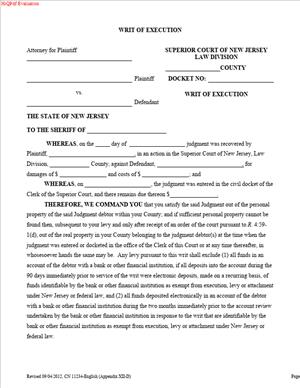
CN 11234 – Writ of Execution (Appendix XII-D)
Fill out nowJurisdiction: Country: United States | Province or State: New Jersey
CN 11234 – Writ of Execution (Appendix XII-D) is a court-issued document used after a judgment has already been entered. It is not about deciding who wins. It is about carrying out what the court has already ordered.
You encounter this form at a specific moment. A court has issued a judgment for money, and payment has not happened voluntarily. This document connects that judgment to enforcement activity.
If you are self-represented, this form can feel intimidating. The language is formal, and the consequences matter. Understanding what each part does helps you complete it accurately.
This document does not stand alone. It relies on earlier court actions, especially the judgment. The form works as part of a process, not as a starting point.
Accuracy matters here. Small errors can delay enforcement or cause rejection. Taking time to understand the form reduces that risk.
This guide explains what CN 11234 – Writ of Execution (Appendix XII-D) is, when it is used, and how its sections typically function.
What is CN 11234 – Writ of Execution (Appendix XII-D)?
Clear definition
CN 11234 – Writ of Execution (Appendix XII-D) is a court form that authorizes the enforcement of a money judgment. It instructs an authorized officer to act on the judgment, usually by identifying and applying property or funds toward the amount owed.
The document is issued under the authority of the court. It reflects that a judgment already exists and remains unpaid, in whole or in part. The writ does not create new obligations. It enforces existing ones.
This form is procedural. It translates a court’s decision into an enforceable command. Without it, enforcement steps generally cannot begin.
The writ is limited by the terms of the judgment. It cannot exceed the judgment amount or change who owes what.
Who typically uses this form?
This form is commonly used by a judgment creditor. That is the party in whose favor the court entered the money judgment. The creditor may be an individual or an entity.
Self-represented litigants often encounter this form after completing the trial or motion phase. At that point, the focus shifts from proving a claim to collecting on it.
Court staff process the form, but they do not complete it for you. An authorized officer, such as a sheriff, relies on the writ to act.
The judgment debtor is not the one who prepares this form. However, the debtor is directly affected by its issuance and execution.
Why might you need this form?
You may need this form when a money judgment exists and remains unpaid. Voluntary payment has not occurred, or has only partially occurred.
The writ serves as the formal trigger for enforcement mechanisms. Without it, the judgment remains a piece of paper without practical effect.
This form is also used to specify the amount due at the time of enforcement. That amount may differ from the original judgment due to payments or credits.
In many cases, the writ is necessary to involve an enforcement officer. The officer relies on the writ to know what authority exists.
Typical real-life scenarios
- A landlord obtains a judgment for unpaid rent. The tenant does not pay after judgment. The landlord turns to the writ process to move toward collection.
- A consumer wins a small civil case involving unpaid services. The other party does not respond to follow-up requests for payment. The writ becomes the next procedural step.
- A business prevails in a contract dispute. Partial payment is made, but a balance remains. The writ reflects the remaining amount and authorizes enforcement for that balance.
- An individual receives a judgment in a court case involving property damage. The responsible party avoids contact. The writ allows enforcement through court-authorized channels.
When would you use CN 11234 – Writ of Execution (Appendix XII-D)?
This form is used after a final money judgment has been entered by the court. It is not used while a case is still pending or undecided.
Timing matters. The writ is connected to the judgment’s status. If the judgment is satisfied, expired, or stayed, the writ may not be appropriate.
In practical terms, the form comes into play when informal efforts to collect have not worked. It represents a shift from voluntary compliance to formal enforcement.
The form is often used when the creditor seeks assistance from an enforcement officer. That officer’s actions must align with what the writ authorizes.
Although the roles vary by case, the common sequence is judgment, lack of payment, and then request for a writ. The form fits squarely into that sequence.
Legal characteristics of CN 11234 – Writ of Execution (Appendix XII-D)
This document derives its authority from the court. Its effectiveness depends on accurate information, proper issuance, and alignment with the underlying judgment.
A common source of problems is inconsistency. If names, amounts, or docket details do not match the judgment, the writ may be rejected or returned.
Another issue involves outdated information. Payments made after judgment must be reflected accurately. Overstating the amount can create complications.
Jurisdictional rules affect how the writ is processed and executed. While the concept of a writ of execution is widely recognized, procedural details vary by state and court division.
The writ does not determine what property is exempt or non-exempt. It does not resolve disputes about ownership. Those issues are handled through other procedures.
This document also does not guarantee collection. It authorizes action, but the outcome depends on available assets and compliance with enforcement rules.
Is it legally binding?
The writ is legally binding once properly issued by the court. It carries the court’s authority and directs an enforcement officer to act.
Its binding nature depends on compliance with procedural requirements. Errors in completion or issuance can undermine its effect.
The writ binds the enforcement process, not the debtor’s choices. It authorizes actions but does not compel immediate payment by itself.
The binding effect also has limits. The officer must act within the scope of the writ and the judgment. Anything outside that scope is not authorized.
How to fill out CN 11234 – Writ of Execution (Appendix XII-D)
Step 1 – Caption and court information
The top section identifies the court, division, and case. This information ties the writ to the correct docket. Accuracy here ensures the writ is connected to the right judgment.
Step 2 – Party identification
This section lists the judgment creditor and judgment debtor. Names must match the judgment exactly, including spelling and order, to avoid confusion during enforcement.
Step 3 – Judgment details
Here, the form references the judgment date and amount. This anchors the writ to the court’s prior decision and establishes its legal foundation.
Step 4 – Amount due
This part states the amount currently owed. It reflects the judgment balance at the time of completion, accounting for any payments or credits.
Step 5 – Interest and costs
If applicable, this section identifies additional amounts related to interest or allowable costs. The form provides space to reflect these figures clearly.
Step 6 – Enforcement direction
This portion authorizes the enforcement officer to act. It outlines the scope of authority tied to the judgment and the amount due.
Step 7 – Issuance and clerk action
The writ includes space for court issuance. This confirms that the document is officially released under court authority.
Step 8 – Review before submission
Before submission, the completed form is reviewed for internal consistency. All sections should align with the judgment and each other.
Step 9 – Finalization
Once issued, the writ becomes part of the enforcement process. Its role is complete at issuance, and subsequent actions occur under its authority.
Legal terms you might encounter in CN 11234 – Writ of Execution (Appendix XII-D)
- Writ of Execution: This is the court’s written command that allows enforcement of a judgment. In this document, it authorizes an officer to take specific actions to satisfy what the judgment says is owed. You are not asking the court to decide the case again. You are asking the court to enforce what is already decided.
- Judgment Creditor: This is the party who won the judgment and is entitled to collect money or property. On this form, the judgment creditor’s name must match the judgment exactly. Any difference can slow or stop enforcement.
- Judgment Debtor: This is the party who owes money under the judgment. The document relies on accurate identification of the debtor, so enforcement is directed at the correct person or entity. Small errors in spelling or entity type matter.
- Principal Amount: This is the base amount awarded in the judgment, before interest and costs. On the form, this amount usually comes directly from the final judgment or amended judgment. Do not recalculate it unless the judgment itself changed.
- Post‑Judgment Interest: This is interest that accrues after the judgment date until payment. The form may require you to state an interest amount or confirm that interest continues to accrue. You usually calculate this from the judgment date to a specific “through” date.
- Costs: These are court‑approved expenses added to the judgment, such as filing fees or service fees. Only costs that were allowed or taxed by the court belong here. Do not add informal expenses.
- Levy: A levy is the act of taking or securing property to satisfy the judgment. When this term appears, it signals what the officer is authorized to do under the writ. The form may specify the type of levy allowed.
- Return Date: This is the date by which the officer must report back to the court about what actions were taken. It does not mean the debt will be paid by that date. It is an administrative deadline tied to enforcement activity.
- Issuing Clerk: This is the court official who signs or stamps the writ to make it effective. Your role is to submit a complete and accurate document so the clerk can issue it. Without issuance, the writ has no force.
FAQs
How do I know which judgment details to copy onto this form?
Use the final judgment or the most recent amended judgment. Match the docket number, judgment date, and party names exactly as they appear there. If anything changed after judgment, only include it if the court entered it formally.
What date should I use when calculating interest?
Choose a clear “through” date and be consistent. Many people use the date they complete the document. Make sure the interest period starts on the judgment date shown in the record and ends on the date you state.
Who is allowed to sign or request the issuance of this document?
The request usually comes from the judgment creditor or someone authorized to act for them. If you are self‑represented, you sign for yourself. If you act for an entity, confirm you have authority and that your name and role are clear.
Do the names on this document have to match the judgment exactly?
Yes. This is one of the most important checks. Even small differences, like missing middle initials or outdated entity names, can cause rejection or enforcement against the wrong party.
What attachments usually go with CN 11234 – Writ of Execution (Appendix XII-D)?
Courts often expect a copy of the judgment. Some situations require a calculation sheet showing how you reached the total due. Only attach what supports the numbers you entered.
What happens after the clerk issues this form?
Once issued, it becomes an enforceable court order. An officer can then act within the limits described in the document. Issuance does not guarantee collection, but it allows enforcement to begin.
Will filing this document change the public court record?
Yes. The docket will usually reflect that a writ was issued. This creates a public record showing that enforcement activity has started, even if no money is collected yet.
What if I discover an error after it has been issued?
Errors should be addressed promptly. Depending on the mistake, you may need to request a corrected or amended document. Do not ignore errors, because enforcement based on incorrect information can be challenged.
Checklist: Before, During, and After CN 11234 – Writ of Execution (Appendix XII-D)
Before
- Locate the final or amended judgment you will rely on.
- Confirm the exact spelling and formatting of all party names.
- Calculate the principal balance still owed.
- Calculate post‑judgment interest through a clear date.
- Confirm which costs were approved by the court.
- Check the docket number and court division.
- Decide what type of enforcement the writ will request.
During
- Copy judgment information directly, without rewording.
- Enter dollar amounts carefully and double‑check math.
- Use consistent dates across the document.
- Leave clerk‑only sections blank.
- Review each field for completeness before moving on.
- Attach required supporting pages, if any.
- Keep a clean copy for your records.
After
- Submit the document using the court’s accepted method.
- Wait for confirmation that the clerk issued the writ.
- Obtain stamped or issued copies for enforcement use.
- Track the return date shown on the issued document.
- Update your records with the issuance date.
- Monitor any payments or enforcement actions.
- Be ready to respond if the court or officer contacts you.
Common mistakes to avoid with CN 11234 – Writ of Execution (Appendix XII-D)
- Mistake: Using names that do not exactly match the judgment, which often happens when people rely on memory instead of the judgment; this can delay or invalidate enforcement, so do not forget to copy names directly from the court record.
- Mistake: Miscalculating interest because the wrong start or end date is used; this can lead to rejection or disputes, so do not forget to clearly state the interest period.
- Mistake: Adding costs that were never approved by the court, often because people assume all expenses count; this can result in denial, so do not forget to limit costs to those allowed.
- Mistake: Filling in sections meant only for the clerk, which happens when the form layout is confusing; this can cause processing delays, so do not forget to leave clerk sections blank.
- Mistake: Submitting without attachments that support the amounts claimed, often due to rushing; this can cause rejection, so do not forget to include copies of the judgment when needed.
- Mistake: Assuming issuance means immediate payment, which leads to missed follow‑up; this can stall enforcement, so do not forget to track the return date and next steps.
What to do after filling out CN 11234 – Writ of Execution (Appendix XII-D)
After you complete the document, slow down and review it one last time. Read it as if you are the clerk seeing it for the first time. Look for missing numbers, unclear dates, or inconsistencies with the judgment.
- Step 1: Make at least one clean copy for yourself before submission.
- Step 2: Submit the original using the filing method accepted by the court handling your case.
- Step 3: Wait for confirmation that the clerk has reviewed and issued the document.
- Step 4: Obtain issued copies showing the clerk’s stamp or signature.
- Step 5: Organize the issued document with your judgment and prior filings.
- Step 6: Note the return date and any instructions printed on the issued writ.
- Step 7: Monitor enforcement activity and keep a log of any payments received.
- Step 8: Update your running balance each time money is paid or credited.
- Step 9: File or request additional documents if enforcement actions change or expire.
Keep everything together in one place. This document becomes part of the enforcement history of your case. Clear records make it easier to explain what has happened if questions arise later.
Disclaimer: This guide is provided for informational purposes only and is not intended as legal advice. You should consult a legal professional.