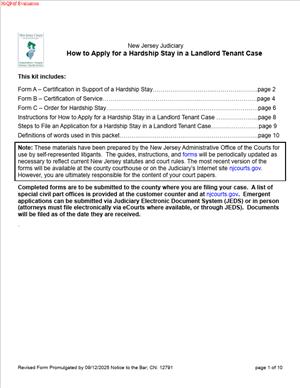
CN 12791 – Apply for a Hardship Stay in a Landlord Tenant Case
Fill out nowJurisdiction: Country: United States | Province or State: New Jersey
CN 12791 – Apply for a Hardship Stay in a Landlord Tenant Case is a court form used in New Jersey landlord-tenant matters. It allows a tenant to ask the court to delay, or “stay,” an eviction because of hardship. You use it after a judgment for possession has been entered against you.
This form is not about disputing rent or arguing your case again. It focuses on your current situation. You are asking the court for more time to move out due to serious personal hardship.
If you are representing yourself, the wording on the form may feel formal. The purpose is straightforward. You explain why leaving right away would create severe difficulty and request a short delay.
Timing matters. A hardship stay is usually requested after the landlord has won the case and the court has issued a judgment for possession. The form gives you a structured way to present your request in writing.
Understanding what this document does and what it does not do helps you complete it clearly and realistically.
What is CN 12791 – Apply for a Hardship Stay in a Landlord Tenant Case?
Clear definition
CN 12791 – Apply for a Hardship Stay in a Landlord Tenant Case is a written request to the court to temporarily postpone an eviction. It is filed in the same landlord-tenant case where the judgment for possession was entered.
A “stay” means a pause. In this context, it asks the court to delay the enforcement of the eviction order for a limited period. It does not cancel the judgment. It does not erase unpaid rent.
The form usually requires you to provide details about your hardship. This may include financial difficulties, medical issues, family circumstances, or other serious problems that make immediate relocation extremely difficult.
The court reviews your request and decides whether to grant extra time. If approved, the stay is typically for a defined period, not an open-ended extension.
Who typically uses this form?
This form is most often used by tenants in residential rental properties. You may be living in an apartment, house, or other rental unit covered by New Jersey landlord-tenant rules.
Self-represented tenants frequently use this form. Many people who reach this stage of the case do not have an attorney. The form is designed to be completed without legal representation.
In some situations, tenants facing a sudden loss of income use it. Others use it when a family emergency or health crisis makes moving immediately unrealistic.
Landlords do not use this form. It is a tenant’s request directed to the court.
Why might you need this form?
You might need CN 12791 – Apply for a Hardship Stay in a Landlord Tenant Case if a judgment for possession has already been entered and you are facing eviction. At that stage, the legal right to possession has been awarded to the landlord.
If you cannot move out by the expected date, and doing so would cause severe hardship, this form allows you to explain why. The court may consider giving you limited extra time.
Common reasons include serious illness, disability, lack of available housing, or financial collapse caused by job loss. The key issue is not inconvenience. It is a significant hardship.
You may also need this form if you are actively looking for new housing but need additional time to secure it. The form gives you a way to document your efforts and your situation.
Typical real-life scenarios
- A tenant loses their job unexpectedly and falls behind on rent. The landlord files for eviction and receives a judgment for possession. The tenant has applied for several new jobs but has not yet secured a stable income. Immediate eviction would leave them without funds for a security deposit elsewhere.
- An elderly tenant with limited mobility receives a judgment for possession. They require accessible housing and assistance with moving. Finding suitable housing takes longer than a standard move. A hardship stay may provide time to arrange safe relocation.
- A parent with young children faces eviction near the end of the school year. They are searching for housing in the same district to avoid disrupting the children’s education. A short delay could allow them to secure a lease and avoid emergency housing.
- A tenant recovering from surgery cannot physically move heavy belongings. They need a brief period to arrange help from family or community services. The hardship stay request explains the medical situation and the short time needed.
- In each scenario, the tenant is not challenging the eviction itself. They are asking for temporary relief based on specific, documented hardship.
When would you use CN 12791 – Apply for a Hardship Stay in a Landlord Tenant Case?
You would use this form after the court has already entered a judgment for possession in favor of the landlord. This typically happens after a hearing in the Special Civil Part, Landlord-Tenant Section.
At that point, the case about whether the landlord is entitled to possession has been decided. The issue is no longer whether rent is owed or whether the lease was violated. The issue is the timing of removal.
If a warrant for removal is about to be issued or has been issued, and you cannot vacate immediately due to hardship, this is when the form becomes relevant. It is a request for a delay in enforcement.
Tenants who have already tried to work out an agreement with the landlord but were unsuccessful may turn to this form. It is a formal request directed to the judge, not an informal conversation.
In some cases, you may be close to resolving your housing situation but need a short, defined extension. The form allows you to explain that you are actively taking steps to move and need a limited time.
You would not use this form to reopen the case or argue that the landlord was wrong. It is not a substitute for an appeal or a motion to vacate a judgment.
Legal characteristics of CN 12791 – Apply for a Hardship Stay in a Landlord Tenant Case
This form is part of the New Jersey court system’s landlord-tenant process. It must be completed accurately and filed in the same case in which the judgment for possession was entered.
For the request to be considered, the information you provide must be truthful and complete. Courts generally expect clear explanations of the hardship and, in many cases, supporting details. Vague statements such as “I need more time” may not be enough.
Common problems that lead to denial include missing case information, failure to explain the hardship in detail, or asking for an indefinite delay. Courts typically look for specific facts and a reasonable, limited time request.
The form does not automatically stop the eviction. Filing it does not guarantee that enforcement will be paused. A judge must review and grant the stay for it to take effect.
In New Jersey, landlord-tenant cases move quickly. Deadlines are short. That means timing is critical when submitting this document. Filing too late may limit the practical benefit of the request.
This form also does not erase rent owed or other financial obligations. Even if a stay is granted, the underlying judgment for possession remains in place unless separately addressed by the court.
Is it legally binding?
The form itself is not a binding agreement between you and the landlord. It is a request to the court. Its legal effect depends on the judge’s decision.
If the court grants the hardship stay, the order granting the stay becomes legally binding. It sets the terms of the delay, including how long it lasts and any conditions attached to it.
If the court denies the request, the eviction process continues under the existing judgment. In that situation, the filing does not change the legal status of the case.
When a stay is granted, both parties are required to follow the court’s order. The landlord must wait until the stay period expires before proceeding with removal. You must comply with any conditions stated in the order.
How to fill out CN 12791 – Apply for a Hardship Stay in a Landlord Tenant Case
Step 1 – Enter the case caption information
At the top of the form, fill in the county, court division, and docket number exactly as they appear on your eviction papers. Write the landlord’s name and your name in the spaces provided. This information connects your request to the correct case file.
Step 2 – Identify yourself and your role
State your full legal name and confirm that you are the tenant in the case. Use the same name that appears on the complaint and judgment. Consistency avoids confusion or delays in processing your submission.
Step 3 – State that you are requesting a hardship stay
In the section that asks what you are requesting, clearly indicate that you are asking for a hardship stay of eviction. Keep your wording direct. The form is designed for this specific type of request.
Step 4 – Explain your hardship in detail
Describe the specific reasons why immediate eviction would cause severe hardship. Focus on concrete facts. Include dates, medical conditions, financial circumstances, family responsibilities, or other relevant details. Avoid general statements and explain how much time you are requesting.
Step 5 – Describe your efforts to relocate or resolve the issue
If the form asks about your efforts, explain what steps you have taken to find new housing or address the situation. Mention applications submitted, housing searches, or assistance programs contacted. This shows that you are actively working toward a solution.
Step 6 – State the length of time you are requesting
Indicate the specific amount of additional time you are seeking. Be clear and realistic. Courts often look for a defined period rather than an open-ended request. Tie the time requested to your stated hardship.
Step 7 – Review for accuracy and completeness
Before signing, read every section carefully. Confirm that names, dates, and the docket number are correct. Make sure you answered each question fully and that your explanation is consistent throughout the document.
Step 8 – Sign and date the form
Sign your name where indicated and write the date of signing. Your signature confirms that the information provided is true to the best of your knowledge. An unsigned form may not be considered by the court.
Step 9 – Prepare for filing and service
After completing the form, follow the court’s process for submitting it in your case. Keep a copy for your records. Make sure the landlord receives a copy as required in landlord-tenant proceedings so the court can consider your request properly.
Legal terms you might encounter in CN 12791 – Apply for a Hardship Stay in a Landlord Tenant Case
- Hardship Stay: A hardship stay is a temporary delay of your eviction after the court has entered a judgment for possession. In this document, you are asking the court to pause the lockout because you would suffer serious difficulty if you had to move immediately. The stay does not cancel the eviction. It only gives you more time.
- Judgment for Possession: This is the court’s decision that the landlord has the right to take back the rental property. It is usually entered after a hearing in landlord-tenant court. You cannot request a hardship stay unless a judgment for possession has already been entered in your case.
- Warrant for Removal: This is the court order that allows a court officer to physically remove you from the property. After the judgment for possession, the landlord may request this warrant. A hardship stay can delay the execution of the warrant for removal, but it does not erase it.
- Certification: A certification is a written statement that you sign to confirm that the facts are true. On this form, you are certifying that your hardship is real and accurate. By signing, you are stating under penalty that everything you wrote is truthful.
- Court Officer: A court officer is the person authorized to carry out the eviction. Once a warrant for removal is issued, the court officer schedules and performs the lockout. If the judge grants your hardship stay, the court officer must wait until the stay expires before removing you.
- Service: Service means delivering a copy of your completed document to the landlord or the landlord’s attorney. The court usually requires proof that you gave the other side notice of your request. If you do not properly serve the other party, the court may not consider your application.
- Filing Fee: This is the amount you may need to pay when submitting your request to the court. Some applicants qualify to have the fee waived based on income. If a fee applies and you do not pay it or request a waiver, your request may not be processed.
- Order: An order is a written decision signed by a judge. If your hardship stay is granted, the judge will issue an order stating how long you may remain in the property and under what conditions. You must follow every term in that order.
- Conditions of Stay: These are requirements the judge may set as part of granting extra time. Conditions often include paying ongoing rent or a specific amount by certain dates. If you fail to meet these conditions, the stay can be canceled.
- Extension: An extension is additional time beyond what was previously granted. If you have already received a hardship stay and need more time, you may need to file another request before the current stay expires. Courts typically limit how long a hardship stay can last.
FAQs
Can I file CN 12791 – Apply for a Hardship Stay in a Landlord Tenant Case before the court enters a judgment?
No. This document is used after a judgment for possession has already been entered. If you have only received a complaint or have a future court date, this is not the correct step. Check your paperwork to confirm that a judgment was entered and note the exact date because you may need to include it.
How much extra time can I ask for in this form?
You can request a specific number of days or weeks, but the judge decides how much time to grant. Courts often have limits on how long a hardship stay can last. When you fill in the length of time requested, be realistic and explain why you need that exact period. Tie the number of days to a concrete plan, such as a confirmed move-in date or saved funds.
Do I have to keep paying rent during the stay?
In many cases, yes. Judges often require you to pay ongoing rent or a set amount as a condition of granting extra time. Look for any section that asks about your ability to pay or current income. If the judge includes payment terms in the order, you must follow them exactly to avoid losing the stay.
What kind of hardship should I describe?
Be specific and factual. Common hardships include medical issues, disability, lack of immediate alternative housing, or the need to secure funds for a move. Use dates, amounts, and supporting details. Instead of writing “I need more time,” explain what steps you have already taken and what will happen during the extra time you are requesting.
Do I need to attach proof to this document?
If you have documents that support your hardship, you should attach copies. Examples include medical letters, proof of income, a lease for a new apartment, or receipts showing moving arrangements. Make sure your name and case number appear on any attachments. Refer to the attachments clearly in your written explanation.
How do I make sure the court accepts my application?
Check that all required fields are completed, including your case caption, docket number, and signature. Confirm that your name matches exactly how it appears on the court record. Submit the form using the method required by the court, and keep proof of filing. If a fee applies, pay it or submit a fee waiver request at the same time.
Do I have to notify my landlord that I filed this?
Yes. You are generally required to provide a copy to the landlord or the landlord’s attorney. Follow the court’s instructions for service and keep proof that you delivered it. Without proper service, the judge may delay or deny your request.
What happens if the judge denies my request?
If the request is denied, the eviction process can continue. The court officer may proceed once the warrant for removal is active and any waiting period has passed. Review the order carefully so you understand the effective date and whether any additional time was granted before removal.
Checklist: Before, During, and After CN 12791 – Apply for a Hardship Stay in a Landlord Tenant Case
Before
- Confirm that a judgment for possession has been entered in your case.
- Write down your docket number exactly as shown on court documents.
- Gather proof of your hardship, such as medical records or housing applications.
- Calculate how much time you realistically need and why.
- Review your income and expenses to explain your financial situation clearly.
- Check whether a filing fee applies or if you qualify for a fee waiver.
- Prepare copies of any documents you plan to attach.
- Make sure you know the landlord’s or attorney’s correct mailing address.
During
- Complete every section of the form without leaving blanks.
- Use clear, specific language when describing your hardship.
- Attach labeled copies of supporting documents.
- Double-check that your name matches the court record.
- State the exact length of time you are requesting.
- Sign and date the certification section.
- Make copies of the full packet for your records and for service.
- Submit the form using the approved filing method.
After
- Confirm that the court received and filed your application.
- Serve a copy on the landlord or attorney and keep proof.
- Monitor your mail, email, or court portal for hearing notices.
- Prepare to explain your hardship clearly if a hearing is scheduled.
- Set reminders for any payment conditions ordered by the judge.
- Keep a copy of the signed court order in a safe place.
- Track the expiration date of any stay granted.
- Continue searching for housing and document your efforts.
Common mistakes to avoid with CN 12791 – Apply for a Hardship Stay in a Landlord Tenant Case
- Mistake: Filing before a judgment for possession is entered, which happens when you confuse a complaint with a final decision; this can lead to rejection of your request, so do not forget to confirm the judgment date first.
- Mistake: Giving vague reasons like “I need more time” because you feel stressed or rushed; this weakens your request and may result in denial, so do not forget to include specific facts, dates, and supporting details.
- Mistake: Leaving out attachments that prove your hardship, often because you assume your word is enough; without proof, the judge may question your claims, so do not forget to attach copies and label them clearly.
- Mistake: Failing to serve the landlord or attorney, usually due to misunderstanding service rules; this can delay or block your application, so do not forget to provide proper notice and keep proof.
- Mistake: Requesting an unrealistic amount of time with no plan, which can make your request seem unreasonable; this may cause the judge to grant less time or deny it, so do not forget to tie your request to a clear plan.
- Mistake: Ignoring payment conditions in the court’s order because you assume the stay is automatic; missing a required payment can cancel the stay, so do not forget to read and follow every condition exactly.
- Mistake: Using a name or address that does not match the court record, often due to recent changes; this can create confusion or delays, so do not forget to verify all identifying information before filing.
- Mistake: Waiting until the last minute to file, which happens when you underestimate deadlines; this can result in removal before your request is heard, so do not forget to act as soon as possible after judgment.
What to do after filling out CN 12791 – Apply for a Hardship Stay in a Landlord Tenant Case
Once you complete the form, your next steps matter just as much as what you wrote. Acting quickly and staying organized can protect the time you are asking for.
- Step 1: Review the entire document from top to bottom. Make sure every required section is filled in and your handwriting is clear if you completed it on paper.
- Step 2: Check that your docket number, property address, and names match the court record exactly. Even small errors can cause delays.
- Step 3: Attach copies of all supporting documents. Keep the originals for yourself.
- Step 4: Make at least two full copies of everything—one for your records and one for the landlord or the landlord’s attorney.
- Step 5: File the original with the court using the approved method, whether in person, electronically, or by another accepted process.
- Step 6: Pay any required filing fee or submit a fee waiver request at the same time. Do not assume the court will process the request without it.
- Step 7: Serve a complete copy on the landlord or attorney. Follow the required method of service and document when and how you delivered it.
- Step 8: Confirm receipt. If you filed electronically, save the confirmation notice. If you filed in person, keep your stamped copy.
- Step 9: Watch for a hearing notice or court communication. Check your mail and any online case system regularly.
- Step 10: Prepare to explain your hardship clearly at any scheduled hearing. Bring copies of your documents and be ready to answer questions directly.
- Step 11: If the judge grants a stay, read the signed order carefully. Note the expiration date and any payment conditions. Mark deadlines on your calendar.
- Step 12: Continue working on your housing plan. Keep records of apartment applications, communications, and payments in case you need to show ongoing efforts.
Stay organized. Keep all court papers together in one folder. Write down important dates and reminders. The more prepared you are, the stronger your position will be during this final stage of your case.
Disclaimer: This guide is provided for informational purposes only and is not intended as legal advice. You should consult a legal professional.