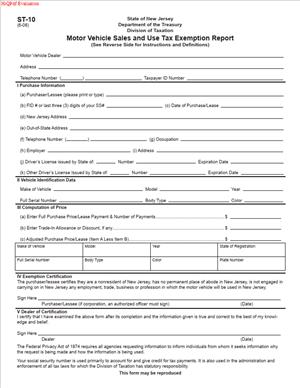
ST-10 – Motor Vehicle Sales and Use Tax Exemption Report
Fill out nowJurisdiction: Country: United States | Province or State: New Jersey
The ST-10 – Motor Vehicle Sales and Use Tax Exemption Report is a tax document used in New Jersey when a vehicle sale qualifies for an exemption from sales and use tax. If you are transferring or acquiring a vehicle and believe no tax is due, this is the form that records that claim.
You complete this form to explain why the transaction should not be taxed. It connects the vehicle, the parties involved, and the specific exemption being claimed. Without it, the transaction may be treated as taxable.
If you are about to fill it out, you likely want clarity. You want to know what counts as a valid exemption, what information is required, and how the form fits into the overall vehicle transfer process.
This guide walks you through what the document is, when it is used, and how to complete it accurately. It focuses on practical details so you can understand what the form is asking for and why each section matters.
What is ST-10 – Motor Vehicle Sales and Use Tax Exemption Report?
Clear definition
The ST-10 – Motor Vehicle Sales and Use Tax Exemption Report is a written statement filed in connection with a motor vehicle transaction in New Jersey. It reports that the transfer of the vehicle qualifies for an exemption from sales and use tax.
Sales tax normally applies when a vehicle is sold. This form documents the reason the tax is not being collected. It creates a record for the Division of Taxation showing why the transaction falls under a recognized exemption category.
The form identifies the seller, the purchaser, the vehicle, and the basis for exemption. It typically requires signatures to confirm that the information provided is accurate.
Who typically uses this form?
You may use this form if you are a buyer claiming that your vehicle purchase is exempt from tax. In some situations, the seller or dealer completes or assists with the form as part of the transaction paperwork.
Private individuals commonly encounter this form during family transfers or other nonstandard vehicle transactions. Businesses may also use it when transferring vehicles between related entities or in reorganizations that qualify for exemption.
Dealership staff, title clerks, or tax personnel may be involved in preparing or reviewing the form. However, the responsibility for accurate information generally rests with the parties to the transaction.
Why might you need this form?
You need this form when a vehicle transfer would normally trigger sales tax, but an exemption applies. The state requires documentation to support that claim.
Without this report, the transaction may be treated as taxable by default. That can lead to unexpected taxes being assessed at the time of title or registration.
The form helps prevent disputes later. If questions arise about why tax was not paid, this document shows the reason that was claimed at the time of transfer.
Typical real-life scenarios
- You may be transferring a vehicle to a close family member without payment. Certain family transfers may qualify for exemption. The form documents that relationship and the nature of the transfer.
- You may be receiving a vehicle as part of a business restructuring. For example, a company might move vehicles between related entities. If the transfer meets exemption rules, the form records that basis.
- You might be acquiring a vehicle as part of an estate distribution. When a vehicle passes to an heir, specific exemptions may apply. The form explains that the transfer is not a standard retail sale.
- You could also be correcting ownership records without a true sale taking place. In these cases, the form helps clarify that no taxable sale occurred, even though ownership is changing on paper.
When would you use ST-10 – Motor Vehicle Sales and Use Tax Exemption Report?
You use this form at the time of the vehicle transaction, not months later. It is typically completed as part of the paperwork submitted when applying for a new title or registration.
If you are purchasing a vehicle in what appears to be a standard retail sale, this form is usually not involved. It becomes relevant when the transaction falls into a special category that may not require tax.
You might encounter it when working with a motor vehicle agency office, a dealer, or another processing office handling title documents. The exemption claim needs to be made at the time the transaction is reported.
Buyers often initiate the exemption claim. Sellers may assist by providing transaction details or signing the required sections. In business transfers, company officers or authorized representatives may complete and sign the form.
The timing matters. If the form is not submitted with the rest of the transaction documents, the transfer may be processed as taxable. Correcting that later can require additional paperwork and explanation.
Legal characteristics of ST-10 – Motor Vehicle Sales and Use Tax Exemption Report
This document functions as a formal declaration. It states that a specific motor vehicle transfer qualifies for exemption under applicable tax rules.
For the form to be effective, it generally must be complete, accurate, and signed by the appropriate party. Missing information, inconsistent vehicle details, or unclear exemption claims commonly cause delays or rejection.
The form typically requires identification details such as names, addresses, and vehicle identification numbers. These must match the title and supporting documents. Even small discrepancies can raise questions.
High-level rules about exemptions are defined by state tax law. While exemption categories may be similar in other states, the exact qualifications can differ. A transfer that qualifies elsewhere may not qualify under New Jersey rules.
This document does not create an exemption on its own. It only reports and supports a claim that an exemption already applies under the law. If the underlying transaction does not meet the criteria, the form does not override that.
It also does not replace title transfer forms, registration applications, or other required filings. It works alongside them as part of a larger submission package.
Is it legally binding?
The ST-10 – Motor Vehicle Sales and Use Tax Exemption Report is legally significant because it is a signed statement submitted to a tax authority. By signing, you confirm that the information is true and correct to the best of your knowledge.
The binding aspect comes from the declaration itself. If the information is inaccurate, incomplete, or misleading, it can lead to tax assessments or other consequences. The form creates an official record of what was claimed at the time of transfer.
However, the form does not act like a contract between buyer and seller. Its primary function is reporting, not creating rights between the parties. Its legal weight relates to tax compliance, not ownership terms or payment agreements.
How to fill out ST-10 – Motor Vehicle Sales and Use Tax Exemption Report
Step 1 – Review the entire form before writing anything
Start by reading the full document from top to bottom. Notice how it is organized. Identify sections for vehicle information, seller information, purchaser information, and the exemption category.
This quick review helps you gather the required details in advance. It reduces the chance of errors or incomplete answers.
Step 2 – Enter the vehicle information exactly as it appears on the title
Provide the make, model, year, and vehicle identification number. Copy these details directly from the current title or official ownership document.
Accuracy is critical here. Even a single incorrect digit in the vehicle identification number can delay processing or cause the form to be rejected.
Step 3 – Complete the seller’s information section
Enter the full legal name and address of the person or entity transferring the vehicle. If the seller is a business, use the registered business name rather than a trade name.
Make sure the information matches the title and any related transaction documents. Inconsistencies between the seller’s name on the title and the name on the form can raise questions.
Step 4 – Complete the purchaser’s information section
Provide your full legal name and current address as the purchaser. If the vehicle is being transferred to more than one person, list all required names as directed on the form.
Use the same name format that will appear on the new title. Consistency across all documents helps prevent processing issues.
Step 5 – Identify the exemption category being claimed
Locate the section of the form that asks for the reason the transfer is exempt from sales and use tax. Select or describe the applicable exemption category as indicated.
Be specific. If the exemption relates to a family relationship, estate distribution, or business reorganization, clearly indicate that category in the space provided.
Step 6 – Provide any required explanatory details
Some exemptions require additional information, such as the nature of the relationship between parties or the circumstances of the transfer. Fill in any narrative or description fields carefully.
Keep your explanation clear and consistent with the rest of the form. The explanation should match the facts of the transaction and any supporting documents.
Step 7 – Review all entries for accuracy and completeness
Before signing, read every section again. Confirm that names, addresses, and vehicle details are correct and spelled consistently.
Check that no required fields are left blank. Incomplete forms are a common reason for processing delays.
Step 8 – Sign and date the form where indicated
Sign the form in the designated signature area. If the form requires signatures from both seller and purchaser, ensure each party signs in the correct place.
Enter the date of signing. The date should reflect when the declaration is actually made, not a future or backdated date.
Step 9 – Submit the form with the rest of your vehicle transfer documents
Attach the completed ST-10 – Motor Vehicle Sales and Use Tax Exemption Report to your title transfer and registration paperwork. Submit all documents together as part of the same transaction.
Keeping the exemption report with the full submission helps ensure the transfer is processed consistently with the tax treatment you are claiming.
Legal terms you might encounter in ST-10 – Motor Vehicle Sales and Use Tax Exemption Report
- Sales and Use Tax: This is the tax normally charged when a vehicle is sold or transferred. Sales tax applies to retail purchases. Use tax applies when tax was not collected at the time of sale, but is still owed because the vehicle will be used in the state. This form is used to claim that no tax is due for a specific reason.
- Exemption Category: This refers to the legal reason you are not paying tax on the vehicle transfer. The form typically lists specific categories, such as transfers between certain family members or transfers involving specific types of organizations. You must choose the category that exactly matches your situation.
- Transferor: This is the person or entity giving up ownership of the vehicle. On the form, this is usually the seller or current titled owner. The transferor’s name must match the name shown on the vehicle’s current title.
- Transferee: This is the person or entity receiving ownership of the vehicle. On the form, this is usually the buyer or new owner. The transferee’s name must be consistent with the name that will appear on the new title and registration.
- Fair Market Value: This is the reasonable value of the vehicle in the open market. Some exemptions may still require you to disclose the vehicle’s value, even if no tax is due. The reported value should be accurate and supportable.
- Consideration: Consideration means what was given in exchange for the vehicle. This can include money, property, services, or the assumption of debt. Even if you claim an exemption, the form may ask whether any consideration was involved.
- Certification: A certification is a signed statement confirming that the information you provided is true and correct. When you sign the form, you are certifying under penalty that your claim of exemption is accurate. This is not a casual signature.
- Penalty of Perjury: This means there can be serious consequences if you knowingly provide false information. When the form includes language about perjury, it signals that incorrect or misleading statements can result in fines or other enforcement actions.
- Supporting Documentation: These are additional documents that prove you qualify for the exemption. Examples may include a copy of a marriage certificate, proof of family relationship, corporate documents, or prior tax records. The form may not list every possible document, but you are responsible for providing proof if requested.
FAQs
Do I always have to file ST-10 – Motor Vehicle Sales and Use Tax Exemption Report when no tax is being paid?
If you are claiming that no sales or use tax is due on a vehicle transfer, you generally need to complete this document to explain why. It creates a written record of the exemption you are claiming. Without it, the transfer may be treated as taxable by default.
What if the names on the title and this form do not match exactly?
You should stop and resolve the mismatch before submitting the paperwork. The name of the transferor must match the current title, and the transferee’s name must match what will appear on the new title. Differences in middle initials, suffixes, or business designations can delay processing.
Do I need to attach proof of my exemption when I submit this document?
You should be prepared to provide documents that support your exemption category. Even if you are not asked for them immediately, the agency may request them during review. Keep copies of any records that prove your eligibility.
What date should I use as the effective date of the transfer?
Use the actual date ownership changed hands. This is usually the same date shown on the title assignment. The date should be consistent across the title, bill of sale, if any, and this form.
Can both parties sign on different dates?
It is best for the signatures to reflect the true date each person signs. However, the transfer date itself should remain accurate. Make sure the form is fully completed before either party signs to avoid having to redo it.
What happens if the agency does not accept my exemption claim?
If your claim is not accepted, you may be required to pay the tax before the title transfer is completed. You could also be asked to submit additional documentation. Review the reason for denial carefully and correct any missing or inconsistent information.
Does this form change the public record of ownership?
The ST-10 – Motor Vehicle Sales and Use Tax Exemption Report does not itself transfer ownership. It supports the tax treatment of the transfer. The title document is what changes the official ownership record.
Who should sign if the vehicle is owned by a business or estate?
An authorized representative must sign. For a business, this is typically an officer, partner, or authorized agent. For an estate, it is usually the executor or administrator. The signer should indicate their capacity and ensure their authority is documented if required.
Checklist: Before, During, and After ST-10 – Motor Vehicle Sales and Use Tax Exemption Report
Before
- Confirm the current title is accurate and free of errors.
- Verify the exact legal names of the transferor and transferee.
- Identify the correct exemption category that applies to your situation.
- Gather supporting documents that prove your eligibility.
- Confirm the vehicle identification number (VIN) matches all records.
- Review whether any consideration was exchanged.
- Check if there are liens that must be addressed.
- Make sure you understand the certification language before signing.
During
- Enter the VIN exactly as shown on the title.
- Write full legal names without abbreviations unless legally part of the name.
- Select only one exemption category unless the form allows multiple.
- Provide clear explanations if the form requests details.
- Double-check dates for consistency across all documents.
- Print legibly if completing by hand.
- Ensure the signer indicates their title if signing on behalf of an entity.
- Review the completed form line by line before signing.
After
- Make a complete copy of the signed form for your records.
- Attach the form to the title transfer paperwork.
- Submit all documents together to avoid delays.
- Monitor for confirmation that the transfer was processed.
- Keep proof of submission, such as a receipt or stamped copy.
- Store supporting documents in case of future questions.
- Update your insurance and registration information as needed.
- Retain records for several years in case of audit or review.
Common mistakes to avoid with ST-10 – Motor Vehicle Sales and Use Tax Exemption Report
- Mistake: Choosing the wrong exemption category because it “seems close enough,” which happens when you do not read each option carefully; this can result in rejection or unexpected tax being assessed, so do not forget to match your facts exactly to the listed category.
- Mistake: Using nicknames or shortened business names, which often occurs out of habit; this can delay title processing due to identity mismatch, so do not forget to use full legal names as shown on official documents.
- Mistake: Entering an incorrect VIN due to copying errors; this can cause the exemption to be applied to the wrong vehicle or trigger rejection, so do not forget to compare the VIN against the title character by character.
- Mistake: Forgetting to sign or date the certification section, which happens when you focus on the tax details and overlook the signature block; this makes the form invalid, so do not forget that unsigned forms are not accepted.
- Mistake: Failing to keep a copy, often because you are in a hurry to complete the transfer; this leaves you without proof of what was submitted, so do not forget to retain a complete copy for your records.
- Mistake: Claiming an exemption without supporting documentation, which can occur when you assume the relationship or status is obvious; this may lead to follow-up requests or denial, so do not forget to gather and keep proof of eligibility.
- Mistake: Listing inconsistent transfer dates across documents, which happens when forms are completed on different days; this can raise questions about the validity of the exemption, so do not forget to ensure all documents reflect the same effective transfer date.
What to do after filling out ST-10 – Motor Vehicle Sales and Use Tax Exemption Report
Once you complete the form, your focus should shift to proper submission and recordkeeping. The exemption only works if it is processed along with the rest of your transfer documents. Treat this as part of a complete package, not a standalone paper.
- Step 1: Review the entire form again for accuracy, including names, VIN, dates, and the selected exemption category.
- Step 2: Confirm that all required signatures are present and dated.
- Step 3: Make at least one clear copy of the signed form for your personal records.
- Step 4: Assemble the vehicle title, any bill of sale, lien release if applicable, and this form together.
- Step 5: Submit the full document package through the appropriate filing method used for vehicle transfers.
- Step 6: Obtain proof that your paperwork was received, such as a receipt, confirmation number, or stamped copy.
- Step 7: Follow up if you do not receive confirmation of title processing within the expected timeframe.
- Step 8: Pay close attention to any notice requesting additional documentation and respond promptly.
- Step 9: Once the transfer is processed, review the new title or registration documents to ensure the information is correct.
- Step 10: Store your copy of the form and supporting documents in a safe place with your other vehicle and tax records.
You should also update any internal or personal records to reflect the completed transfer. That may include insurance policies, accounting records, estate inventories, or business asset lists. Keeping everything consistent reduces confusion later.
If questions arise in the future about why no tax was paid, your signed form and supporting documents will be your primary evidence. Organized records make it easier to respond quickly and confidently.
Disclaimer: This guide is provided for informational purposes only and is not intended as legal advice. You should consult a legal professional.