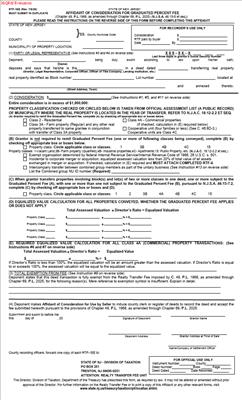
RTF-1EE- Affidavit of Consideration for Graduated Percent Fee
Fill out nowJurisdiction: Country: United States | Province or State: New Jersey
The RTF-1EE- Affidavit of Consideration for Graduated Percent Fee is a tax-related filing used in certain real estate transactions in New Jersey. You complete it when a deed is being recorded, and the transfer is subject to a graduated realty transfer fee based on the amount of consideration paid.
If you are buying, selling, or transferring property, you may come across this document during closing. It is often prepared along with the deed and other transfer tax forms. The information you provide affects how the recording office calculates the realty transfer fee.
This form matters because the fee is based on the actual consideration paid for the property. If the amount is not reported correctly, the filing may be rejected or the fee may be recalculated. Delays can affect the recording and final processing of the transfer.
You do not use this form for every property transfer. It is typically required when the transfer qualifies for the graduated percent fee structure. Understanding what the form asks for helps you complete it accurately and avoid processing issues.
What is RTF-1EE- Affidavit of Consideration for Graduated Percent Fee?
Clear definition
The RTF-1EE- Affidavit of Consideration for Graduated Percent Fee is a sworn statement that reports the total consideration paid for a property being transferred in New Jersey. “Consideration” generally means the full value given in exchange for the property. This may include cash, assumed mortgages, or other items of value.
The document is filed with the county recording office at the time the deed is recorded. It supports the calculation of the graduated realty transfer fee. The fee increases in tiers as the consideration amount rises.
By signing the form, you confirm that the information provided about the transaction value is accurate. The affidavit format means you are making that statement under oath.
Who typically uses this form?
This form is commonly used by property sellers in residential real estate transactions. In many closings, the seller or the seller’s representative completes and signs it.
Buyers may review the form as part of the closing package, especially when the total consideration affects overall transaction costs. Closing agents and title professionals often prepare the form for signature based on the settlement statement.
It is also used in certain non-traditional transfers, such as transfers between related parties, when the transaction still falls within the graduated fee structure. In those cases, the parties must carefully state the true consideration.
Why might you need this form?
You may need the RTF-1EE- Affidavit of Consideration for Graduated Percent Fee when the property sale price exceeds the base threshold for standard transfer fees and triggers the graduated rate. The graduated structure applies higher percentages as the price increases.
The county clerk or recording office relies on the information in this document to assess the correct fee. Without it, the deed may not be recorded.
If the reported consideration does not match other closing documents, such as the deed or settlement statement, the filing may be flagged for review. Accurate completion helps prevent delays.
Typical real-life scenarios
- You are selling a single-family home for a price that falls within one of the higher graduated fee brackets. At closing, you sign this affidavit to confirm the total amount the buyer is paying.
- You are transferring a condominium where part of the purchase price includes the assumption of an existing mortgage. The full amount of consideration, including assumed debt, is disclosed on the form.
- You are involved in a transfer between family members for a stated amount that reflects fair market value. Even though the parties are related, the transaction may still require reporting under the graduated fee rules.
- You are selling a property that includes additional consideration beyond cash, such as credits or property exchanged. The total value given in exchange must be reflected in the affidavit for fee calculation purposes.
When would you use RTF-1EE- Affidavit of Consideration for Graduated Percent Fee?
You use this form at the time of recording a deed when the transaction is subject to New Jersey’s graduated realty transfer fee. It is typically part of the closing package prepared before or on the day of settlement.
The seller is often the party responsible for signing because the realty transfer fee is commonly imposed on the grantor. However, the exact allocation of costs between buyer and seller may vary by agreement.
In some cases, a closing agent presents the completed document for review and signature shortly before recording. The form must accompany the deed when submitted to the county recording office.
If the transaction structure is complex, such as including multiple parcels or mixed-use property, the form helps clarify the total consideration attributable to the transfer. Clear reporting ensures the proper fee tier is applied.
Legal characteristics of RTF-1EE- Affidavit of Consideration for Graduated Percent Fee
This document is an affidavit. That means it is a sworn statement of fact. The person signing declares that the reported consideration is true and complete to the best of their knowledge.
For the form to be effective, it generally must be fully completed, signed, and submitted with the deed. Missing information, inconsistent amounts, or unsigned sections commonly lead to rejection or delay at the recording office.
The form works together with other transfer documents. It does not replace the deed, nor does it change ownership by itself. Its purpose is to support fee assessment, not to transfer title.
Fee structures and exemptions may differ depending on the nature of the property or the parties involved. While the graduated percent fee applies in many residential transactions, certain transfers may fall under different rules. The form does not determine eligibility for every exemption; it reports the consideration used to calculate the fee when applicable.
Is it legally binding?
Yes, the affidavit is legally binding in the sense that you are making a sworn statement. By signing, you affirm that the information about the consideration is accurate.
If the information is incorrect or incomplete, there may be financial consequences, such as reassessment of the fee. Because the statement is made under oath, accuracy is important.
The document itself does not create the tax obligation. The obligation arises from the transfer of property under state law. The affidavit confirms the facts used to calculate the amount owed.
How to fill out RTF-1EE- Affidavit of Consideration for Graduated Percent Fee
Step 1 – Review the property and transaction details
Gather the deed, settlement statement, and any documents showing the total purchase price. Confirm the property address, block and lot, and the names of the grantor and grantee. Make sure the consideration amount matches the final agreed value.
Step 2 – Enter the grantor and grantee information
Provide the full legal names of the seller and buyer as they appear on the deed. Check spelling and formatting. The names on this form should be consistent with the recorded instrument.
Step 3 – State the total consideration
Enter the full amount paid or given in exchange for the property. Include cash, assumed mortgages, and any other items of value that form part of the transaction. Use the exact figures from the closing documents.
Step 4 – Identify the applicable fee category
Indicate that the transfer is subject to the graduated percent fee. Follow the form’s instructions for selecting or confirming the appropriate category based on the consideration amount.
Step 5 – Review for accuracy and completeness
Read through each section before signing. Check that all required fields are filled in and that the numbers are consistent across documents. Incomplete or inconsistent information may delay recording.
Step 6 – Sign the affidavit
The person required to attest to the consideration signs was indicated. Because this is an affidavit, the signature may need to be notarized if the form requires it. Ensure the signature is dated and properly acknowledged before submission.
Legal terms you might encounter in RTF-1EE- Affidavit of Consideration for Graduated Percent Fee
- Consideration: This is the total value paid or given for the property. It usually means the purchase price, but it can also include assumed mortgages or other things of value. On this form, you must state the full consideration because the fee is calculated from that amount.
- Graduated Percent Fee: This is a recording fee that increases in tiers based on the amount of consideration. The higher the consideration, the higher the percentage applied to certain portions of the price. This form is used to determine how the graduated fee applies to your transaction.
- Grantor: The grantor is the person or entity transferring ownership of the property. The name of the grantor must match exactly how it appears on the deed. Any mismatch can delay recording.
- Grantee: The grantee is the person or entity receiving ownership. The grantee’s name and address must be accurate because this information becomes part of the public record and may be used for future tax notices.
- Affidavit: An affidavit is a written statement made under oath. By signing this document, you confirm that the information about the consideration and transaction is true. False statements can lead to penalties.
- Recording: Recording is the process of officially entering a deed into the county’s public land records. This form is submitted at the time of recording to calculate and collect the proper fee.
- Exemption: An exemption is a legally recognized reason why a transaction may not be subject to part or all of the graduated percent fee. If you claim an exemption, you must clearly identify the applicable category and ensure it fits your situation.
- Assessed Value: This is the value assigned to the property for property tax purposes. It is not always the same as the purchase price. While the fee is based on consideration, assessed value can raise questions if it differs significantly from the stated price.
- Supporting Documentation: These are additional papers that may be required to explain the transaction. Examples include contracts, settlement statements, or proof of exemption. You may need to provide them if the recording office requests clarification.
FAQs
What amount do I enter as consideration if there is a mortgage involved?
You must enter the full consideration paid for the property, not just the cash portion. If the buyer assumes an existing mortgage, that assumed debt is usually part of the total consideration. Review your settlement statement or contract to confirm the total amount being transferred in exchange for the property and enter that figure exactly as it appears.
Do the names on this document have to match the deed exactly?
Yes. The grantor and grantee names must match the deed word for word, including middle initials, suffixes, and entity designations like LLC or Inc. Recording offices compare this form to the deed. If the names do not match, the document may be rejected or delayed.
When do I submit the RTF-1EE- Affidavit of Consideration for Graduated Percent Fee?
You submit it at the same time you present the deed for recording. The recording office uses this document to calculate the graduated percent fee owed. If it is missing or incomplete, the deed cannot be properly recorded.
Who is allowed to sign this form?
The person signing must have authority to act for the grantor or the party responsible for the affidavit. For individuals, this is typically the seller. For a business entity, it must be an authorized officer, manager, or member. Make sure the signer’s title is listed if signing on behalf of an entity.
What if the purchase price seems lower than the property’s market value?
You still enter the actual consideration paid. However, if the amount appears unusually low compared to the assessed or market value, the recording office may request clarification. Keep documents that explain the transaction, such as a family transfer agreement or evidence of property condition.
Can I correct an error after I submit this document?
If you discover an error before the recording is finalized, contact the recording office immediately to ask about correction procedures. If the document has already been recorded, you may need to file a corrective affidavit. Errors in consideration can affect the fee calculation, so act quickly.
Does this form become part of the public record?
Yes. Once submitted with the deed, it generally becomes part of the official record. The consideration and property details are accessible as public information. Make sure all entries are accurate and complete before signing.
What happens if I claim the wrong fee category on the RTF-1EE- Affidavit of Consideration for Graduated Percent Fee?
If the wrong category is selected, the calculated fee may be incorrect. The recording office can require additional payment before recording or may reject the filing. In some cases, you could face delays or additional administrative steps to correct the record.
Checklist: Before, During, and After RTF-1EE- Affidavit of Consideration for Graduated Percent Fee
Before
- Review the signed purchase agreement for the exact total consideration.
- Confirm the final settlement statement reflects all cash and assumed debt.
- Verify the grantor and grantee names match the deed exactly.
- Gather supporting documents if claiming an exemption.
- Confirm the authority of the person who will sign the form.
- Check the property’s block and lot information for accuracy.
- Make sure you understand which graduated fee tier applies.
During
- Print or type all names clearly and consistently.
- Enter the full consideration without rounding unless instructed.
- Double-check numerical entries for transposed digits.
- Identify the correct fee category or exemption section.
- Complete every required field; do not leave blanks unless allowed.
- Review the form line by line before signing.
- Sign and date the affidavit in the correct place.
- Include any required titles if signing for a business entity.
After
- Attach the completed form to the deed for submission.
- Confirm the correct fee payment amount is included.
- Obtain a receipt or confirmation of submission.
- Keep a complete copy of the signed form for your records.
- Verify that the deed has been officially recorded.
- Review the recorded documents for indexing accuracy.
- Store the document with your permanent property records.
Common mistakes to avoid with RTF-1EE- Affidavit of Consideration for Graduated Percent Fee
- Mistake: Listing only the cash paid and forgetting assumed mortgage amounts, which happens when you rely on memory instead of the settlement statement, leading to underpayment of fees and possible rejection; do not forget to include the full consideration.
- Mistake: Misspelling a party’s name or omitting an entity suffix, which often occurs when copying by hand, causing recording delays or indexing errors; do not forget to match the deed exactly.
- Mistake: Selecting the wrong graduated fee category because you did not review the tier thresholds carefully, resulting in incorrect fee calculation and additional payments; do not forget to confirm the correct tier.
- Mistake: Leaving required sections blank due to uncertainty, which can cause the filing to be rejected outright; do not forget to complete every mandatory field or clarify before submitting.
- Mistake: Having someone sign without proper authority, often in business transactions, which can invalidate the affidavit and delay recording; do not forget to confirm signer authority and include their title.
- Mistake: Failing to keep a copy of the signed form, which happens during rushed closings and creates problems if questions arise later; do not forget to retain a full copy for your records.
- Mistake: Rounding numbers or estimating the consideration, which may seem minor but can affect fee calculations and trigger review; do not forget to use exact figures from your closing documents.
- Mistake: Submitting the deed without attaching this form, which can occur if documents are separated during closing, leading to immediate rejection; do not forget to attach it securely before filing.
What to do after filling out RTF-1EE- Affidavit of Consideration for Graduated Percent Fee
Once you complete the form, shift your focus to proper submission and recordkeeping. Accuracy matters just as much after signing as it did during preparation.
- Step 1: Make at least two complete copies of the signed form, including any attachments.
- Step 2: Attach the original form to the deed and organize the packet in the required order.
- Step 3: Confirm the total recording fee, including the graduated percent fee, and prepare payment in the accepted format.
- Step 4: Submit the documents to the appropriate recording office in person or by approved delivery method.
- Step 5: Request written confirmation or a receipt showing the date of submission and amount paid.
- Step 6: Monitor the status of the recording if you do not receive confirmation within the expected timeframe.
- Step 7: Once recorded, review the stamped or indexed copy for accuracy in names, consideration, and property identifiers.
- Step 8: Store the recorded deed and this affidavit together in your permanent property file.
- Step 9: Update your internal records, such as ownership logs or accounting files, to reflect the recorded transfer and fees paid.
- Step 10: Provide copies to any interested parties, such as co-owners or financial institutions, if needed for their records.
Stay organized. Keep digital and paper copies in secure locations. If questions arise months or years later about the consideration or fee paid, your complete file will help you respond quickly and confidently.
Disclaimer: This guide is provided for informational purposes only and is not intended as legal advice. You should consult a legal professional.