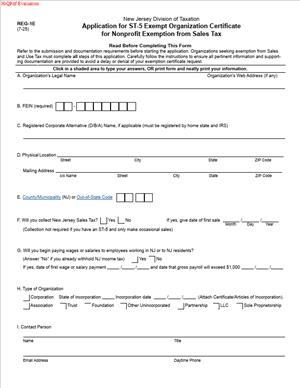
REG-1E – Application for ST-5 Exempt Organization Certificate for Nonprofit Exemption from Sales Tax
Fill out nowJurisdiction: Country: United States | Province or State: New Jersey
The REG-1E – Application for ST-5 Exempt Organization Certificate for Nonprofit Exemption from Sales Tax is a state tax form used by nonprofit organizations in New Jersey. It is the document you complete to request recognition as a sales tax–exempt organization.
If your organization is organized for charitable, religious, educational, or similar purposes, this filing may be part of your setup process. It connects your nonprofit status with New Jersey sales and use tax rules.
When approved, the form allows your organization to receive an ST-5 Exempt Organization Certificate. That certificate is what you present to sellers when making qualifying purchases without paying sales tax.
If you are about to fill this out, you likely want clarity on eligibility, required information, and how to avoid delays. Understanding what the form does—and what it does not do—helps you complete it accurately the first time.
What is REG-1E – Application for ST-5 Exempt Organization Certificate for Nonprofit Exemption from Sales Tax?
Clear definition
The REG-1E – Application for ST-5 Exempt Organization Certificate for Nonprofit Exemption from Sales Tax is an application submitted to the New Jersey Division of Taxation. It requests recognition that your nonprofit organization qualifies for exemption from paying New Jersey sales and use tax on certain purchases.
It is not the exemption certificate itself. Instead, it is the filing that leads to the issuance of Form ST-5 if your organization meets the requirements.
The document collects information about your organization’s legal structure, purpose, activities, and federal tax status. The state reviews that information to determine whether your organization fits within the categories eligible for exemption under New Jersey law.
Who typically uses this form?
This form is typically used by nonprofit corporations formed in New Jersey. It is also used by out-of-state nonprofits that conduct activities within New Jersey and want to claim sales tax exemption for purchases made in the state.
Common users include charitable foundations, religious organizations, educational institutions, volunteer fire companies, veterans’ organizations, and certain civic groups. The organization’s treasurer, president, or another authorized officer often completes and signs the filing.
Accountants and administrative staff may help gather supporting documents. However, the form itself is generally signed by someone with authority to certify the accuracy of the information.
Why might you need this form?
You may need this form if your nonprofit plans to purchase goods or services in New Jersey without paying sales tax. This can include office supplies, equipment, event materials, or other items used in your exempt activities.
Without approval and issuance of an ST-5 certificate, vendors will usually charge sales tax. The exemption does not apply automatically just because you are incorporated as a nonprofit or recognized federally as tax-exempt.
This application also helps formalize your organization’s status with the state tax authority. It creates a record that your organization has been reviewed for sales tax exemption purposes.
Typical real-life scenarios
- You recently formed a nonprofit corporation focused on youth mentoring. After receiving federal recognition as a tax-exempt organization, you want to purchase computers and supplies for your programs. Before making those purchases, you submit this application to request a sales tax exemption certificate.
- A church plans a major renovation and expects to buy building materials and furnishings. To avoid paying sales tax on qualifying purchases used for religious purposes, church leadership files this document with the state.
- A volunteer fire company regularly buys safety equipment and uniforms. To ensure those purchases qualify for exemption, an officer completes and submits the form with supporting documentation.
- An out-of-state charitable organization holds fundraising events in New Jersey. It applies for recognition so it can make event-related purchases in the state without paying sales tax, provided the purchases meet exemption rules.
When would you use REG-1E – Application for ST-5 Exempt Organization Certificate for Nonprofit Exemption from Sales Tax?
You would use this form when your organization is ready to request official recognition of sales tax exemption in New Jersey. This often happens after incorporation and after obtaining federal tax-exempt status, although timing can vary depending on your structure.
It is commonly filed before making significant purchases. Many organizations apply early to avoid paying tax and later seeking refunds, which can be more complicated.
You might also use this form if your nonprofit changes its structure or activities and needs the state to review updated information. In some cases, organizations apply after realizing that vendors require an ST-5 certificate before honoring exemption claims.
The person completing the form is usually an officer, director, trustee, or authorized representative. That individual provides identifying information and certifies that the organization’s activities align with its stated exempt purpose.
Legal characteristics of REG-1E – Application for ST-5 Exempt Organization Certificate for Nonprofit Exemption from Sales Tax
This application becomes effective only after review and approval by the New Jersey Division of Taxation. Submission alone does not grant exemption. The state must determine that your organization qualifies under applicable statutes and regulations.
For the filing to be valid, it generally must be complete and accurate. Required fields must be filled in, and supporting documents must be attached. These often include organizing documents, bylaws, and proof of federal tax-exempt status.
Common reasons for delay or rejection include missing attachments, inconsistent information about your organization’s purpose, or activities that do not clearly fall within exempt categories. Errors in the organization’s legal name or identification numbers can also cause processing issues.
The rules governing exemption are specific to New Jersey. Other states have their own procedures and criteria. Approval in one state does not automatically grant an exemption in another.
This form does not exempt your organization from all taxes. It addresses sales and use tax on qualifying purchases. It does not replace corporate registration requirements, payroll tax obligations, or federal tax filings. It also does not authorize you to avoid collecting sales tax if your organization engages in taxable sales.
Is it legally binding?
The application itself is a formal statement made to a state agency. When an authorized officer signs it, that person certifies that the information provided is true and complete to the best of their knowledge.
While the form is not a contract between private parties, it carries legal significance. False or misleading information can result in denial, revocation of exemption, or other consequences under tax laws.
Once approved, the resulting ST-5 certificate serves as official recognition of your organization’s exempt status for sales tax purposes. Vendors rely on that certificate when deciding not to charge sales tax on qualifying transactions.
How to fill out REG-1E – Application for ST-5 Exempt Organization Certificate for Nonprofit Exemption from Sales Tax
Step 1 – Gather your organizational documents
Before you begin filling out the form, collect your certificate of incorporation, bylaws, and federal determination letter if you have one. You will need exact legal names, dates of formation, and identification numbers.
Having these documents in front of you reduces the risk of inconsistencies. The information on your application should match your official records.
Step 2 – Enter the legal name and contact information
Provide the full legal name of your organization as it appears in your formation documents. Include the principal business address and any mailing address if different.
List a current phone number and contact person. This helps the Division of Taxation reach you if clarification is needed.
Step 3 – Provide identification numbers
Enter your federal employer identification number. If the form asks for a New Jersey tax identification number and you have one, include it exactly as assigned.
Double-check all numbers for accuracy. A single digit error can delay processing.
Step 4 – Describe your organizational purpose
State your organization’s primary purpose clearly and consistently with your certificate of incorporation and bylaws. Use plain language that reflects your charitable, religious, educational, or other qualifying activities.
Avoid broad or vague descriptions. The reviewing agency looks for alignment between your stated purpose and recognized exempt categories.
Step 5 – Explain your activities
Describe the actual activities your organization conducts or plans to conduct in New Jersey. Focus on programs, services, and events that support your exempt purpose.
If you engage in fundraising, briefly explain how funds are used. The explanation should show that proceeds support your nonprofit mission.
Step 6 – Attach required supporting documents
Include copies of organizing documents and any federal tax-exempt determination letter, if applicable. Ensure the copies are complete and legible.
If the form lists specific required attachments, confirm each one is included before submission. Missing documentation is a common cause of delay.
Step 7 – Review for consistency and completeness
Read through the entire application carefully. Check that names, dates, and identification numbers match across all sections and attachments.
Confirm that every required question is answered. If a question does not apply, follow the form’s instructions for indicating that response.
Step 8 – Sign and date the application
An authorized officer, such as a president, treasurer, or trustee, signs the form. The signature certifies that the information provided is accurate and complete.
Enter the date of signing. Keep a copy of the signed application and all attachments for your records.
Step 9 – Submit the application to the appropriate state office
Follow the submission instructions provided with the form. This may involve mailing or electronically submitting the completed application and attachments.
After submission, allow time for review. If the application is approved, the state will issue an ST-5 Exempt Organization Certificate for use in qualifying sales tax–exempt purchases.
Legal terms you might encounter in REG-1E – Application for ST-5 Exempt Organization Certificate for Nonprofit Exemption from Sales Tax
- Exempt Organization Certificate (ST-5): This is the certificate your organization receives if the application is approved. It allows you to make certain purchases without paying sales tax. The form you submit is the request for this certificate.
- Incorporation Date: This is the date your organization was legally formed. You must enter the exact date shown on your formation documents. The state uses this to confirm your legal existence and status.
- Federal Employer Identification Number (FEIN): This is the federal tax ID issued to your organization. You must provide the correct number so the state can match your records with federal information. An incorrect FEIN can delay processing.
- Organizational Purpose: This is the mission or reason your nonprofit exists. You typically copy this from your certificate of incorporation or bylaws. The wording matters because the state reviews it to determine eligibility for exemption.
- Bylaws: These are your internal rules for governance. While you may not enter the full bylaws into the form, you may need to submit them as an attachment. The state reviews them to confirm nonprofit structure and operation.
- Charitable, Religious, Educational, or Scientific Purpose: These categories describe the types of organizations that may qualify. You must clearly show that your activities fall within one or more of these recognized purposes. Vague descriptions can lead to follow-up questions.
- Authorized Officer: This is the person legally permitted to sign the application. It is usually a president, treasurer, or other officer listed in your governing documents. The signature confirms that the information provided is accurate.
- Effective Date of Exemption: This refers to when your exemption status begins, if approved. It is not always retroactive. You should understand that purchases made before approval may not qualify.
- Supporting Documentation: These are attachments required with the application. They can include formation documents, IRS determination letters, and financial information. Missing documents are a common reason for delays.
- Sales Tax Liability: This refers to your obligation to pay sales tax on purchases. If you do not have an approved certificate, you remain responsible for paying tax. Approval changes how you handle qualifying purchases going forward.
FAQs
Do I need to wait for federal tax-exempt approval before submitting this form?
You should check whether this document requires proof of federal tax-exempt status as part of the attachments. If the application asks for a copy of your IRS determination letter, you will need that before filing. Review the attachment section carefully so you do not submit an incomplete package.
What name should I use if my organization operates under a trade name?
Use the exact legal name shown on your formation documents in the main name field. If there is a space for an alternate or trade name, list it there. The legal name must match your incorporation records and federal tax ID records to avoid processing delays.
Who is allowed to sign REG-1E – Application for ST-5 Exempt Organization Certificate for Nonprofit Exemption from Sales Tax?
An authorized officer must sign. This is typically someone listed in your bylaws or official records as having authority to act for the organization. Before signing, confirm that the title and printed name match your internal records.
Can I use the exemption while the application is pending?
Until you receive the official certificate, you generally cannot claim exemption on purchases. This form is only a request. Wait for written confirmation and the issued certificate before presenting it to vendors.
What happens if I make a mistake on this form?
If you notice an error before submission, correct it clearly and ensure all entries remain readable. If you discover a mistake after filing, you may need to submit a corrected application or provide written clarification. Always keep a copy of what you submitted so you can reference the original entries.
What attachments are most often overlooked?
Organizations often forget to include a full copy of their certificate of incorporation or their bylaws. Some also omit financial statements or proof of federal exemption when required. Review the attachment checklist in this document line by line before sending it.
Will my organization’s information become public after approval?
Certain organizational details may become part of public records maintained by the state. This typically includes your legal name and status. Make sure the contact address and officer information you provide are accurate and appropriate for official records.
How will I know if my application for REG-1E – Application for ST-5 Exempt Organization Certificate for Nonprofit Exemption from Sales Tax is approved?
You will receive an official notice and the exemption certificate if approved. Review the certificate for accuracy, including your organization’s name and identification numbers. Keep the original in a secure place and provide copies to vendors as needed.
Checklist: Before, During, and After REG-1E – Application for ST-5 Exempt Organization Certificate for Nonprofit Exemption from Sales Tax
Before
- Confirm your organization is properly formed and in good standing.
- Locate your certificate of incorporation and note the exact legal name.
- Obtain your federal employer identification number documentation.
- Gather your IRS determination letter, if applicable.
- Review your bylaws for officer names and authority.
- Prepare a clear summary of your organization’s activities.
- Collect recent financial information if required.
- Verify your current mailing address and contact details.
During
- Enter your organization’s legal name exactly as registered.
- Double-check all identification numbers for accuracy.
- Use clear, specific language when describing your purpose.
- Ensure officer titles match your governing documents.
- Attach all required supporting documents in the correct order.
- Review each page for completeness before moving on.
- Confirm that all required fields are filled in.
- Have the authorized officer review the entire application before signing.
After
- Make a complete copy of the signed application and attachments.
- Submit the application using the approved filing method.
- Record the date of submission for your records.
- Monitor your mail or official correspondence for a response.
- Respond promptly to any requests for additional information.
- Store the exemption certificate securely once received.
- Provide copies of the certificate to vendors when making exempt purchases.
- Update your internal accounting procedures to reflect exempt status.
Common mistakes to avoid with REG-1E – Application for ST-5 Exempt Organization Certificate for Nonprofit Exemption from Sales Tax
- Mistake: Listing a trade name as the primary legal name, which happens when organizations use their public-facing name; this can cause record mismatches and delays, so do not forget to use the exact incorporated name.
- Mistake: Entering an incorrect FEIN due to a typing error; this often occurs when copying numbers manually and can lead to rejection, so do not forget to verify each digit.
- Mistake: Providing a vague mission statement copied from marketing materials; this happens when applicants avoid legal language and can raise eligibility concerns, so do not forget to use the formal purpose from your formation documents.
- Mistake: Failing to attach required documents because you assume they are already on file; this can result in processing delays or denial, so do not forget to include every listed attachment.
- Mistake: Having someone without proper authority sign the form; this often occurs in small organizations and can invalidate the submission, so do not forget to confirm signer authority in your bylaws.
- Mistake: Claiming exemption before receiving approval, which may happen due to a misunderstanding of timelines and can create tax liability issues, so do not forget to wait for the official certificate.
What to do after filling out REG-1E – Application for ST-5 Exempt Organization Certificate for Nonprofit Exemption from Sales Tax
Once you finish the application, pause before sending it. A careful final review can prevent weeks of delay. Read every field out loud. Confirm that names, dates, and identification numbers match your official documents exactly.
- Step 1: Make a complete copy of the signed application and every attachment.
- Step 2: Organize the documents in the same order listed in the instructions.
- Step 3: Submit the full package using the accepted filing method.
- Step 4: Note the date you submitted the application in your internal records.
- Step 5: Create a simple tracking file, digital or paper, for all correspondence about the exemption request.
- Step 6: Check your mail and official contact channels regularly for a response.
- Step 7: Respond promptly if the state requests clarification or additional documents.
- Step 8: Review the issued ST-5 certificate carefully once received.
- Step 9: Store the original certificate in a secure, centralized location.
- Step 10: Provide copies of the certificate to vendors only when making qualifying purchases.
After approval, update your internal purchasing procedures. Train staff or volunteers who handle purchases so they know when and how to present the certificate. Keep a log of vendors who have received a copy.
Adjust your accounting system to track exempt purchases separately. This helps with internal audits and future reporting. Keep all exemption-related documents together, including the approval notice and certificate.
Finally, review your organizational information annually. If your legal name, address, or structure changes, you may need to update your records with the state. Keeping your information current helps protect your exempt status and prevents confusion during future transactions.
Disclaimer: This guide is provided for informational purposes only and is not intended as legal advice. You should consult a legal professional.