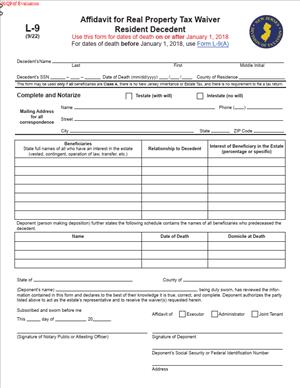
L-9 – Affidavit for Real Property Tax Waiver- Resident Decent
Fill out nowJurisdiction: Country: United States | Province or State: New Jersey
The L-9 – Affidavit for Real Property Tax Waiver- Resident Decent is a tax form used in New Jersey when real estate is being transferred after someone’s death. If you are settling an estate and need to deal with a home or other real property, this document may become part of the process.
This form is commonly used when the person who passed away was a New Jersey resident. It helps confirm whether a waiver is required before the property can be transferred to heirs or beneficiaries. Without the proper filing, the county clerk may not record the deed.
If you are acting as an executor, administrator, or surviving joint owner, you may come across this form early in the estate process. It connects estate administration with state tax requirements.
Understanding how this document works can save time and prevent delays in transferring property. The form is short, but the information you provide must be accurate and complete.
What is L-9 – Affidavit for Real Property Tax Waiver- Resident Decent?
Clear definition
The L-9 – Affidavit for Real Property Tax Waiver- Resident Decent is an affidavit filed with the New Jersey Division of Taxation. It is used to request a real property tax waiver when a New Jersey resident dies, and real estate is being transferred.
An affidavit is a sworn written statement. By signing this form, you are declaring that the information provided is true to the best of your knowledge. The state uses this information to determine whether a tax waiver can be issued without further review.
The waiver allows the county clerk to record documents that transfer title to real estate from the deceased person to heirs, beneficiaries, or joint owners.
Who typically uses this form?
You may use this form if you are the executor named in a will. If there is no will, the court-appointed administrator may complete it.
In some situations, a surviving spouse or joint owner may be involved in the filing. Attorneys often prepare and submit the document, but individuals handling an estate on their own also complete it.
The form is generally used when the estate qualifies for a tax waiver based on the relationship between the deceased person and the beneficiary. It is not limited to large estates. Even modest estates with real property may require this filing.
Why might you need this form?
When someone dies owning real estate in New Jersey, the property cannot always be transferred immediately. The state may require confirmation that any applicable inheritance or estate taxes have been addressed.
The L-9 – Affidavit for Real Property Tax Waiver- Resident Decent helps establish that the transfer qualifies for a waiver. Without the waiver, the county recording office may refuse to record a deed or other transfer document.
This form can prevent delays in selling a home, refinancing property, or distributing assets to beneficiaries. It also helps ensure that the estate complies with state tax procedures.
Typical real-life scenarios
- A common scenario involves a surviving spouse inheriting the marital home. The executor files the affidavit to confirm that the spouse is an eligible beneficiary and that a waiver can be issued so the deed can be recorded.
- Another situation arises when parents leave property to their children. The executor uses the form to show the relationship between the deceased and the heirs, which may qualify for a waiver under state rules.
- You might also see this form used when property passes under a will to a close family member. The affidavit supports the request for a tax waiver so that the title can be formally updated.
- In some estates, there is no will, and the property passes under intestacy laws. The appointed administrator completes the form to confirm the heirs and request the waiver needed to transfer ownership.
When would you use L-9 – Affidavit for Real Property Tax Waiver- Resident Decent?
You would typically use this form after the death of a New Jersey resident who owned real estate in their name alone or as a tenant in common. It is part of the process of transferring title to the rightful heir or beneficiary.
The form is often submitted before or at the same time as recording a deed. The county clerk usually requires proof that the state has issued a waiver before accepting the deed for recording.
If you are preparing to sell estate property, the waiver may be necessary before closing. Title companies often look for confirmation that tax requirements have been satisfied.
Executors and administrators usually handle this filing during estate administration. In smaller estates, a family member acting without an attorney may complete and submit the document directly.
You may not need this form if the property passes automatically by operation of law, such as certain joint ownership arrangements. However, even in those cases, a waiver may still be required before recording updated documents. The specific facts of ownership matter.
Legal characteristics of L-9 – Affidavit for Real Property Tax Waiver- Resident Decent
The L-9 – Affidavit for Real Property Tax Waiver- Resident Decent is a sworn statement made under penalty of perjury. This means the person signing the document affirms that the information is true and complete.
For the form to be effective, it must be filled out accurately. Names must match the death certificate and deed. Property details must be correct, including block and lot numbers. Even small errors can lead to rejection or delays.
The affidavit generally requires notarization. The notary confirms the identity of the signer and witnesses the signature. Without proper notarization, the submission may not be accepted.
The state reviews the information provided to determine whether the estate qualifies for a waiver. If the estate does not qualify, additional tax filings or payments may be required before property can be transferred.
Common reasons for problems include incomplete information, incorrect beneficiary classifications, missing signatures, and inconsistencies between the affidavit and other estate documents. If the property description does not match the recorded deed, the county clerk may refuse to record the transfer.
Although this form is specific to New Jersey, other states have similar processes. Some states require formal tax clearance documents before property transfers. Others rely on different types of affidavits. The exact procedures vary by jurisdiction.
It is important to understand what this form does not do. It does not transfer ownership by itself. A separate deed or legal instrument is still required to change title. It also does not serve as a substitute for a full estate tax return if one is required.
Is it legally binding?
Yes, the affidavit is legally binding in the sense that you are making a sworn statement. By signing it, you are affirming that the facts stated are accurate. False statements may carry legal consequences.
The document becomes part of the official tax record. Government agencies rely on the information to determine eligibility for a waiver. If the information is later found to be incorrect, the waiver could be challenged.
However, the form does not create new rights to property. It reflects and supports rights that already exist under a will or state intestacy laws. The binding effect relates to the truthfulness of the statements, not to the creation of ownership.
How to fill out L-9 – Affidavit for Real Property Tax Waiver- Resident Decent
Step 1 – Identify the decedent
Begin by entering the full legal name of the person who passed away. Use the exact name shown on the death certificate. Include the date of death and the county of residence at the time of death.
Accuracy matters here. Any difference between this name and the name on the deed can cause delays.
Step 2 – Provide the decedent’s personal details
Enter the decedent’s last address and any other identifying information requested on the form. This may include a Social Security number or similar identifier.
Make sure the address reflects the legal residence at the time of death. The form is intended for resident decedents, so residency status is important.
Step 3 – Describe the real property
List the complete property address. Include the block and lot numbers as shown on the property tax records.
You may also need to provide the county where the property is located. Double-check these details against the most recent deed to avoid inconsistencies.
Step 4 – Identify the beneficiaries or transferees
Enter the names and addresses of the individuals who will receive the property. Their relationship to the decedent is typically required.
Be precise when stating the relationship, such as spouse, child, or other family connection. The classification may affect eligibility for a waiver.
Step 5 – Confirm qualification for waiver
The form will ask you to confirm that the transfer qualifies for a tax waiver under applicable rules. Read each statement carefully before marking or signing.
This section usually involves confirming the relationship between the decedent and the beneficiary. Ensure the information aligns with the will or intestacy documents.
Step 6 – Review for completeness
Before signing, review the entire document. Check spelling of names, property identifiers, and dates.
Make sure all required fields are filled in. Incomplete forms are commonly returned without processing.
Step 7 – Sign in the presence of a notary
Sign the affidavit where indicated. Do not sign it in advance if notarization is required.
The notary will verify your identity and witness your signature. The notary will then complete their section and apply their seal.
Step 8 – Submit the form to the appropriate office
After signing and notarizing, submit the form to the New Jersey Division of Taxation as required. Keep a copy for your records.
Once the waiver is issued, it can be presented to the county clerk with the deed or transfer document so the property transfer can be recorded.
Legal terms you might encounter in L-9 – Affidavit for Real Property Tax Waiver- Resident Decent
- Decedent: The person who has died. On this form, you must enter the decedent’s full legal name exactly as it appears on the deed and the death certificate. Any mismatch can delay acceptance or recording.
- Affidavit: A written statement made under oath. When you sign this document, you are swearing that the information is true. False statements can lead to penalties and rejection of the filing.
- Real Property: Land and anything permanently attached to it, such as a house or building. This form applies only to real estate located in New Jersey. You must describe the property clearly so it matches the public land records.
- Transferee: The person or people receiving ownership of the property. Their names must be written exactly as they will appear on the recorded deed. If there are multiple transferees, list each one completely.
- Waiver: Official confirmation that no inheritance tax is due on the transfer of the real property. This form is used to establish that the transfer qualifies for a tax waiver. Without it, the county clerk may refuse to record the deed.
- Class of Beneficiary: A category that determines whether inheritance tax applies. Close family members often fall into exempt classes. You must confirm that the transferee’s relationship to the decedent qualifies for the waiver.
- Consideration: Anything of value exchanged in a transfer, usually money. In most inheritance situations, property passes without consideration. If money is involved, it may affect how the transfer is treated.
- Executor or Administrator: The person legally responsible for handling the decedent’s estate. If one has been appointed, their authority may affect who signs related documents. You must understand your role before completing the affidavit.
- Notary Public: An official who verifies your identity and witnesses your signature. This form must be signed in front of a notary. The notary’s seal and signature are required for acceptance.
- Recording: The process of filing a document with the county clerk so it becomes part of the public land records. Recording updates the chain of title and shows the new ownership of the property.
FAQs
Do I need to file the L-9 – Affidavit for Real Property Tax Waiver- Resident Decent before recording the deed?
Yes. The county clerk generally requires proof that no inheritance tax is due before recording a deed that transfers property from a deceased person. This form serves as proof that the transfer qualifies for a waiver. If you attempt to record without it, the clerk may reject the deed.
Who is allowed to sign this document?
The person completing the affidavit must have personal knowledge of the facts. This is often the executor, administrator, or a beneficiary receiving the property. You must confirm your authority to act and ensure your role is consistent with the estate documents and the deed being recorded.
What information must match exactly to avoid rejection?
Names and property details must match the public record and the death certificate. The decedent’s name should be identical to how it appears on the deed. The property description should match the legal description or official tax block and lot numbers used in land records.
Do I need to attach a copy of the death certificate?
In most situations, you will need to provide proof of death. The county clerk or recording office may require a copy of the death certificate along with this form. Make sure the name and date of death match what you entered in the affidavit.
What if there are multiple beneficiaries receiving the property?
You must list every transferee clearly and completely. If ownership is divided, the deed must show how each person will hold title. The affidavit should reflect the same names and ownership structure that appear in the deed.
Does this form change the public record by itself?
No. This document supports the recording of a deed. The public record changes when the deed is accepted and recorded by the county clerk. The affidavit helps clear the way for that recording by confirming the tax waiver status.
What happens if the relationship does not qualify for a waiver?
If the transferee does not fall within an exempt class, inheritance tax may be due. In that case, you may need a different filing or formal tax clearance. Submitting this form when the transfer does not qualify can delay the entire transaction.
How will I know if the filing was accepted?
You will receive confirmation when the deed is recorded. This may be a stamped copy, a recording receipt, or an instrument number. Keep this proof with your estate records because it shows the property transfer is complete.
Checklist: Before, During, and After L-9 – Affidavit for Real Property Tax Waiver- Resident Decent
Before
- Confirm the decedent was a New Jersey resident at the time of death.
- Obtain a certified copy of the death certificate.
- Review the deed to verify the exact legal name and property description.
- Confirm the relationship between the decedent and each transferee.
- Determine whether an executor or administrator has been appointed.
- Gather tax block, lot, and full legal property description details.
- Ensure the deed transferring the property is prepared and consistent with the affidavit.
During
- Enter the decedent’s name exactly as it appears on the deed.
- Provide the correct date of death from the death certificate.
- List the full property description without abbreviating critical details.
- Identify each transferee clearly and consistently with the deed.
- Confirm the relationship category qualifies for a tax waiver.
- Review every section for blanks or incomplete answers.
- Sign only in the presence of a notary public.
- Check that the notary completes all required fields and applies their seal.
After
- Make copies of the signed and notarized affidavit.
- Attach the affidavit to the deed for recording if required.
- Submit the documents to the appropriate county recording office.
- Pay any applicable recording fees.
- Obtain a receipt or confirmation of recording.
- Store the recorded deed and affidavit in a secure place.
- Provide copies to beneficiaries for their records.
- Update estate inventory records to reflect the completed transfer.
Common mistakes to avoid with L-9 – Affidavit for Real Property Tax Waiver- Resident Decent
- Mistake: Entering a shortened or misspelled version of the decedent’s name, which happens when people rely on memory instead of the deed, leading to rejection by the county clerk; do not forget to copy the name exactly as shown in the land records.
- Mistake: Listing an incomplete property description because you assume the street address is enough, which can prevent proper recording; do not forget to include the full legal description or official tax identifiers.
- Mistake: Failing to confirm the beneficiary’s relationship category, often due to misunderstanding inheritance classes, which may result in tax issues or filing delays; do not forget to verify eligibility before claiming a waiver.
- Mistake: Signing the affidavit before meeting with a notary, which makes the notarization invalid and forces you to redo the document; do not forget to wait and sign in the notary’s presence.
- Mistake: Submitting the affidavit without the deed, which happens when you treat it as a standalone filing, causing processing delays; do not forget that the waiver supports the deed recording.
- Mistake: Leaving blanks or unanswered questions because you think they do not apply, which can trigger rejection or requests for clarification; do not forget to review every line and mark items appropriately.
- Mistake: Forgetting to keep copies after submission, which creates problems if the document is misplaced or questioned later; do not forget to store stamped or recorded copies securely.
What to do after filling out L-9 – Affidavit for Real Property Tax Waiver- Resident Decent
Once you complete and notarize the form, your focus shifts to proper submission and recordkeeping. The affidavit supports the legal transfer of real estate. Handling the next steps carefully ensures the ownership change is reflected in the public record without delays.
- Step 1: Review the completed affidavit alongside the deed to confirm names, dates, and property details match exactly.
- Step 2: Make at least two complete copies of the signed and notarized affidavit for your records.
- Step 3: Attach the affidavit to the deed if required for recording submission.
- Step 4: Prepare payment for any recording fees required by the county clerk.
- Step 5: Submit the deed and affidavit package to the appropriate county recording office.
- Step 6: Request confirmation of receipt if submitting in person, or track delivery if submitting by mail.
- Step 7: Wait for notice that the deed has been officially recorded and assigned a recording reference number.
- Step 8: Obtain and store the recorded copy of the deed with the recording stamp or instrument number.
- Step 9: Provide copies of the recorded documents to the transferees for their personal files.
- Step 10: Update estate records to reflect that the real property has been transferred and the waiver has been processed.
Keep all related documents together. This includes the death certificate, the deed, the recorded affidavit, and any correspondence about the filing. Organized records protect you if questions arise later about ownership or tax status.
Disclaimer: This guide is provided for informational purposes only and is not intended as legal advice. You should consult a legal professional.