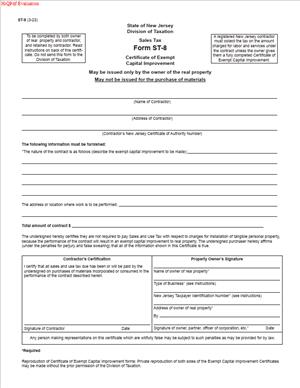
Form ST-8 – Certificate of Exempt Capital Improvement
Fill out nowJurisdiction: Country: United States | Province or State: New Jersey
If you are planning or completing construction work on property in New Jersey, you may come across Form ST-8 – Certificate of Exempt Capital Improvement. This document plays a key role in how sales tax is handled on certain types of construction and renovation work.
Form ST-8 – Certificate of Exempt Capital Improvement is used to certify that specific work qualifies as a capital improvement rather than a taxable repair or maintenance service. The distinction can affect whether sales tax applies to the labor portion of the job.
If you are a property owner, tenant, or contractor, you may be asked to complete or accept this form before work begins. It is typically signed by the property owner or customer and provided to the contractor.
Understanding how this form works can help you avoid tax errors, billing disputes, or delays. When filled out correctly, it clarifies the tax treatment of the project and documents the reason no sales tax is charged on qualifying labor.
What is Form ST-8 – Certificate of Exempt Capital Improvement?
Clear definition
Form ST-8 – Certificate of Exempt Capital Improvement is a written certification that construction work performed on real property qualifies as a capital improvement and is therefore exempt from sales tax on labor charges in New Jersey.
A capital improvement generally means an installation or alteration that permanently adds to the value of the property or substantially prolongs its useful life. It usually becomes part of the real property and cannot be removed without causing damage.
This form is not a permit and not a contract. It is a tax document. Its purpose is to document the nature of the work and confirm that it meets the requirements for exemption from sales tax on services related to capital improvements.
Who typically uses this form?
Property owners most commonly complete and sign this form. That includes homeowners, landlords, commercial property owners, and in some cases tenants who are responsible for improvements under a lease.
Contractors and subcontractors rely on this document to determine whether to charge sales tax on labor. They keep the completed form in their records to support the tax treatment of the project.
Accountants, bookkeepers, and project managers may also be involved in reviewing or preparing the form as part of project documentation and tax compliance procedures.
Why might you need this form?
You may need this form when you hire a contractor to perform work that changes or improves your property in a lasting way. Without the form, a contractor may charge sales tax on labor by default.
The document protects the contractor by confirming that the customer is claiming the work qualifies as a capital improvement. It also protects the property owner by clarifying why sales tax is not being applied to labor charges.
If the form is not completed properly, the contractor could later be held responsible for unpaid sales tax. That risk often leads contractors to require a completed form before they treat labor as exempt.
Typical real-life scenarios
- You hire a contractor to install a new roof on your home. The roof becomes a permanent part of the structure and increases its value. In this situation, you may be asked to complete this form so the contractor does not charge sales tax on labor.
- You decide to add a new bathroom to your house. The addition changes the structure and increases the usable space. Because this is a permanent improvement, the contractor may request the certificate before starting work.
- A commercial property owner installs a new central air conditioning system that is integrated into the building. Since it becomes part of the real property and is not easily removed, the project may qualify as a capital improvement.
- A tenant in a retail space builds out the interior under a long-term lease. If the improvements become part of the property and remain after the lease ends, the work may qualify as a capital improvement, and the form may be used to document that status.
When would you use Form ST-8 – Certificate of Exempt Capital Improvement?
You use this form when construction or installation work is being treated as a capital improvement instead of a taxable repair or maintenance service.
It is typically completed before or during the project. Contractors often request it before issuing an invoice without sales tax on labor. Timing matters because the form supports the tax treatment applied at billing.
The form is most commonly used in residential and commercial construction projects. This includes new construction, additions, major renovations, and installation of systems that become permanently attached to the property.
If the work involves repairs, maintenance, or replacement of parts without significantly increasing value or extending useful life, the form is generally not used. In those cases, sales tax may apply to labor charges.
Owners, tenants, and contractors each have a role. The property owner or customer usually certifies the nature of the work. The contractor keeps the form as part of their tax records. This shared responsibility helps document why tax was or was not collected.
Legal characteristics of Form ST-8 – Certificate of Exempt Capital Improvement
This form functions as a tax certification. Its effectiveness depends on accurate and complete information. It must clearly describe the work and identify the property and parties involved.
For the form to be valid in practice, it typically needs to be signed and dated by the property owner or authorized representative. Missing signatures, incomplete property details, or vague project descriptions can cause problems.
Common issues include describing work too broadly, misclassifying repairs as capital improvements, or failing to match the form to the actual scope of work performed. If the description on the form does not align with the invoice, questions may arise later.
The form does not automatically make a project tax-exempt. The work itself must meet the criteria of a capital improvement. The certificate documents that claim, but it does not override the underlying rules.
Tax treatment of construction services can vary by state. In New Jersey, the distinction between capital improvements and repairs affects whether sales tax applies to labor. Other states may follow different rules, so this form is specific to this jurisdiction.
The document also does not eliminate tax on materials. Contractors generally pay sales tax on materials they purchase for capital improvement jobs, even if labor is not taxed. The form addresses the service portion, not all project costs.
Is it legally binding?
Yes, in practical terms, it carries legal weight because it is a signed certification related to tax treatment. When you sign it, you are affirming that the work qualifies as a capital improvement.
The contractor relies on that certification to determine whether to collect sales tax on labor. If the information is incorrect, it can affect tax reporting and liability.
However, the form does not replace a construction contract. It does not set payment terms, project scope, deadlines, or warranties. Those details are handled in separate agreements.
Its binding nature is limited to tax representation. It documents your statement about the character of the work. Tax authorities may review it if questions arise about how sales tax was handled on the project.
How to fill out Form ST-8 – Certificate of Exempt Capital Improvement
Step 1 – Enter the property owner’s information
Start by providing the full legal name of the property owner or customer. Include the complete address of the property where the work will be performed. Make sure the address matches the project location, not just a mailing address, if they differ.
Step 2 – Identify the contractor
Enter the name and business information of the contractor performing the work. This typically includes the business name and address. The details should match the contractor’s invoice and contract documents.
Step 3 – Describe the capital improvement work
Provide a clear and specific description of the work being performed. Avoid general phrases like “construction services.” Instead, describe the actual improvement, such as “installation of new roof” or “construction of rear home addition.”
The description should reflect work that permanently improves the property. Make sure it aligns with the written contract or proposal.
Step 4 – Confirm that the work qualifies as a capital improvement
Review the certification language in the form. By signing, you confirm that the work results in a permanent improvement to real property and is not a repair, maintenance, or installation of tangible personal property.
Read this section carefully so you understand what you are certifying. The form is based on the nature of the work, not simply on your preference for tax treatment.
Step 5 – Sign and date the form
The property owner or authorized representative signs and dates the certificate. Use your legal name and include any required title if signing on behalf of a business entity.
Dating the form is important because it ties the certification to the timing of the project and billing.
Step 6 – Provide the completed form to the contractor
After signing, give the completed document to the contractor. Contractors typically keep it in their records to support why they did not charge sales tax on labor.
Keep a copy for your own records. This helps you track the tax treatment of the project and respond to any future questions about the work.
Legal terms you might encounter in Form ST-8 – Certificate of Exempt Capital Improvement
- Capital Improvement: A permanent improvement that adds value to real property, prolongs its useful life, or adapts it to a new use. On this document, you are certifying that the work meets this standard. The classification matters because only qualifying capital improvements are exempt from sales tax on labor.
- Exempt Capital Improvement: A project that meets the legal definition of a capital improvement and is not subject to sales tax on the contractor’s labor charges. This phrase appears in the title and is the core reason you complete the certificate. By signing, you state that the work falls within this category.
- Tangible Personal Property: Physical items that are movable and not permanently attached to real property. This term matters because work involving only tangible personal property is generally taxable. If the project does not become a permanent part of the building, it likely does not qualify.
- Real Property: Land and anything permanently attached to it, such as buildings, structures, and built-in systems. The form applies only to improvements made to real property. You must confirm that the project relates to real property, not personal items.
- Contractor: The person or business performing the work. The contractor relies on this certificate to treat the labor as tax-exempt. The form requires you to identify the contractor clearly so there is no confusion about who is covered.
- Property Owner: The individual or entity that owns the real property where the work is performed. The owner completes and signs the certificate. If ownership is shared or held by a business entity, the correct legal name must be used.
- Certificate: A written statement signed under penalty of law that certain facts are true. This certificate serves as proof that the work qualifies as an exempt capital improvement. Contractors keep it in their records to support their tax treatment.
- Permanent Installation: An attachment that becomes part of the building or structure and cannot be removed without causing damage. The concept is central to deciding whether work is a capital improvement. You should consider whether removal would alter the structure.
- Sales Tax: A tax imposed on certain goods and services. In this context, it applies to labor unless the work qualifies as an exempt capital improvement. The purpose of the form is to clarify when labor charges are not subject to sales tax.
- Effective Date: The date the certificate is signed and becomes valid. This date should match or follow the date the work qualifies as a capital improvement. It helps establish when the exemption applies.
FAQs
What if I am not sure whether my project qualifies as a capital improvement?
You need to review the scope of work in your contract and compare it to the definition of a permanent improvement. Ask yourself whether the work adds value, extends the life of the property, or adapts it to a new use, and whether it becomes permanently attached. If you are uncertain, clarify the nature of the installation with your contractor before signing this document.
Does the effective date on this form have to match the contract date?
The effective date is usually the date you sign the certificate. It does not have to be the same as the contract date, but it should not precede the time when the work qualifies as a capital improvement. Make sure the date is accurate and consistent with your records so there is no confusion later.
Who is authorized to sign if the property is owned by a company or trust?
The signer must have authority to act on behalf of the owner. That may be a member, manager, officer, trustee, or other authorized representative. Use the full legal name of the owner as it appears in official records, and include the signer’s title to show authority.
Do I need to attach contracts or plans to Form ST-8 – Certificate of Exempt Capital Improvement?
This document itself does not require attachments in most cases. However, you should keep copies of your contract, invoices, and any plans that describe the work. These records support the statements made in Form ST-8 – Certificate of Exempt Capital Improvement if questions arise later.
What happens if the names on the invoice and this form do not match exactly?
Inconsistent names can create doubt about whether the exemption applies. Make sure the property owner’s name matches the name on the contract and invoices. If there has been a name change or ownership transfer, clarify it in writing and keep supporting documentation with this certificate.
Do I file this document with a government agency?
Typically, you provide this certificate directly to the contractor, not to a government office. The contractor keeps it in their tax records. Confirm with the contractor that they have received and accepted it for their files.
What if the project changes after I sign the form?
If the scope of work changes and the new work does not qualify as a capital improvement, the exemption may no longer apply to that portion. Review any change orders carefully. If needed, issue a revised certificate that accurately reflects the updated work.
Can I use one Form ST-8 – Certificate of Exempt Capital Improvement for multiple projects?
This certificate should describe a specific project at a specific property. If you have separate projects or different properties, complete a separate document for each. Clear project descriptions reduce the risk of misapplication of the exemption.
Checklist: Before, During, and After Form ST-8 – Certificate of Exempt Capital Improvement
Before
- Review your construction contract to confirm the scope of work.
- Verify that the project involves permanent improvements to real property.
- Confirm the correct legal name of the property owner.
- Check the property address for accuracy and completeness.
- Identify the full legal name of the contractor.
- Gather copies of plans, proposals, and change orders.
- Confirm who has the authority to sign on behalf of the owner.
During
- Enter the property owner’s name exactly as it appears on official records.
- Fill in the complete property address, including unit numbers if applicable.
- Clearly identify the contractor performing the work.
- Provide a detailed but concise description of the improvement.
- Double-check that the work described is permanent in nature.
- Review all entries for spelling and numerical errors.
- Sign and date the certificate using the correct authority title.
After
- Make a copy of the signed certificate for your records.
- Deliver the original to the contractor promptly.
- Confirm the contractor acknowledges receipt.
- Keep the certificate with your contract and invoices.
- Monitor any project changes that could affect tax status.
- Store records in a secure place for future reference.
- Update internal accounting records to reflect the tax treatment.
Common mistakes to avoid with Form ST-8 – Certificate of Exempt Capital Improvement
- Mistake: Signing the form before confirming the work qualifies as a capital improvement, which happens when you assume all construction is exempt, leading to possible tax assessments later; do not forget to compare the actual scope of work to the definition of permanent improvement.
- Mistake: Using an incorrect or abbreviated legal name for the property owner because you rely on informal documents, which can create record inconsistencies and audit issues; do not forget to use the exact legal name as registered.
- Mistake: Providing a vague project description due to copying a short invoice line, which makes it unclear what was installed and may weaken the exemption claim; do not forget to describe the work in enough detail to show permanence.
- Mistake: Failing to update the certificate after major change orders, often because the project evolves over time, which can result in part of the work being improperly treated as exempt; do not forget to review tax status when scope changes.
- Mistake: Forgetting to keep a copy for your own records because you assume the contractor will handle everything, which leaves you without proof if questions arise; do not forget to store a signed copy with your financial documents.
- Mistake: Dating the form incorrectly or leaving it undated due to oversight, which can create uncertainty about when the exemption applies; do not forget to check that the signature date is accurate and legible.
- Mistake: Allowing someone without proper authority to sign, often in larger organizations where roles are unclear, which can invalidate the certificate; do not forget to confirm signer authority and include their title.
- Mistake: Submitting one certificate for multiple unrelated projects to save time, which can blur distinctions between taxable and exempt work; do not forget to complete a separate document for each property or project.
What to do after filling out Form ST-8 – Certificate of Exempt Capital Improvement
Once you complete the form, your job is not quite finished. You need to make sure it is properly delivered, documented, and aligned with the rest of your records.
- Step 1: Review the entire document one more time for accuracy, including names, addresses, dates, and the project description.
- Step 2: Confirm that the signer’s title and authority are clearly stated next to the signature.
- Step 3: Make at least one clear copy of the signed certificate for your personal or business records.
- Step 4: Provide the original signed certificate to the contractor performing the work.
- Step 5: Request written confirmation, such as an email acknowledgment, that the contractor received and accepted the certificate.
- Step 6: Attach your copy of the certificate to the related contract, invoices, and payment records.
- Step 7: Update your accounting or bookkeeping records to reflect that labor charges are treated as exempt capital improvements.
- Step 8: Monitor the project for change orders or additions that might affect whether the work remains a qualifying capital improvement.
- Step 9: If ownership of the property changes before completion, review whether a new certificate is necessary.
- Step 10: Keep the certificate and supporting documents for the same retention period you use for tax and construction records.
By taking these follow-up steps, you create a clear paper trail. That paper trail supports the tax treatment applied to the project. It also helps you respond quickly if questions arise later about why sales tax was not charged on the labor.
Disclaimer: This guide is provided for informational purposes only and is not intended as legal advice. You should consult a legal professional.