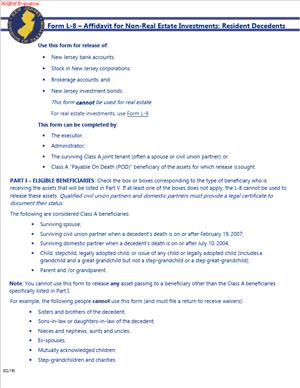
Form L-8 – Affidavit for Non-Real Estate Investments – Resident Decedents
Fill out nowJurisdiction: Country: United States | Province or State: New Jersey
If you are handling the estate of someone who lived in New Jersey and has passed away, you may come across Form L-8 – Affidavit for Non-Real Estate Investments – Resident Decedents. This document is used to address certain tax clearance requirements before financial institutions release assets.
Form L-8 – Affidavit for Non-Real Estate Investments – Resident Decedents relates only to specific types of property. It does not apply to real estate. Instead, it focuses on financial accounts and investment assets held by a New Jersey resident who has died.
You may need this form if you are trying to collect or transfer bank accounts, stocks, bonds, or similar assets. Financial institutions often require it before they release funds to beneficiaries or an estate representative.
Understanding what this form does can save you time and prevent delays. When filled out correctly, it helps confirm whether a tax waiver is required before assets can be transferred.
This guide walks you through what the form is, when it is used, and how to complete it carefully and accurately.
What is Form L-8 – Affidavit for Non-Real Estate Investments – Resident Decedents?
Clear definition
Form L-8 – Affidavit for Non-Real Estate Investments – Resident Decedents is a sworn statement used in New Jersey to request the release of certain financial assets owned by a deceased resident. It is submitted to financial institutions rather than recorded with a county office.
The form is connected to New Jersey inheritance tax rules. It allows the person completing it to certify that the assets qualify for release without the need for a formal tax waiver from the state, if specific conditions are met.
This document applies only to non-real estate assets. That means it covers intangible property such as bank accounts, certificates of deposit, brokerage accounts, and stocks. It does not cover land, houses, or other real property.
By signing the affidavit, you are stating that the information provided is true and complete. Because it is an affidavit, it must be signed under oath.
Who typically uses this form?
The form is commonly completed by an executor named in a will. If there is no will, an administrator appointed to manage the estate may use it.
In some situations, a surviving joint account holder may be involved in the process. A beneficiary who is entitled to receive the funds may also need to provide information.
Family members handling a small or straightforward estate often encounter this document. It is especially common when most of the deceased person’s assets are financial accounts rather than real estate.
Financial institutions may provide a blank copy and request that it be completed before they release funds.
Why might you need this form?
New Jersey law places certain inheritance tax obligations on transfers from a deceased person’s estate. Before some assets can be released, the state may require confirmation that no tax is due or that a waiver has been issued.
Form L-8 is used when the assets qualify for release without a formal waiver. The affidavit provides details about the decedent, the beneficiaries, and the relationship between them.
If the beneficiaries fall into categories that are generally exempt from inheritance tax, the form can help document that status. This may allow the financial institution to release funds more quickly.
Without this document, a bank or brokerage firm may freeze the account until it receives proper authorization.
Typical real-life scenarios
- A parent passes away and leaves a savings account to an adult child. The bank informs the child that it needs Form L-8 before releasing the funds. The child completes the affidavit, confirming the relationship and other required details.
- An executor is managing an estate that includes several certificates of deposit. The beneficiaries are the surviving spouse and children. The executor uses the form to certify that these transfers qualify under the applicable tax rules.
- A decedent held a brokerage account in their sole name. The named beneficiaries are close family members. The brokerage firm requests the affidavit to confirm that no tax waiver is required before distributing the investments.
- An estate has no real property, only checking and investment accounts. The personal representative gathers account balances and completes the form for each institution holding assets.
- In each of these situations, the form serves as a tool to move the process forward without waiting for additional state-issued documentation.
When would you use Form L-8 – Affidavit for Non-Real Estate Investments – Resident Decedents?
You use this form when a New Jersey resident has died and left behind non-real estate financial assets that need to be transferred or released.
It is typically used early in the estate administration process. After gathering information about the decedent’s accounts, you may learn that a bank or financial institution requires this affidavit before taking further steps.
The form is often used when beneficiaries are in categories that are commonly exempt from inheritance tax. In those cases, the affidavit helps confirm that the transfer qualifies for release without a separate waiver document.
Executors and administrators frequently handle the form as part of their broader duties. These duties may include identifying assets, notifying financial institutions, and preparing required tax filings.
You would not use this form to transfer real estate. Real property usually involves different forms and procedures. Likewise, if the estate does not meet the conditions outlined in the affidavit, a different process may apply.
In practical terms, if a financial institution tells you it cannot release funds without either a tax waiver or Form L-8, that is the point when this document becomes relevant.
Legal characteristics of Form L-8 – Affidavit for Non-Real Estate Investments – Resident Decedents
This form is an affidavit. That means it is a sworn statement made under oath. When you sign it, you are affirming that the information provided is true to the best of your knowledge.
For the document to be effective, it must be completed accurately and signed properly. In many cases, it must be notarized. Missing signatures, incorrect beneficiary information, or incomplete asset descriptions can lead to rejection.
Financial institutions rely on the statements made in the form. If key sections are left blank or if relationships are unclear, the institution may refuse to release the assets until corrections are made.
The form interacts with New Jersey inheritance tax rules, but it does not replace a full tax return where one is required. If the estate does not qualify under the affidavit’s terms, additional filings may be necessary.
Requirements can vary depending on the type of asset and how it was titled. Joint accounts, payable-on-death accounts, and individually owned accounts may be treated differently in practice.
It is also important to understand what this form does not do. It does not transfer ownership by itself. It does not appoint you as executor. It does not settle disputes among heirs. It is a certification related to tax clearance for certain financial assets.
Is it legally binding?
Yes, the affidavit is legally binding in the sense that you are making sworn statements. When you sign under oath, you accept responsibility for the truthfulness of the information.
If information is knowingly false, there can be legal consequences. That is because affidavits are treated as formal declarations.
The binding effect relates to the statements you make, not to creating a contract between parties. The form does not create new rights. Instead, it confirms facts that allow a financial institution to act.
Its effectiveness depends on proper completion and compliance with the relevant requirements. If the form is incomplete or inaccurate, it may not be accepted.
How to fill out Form L-8 – Affidavit for Non-Real Estate Investments – Resident Decedents
Step 1 – Enter the decedent’s personal information
Start by providing the full legal name of the deceased person. Include their date of death and last residential address. Make sure the information matches the death certificate and financial account records.
You will also enter the decedent’s Social Security number or other identifying number if requested. Accuracy here is critical because institutions use this data to locate the correct accounts.
Step 2 – Identify the person completing the affidavit
Next, fill in your name and address. Indicate your role, such as executor, administrator, surviving spouse, or beneficiary.
Provide contact information if the form asks for it. Financial institutions may use this to reach you if questions arise about the submission.
Step 3 – List the financial assets
Describe the non-real estate assets covered by the affidavit. This may include bank accounts, certificates of deposit, stocks, bonds, or brokerage accounts.
Include account numbers and the name of each financial institution. Some versions of the form require you to state the date-of-death value of each asset.
Be specific. Vague descriptions can delay processing.
Step 4 – Identify the beneficiaries and their relationship
List the names of all beneficiaries receiving the assets. For each person, state their relationship to the decedent.
The relationship is important because inheritance tax treatment often depends on how the beneficiary is related to the deceased. Double-check spelling and relationship details to avoid confusion.
If there are multiple beneficiaries, ensure that all are clearly identified.
Step 5 – Review tax-related declarations
Carefully read the statements in the affidavit regarding inheritance tax. You will be certifying that the transfer qualifies under the terms described in the form.
Take time to understand each declaration before signing. Confirm that the facts of the estate match what the document requires.
This section is where errors are most likely to cause problems, so review it slowly and thoroughly.
Step 6 – Sign the affidavit before a notary
Do not sign the form until you are in front of a notary if notarization is required. Bring valid identification.
Sign your name exactly as printed in the form. The notary will complete their portion, confirming that you signed under oath.
An unsigned or improperly notarized affidavit is likely to be rejected.
Step 7 – Submit the form to the financial institution
Once completed and notarized, provide the form to the bank, brokerage firm, or other institution holding the assets.
Keep a copy for your records. The institution will review the affidavit and determine whether it can release the funds based on the information provided.
If the institution requests clarification or additional documents, respond with complete and consistent information to avoid further delay.
Legal terms you might encounter in Form L-8 – Affidavit for Non-Real Estate Investments – Resident Decedents
- Affiant: The affiant is the person who signs the affidavit. In this document, you are the affiant if you complete and sign it. You swear that the information you provide about the decedent, the assets, and the beneficiaries is true to the best of your knowledge.
- Resident Decedent: This refers to a person who lived in the state at the time of death. The form is specifically for the estates of individuals who were legal residents. You must confirm residency because it affects how inheritance tax rules apply.
- Non-Real Estate Investments: These are assets that are not land or buildings. They include bank accounts, stocks, bonds, brokerage accounts, mutual funds, and similar financial holdings. The form only covers these types of assets, not houses or other real property.
- Inheritance Tax: This is a tax that may apply when assets pass to certain beneficiaries. The form helps determine whether tax is due or whether an exemption applies. You will see questions about the beneficiaries’ relationship to the decedent because that relationship affects tax treatment.
- Class of Beneficiary: Beneficiaries are grouped into classes based on their relationship to the decedent. For example, spouses, children, siblings, or unrelated individuals may fall into different classes. You must correctly identify each person’s relationship because it directly affects tax liability.
- Exempt Transfer: An exempt transfer is a distribution that is not subject to inheritance tax. Certain close family members often qualify for exemptions. The form requires you to state whether the transfer qualifies and why.
- Date of Death Value: This is the fair market value of each asset on the exact date the person died. You must report accurate values because tax calculations are based on this figure. Financial institutions often provide statements to help confirm these numbers.
- Waiver: A waiver is formal permission to release funds. In some cases, financial institutions require proof that the state has no claim before releasing assets. This affidavit can serve as part of that clearance process when no tax is due.
- Notarization: Notarization means signing the document in front of a notary public. The notary verifies your identity and witnesses your signature. Without proper notarization, the institution may reject the form.
- Personal Representative: This is the person responsible for handling the estate. It may be an executor named in a will or an administrator appointed by a court. Even if you are not formally appointed, you must have the authority to act when signing the affidavit.
FAQs
Do I need to file Form L-8 – Affidavit for Non-Real Estate Investments – Resident Decedents with a court?
No. This document is not filed with a court. You submit it directly to the bank or financial institution that holds the decedent’s non-real estate assets. The institution uses it to determine whether it can release funds without requiring a tax waiver.
Who is allowed to sign this form?
You must be someone with authority to act for the estate. That may be an executor named in the will or a next of kin handling the estate when no formal probate is required. Before signing, confirm that you have the legal right to request release of the listed assets.
What information do I need to gather before completing this document?
You need the decedent’s full legal name, address at death, date of death, and Social Security number. You also need statements showing the date-of-death value of each account listed. Finally, you must know the full names, addresses, and relationships of each beneficiary receiving the assets.
How do I determine the correct date-of-death value for each account?
Contact the financial institution and request the balance or fair market value as of the exact date of death. For investment accounts, this may involve market pricing on that specific day. Do not estimate. Use official statements or written confirmations.
What happens if I list the wrong beneficiary relationship?
The beneficiary’s relationship determines whether inheritance tax applies. If you list the wrong relationship, the institution may release funds incorrectly or delay the process. You may need to submit a corrected affidavit and supporting documents to fix the record.
Do I need to attach supporting documents to this form?
Financial institutions often require a certified copy of the death certificate. They may also ask for a copy of the will, letters of authority, or account statements showing values. Confirm their checklist before submitting to avoid rejection.
How will I know if the institution has accepted this document?
The institution typically confirms acceptance by processing the transfer or releasing the funds. If anything is missing, we will contact you for corrections or additional paperwork. Keep written confirmation of acceptance or proof of distribution for your records.
Can I correct Form L-8 – Affidavit for Non-Real Estate Investments – Resident Decedents after I submit it?
Yes, but you must act quickly. If you discover an error, notify the institution immediately and ask about its correction process. You may need to complete and notarize a new affidavit and clearly mark it as a corrected version.
Checklist: Before, During, and After Form L-8 – Affidavit for Non-Real Estate Investments – Resident Decedents
Before
- Confirm the decedent was a resident at the time of death.
- Obtain certified copies of the death certificate.
- Gather the will and any documents showing your authority.
- Request date-of-death balances from each financial institution.
- Identify all beneficiaries and confirm their legal names and addresses.
- Verify each beneficiary’s exact relationship to the decedent.
- Check whether any beneficiary predeceased the decedent.
- Review account titles to confirm they are solely in the decedent’s name.
During
- Enter the decedent’s name exactly as it appears on official records.
- Double-check the date of death for accuracy.
- List each asset separately with its correct value.
- Use full legal names for all beneficiaries.
- Clearly state each beneficiary’s relationship.
- Review all tax-related declarations carefully before signing.
- Do not leave required sections blank.
- Sign only in front of a notary public.
- Bring valid identification to the notarization appointment.
After
- Make copies of the signed and notarized affidavit.
- Attach required supporting documents.
- Submit the packet to each relevant financial institution.
- Confirm receipt with the institution.
- Respond promptly to any follow-up requests.
- Keep proof of when and how you submitted the document.
- Track which assets have been released.
- Store copies with the estate’s permanent records.
Common mistakes to avoid with Form L-8 – Affidavit for Non-Real Estate Investments – Resident Decedents
- Mistake: Listing estimated account values because you do not have statements, which happens when you are in a hurry; this can lead to rejection or tax miscalculations, so do not forget to obtain official date-of-death balances.
- Mistake: Misstating a beneficiary’s relationship due to assumptions about family ties; this can trigger incorrect tax treatment or delays, so do not forget to confirm the exact legal relationship.
- Mistake: Forgetting to notarize the document because you signed it at home first; this makes the affidavit invalid, so do not forget to wait and sign in front of a notary.
- Mistake: Using nicknames or shortened names instead of full legal names; this can cause processing issues or mismatched records, so do not forget to match names exactly to official IDs.
- Mistake: Omitting one of the decedent’s accounts because you overlooked a statement; this can delay estate settlement, so do not forget to review all financial records carefully.
- Mistake: Submitting the affidavit without required attachments because you assumed they were optional; this often results in rejection, so do not forget to confirm and include all supporting documents.
What to do after filling out Form L-8 – Affidavit for Non-Real Estate Investments – Resident Decedents
Once you complete and notarize the affidavit, your job is not finished. You still need to manage submission, follow-up, and recordkeeping carefully.
Start by organizing a clean submission packet for each financial institution. Each institution may have its own internal review process. Clear documentation speeds things up.
- Step 1: Make at least two copies of the signed and notarized affidavit for your records.
- Step 2: Attach a certified copy of the death certificate to each submission set.
- Step 3: Include any required proof of authority, such as executor documentation if applicable.
- Step 4: Add statements showing date-of-death values for the listed accounts.
- Step 5: Confirm the correct mailing address or in-person submission process for the institution.
- Step 6: Submit the documents using a method that provides delivery confirmation.
- Step 7: Record the date you submitted each packet and the name of any representative you speak with.
- Step 8: Follow up within a reasonable time if you do not receive acknowledgment.
- Step 9: Review any correspondence carefully and respond promptly to requests for clarification.
- Step 10: Once funds are released, document the amount and the date received in your estate records.
Keep a dedicated estate file. Store copies of the affidavit, attachments, confirmation letters, and notes from phone calls. This protects you if questions arise later about how assets were handled.
If you are distributing funds to beneficiaries, update your internal accounting. Record who received what and when. Clear records prevent disputes and help you close the estate efficiently.
Finally, retain the documents even after the estate is settled. Questions about inheritance or tax reporting can surface later. Organized records give you confidence and proof that you handled the process properly.
Disclaimer: This guide is provided for informational purposes only and is not intended as legal advice. You should consult a legal professional.