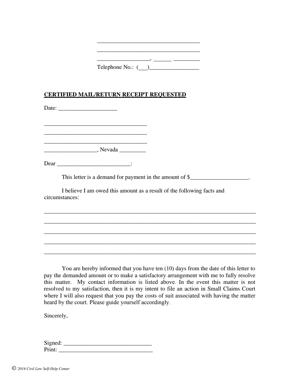
Certified Mail or Return Receipt Requested
Fill out nowJurisdiction: Country: United States | Province or State: Nevada
Certified Mail or Return Receipt Requested is a mailing method that provides proof that you sent a document and that it was delivered. In Nevada, especially in Clark County Small Claims Court matters, this mailing method is often used to show that the other party received important paperwork.
If you are representing yourself, you may need to prove that you notified someone about a claim, demand, or court filing. Certified Mail or Return Receipt Requested helps create a paper trail. It connects your mailing to a delivery record and, in many cases, a signature.
This process is not a court pleading by itself. It is a way to send documents. The value comes from the proof it creates, which may later be used in court.
You might use this mailing method when sending a demand letter, notice, or copy of a filed claim. It helps reduce disputes about whether something was sent or received. For small claims matters in Nevada, that proof can matter.
Understanding how this works before you mail anything saves time and avoids rejection. Small errors on the mailing receipt can weaken your proof later.
What is Certified Mail or Return Receipt Requested?
Clear definition
Certified Mail or Return Receipt Requested is a mailing service that provides written confirmation that a document was sent and delivered. When you use this method, you receive a receipt showing the date of mailing. You may also receive confirmation that the item was delivered, often including the recipient’s signature.
The “certified” portion confirms mailing and creates a tracking record. The “return receipt requested” portion adds proof of delivery. Together, they create documentation that you can keep with your records.
This is not a lawsuit, motion, or formal court form. It is a mailing option used when sending legal or important documents. Its purpose is evidence of mailing and delivery.
Who typically uses this form?
Self-represented individuals often use this mailing method when they need to notify someone about a legal issue. In Clark County Small Claims Court matters, plaintiffs frequently use it to send demand letters before filing a claim.
Landlords and tenants sometimes use it to send notices about unpaid rent, damages, or lease issues. Businesses may use it to notify customers about unpaid balances. Individuals may use it to request payment or resolve disputes before going to court.
Attorneys also use this mailing method, but it is especially helpful for people handling their own case. It gives you structured proof without needing a process server in some situations.
Court rules sometimes require specific service methods. In certain steps of a case, certified mail may be allowed. In others, personal service may be required. The mailing method does not replace every service requirement.
Why might you need this form?
You may need Certified Mail or Return Receipt Requested to show that you gave someone notice. Many legal processes require notice before filing a claim or taking action.
For example, in small claims disputes, you may send a written demand for payment before filing in court. If the other party later claims they never received your demand, your mailing record helps address that dispute.
This method also helps establish timelines. The mailing receipt shows when you sent the document. The delivery confirmation shows when it was received. These dates can matter when deadlines apply.
It also encourages resolution. When someone signs for a certified letter, they often take it more seriously than regular mail. That added formality can prompt a response or payment.
Typical real-life scenarios
- You send a written demand for payment to someone who owes you money for car repairs. You use certified mail with a return receipt to document that they received your request before you file a small claims case.
- A landlord sends a notice about property damage after a tenant moves out. The landlord wants proof that the former tenant received the notice and the itemized list of charges.
- A contractor sends a final invoice to a client who has not paid. The contractor wants evidence that the client received the invoice and the payment deadline.
- You notify someone that you intend to file a small claims action if the issue is not resolved. Later, if the court asks whether you attempted to resolve the dispute, you can present your mailing receipt and delivery confirmation.
- In each of these situations, the mailing method supports your position. It does not decide the case, but it strengthens your documentation.
When would you use Certified Mail or Return Receipt Requested?
You would use this mailing method when proof of mailing and delivery matters. This often happens before or during a legal dispute.
In Nevada small claims matters, a plaintiff may send a demand letter before filing a claim. The letter explains the dispute and requests payment by a certain date. Using certified mail helps show that the demand was actually sent and received.
You may also use it after filing a claim, if the court rules allow service by certified mail in your situation. Some courts permit service by certified mail under certain conditions, while others require personal service. The specific rule depends on the stage of the case and the type of claim.
Outside of court, you may use this method when ending a contract, requesting a refund, disputing charges, or giving formal notice under a lease. In these cases, you want a record showing that the other party was informed.
If you expect the other party to deny receiving your document, certified mail creates independent documentation. That record may later be attached to your court papers or brought to a hearing.
You may also use this method when a deadline is involved. The mailing date and delivery date can help show that you acted within a required time frame.
Legal characteristics of Certified Mail or Return Receipt Requested
Certified Mail or Return Receipt Requested is effective because it creates documented evidence. The mailing receipt shows that you sent something to a specific address on a specific date. The return receipt or delivery confirmation shows that the item reached that address.
For it to be effective, the address must be accurate. If you mail the document to the wrong address, your proof may not help. Courts generally look at whether notice was reasonably calculated to reach the person involved.
Problems often arise when the recipient refuses delivery. In some situations, a refusal may still count as attempted notice. In others, it may not satisfy service requirements. The effect can vary depending on the type of case and the court’s rules.
Another common issue is an unsigned return receipt. If no one signs for the letter, you may only have proof of attempted delivery. That may or may not meet a court’s requirements for service.
This mailing method does not prove what was inside the envelope. It proves that something was mailed and delivered. If the contents are later disputed, your copy of the document and your records become important.
It also does not automatically start a lawsuit or enforce a judgment. It is a tool used alongside legal procedures. It supports your position but does not replace court approval or a judge’s decision.
In Nevada, courts may have specific rules about acceptable service methods in small claims matters. Some steps may allow certified mail. Others may require personal delivery by someone who is not a party to the case. The mailing method itself does not override court rules.
Is it legally binding?
Certified Mail or Return Receipt Requested is not a contract and does not create legal obligations by itself. It is a method of delivery. The legal effect comes from the document you send and the laws that apply to it.
For example, if you send a demand letter, the letter may create a clear record of your claim. The certified mailing proves the other party received it. The binding effect, if any, depends on the underlying agreement or legal duty.
In some legal contexts, proof of delivery can trigger deadlines. Once a notice is received, the recipient may have a limited time to respond. In that sense, the delivery confirmation can play an important role.
However, simply sending something by certified mail does not guarantee that a court will treat it as proper service. Courts look at whether service rules were followed. If the rules require personal service and you only used certified mail, the court may find service insufficient.
The mailing method strengthens your evidence. It does not replace compliance with procedural rules.
How to fill out Certified Mail or Return Receipt Requested
Step 1 – Prepare Your Document
Before you complete any mailing forms, prepare the document you intend to send. This may be a demand letter, notice, or copy of a court filing.
Make sure the document is complete and dated. Keep a copy for your records. If possible, sign the document so there is no question about authorship.
Place the document in an envelope addressed to the correct recipient. Double-check the spelling of the name and the full mailing address, including apartment or suite numbers.
Step 2 – Address the Envelope Clearly
Write or print the recipient’s name and address clearly on the envelope. Use the most reliable address available to you.
If you are sending the document to a business, include the full business name. If you are sending it to an individual, use their full legal name if known.
In the return address section, include your full name and mailing address. This ensures that any undelivered mail or receipts come back to you.
Accuracy at this stage is critical. An incorrect address can undermine your proof of delivery.
Step 3 – Request Certified Mail Service
At the mailing location, request certified mail service for your envelope. You will complete a certified mail receipt form with the recipient’s name and address.
The receipt will include a tracking number. Keep this receipt. It is your proof that you mailed the item on a specific date.
Make sure the information on the receipt matches the envelope exactly. Any mismatch can create confusion later.
Once processed, you will receive a dated receipt. Store it in a safe place with your copy of the document.
Step 4 – Add Return Receipt Requested
If you also need proof of delivery with a signature, request return receipt service. You will complete an additional form that is attached to the envelope.
This form typically includes the recipient’s name and address again. It also includes your address so the signed receipt can be returned to you.
Check that all fields are legible. If the writing is unclear, the receipt may not be processed correctly.
When the item is delivered, the recipient signs for it. The signed confirmation is then returned to you or made available as delivery confirmation, depending on the option selected.
Step 5 – Track Delivery
After mailing, use the tracking number on your receipt to monitor the status of delivery. This allows you to see when the item is delivered or if delivery was attempted.
Once delivery is confirmed, print or save the tracking confirmation for your records. Keep it with your mailing receipt and copy of the document.
If the item is returned as undeliverable, keep the unopened envelope. It may serve as evidence of attempted notice.
Maintaining a complete record strengthens your documentation if the matter proceeds to court.
Step 6 – Organize Your Proof for Court Use
If you plan to rely on the mailing in a small claims case, organize your paperwork. This usually includes your copy of the document sent, the certified mail receipt, and the return receipt or delivery confirmation.
Arrange these documents in chronological order. Be prepared to explain when you sent the document and when it was delivered.
Clear, organized records make it easier to present your timeline. They also reduce confusion during a hearing.
Once you have completed these steps, you will have created a documented record of mailing and delivery that can support your position in a Nevada small claims matter.
Legal terms you might encounter in Certified Mail or Return Receipt Requested
- Proof of Service: This is evidence that you sent your document to the other party. When you use certified mail with a return receipt, your mailing receipt and the signed green card (or electronic confirmation) serve as your proof. Courts often require proof of service before they will move your case forward.
- Return Receipt: This is the postcard or electronic record that shows who signed for the mail and the date it was delivered. It connects the mailing to a specific recipient and delivery date. You keep this as part of your case file.
- Tracking Number: This is the unique number printed on your certified mail receipt. You use it to monitor delivery status online or by phone. It helps you confirm whether the mail was delivered, attempted, or returned.
- Addressee: This is the person or business you are sending the document to. The name must match the legal name used in your court paperwork. If you are serving a business, you may need to address it to an authorized agent or officer.
- Delivery Confirmation: This is the official record that the mail reached the destination address. It includes the delivery date and often the signature of the person who accepted it. Courts rely on this date to calculate deadlines.
- Service by Mail: This is a method of delivering legal documents through the postal system instead of personal delivery. Some courts allow service by certified mail in small claims matters. You must follow the court’s rules about timing and documentation.
- Restricted Delivery: This is an optional mailing service that limits who can sign for the mail. Only the named recipient (or authorized agent) may accept it. This can be useful when you want to be sure a specific individual receives the documents.
- Attempted Delivery: This status means the postal service tried to deliver the mail but could not complete delivery. It may result in a notice left at the address. If the recipient does not pick it up, the mail can be returned to you.
- Returned Mail: This occurs when the mail cannot be delivered or is refused. The envelope is sent back to you with a reason marked on it. You may need to try another service method if this happens.
FAQs
Do I need to write anything special on the envelope when using Certified Mail or Return Receipt Requested?
You must clearly print the recipient’s full legal name and complete address exactly as it appears in your court documents. Include apartment or suite numbers and the correct ZIP code. If you are mailing to a business, confirm whether you must list an individual, such as a registered agent. Double-check spelling before sealing the envelope.
What if the person refuses to sign this document?
If the recipient refuses delivery, the postal record will usually show “refused.” Keep that record. Courts often treat refusal as proof that you attempted proper service. Do not discard the returned envelope. File or present it as part of your proof of service if required.
How do I know the court will accept my mailing as valid service?
You must confirm that service by mail is allowed for your type of case. Then make sure you have the mailing receipt, tracking number, and return receipt or delivery confirmation. The court looks for the date of mailing, the date of delivery, and the correct recipient name. Missing any of these can delay acceptance.
What delivery date should I use when calculating deadlines?
Use the date shown on the delivery confirmation or return receipt as the official delivery date. If the rules measure time from mailing instead of delivery, use the postmark date on your receipt. Write this date in your calendar immediately to avoid missing deadlines.
Can someone else mail the documents for me?
Yes, but you remain responsible for accuracy. Make sure the person mailing the documents uses the correct address and purchases both certified mail and return receipt service. Keep copies of all receipts in your own records, not just with the person who mailed them.
What if the green card never comes back to me?
First, check the tracking number to see if the delivery was completed. If delivery is confirmed, you may be able to obtain an electronic proof of delivery. Print that confirmation and attach it to your records. If there is no delivery confirmation, you may need to resend the documents.
Do I need to file the mailing receipt with the court?
In many small claims matters, you must show proof that you served the other party. Bring or file a copy of the certified mailing receipt and the signed return receipt. Keep the originals in your file unless the court specifically requires the original document.
What if the name on the signature is different from the defendant’s name?
Compare the signature to the addressee information. If the mailing was not restricted, someone else at the address may have signed. Courts often accept this if it was delivered to the correct address. Keep the envelope and delivery record to show that the address matched your court filing.
Checklist: Before, During, and After Certified Mail or Return Receipt Requested
Before
- Confirm that service by mail is allowed in your type of small claims case.
- Verify the defendant’s full legal name and exact address from your court paperwork.
- Check whether you must address the mailing to a registered agent or a specific person.
- Make complete copies of every document you plan to mail.
- Prepare a properly sized envelope that fits your documents without folding important pages.
- Write your return address clearly in the top left corner.
- Review court deadlines so you know when the documents must be delivered.
- Bring identification and payment method for mailing fees.
During
- Request certified mail service at the counter.
- Request return receipt service, either postcard or electronic confirmation.
- Confirm that the recipient’s name and address are printed correctly on the receipt.
- Check that the tracking number is legible before leaving.
- Ask for a date-stamped mailing receipt.
- Verify that any optional services, such as restricted delivery, are correctly selected if needed.
- Keep the receipt separate from other papers so it does not get lost.
After
- Track the package using the tracking number within 24–48 hours.
- Print or save the delivery confirmation once it shows delivered.
- Attach the signed return receipt to your copy of the mailed documents.
- Note the delivery date in your calendar and case file.
- Prepare any required proof of service form for filing.
- Bring copies of the mailing proof to your court hearing.
- Store all original receipts in a safe folder labeled with your case number.
- If the mail is returned, review the reason and decide on the next service step quickly.
Common mistakes to avoid with Certified Mail or Return Receipt Requested
- Mistake: Addressing the envelope with a nickname or incomplete business name because it seems informal, which can cause disputes about proper service and delay your case; do not forget to match the exact legal name used in your court filing.
- Mistake: Forgetting to request return receipt service because you assume certified mail alone is enough, which may leave you without a signature proof and weaken your evidence; do not forget to confirm both services are listed on your receipt.
- Mistake: Losing the mailing receipt due to poor organization, which makes it hard to prove when you sent the documents and can lead to court rejection; do not forget to store receipts immediately in your case folder.
- Mistake: Waiting too long to mail the documents because you misunderstood the deadline, which can result in late service and possible dismissal; do not forget to count days carefully and allow extra time for delivery attempts.
- Mistake: Ignoring a returned envelope marked “unclaimed” or “insufficient address,” which can stall your case if you take no further action; do not forget to review the reason and arrange a new service method promptly.
- Mistake: Failing to track the mailing after sending it because you assume it will arrive, which may leave you unaware of delivery problems; do not forget to check the tracking status until it shows final delivery or return.
- Mistake: Detaching and discarding the envelope after delivery, which removes important postmarks and labels that prove proper service; do not forget to keep the entire envelope as part of your records.
- Mistake: Bringing only digital proof to court without printed copies, which can create delays if technology is not available; do not forget to print and organize physical copies of all confirmations.
What to do after filling out Certified Mail or Return Receipt Requested
Once you complete the mailing request and send your documents, your job is not finished. You must manage the proof carefully. Courts rely on clear, organized records.
- Step 1: Make a full copy of everything you mailed, including the envelope if possible.
- Step 2: Attach your certified mail receipt with the tracking number to your copy set.
- Step 3: Track the mailing online within the first two days to confirm it is moving through the system.
- Step 4: Print the delivery confirmation showing the date and signature once it becomes available.
- Step 5: Staple the return receipt card or printed confirmation to your proof of service documents.
- Step 6: Complete any required proof of service form for the small claims court and attach copies of your mailing evidence.
- Step 7: File the proof of service with the court clerk if required, or bring it with you to your hearing.
- Step 8: Mark the delivery date in your calendar and calculate any response deadlines tied to that date.
- Step 9: Store all originals in a labeled folder with your case number and hearing date.
- Step 10: Review your case file one week before your hearing to ensure all mailing documents are complete and easy to present.
Staying organized protects you. If the other party claims they were never notified, you will have clear documentation showing when and how the documents were delivered. That preparation can prevent delays and keep your small claims case on track.
Disclaimer: This guide is provided for informational purposes only and is not intended as legal advice. You should consult a legal professional.