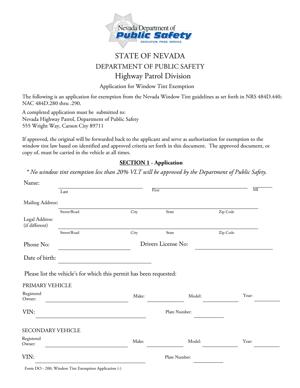
Form DO-200 – Window Tint Exemption Application
Fill out nowJurisdiction: Country: United States | Province or State: Nevada
The Form DO-200 – Window Tint Exemption Application is a document used in Nevada to request permission for darker vehicle window tint than normally allowed under state law. If you have a medical condition that makes you sensitive to sunlight, this form is how you formally ask for an exception.
Vehicle window tint laws set limits on how dark your windows can be. These limits are designed for safety and visibility. However, some drivers need additional protection from sunlight due to health concerns. This form creates a structured way to explain and document that need.
If you are preparing to complete the Form DO-200 – Window Tint Exemption Application, you are likely trying to understand what information is required and how the process works. The form is not complicated, but it must be filled out carefully and completely.
Submitting an incomplete or unclear document can delay your request. Understanding what the form does, who signs it, and how it is reviewed will help you approach the process with confidence.
What is Form DO-200 – Window Tint Exemption Application?
Clear definition
Form DO-200 – Window Tint Exemption Application is an official request form used to seek a medical exemption from Nevada’s standard window tint limits. It allows an individual to ask the Nevada Department of Public Safety to authorize darker tint on a specific vehicle.
This form connects three key pieces of information: the applicant, the vehicle, and the medical basis for the request. It documents the reason for the exemption and creates a written record for state review.
It is not a general request for preference or comfort. It is specifically tied to medical necessity. The approval, if granted, applies under defined conditions and may include restrictions.
Who typically uses this form?
Most applicants are drivers or vehicle owners who have a medical condition that increases sensitivity to sunlight or ultraviolet exposure. This may include skin disorders, autoimmune conditions, or other medically documented issues that require reduced sun exposure.
In many cases, a licensed medical professional must complete or certify part of the form. The applicant provides personal and vehicle information, while the medical provider confirms the diagnosis or need for additional protection.
Parents or legal guardians may use the form on behalf of a minor. In that case, the adult completes the identifying information and signs where required.
Fleet operators and businesses generally do not use this form for commercial purposes. It is typically reserved for personal medical situations.
Why might you need this form?
You may need this form if your medical condition makes standard window tint insufficient to protect you while driving. Without an approved exemption, installing darker tint than allowed can lead to citations or inspection issues.
The form creates a formal process to explain your condition and request lawful accommodation. It helps ensure that law enforcement officers can verify your exemption if questions arise about your window tint.
If you have already installed darker tint for medical reasons, this application may be necessary to bring your vehicle into compliance. It provides a pathway to align your vehicle setup with state requirements.
In some situations, your healthcare provider may suggest additional sun protection while driving. If that protection requires tint darker than standard limits, this document becomes relevant.
Typical real-life scenarios
- You have a diagnosed skin condition that worsens with sun exposure. Even short drives cause flare-ups. Your doctor recommends limiting ultraviolet light inside your vehicle. You apply for an exemption so you can legally use darker tint.
- You are undergoing medical treatment that increases light sensitivity. During treatment, you find that regular window tint does not provide enough comfort. You seek temporary or documented relief through an official request.
- Your child has a medical condition that requires minimizing sun exposure during transportation. As a parent, you complete the form to ensure the vehicle used for school and medical visits provides adequate protection.
- You were cited for window tint that exceeds standard limits. You believe your medical condition justifies the tint. You apply for an exemption to address the issue through proper documentation rather than continuing without approval.
- You are purchasing a new vehicle and know in advance that you will need additional tint due to a long-standing condition. You complete the application before installing darker film so the vehicle remains compliant from the start.
When would you use Form DO-200 – Window Tint Exemption Application?
You would use this form when your need for darker window tint is based on a medical reason rather than personal preference. The key factor is that the request relates to health and documented necessity.
Timing can vary. Some people complete the application before installing darker tint. Others apply after realizing that standard tint limits are not enough for their condition. The form can be part of proactive planning or a response to a specific issue.
The applicant is usually the registered owner of the vehicle. In some cases, the primary driver completes it if different from the owner. A medical provider plays an important role by verifying the condition and supporting the request.
You would not use this form to change general vehicle registration details, transfer ownership, or resolve traffic fines unrelated to tint. Its purpose is narrow and specific to medical tint exemptions.
If you drive more than one vehicle, you may need to consider how the exemption applies. Exemptions often relate to a specific vehicle identified by make, model, and vehicle identification number. Understanding that connection helps you prepare the correct information.
This form becomes relevant any time you want formal approval that can be shown during a traffic stop or inspection. It provides documented proof that your darker tint has been reviewed through the proper process.
Legal characteristics of Form DO-200 – Window Tint Exemption Application
This document functions as an official request submitted to a state agency. It becomes part of an administrative review process. The effectiveness of the form depends on accurate information, required signatures, and any supporting documentation.
For a submission to be considered valid, it typically must include complete identifying details, vehicle information, and medical certification where required. Missing signatures, illegible handwriting, or incomplete sections can result in rejection or delay.
Approval is not automatic. The reviewing authority evaluates whether the information meets the criteria for exemption. If the documentation does not clearly establish medical necessity, the request may be denied.
High-level differences may exist across jurisdictions. While many states offer some form of medical tint exemption, the limits, documentation standards, and duration of approval can vary. This form applies specifically within Nevada and reflects that state’s administrative process.
The form does not change traffic laws in general. It does not give unlimited permission to tint any vehicle at any level. It authorizes an exception within defined parameters. Those parameters may include specific windows, tint levels, or time limits.
It also does not serve as a substitute for proper vehicle equipment standards. Even with an exemption, other safety rules continue to apply.
Is it legally binding?
Form DO-200 – Window Tint Exemption Application itself is a request, not a contract. When you sign it, you are typically certifying that the information provided is true and accurate. That certification carries legal significance.
If the exemption is approved, the approval becomes an official authorization. Driving with darker tint under that authorization is recognized as permitted within the scope of the exemption.
Providing false or misleading information on the form can create legal consequences. The signature affirms that the statements are correct to the best of your knowledge. The medical provider’s certification also carries professional responsibility.
The form does not create a private agreement between you and another person. Instead, it operates within an administrative framework. Its legal effect depends on review and approval by the appropriate authority.
How to fill out Form DO-200 – Window Tint Exemption Application
Step 1 – Review the entire form before writing
Read through all sections from start to finish. Identify which parts you complete and which parts require a medical professional. This helps you gather all necessary information in advance.
Step 2 – Enter your personal identification information
Provide your full legal name as it appears on your driver’s license or identification card. Include your current address and contact details. Make sure the information is consistent with your vehicle registration records.
Step 3 – Provide vehicle details
Enter the make, model, year, and vehicle identification number of the vehicle for which you are requesting the exemption. Double-check the Vehicle Identification Number for accuracy. Errors in this section can delay processing.
Step 4 – Describe the medical basis as required
Complete any portion that asks you to identify the medical condition or reason for the request. Keep your responses clear and consistent with your medical documentation. Do not leave required fields blank.
Step 5 – Obtain medical certification
Have a licensed medical professional complete the required certification section. This often includes confirming the diagnosis and stating that reduced sunlight exposure is medically necessary. Ensure the provider signs and dates the form where indicated.
Step 6 – Review all signatures and dates
Confirm that you have signed and dated the application in the correct location. Check that the medical provider has also signed and included any required license information. Missing signatures are a common reason for delay.
Step 7 – Verify attachments and supporting documents
If the form requires additional documentation, such as medical statements or identification copies, confirm they are included. Keep copies of everything for your records before submission.
Step 8 – Submit the completed application
Send or deliver the completed Form DO-200 – Window Tint Exemption Application to the designated office as instructed on the form. After submission, monitor any communication regarding approval, additional information requests, or final determination.
Legal terms you might encounter in Form DO-200 – Window Tint Exemption Application
- Medical Necessity: This refers to a health condition that requires darker window tint than normally allowed by law. On this document, a licensed medical professional must confirm that your condition makes standard tint limits unsafe or harmful for you. The exemption depends on clearly stating this need.
- Licensed Medical Professional: This is the doctor or other authorized healthcare provider who certifies your condition. The form requires their printed name, license information, signature, and contact details. Incomplete provider information can delay approval.
- Vehicle Identification Number (VIN): The VIN is the unique 17-character number assigned to your vehicle. You must enter it exactly as it appears on your registration. Errors in the Vehicle Identification Number can tie the exemption to the wrong vehicle or cause rejection.
- Applicant: You are the applicant if you are requesting the exemption. Your legal name, address, and contact information must match your identification and vehicle records. If the vehicle is registered to someone else, you may need to clarify your relationship to the owner.
- Certification: Certification is the formal statement by the medical provider that your condition qualifies for an exemption. It is not just a note. It must be completed in the designated section of the form and signed.
- Affidavit: Some versions of this document may include language stating that you swear the information is true. This means you are making a statement under penalty of law. False information can lead to penalties or cancellation of the exemption.
- Exemption Permit: If approved, you may receive a permit or written confirmation. This document shows law enforcement that your vehicle is allowed to have darker tint due to medical reasons. You may need to keep it in the vehicle.
- Effective Date: This is the date the exemption becomes valid. It may be the approval date or another stated date. You should confirm this so you know when you are legally covered.
- Expiration Date: Some medical exemptions are valid only for a limited time. The expiration date tells you when you must renew or reapply. Driving with expired documentation can result in citations.
FAQs
Does this form allow me to tint all windows as dark as I want?
No. This document requests permission to exceed standard tint limits for medical reasons, but it does not automatically remove all restrictions. If approved, the exemption usually applies within specific boundaries. You should confirm exactly which windows are covered and whether there are still minimum visibility requirements.
What information must my doctor complete?
Your doctor must clearly describe the medical condition that supports the request. They must complete every required field in the medical certification section, including their license details and signature. If handwriting is unclear or required fields are blank, the application may be delayed or rejected.
Do I submit the Form DO-200 – Window Tint Exemption Application before or after installing darker tint?
You should wait for approval before installing tint that exceeds legal limits. Installing darker tint first can expose you to citations if the exemption is denied or delayed. Check the effective date on your approval so you know when you are legally protected.
What happens if the name on this document does not match my vehicle registration?
A mismatch can cause processing problems. The agency reviewing your application may question whether you are authorized to request the exemption. Make sure your legal name matches your driver’s license and the vehicle registration, or include documentation that explains the difference.
How will I know if my request is approved?
You should receive written confirmation, such as an approval letter or permit. Review the document carefully to confirm your name, vehicle details, and any conditions. Keep a copy in your vehicle in case you are asked to show proof during a traffic stop.
Does the exemption transfer if I sell my car?
No. The exemption is typically tied to a specific vehicle and the medical need of the applicant. If you change vehicles, you will likely need to complete a new Form DO-200 – Window Tint Exemption Application with updated vehicle information.
What if my medical condition improves or changes?
If your condition no longer requires darker tint, you may not qualify to keep the exemption. You should review the terms of your approval and confirm whether you must notify the agency. Continuing to use the exemption without a valid medical basis can create legal risk.
Can someone else submit this form for me?
Another person can help you complete or deliver this document, but you must sign where required. The medical provider must also personally complete and sign their section. Unsigned applications are generally not processed.
Checklist: Before, During, and After Form DO-200 – Window Tint Exemption Application
Before
- Confirm your vehicle is registered in your name or gather proof of your connection to the owner.
- Schedule an appointment with a licensed medical professional.
- Review the tint laws so you understand what the exemption changes.
- Locate your vehicle registration to copy the Vehicle Identification Number accurately.
- Bring photo identification to your medical appointment.
- Check whether the exemption is temporary or permanent.
- Gather any prior exemption paperwork if you are renewing.
During
- Print clearly in black or blue ink if completing by hand.
- Enter your full legal name exactly as shown on your identification.
- Double-check the Vehicle Identification Number character by character.
- Provide a current mailing address and phone number.
- Ensure the medical provider completes every required field.
- Verify that both you and the provider sign and date the form.
- Review the entire document once more before submission.
After
- Make a complete copy of the signed form for your records.
- Submit the application using the approved method.
- Track any confirmation number or receipt.
- Wait for written approval before installing noncompliant tint.
- Place the approval document in your vehicle once received.
- Note the effective and expiration dates in your calendar.
- Plan ahead for renewal if the exemption is temporary.
Common mistakes to avoid with Form DO-200 – Window Tint Exemption Application
- Mistake: Leaving sections blank because you think they do not apply, which often happens when instructions are skimmed, can result in rejection; do not forget to write “N/A” where appropriate if the form requires a response.
- Mistake: Entering the wrong VIN due to copying errors, which happens when you rely on memory instead of the registration, can tie the exemption to the wrong vehicle; do not forget to verify every character.
- Mistake: Submitting the form without a medical signature, which often occurs when you plan to “get it signed later,” will stop processing; do not forget that both signatures are required before submission.
- Mistake: Installing darker tint before approval because you assume medical need guarantees acceptance can lead to citations; do not forget to wait for written confirmation and check the effective date.
- Mistake: Forgetting to keep the approval document in the vehicle, which happens when paperwork is stored at home, can create problems during traffic stops; do not forget to carry proof with you.
- Mistake: Missing the expiration date because you did not calendar it, which is common with temporary medical conditions, can leave you driving with an invalid exemption; do not forget to track renewal deadlines.
- Mistake: Providing outdated contact information, which happens after a recent move, can prevent you from receiving approval notices; do not forget to update your address before submitting.
- Mistake: Assuming the exemption covers any future vehicle, which people often believe when they trade in cars, can leave your new vehicle unprotected; do not forget that a new application is usually required for each vehicle.
What to do after filling out Form DO-200 – Window Tint Exemption Application
Once you complete the form, slow down. Your next steps matter just as much as filling it out correctly.
- Step 1: Make a clear copy of the entire signed application, including the medical certification section.
- Step 2: Review all signatures and dates one more time to confirm nothing was missed.
- Step 3: Confirm you have attached any required supporting documentation.
- Step 4: Submit the application using the accepted delivery method, whether by mail or in person.
- Step 5: If you submit in person, ask for a receipt or confirmation that it was received.
- Step 6: If you mail it, consider using a method that provides proof of delivery.
- Step 7: Mark your calendar to follow up if you do not receive a response within a reasonable processing period.
- Step 8: Once approved, review the exemption document carefully for accuracy.
- Step 9: Place the approval letter or permit in your vehicle where you can access it during a traffic stop.
- Step 10: Record the effective and expiration dates in your personal records and set reminders for renewal if needed.
Keep your paperwork organized. Store your copy of the application and the approval document together with your vehicle records. If you move or change contact information, update your records promptly. If your medical condition changes, review whether you still qualify under the terms of your exemption.
Staying organized protects you. It helps you respond quickly if law enforcement asks for proof. It also makes renewal easier if the exemption has a time limit. A few careful steps now can prevent costly problems later.
Disclaimer: This guide is provided for informational purposes only and is not intended as legal advice. You should consult a legal professional.