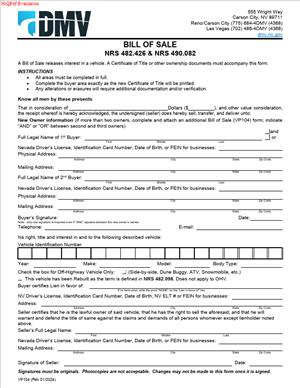
VP-104 – Bill of Sale
Fill out nowJurisdiction: Country: United States | Province or State: Nevada
The VP-104 – Bill of Sale is a written record of a vehicle transfer between a seller and a buyer in Nevada. It documents the details of the sale, including the vehicle information and the agreed purchase price.
If you are about to complete the VP-104 – Bill of Sale, you are likely buying or selling a motor vehicle in a private transaction. This form helps create a clear paper trail of what was sold, when it was sold, and for how much.
This document is commonly used when a vehicle is not sold through a dealership. It supports the transfer process by confirming the terms of the sale in writing.
Filling it out accurately matters. Errors or missing information can delay registration, create confusion about ownership, or cause issues with taxes and fees. Understanding what belongs on the form before you start makes the process smoother.
What is VP-104 – Bill of Sale?
Clear definition
The VP-104 – Bill of Sale is a Nevada Department of Motor Vehicles form used to record the sale or transfer of a motor vehicle. It serves as written evidence that ownership of the vehicle has changed from one person to another.
The form typically captures identifying details about the vehicle, the buyer, the seller, and the purchase price. It may also include the date of sale and signatures from the parties involved.
This document does not replace a vehicle title. Instead, it supports the title transfer process by documenting the transaction itself.
Who typically uses this form?
Private sellers use this form when selling a car, truck, motorcycle, or other motor vehicle directly to another person. Buyers use it to confirm the details of the purchase and to support registration and title transfer.
Individuals often use it when the sale does not involve a dealership. It may also be used in transfers between family members, friends, or acquaintances.
In some cases, a bill of sale is completed even when the vehicle is given as a gift. In that situation, the document records the transfer and the stated value, if any.
Why might you need this form?
You may need this form to document the exact date the vehicle changed hands. That date can be important for tax purposes, registration deadlines, and liability concerns.
The form also helps establish the agreed purchase price. This information may be relevant when calculating certain fees or taxes related to the transfer.
If there is ever a dispute about the terms of the sale, a completed bill of sale provides a written record of what both parties agreed to at the time of signing.
In situations where the title does not clearly show the transaction details, the bill of sale can help clarify the history of ownership transfer.
Typical real-life scenarios
- You are selling your used car to a neighbor. You agree on a price, exchange payment, and sign over the title. Completing the bill of sale creates a clear record of the deal and the exact date of transfer.
- You are buying a motorcycle from a private seller you found through a local listing. Before heading to the DMV to transfer the title, you complete the bill of sale to confirm the purchase price and vehicle details.
- You are transferring a vehicle to a family member. Even if no money changes hands, documenting the transfer in writing helps show when ownership changed and under what terms.
- You are purchasing a vehicle that is several years old. To avoid confusion later about the agreed price or the vehicle identification number, you complete the bill of sale carefully and keep a copy for your records.
When would you use VP-104 – Bill of Sale?
You would typically use this form at the time of a private vehicle sale. It is completed when the buyer and seller meet to finalize the transaction.
The form is often prepared on the same day the payment is made, and the title is signed. This keeps the documentation consistent and reduces the risk of conflicting dates.
If you are the seller, you may use the form to record the transfer immediately after receiving payment. This helps show the exact moment responsibility for the vehicle shifted.
If you are the buyer, you may use the form to support your application for title and registration. The information on the bill of sale can help confirm the purchase price and vehicle details during submission.
In some transfers, such as gifts or sales for a nominal amount, the bill of sale records the stated value and the relationship between the parties, if required by the form. This provides context for the transaction.
The form is also useful when there is no other written contract between the parties. In that case, it may be the primary written agreement documenting the sale.
Legal characteristics of VP-104 – Bill of Sale
The VP-104 – Bill of Sale functions as a written agreement between the buyer and seller. It identifies the parties, the vehicle, and the key terms of the transaction.
For the form to be effective, it generally needs complete and accurate information. This often includes the vehicle identification number, make, model, year, and the full legal names of both parties.
Signatures are a critical part of the document. Without the required signatures, the form may not serve its intended purpose as proof of the transaction.
Common problems include incomplete vehicle descriptions, mismatched names compared to the title, missing dates, or unclear purchase amounts. These issues can create delays when the buyer attempts to register or transfer the vehicle.
It is important to understand what this document does not do. It does not automatically transfer title by itself. The title document and other required filings are still part of the overall transfer process.
Requirements and practices may vary slightly depending on the specific circumstances of the transfer. For example, certain vehicles or special situations may involve additional documentation beyond the bill of sale.
Is it legally binding?
A bill of sale can be legally binding when it includes clear terms, accurate information, and the signatures of the parties involved. By signing, both parties confirm the details stated in the document.
The binding effect generally relates to the agreement between the buyer and seller. It reflects the agreed price and the transfer of ownership interest in the vehicle.
However, the document’s effectiveness depends on proper completion. If key details are missing or incorrect, it may weaken the document’s reliability as evidence of the transaction.
While the bill of sale can serve as proof of the agreement, it does not override other required steps in the vehicle transfer process. Title transfer, registration, and any required submissions must still be completed separately.
How to fill out VP-104 – Bill of Sale
Step 1 – Identify the vehicle
Begin by entering the full details of the vehicle. This typically includes the year, make, model, and vehicle identification number. Check the VIN carefully against the vehicle and the title to avoid errors. Even a single incorrect character can cause problems later.
Step 2 – Enter the seller’s information
Provide the seller’s full legal name as it appears on the title. Include the current address and any other identifying information requested on the form. The information should match the title record to reduce confusion during processing.
Step 3 – Enter the buyer’s information
Write the buyer’s full legal name and address clearly. This should reflect the person who will be taking ownership and registering the vehicle. Make sure the spelling is accurate and consistent with identification documents.
Step 4 – State the purchase price
Record the agreed purchase price in the space provided. If the vehicle is being given as a gift or transferred without payment, enter the appropriate value as indicated on the form. Do not leave this section blank unless the form specifically allows it.
Step 5 – Enter the date of sale
Write the exact date the transaction takes place. This is usually the date when payment is made, and the vehicle changes possession. The date should be consistent with any related title signatures.
Step 6 – Review all information for accuracy
Before signing, read through the entire form carefully. Confirm that names, addresses, VIN, and the purchase price are correct. Corrections made after signing can create questions or require a new form.
Step 7 – Sign the form
Have the seller sign in the designated signature area. If the form requires the buyer’s signature as well, ensure the buyer signs in the correct space. Signatures confirm that both parties agree with the information recorded.
Step 8 – Make copies for your records
After signing, create a copy for both the buyer and the seller. Each party should keep a copy as part of their personal records. This copy can be useful if questions arise about the transaction or the date of transfer.
Legal terms you might encounter in VP-104 – Bill of Sale
- Vehicle Identification Number (VIN): This is the unique 17-character code assigned to a specific vehicle. On this form, you must enter the VIN exactly as it appears on the vehicle and the title. One incorrect character can cause processing delays or rejection.
- Odometer Reading: This is the vehicle’s mileage at the time of sale. You record the exact number shown on the dashboard. It documents the vehicle’s usage and may be reviewed for accuracy during title transfer.
- Seller (Transferor): The person or entity transferring ownership of the vehicle. The seller must provide their legal name as it appears on the current title. If multiple owners are listed, each required owner must sign.
- Buyer (Transferee): The person or entity receiving ownership. The buyer’s full legal name and address must match the information that will appear on the new title application. Inconsistent spelling can slow down the transfer.
- Purchase Price: The amount the buyer agrees to pay for the vehicle. You must write the full amount in dollars. This figure may be used to calculate taxes and fees during registration.
- Date of Sale: The calendar date when ownership changes hands. This date is important for determining responsibility for the vehicle, including liability and registration deadlines. Enter the full month, day, and year.
- Signature: The handwritten or legally recognized signature of the seller (and buyer, if required). A signature confirms that the information provided is true and that the seller intends to transfer ownership. Missing signatures can invalidate the document.
- Lienholder: A person or company with a financial interest in the vehicle, usually because of a loan. If a lien exists, it may need to be released before ownership can transfer. Check the title for any listed lienholder.
- As-Is Sale: A term that means the vehicle is sold in its current condition, with no guarantees about performance or defects unless stated otherwise. If the sale is “as-is,” this should be clearly understood by both parties before signing.
- Notarization: The process of having a notary public witness the signing of a document. Some transactions may require notarization to confirm identity and authenticity. If notarization is needed, do not sign until you are in front of the notary.
FAQs
Do I need to use the official VP-104 – Bill of Sale form, or can I write my own?
You should use the official form to avoid missing required information. This document is structured to capture the vehicle description, VIN, purchase price, and signatures in a format that can be processed smoothly. A handwritten bill of sale may leave out key details, which can delay the title transfer.
What information must exactly match the vehicle title?
The seller’s name, the VIN, and the vehicle description should match the current title exactly. Check spelling, middle initials, and number sequences. Even small differences can create issues when the ownership transfer is reviewed.
What if there are two sellers listed on the title?
Look at how the names are connected on the title. If both owners are required to sign, each must sign this form. Do not assume one signature is enough. If one signature is missing, the transfer may not be accepted.
Do both the buyer and seller need to sign this document?
The seller’s signature is essential because it confirms the transfer of ownership. The buyer’s signature may also be requested to confirm the agreed purchase price and date. Review the signature areas carefully and make sure all required parties sign in the correct place.
How do I enter the purchase price if the vehicle was a gift?
If no money was exchanged, you still need to clearly state that the vehicle was a gift and enter the amount as zero if the form requires a dollar figure. Be accurate. This entry affects how the transaction is recorded and may affect tax assessment.
What date should I use as the date of sale?
Use the actual date when ownership changed hands, and the vehicle was delivered. Do not backdate or postdate the document. The date you enter on this form establishes when responsibility for the vehicle shifts from seller to buyer.
What if I notice a mistake after signing?
Do not use correction fluid or scratch out information. If the error is significant, it is usually safer to complete a new form with correct details. Make sure all parties sign the corrected version. Keep the voided copy for your records.
Is notarization required for this form?
Review the signature section carefully. If a notary block appears, you must sign in front of a notary. If there is no notary section, notarization may not be required. Do not assume. Confirm by checking the instructions associated with this document.
Checklist: Before, During, and After VP-104 – Bill of Sale
Before
- Review the current vehicle title for correct owner names and any lienholders.
- Confirm the VIN on the vehicle matches the VIN on the title.
- Agree in writing on the exact purchase price and payment method.
- Check the odometer reading and verify it is accurate.
- Gather valid identification for both buyer and seller.
- Confirm whether notarization will be required.
- Make sure all owners listed on the title are available to sign.
- Prepare a pen with dark ink for clear signatures.
During
- Write the VIN carefully, checking each character.
- Enter the full legal names of buyer and seller as shown on official documents.
- Record the exact purchase price in dollars.
- Enter the complete date of sale (month, day, year).
- Fill in the odometer reading without rounding.
- Review every line before anyone signs.
- Ensure all required sellers sign in the designated spaces.
- Sign only after all information is complete and accurate.
After
- Make at least one copy for the buyer and one for the seller.
- Attach the bill of sale to the title transfer paperwork.
- Submit the required documents to the appropriate motor vehicle office.
- Keep proof of submission or receipt confirmation.
- Store your copy in a safe place with other vehicle records.
- Confirm that the title transfer has been processed.
- Remove license plates if required and handle them properly.
- Update your personal records to reflect the sale or purchase.
Common mistakes to avoid with VP-104 – Bill of Sale
- Mistake: Writing the VIN from memory instead of copying it directly from the vehicle and title, which happens when you rush and leads to processing delays or rejection; do not forget to double-check each character before signing.
- Mistake: Using nicknames or shortened names for the buyer or seller because it feels informal, which can cause mismatches with the title and create transfer problems; do not forget to use full legal names exactly as shown.
- Mistake: Leaving the purchase price blank due to uncertainty about taxes, which can result in incomplete documentation and delays; do not forget to clearly state the agreed amount or indicate if it was a gift.
- Mistake: Forgetting one required seller’s signature when multiple owners are listed, often because you assume one signature is enough, which can invalidate the transfer; do not forget to check the title for all required signers.
- Mistake: Entering the wrong date of sale because you complete the form days later, which can affect responsibility and deadlines; do not forget to record the actual transfer date.
- Mistake: Making handwritten corrections without re-signing, which can raise questions about authenticity; do not forget that major errors are best fixed by completing a new, clean form.
What to do after filling out VP-104 – Bill of Sale
Once you complete the form, your job is not finished. You need to make sure the ownership transfer process moves forward smoothly and that you protect your own records.
Start by reviewing the document one more time. Confirm the VIN, names, date of sale, and purchase price are correct. Make sure all required signatures are present. If anything looks unclear, resolve it immediately while both parties are available.
- Step 1: Make clear, legible copies for both the buyer and the seller.
- Step 2: Attach the bill of sale to the vehicle title and any required transfer application.
- Step 3: Submit the title and supporting documents to the appropriate motor vehicle office.
- Step 4: Pay any required fees and obtain a receipt or confirmation.
- Step 5: Confirm that the title transfer has been accepted and processed.
- Step 6: If you are the seller, remove and handle license plates as required.
- Step 7: If you are the buyer, complete registration and obtain new plates or validation as needed.
- Step 8: Store your copy of the bill of sale with other important vehicle records.
- Step 9: Update your insurance coverage to reflect the sale or purchase.
- Step 10: Keep proof of the transaction date in case questions arise later.
If you are the seller, keep your copy even after the transfer is complete. It serves as proof that you no longer own the vehicle as of the date listed. This can be important if you receive future notices related to the vehicle.
If you are the buyer, keep your copy with your title and registration documents. It supports the purchase details and can help resolve questions about price or date of transfer.
Taking these follow-up steps ensures the transaction is properly documented, recorded, and finalized. A carefully completed and properly submitted bill of sale protects both parties and helps prevent avoidable disputes.
Disclaimer: This guide is provided for informational purposes only and is not intended as legal advice. You should consult a legal professional.