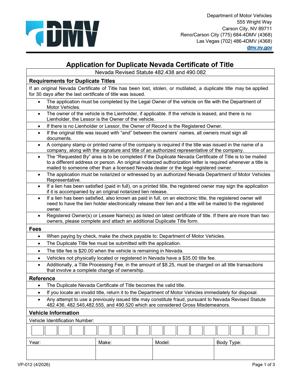
VP-012 – Application for Duplicate Nevada Certificate of Title
Fill out nowJurisdiction: Country: United States | Province or State: Nevada
If your Nevada vehicle title is lost, stolen, or damaged, the VP-012 – Application for Duplicate Nevada Certificate of Title is the document you use to request a replacement. This form allows the Nevada Department of Motor Vehicles to issue a new certificate of title that reflects the current ownership record.
A vehicle title is the legal document that proves ownership. Without it, you may have trouble selling your vehicle, transferring it to someone else, or using it as collateral for a loan. The duplicate title replaces the original and carries the same ownership information on record.
This form is designed for vehicle owners whose original Nevada title is no longer available. It is also used when the title has been mutilated or is otherwise unreadable. The process centers on confirming your identity and matching it to the vehicle record on file.
Understanding what this document does helps you avoid delays. Small mistakes in names, vehicle identification numbers, or signatures can lead to rejection. Knowing what information is required before you begin makes the completion and submission smoother.
What is VP-012 – Application for Duplicate Nevada Certificate of Title?
Clear definition
The VP-012 – Application for Duplicate Nevada Certificate of Title is an official request for a replacement Nevada vehicle title. It tells the state that the original certificate of title is no longer available and asks for a duplicate to be issued.
The form connects three key pieces of information: the vehicle, the registered owner or owners, and the existing title record. By signing it, you confirm that the information you provide is accurate and that you are entitled to request the duplicate.
The duplicate title that results from this filing replaces the prior document in the state’s records. If the original is later found, it is typically no longer valid for transfer purposes.
Who typically uses this form?
Most often, the registered owner of a vehicle completes this form. That includes individuals who own a car, truck, motorcycle, or other titled vehicle in Nevada.
Co-owners listed on the original title may also be involved. If two or more people are named on the title, their signatures may be required depending on how ownership is recorded.
Lenders or lienholders may interact with the process if there is an active lien on the vehicle. In some situations, a lienholder may request or control the title document until the loan is paid off.
Businesses that own fleet vehicles can also use this form. In those cases, an authorized representative typically signs on behalf of the company.
Why might you need this form?
You may need this form if your title was lost during a move. Paper titles are often stored with other important documents, and they can be misplaced without notice.
You might also use it if your title was stolen. A missing title can create risk if someone tries to use it improperly, so replacing it ensures the state record reflects a current, valid document.
Another common reason is damage. If the title was exposed to water, fire, or tearing, and key information is no longer readable, a duplicate may be required before a transfer can occur.
You may also need a duplicate before selling your vehicle. Buyers typically require a valid, original title to complete a transfer. If you cannot locate yours, you must first obtain a replacement.
Typical real-life scenarios
- You decide to sell your car to a private buyer and cannot find the title in your records. The buyer is ready to pay, but the transfer cannot proceed without a valid title. In that case, you would complete this form to obtain a duplicate before finalizing the sale.
- You finish paying off an auto loan and expect to receive your title. After some time, you realize it was mailed but never reached you. To move forward with a future sale or transfer, you would request a duplicate title.
- Your vehicle title was stored in the glove compartment and was damaged in a flood. The document is no longer legible. Before you can transfer ownership, you must replace it using the proper filing.
- You are gifting your vehicle to a family member. While preparing the paperwork, you discover the title is missing. Applying for a duplicate allows you to complete the ownership transfer correctly.
- You operate a small business and maintain several service vehicles. During an internal audit, you notice one title is missing from your files. To maintain complete records, you file for a duplicate.
When would you use VP-012 – Application for Duplicate Nevada Certificate of Title?
You would use this form any time the original Nevada certificate of title cannot be presented, but ownership needs to be proven or transferred. The key factor is that the vehicle is already titled in Nevada, and the state has an existing ownership record.
If you are planning to sell, donate, or transfer your vehicle, having a valid title is typically necessary. Without it, most transactions cannot move forward. Filing for a duplicate becomes part of the preparation process.
You might also use the form when updating your records. For example, if the title in your possession is so damaged that it may not be accepted during a future transaction, replacing it early can prevent last-minute complications.
In situations involving inheritance, the personal representative of an estate may encounter a missing title. The duplicate application can become part of the broader estate administration process, along with other required documents.
The form is not used to change ownership by itself. Instead, it restores the document that proves current ownership. Any transfer or reassignment is handled through separate filings.
Legal characteristics of VP-012 – Application for Duplicate Nevada Certificate of Title
This document functions as a formal request to the state. Its effectiveness depends on accurate information and proper completion. The state compares the details on the form with its existing records before issuing a duplicate.
Key elements typically include the vehicle identification number, the year, make, and model, and the full legal names of the owner or owners as they appear in state records. Even small differences in spelling or order of names can create delays.
Signatures are critical. If the title record shows multiple owners joined by specific language, the required parties generally need to sign the application. Missing signatures are a common reason for rejection.
If there is an active lien on the vehicle, additional steps may be involved. The presence of a lien can affect who receives the duplicate title and how it is processed. The form itself does not remove or change a lien.
Different states have their own procedures for duplicate titles. This form applies to vehicles titled in Nevada. If your vehicle was last titled in another state, you may need to follow that state’s process instead.
The form does not change ownership. It does not correct major errors in the original title record by itself. It does not transfer the vehicle to another person. It strictly requests a replacement of the existing certificate.
Providing false information on the form can have serious consequences. Because it affects legal ownership records, accuracy and honesty are essential in every section.
Is it legally binding?
Yes, in the sense that it is an official sworn request to the state. When you sign the application, you are confirming that the statements made in the document are true to the best of your knowledge.
Your signature ties you to the information provided. If the state relies on that information to issue a duplicate title, the document becomes part of the official motor vehicle record.
However, the form does not create a new ownership agreement between private parties. It does not function like a bill of sale or transfer document. Its binding effect relates to the accuracy of your representations and the state’s authority to issue a replacement title.
How to fill out VP-012 – Application for Duplicate Nevada Certificate of Title
Step 1 – Enter the vehicle information
Begin by carefully entering the vehicle identification number. This number must match the state’s record exactly. Then provide the year, make, and model as requested. Double-check each character of the VIN to avoid processing delays.
Step 2 – Provide the owner’s legal name and address
Write your full legal name as it appears on the original title record. Include any middle names or initials if they are part of the official record. Enter your current mailing address clearly and completely so the duplicate title can be delivered properly.
If there are multiple owners listed on the original title, include each name as shown in the record. The order of names can matter, so copy it carefully.
Step 3 – Indicate the reason for requesting a duplicate
Select or state the reason the original title is unavailable. Common reasons include lost, stolen, or mutilated. If the title is damaged but still in your possession, follow any instructions about submitting it along with the application.
Be accurate about the reason. The explanation helps clarify the status of the prior document in the state’s records.
Step 4 – Address lienholder information if applicable
Review whether a lien is recorded on the vehicle. If a lender has a security interest, provide the requested lienholder details as shown in the record. Make sure the information aligns with the existing title data.
If the loan has been satisfied but the lien is still on record, additional documentation may be required before a clear duplicate title can be issued.
Step 5 – Review all information for accuracy
Pause before signing and compare each entry with your vehicle registration and any prior title documents you have. Confirm that names, numbers, and addresses are consistent. Correct errors neatly if the form allows, or start over if necessary.
Careful review at this stage reduces the chance that your submission will be returned for corrections.
Step 6 – Sign and date the application
Sign your name exactly as it appears in the owner section. If more than one owner is required to sign, ensure each person signs in the appropriate space. Add the date of signing where indicated.
Your signature confirms that the statements in the application are true and complete.
Step 7 – Prepare the form for submission
Make sure all required fields are filled in and that any additional documents, such as a damaged title if applicable, are included. Keep a copy of the completed form for your records before submitting the original according to the instructions provided with the document.
Legal terms you might encounter in VP-012 – Application for Duplicate Nevada Certificate of Title
- Certificate of Title: This is the official document that proves legal ownership of a vehicle. When you apply for a duplicate, you are asking the state to issue a replacement of that ownership record. The duplicate carries the same legal weight as the original.
- Registered Owner: This is the person or business listed in the state’s records as owning the vehicle. The name you enter on the application must match how the owner appears in the vehicle record. If there is more than one registered owner, each may need to be identified and may need to sign.
- Lienholder: A lienholder is a lender or other party with a legal claim against the vehicle, usually because of a loan. If a lien is still active, the duplicate title may be sent directly to the lienholder rather than to you. You must list lienholder details accurately to avoid delays.
- Vehicle Identification Number (VIN): The VIN is the unique 17-character code assigned to your vehicle. It identifies the exact vehicle in the state database. Entering the Vehicle Identification Number correctly is critical because even one incorrect character can prevent the duplicate from being issued.
- Odometer Reading: This is the mileage shown on your vehicle’s dashboard at the time you complete the form. In some situations, you may need to report the current reading. Accurate mileage reporting helps maintain a clear ownership and vehicle history record.
- Joint Tenancy: This term describes a type of co-ownership where two or more people own the vehicle together with specific survivorship rights. If your title was issued in joint tenancy, ownership may pass automatically to the surviving owner. The way names are connected on the record affects who must sign the duplicate request.
- Power of Attorney: This is a written authorization allowing someone else to act on your behalf. If another person signs the duplicate title application for you, they must have proper authority. The document granting that authority may need to be presented with the application.
- Legal Name: Your legal name is the name that appears on your identification and on the state’s vehicle record. It must match the existing ownership record. If your name has changed, you may need to update the ownership record before or at the same time as requesting a duplicate.
- Mailing Address: This is the address where the duplicate title will be sent, unless a lienholder is listed. Make sure it is complete and current. An incorrect address can cause significant delays and require another application.
- Release of Lien: This is a formal statement from a lienholder confirming that a loan has been paid off and the lien is removed. If your record still shows a lien that has already been satisfied, you may need proof of release before a clear duplicate title can be issued to you.
FAQs
What if I lost my original title but later find it after submitting this form?
Once a duplicate is issued, it generally replaces the original in the state record. If you later find the old title, you should treat it as void and not use it for any transfer or sale. Only the most recently issued title reflects the active record.
Can I request a duplicate if there is still a lien on my vehicle?
Yes, but you must list the lienholder information exactly as it appears in the vehicle record. If the lien is active, the duplicate title may be mailed directly to the lienholder instead of to you. Check your loan status before completing this document so you know what to expect.
Do all owners have to sign the VP-012 – Application for Duplicate Nevada Certificate of Title?
If the vehicle is titled in more than one name, the way those names are connected on the record matters. If the record requires joint action, each owner must sign this form. Review how the names appear on your registration or prior title and make sure every required signature is included.
What happens if my name has changed since the original title was issued?
Your name on this form must match the state’s current vehicle record. If your legal name has changed due to marriage, divorce, or court order, you may need to update the ownership record first. Make sure the identification you use and the name you enter are consistent.
How do I know if my application has been accepted?
Acceptance usually depends on whether the information matches the state’s vehicle database. If key details like the Vehicle Identification Number, owner name, or lienholder do not match, processing can stop. You can confirm receipt and status through the filing method you choose, and you should keep proof of submission.
Will the duplicate title show that it is a replacement?
A duplicate title is typically marked in the state record as a reissued document. This does not change your ownership rights. It simply shows that the previous certificate was replaced, which helps prevent fraud and confusion.
Can someone else sign and submit this form for me?
Yes, but only if they have proper authority, such as a valid power of attorney. The person signing must clearly indicate their representative capacity. Make sure any supporting authorization is complete and matches the owner information in this document.
What if I made a mistake on the VP-012 – Application for Duplicate Nevada Certificate of Title after signing it?
If you notice an error before submission, complete a new form to avoid rejection. If the mistake is discovered after submission, you may need to submit a corrected application. Small errors, especially in the VIN or owner name, can prevent processing, so review carefully before signing.
Checklist: Before, During, and After VP-012 – Application for Duplicate Nevada Certificate of Title
Before
- Confirm that the original title is lost, stolen, or destroyed and cannot be located.
- Gather your vehicle information, including the full Vehicle Identification Number and current license plate number.
- Verify how the owner name appears on your vehicle registration.
- Check whether a lien is still active on the vehicle.
- Locate identification that matches the name on the vehicle record.
- Confirm your current mailing address for receiving the duplicate.
- Determine whether all co-owners are available to sign.
- Gather any supporting documents, such as lien releases or power of attorney.
During
- Print clearly and use consistent information throughout the form.
- Enter the Vehicle Identification Number carefully, checking each character twice.
- Write the owner’s name exactly as it appears in the state record.
- Provide complete lienholder details if applicable.
- Review the mailing address for accuracy, including apartment or unit numbers.
- Ensure all required owners sign in the correct places.
- Date the application accurately.
- Double-check every field before finalizing.
After
- Make a complete copy of the signed form for your records.
- Attach any required supporting documents.
- Prepare payment in the correct amount and form.
- Submit the application using an approved filing method.
- Keep proof of submission or mailing.
- Monitor your mail for the duplicate title or correspondence.
- Respond promptly if you are contacted about missing information.
- Store the new title in a secure location once received.
Common mistakes to avoid with VP-012 – Application for Duplicate Nevada Certificate of Title
- Mistake: Entering the wrong Vehicle Identification Number because you copied it from memory, which leads to rejection or delays; always verify it directly from the vehicle or official registration and do not forget to check every character.
- Mistake: Using a nickname or shortened name instead of the full legal name on record, which causes a mismatch in the database; always match the exact name shown in the vehicle record and do not forget middle initials if listed.
- Mistake: Forgetting to include lienholder information because you believe the loan is paid off, which can result in the duplicate being issued incorrectly or not at all; always confirm lien status and do not forget to attach proof of release if needed.
- Mistake: Missing a required co-owner signature because you assume one signature is enough, which can invalidate the application; always review how ownership is listed and do not forget that some ownership types require all signatures.
- Mistake: Providing an outdated mailing address because you recently moved, which can cause the duplicate title to be sent to the wrong place; always confirm your current address and do not forget unit or suite numbers.
- Mistake: Submitting a form with corrections or white-out, which can raise processing issues; always complete a clean new copy if you make an error and do not forget to destroy incorrect drafts.
- Mistake: Failing to keep a copy of the completed application, which leaves you without proof of what was submitted; always make and store a full copy and do not forget to keep any submission receipt.
What to do after filling out VP-012 – Application for Duplicate Nevada Certificate of Title
After you complete the form, pause and review it one more time. Look at it as if you were the clerk processing it. Confirm that every required field is filled in and that the handwriting is legible. Make sure all signatures are present and dated.
- Step 1: Make a clear copy or scan of the fully signed application for your personal records.
- Step 2: Attach any supporting documents, such as a lien release or power of attorney, if applicable.
- Step 3: Prepare the required fee in the accepted payment method.
- Step 4: Choose your submission method, such as mailing or delivering it in person, based on what is available to you.
- Step 5: If mailing, use the correct address and consider a mailing option that provides confirmation of delivery.
- Step 6: If submitting in person, bring identification that matches the name on the application.
- Step 7: Keep any receipt, confirmation number, or proof of submission you receive.
- Step 8: Monitor your mail for the duplicate title or any notice requesting additional information.
- Step 9: If you receive a request for clarification or correction, respond promptly with the exact information requested.
- Step 10: Once you receive the duplicate title, review it immediately to confirm all information is correct.
- Step 11: Store the duplicate title in a secure place, such as a safe or locked file, to prevent future loss.
- Step 12: Update your personal records to reflect that a duplicate was issued and note the date for your reference.
Handling the process carefully reduces the risk of delays. A duplicate title is an important ownership document. Treat it with the same care as the original.
Disclaimer: This guide is provided for informational purposes only and is not intended as legal advice. You should consult a legal professional.