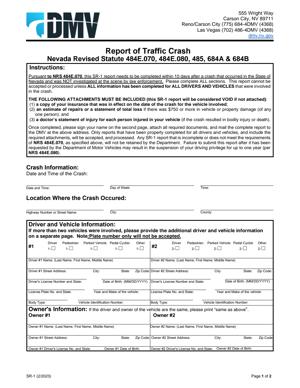
SR-001 – Report of Traffic Crash
Fill out nowJurisdiction: Country: United States | Province or State: Nevada
The SR-001 – Report of Traffic Crash is a formal document used to report details of a motor vehicle accident. In Nevada, this form is connected to the state’s motor vehicle administration process and is typically submitted to the appropriate state agency after a crash.
If you are about to complete the SR-001 – Report of Traffic Crash, you are likely dealing with the aftermath of an accident. You may be sorting out insurance claims, vehicle damage, injuries, or questions about liability. This form gathers key facts about what happened.
The document focuses on facts. It asks for information about the drivers, vehicles, location, time, and circumstances of the crash. It may also require details about injuries and property damage.
Completing this form accurately matters. Errors or missing information can delay processing or create confusion about the event. Understanding each section before you begin makes the process more manageable and reduces stress.
What is SR-001 – Report of Traffic Crash?
Clear definition
The SR-001 – Report of Traffic Crash is a state form used to document the details of a traffic collision. It serves as an official written account of what occurred during a motor vehicle accident within Nevada.
The form collects identifying information about the parties involved. It also records vehicle data, insurance details, and a description of how the crash happened. In many cases, it supplements or mirrors information found in a police report, but it may also be used when law enforcement did not prepare a full report.
This document becomes part of an administrative record. State agencies use it to track accidents, confirm compliance with reporting requirements, and review insurance information.
Who typically uses this form?
Drivers involved in a crash are the most common users of this form. If you were operating a vehicle at the time of the accident, you may be responsible for completing and submitting it.
Vehicle owners may also complete the form if they were not driving but their vehicle was involved. In some situations, a legal guardian, parent, or representative fills it out on behalf of a minor or an incapacitated person.
Insurance companies may reference the information contained in the filing. However, the form itself is typically completed and signed by an individual involved in the accident, not by the insurer.
Why might you need this form?
You may need this form to comply with state reporting requirements after a crash. Certain accidents trigger mandatory reporting, especially when there is injury, death, or damage above a specific amount.
The form also creates a formal record of your version of events. This can be important when insurance claims are being processed or when questions arise later about what happened.
In some cases, the document is required even if a police officer came to the scene. In other cases, it may be required because law enforcement did not investigate the accident in person.
Filing the report helps ensure that the state has accurate information about vehicles and drivers involved in the collision. It can also confirm that required insurance coverage was in place at the time of the crash.
Typical real-life scenarios
- You are involved in a two-car collision at an intersection. There are no serious injuries, but both vehicles have visible damage. Police do not file a detailed report. You may need to complete this form to document the event officially.
- You rear-end another vehicle during heavy traffic. The other driver later claims injury. Even if the scene seemed minor, reporting the crash through the appropriate document can become important once injuries are alleged.
- Your parked car is struck by another driver who leaves contact information, but no officer responds. You still need a structured way to report the property damage and identify the other party.
- You are involved in a crash during a rideshare shift or while driving a company vehicle. Even though insurance may be handled through another party, you may still be required to complete the state’s accident reporting form in your individual capacity.
When would you use SR-001 – Report of Traffic Crash?
You would use this form after a motor vehicle accident that meets reporting criteria set by Nevada authorities. This often depends on the level of damage, whether anyone was injured, or whether there was a fatality.
The timing of the submission is important. Many accident reporting systems require filing within a specific period after the crash. The clock usually starts on the date of the incident, not when insurance discussions begin.
Drivers most commonly complete the form shortly after the accident, once they have gathered all necessary details. This includes driver’s license numbers, vehicle identification numbers, license plate numbers, and insurance policy information.
If you discover injuries days later, you may still need to report the accident if it meets reporting thresholds. The obligation to file is typically based on the nature and consequences of the crash, not just what was obvious at the scene.
In multi-vehicle accidents, each driver may be responsible for submitting their own report. The form captures each person’s account, which may differ from others involved.
You might also use this document when requested by a state agency as part of a review of your driving record. In some situations, failure to report a qualifying accident can affect driving privileges or vehicle registration status.
Legal characteristics of SR-001 – Report of Traffic Crash
This form functions as an official statement to a government agency. Its effectiveness depends on accuracy, completeness, and proper submission.
To be valid, the document must typically include all required identifying information. Missing signatures, incomplete vehicle details, or unclear descriptions can delay processing or lead to follow-up requests.
The information provided is generally treated as a factual declaration. Intentionally false statements on government forms can create serious consequences. Accuracy matters not just for administrative purposes, but also for insurance and liability issues.
Different states have different reporting thresholds and procedures. While the general concept of an accident report is common across the United States, deadlines and requirements vary. The Nevada version is specific to its own motor vehicle administration system.
This document does not determine fault by itself. It records information. Insurance companies, courts, or administrative agencies may later review the facts when making decisions, but the form itself is primarily a reporting tool.
It also does not replace an insurance claim. Filing the document with the state does not automatically notify your insurer or initiate payment for damages. Those processes usually require separate steps.
Common problems that lead to rejection or complications include illegible handwriting, inconsistent dates, incorrect policy numbers, and unsigned declarations. In some cases, submitting the wrong version of the form can also cause delay.
Is it legally binding?
The form is legally significant because it is an official submission to a government agency. When you sign it, you are affirming that the information provided is true to the best of your knowledge.
It is not a contract between you and another driver. You are not agreeing to accept fault or to waive any rights simply by completing it. Instead, you are fulfilling a reporting requirement.
However, the statements you make can be referenced later. If there are disputes about how the accident occurred, the information you provided may be compared to other evidence, such as witness statements or police reports.
In that sense, the form carries legal weight as a record. It does not create liability on its own, but it can influence how facts are viewed in future proceedings or insurance evaluations.
How to fill out SR-001 – Report of Traffic Crash
Step 1 – Identify the accident details
Begin by entering the date, time, and exact location of the crash. Be precise. Include street names, intersections, city, and any nearby landmarks if requested. If the form asks for weather or road conditions, describe them clearly and factually.
Step 2 – Provide your personal information
Fill in your full legal name, current address, date of birth, and driver’s license number. Make sure the information matches your official identification. If you were not the driver but are completing the form as the vehicle owner, indicate your role as requested.
Step 3 – Enter vehicle information
List the make, model, year, color, and license plate number of your vehicle. Include the vehicle identification number if the form requires it. Double-check these details against your registration to avoid mistakes.
Step 4 – Add insurance information
Provide the name of your insurance company, your policy number, and the policy’s effective dates if requested. Confirm that the information reflects the coverage in place on the date of the accident. Inaccurate policy numbers are a common source of delay.
Step 5 – Identify other parties involved
Enter the names, addresses, driver’s license numbers, and vehicle details for the other driver or drivers. Use information exchanged at the scene. If some details are unknown, complete as much as you can based on what was available at the time.
Step 6 – Describe injuries and property damage
Indicate whether anyone was injured or killed. If the form asks for the nature of injuries, provide a brief and factual description. Also estimate the visible property damage to all vehicles and any other property involved, such as fences or signs.
Step 7 – Explain how the crash occurred
Write a clear narrative of what happened. Keep your description chronological. Start with where you were and what you were doing just before the impact. Describe the movements of each vehicle and the point of collision. Avoid speculation and focus on observable facts.
Step 8 – Include diagrams if required
Some versions of the form request a sketch of the accident. Draw the roadway layout, vehicle positions, direction of travel, and point of impact. Label streets and indicate traffic signals or stop signs if relevant. Keep the diagram simple but accurate.
Step 9 – Review the entire form
Before signing, read every section carefully. Confirm that names are spelled correctly, numbers are accurate, and dates match the actual event. Make sure all required fields are completed. Correct any unclear handwriting if necessary.
Step 10 – Sign and date the form
Sign your name where indicated and enter the date of signing. Your signature confirms that the information is true to the best of your knowledge. Once signed, prepare the document for submission according to the instructions provided with the form.
Legal terms you might encounter in SR-001 – Report of Traffic Crash
- Reporting Threshold: This is the minimum level of injury or property damage that triggers your duty to file this form. The document may ask whether damage exceeds a specific dollar amount or whether anyone was injured. You must answer carefully because it determines whether filing is required.
- Driver: The person operating the vehicle at the time of the crash. This form separates the driver from the vehicle owner. If you were driving someone else’s car, you are still listed as the driver.
- Registered Owner: The individual or business listed on the vehicle registration. The form may require both the driver’s and the owner’s information. If they are different people, you must complete both sections.
- Liability Insurance: The insurance coverage that pays for injuries or damage you cause to others. You will be asked to provide the insurer’s name, policy number, and effective dates. This information confirms whether coverage was active on the crash date.
- Bodily Injury: Physical harm to a person resulting from the crash. The form typically asks you to identify whether anyone was injured and to describe the severity. Even minor injuries should be noted if known.
- Property Damage: Damage to vehicles, buildings, fences, signs, or other objects. The form may require an estimated dollar amount. Use your best reasonable estimate if exact figures are not yet available.
- Contributing Factors: Conditions or behaviors that may have played a role in the crash. This can include weather, road conditions, speed, distraction, or mechanical failure. The form may provide checkboxes or space for explanation.
- Diagram: A visual sketch of how the crash occurred. You may be required to show vehicle positions, direction of travel, traffic controls, and points of impact. The diagram supports your written description.
- Hit-and-Run: A situation where a driver leaves the scene without providing required information. The form may ask you to indicate whether another party fled. If so, include any identifying details you have.
- Certification: The statement near the end of the form where you confirm that the information is true and correct. By signing, you attest that the details are accurate to the best of your knowledge.
FAQs
Do I have to file SR-001 – Report of Traffic Crash if the police already came to the scene?
Yes, you may still need to file this document even if law enforcement investigated the crash. A police report does not always replace your personal reporting duty. Check whether the crash meets the reporting threshold for injury or property damage. If it does, you are responsible for submitting this form with complete driver, vehicle, and insurance information.
What if I do not know the exact amount of property damage?
You should provide a reasonable estimate based on visible damage at the time you complete the document. Look at repair estimates if you have them. If you do not, give your best good-faith estimate and clearly state that it is approximate. Do not leave the damage section blank.
How do I list insurance if my policy started or ended close to the crash date?
Locate your insurance card or declarations page and confirm the effective dates. Enter the policy number exactly as shown. Make sure the coverage was active on the crash date. If the dates are close, double-check to avoid reporting expired or future coverage.
What if I was driving someone else’s car?
You must enter yourself as the driver and list the registered owner separately. Provide the owner’s name and address exactly as it appears on the registration. Do not assume the owner’s insurance covers you without confirming the policy details. This form records both roles clearly.
What happens if I realize I made a mistake after submitting this form?
Act quickly to correct the record. Prepare a corrected version with accurate information and clearly indicate that it amends a prior submission. Keep a copy of both versions for your records. Contact the appropriate office to confirm how to submit the correction and that it has been received.
Do I need to attach photos or repair estimates?
Follow the instructions provided with the document. Some sections may ask for supporting documents, while others do not require attachments. If you attach materials, label them clearly with the crash date and your name. Keep copies of everything you send.
Who is allowed to sign this document?
The driver involved in the crash typically signs the certification section. If the driver is unable to sign, review the instructions to see who may sign on their behalf. The signature confirms that the information in the SR-001 – Report of Traffic Crash is true to the best of the signer’s knowledge.
Will the information I provide become part of a public record?
Crash reports can become part of official records maintained by the motor vehicle authority. The details you enter may be used for administrative or legal purposes. Make sure names, addresses, license numbers, and policy numbers are accurate before you sign. Errors can affect insurance claims or driving records.
Checklist: Before, During, and After SR-001 – Report of Traffic Crash
Before
- Gather your driver’s license and confirm your license number.
- Locate your vehicle registration to verify the registered owner’s name and address.
- Find your insurance card and confirm the policy number and effective dates.
- Collect contact information for all other drivers involved.
- Review any notes you made at the scene about time, location, and weather.
- Gather photos of vehicle damage and the crash scene.
- Check whether the crash meets the reporting threshold for injury or damage.
- Set aside uninterrupted time to complete the form carefully.
During
- Enter the crash date and time exactly as they occurred.
- Write the location clearly, including street names and direction of travel.
- List all drivers and owners separately if they are different people.
- Provide complete insurance information without abbreviations.
- Estimate property damage honestly and label it as approximate if needed.
- Describe injuries clearly, even if they appear minor.
- Use the diagram space to show vehicle positions and points of impact.
- Review each section before moving to the next.
After
- Re-read the entire form for spelling and number accuracy.
- Confirm that policy numbers and license numbers match your documents.
- Make a complete copy for your personal records.
- Attach any required supporting documents.
- Submit the form using the approved method.
- Note the date you submitted it.
- Watch for confirmation or follow-up requests.
- Store your copy with your insurance and accident records.
Common mistakes to avoid with SR-001 – Report of Traffic Crash
- Mistake: Leaving required sections blank because you think they do not apply, which happens when you rush; this can lead to processing delays or rejection, so do not forget to write “N/A” where appropriate.
- Mistake: Entering an incorrect insurance policy number due to copying it from memory; this can create coverage verification problems, so do not forget to check the number directly from your insurance card.
- Mistake: Confusing the driver and registered owner fields because they are often the same person; this can cause record inaccuracies, so do not forget to list both separately when they differ.
- Mistake: Underestimating property damage to minimize the incident; this can affect claims and compliance, so do not forget to provide a realistic estimate.
- Mistake: Drawing an unclear diagram without street names or direction arrows because you assume the written description is enough; this can create confusion, so do not forget to label roads and show direction of travel.
- Mistake: Failing to sign and date the certification section because it appears administrative; this can make the form invalid, so do not forget that your signature is required.
- Mistake: Missing the submission deadline due to uncertainty about timing; this can result in penalties or license issues, so do not forget to confirm and track the due date.
- Mistake: Forgetting to keep a copy for yourself because you assume you will not need it later; this can leave you without proof of compliance, so do not forget to store a complete copy.
What to do after filling out SR-001 – Report of Traffic Crash
Once you complete the form, shift your focus to accuracy and proof of submission. Small follow-up steps protect you later.
- Step 1: Review every page slowly. Confirm names, dates, driver’s license numbers, and insurance policy numbers match your documents exactly.
- Step 2: Make a clear copy of the entire completed form, including any attachments or diagrams. Keep both a digital and paper copy if possible.
- Step 3: Confirm the correct submission method. Determine whether you must mail it or deliver it in person, and verify the proper office location.
- Step 4: If mailing, use a method that provides delivery confirmation. Keep the receipt with your copy of the form.
- Step 5: If delivering in person, request a stamped copy or written confirmation that it was received.
- Step 6: Mark your calendar with the submission date and any expected processing timeframe so you can follow up if needed.
- Step 7: Notify your insurance company that you filed the report, if you have not already done so. Provide them with consistent information.
- Step 8: Organize all crash-related documents together, including repair estimates, medical records, correspondence, and your copy of the form.
- Step 9: Respond promptly if you receive any request for clarification or additional information. Provide corrections in writing and keep copies.
- Step 10: Monitor your mail and driving record for any official notices related to the crash. Address issues immediately to avoid further complications.
These steps help you prove compliance and maintain clear records. Staying organized now can prevent problems months later.
Disclaimer: This guide is provided for informational purposes only and is not intended as legal advice. You should consult a legal professional.