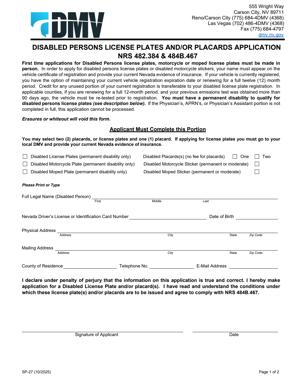
SP-27 – Disabled Persons License Plates and or Placards Application
Fill out nowThe SP-27 – Disabled Persons License Plates and or Placards Application is the document you use in Nevada to request special parking privileges based on a qualifying disability. It allows you to apply for disabled person license plates, parking placards, or both.
If you are living with a medical condition that limits your mobility, this form connects your medical certification to your vehicle registration record. It is the formal request that starts the review process.
You may be filling out this form for yourself, a family member, or someone you care for. Understanding each section before you write anything can save time and prevent delays.
This document matters because it affects your ability to park in designated accessible spaces. An incomplete or incorrect submission can slow down approval or require you to start over.
What is SP-27 – Disabled Persons License Plates and or Placards Application?
Clear definition
The SP-27 – Disabled Persons License Plates and or Placards Application is an official Nevada form used to apply for disabled person license plates or parking placards. It gathers personal details, vehicle information, and medical certification in one place.
The form serves as both an application and a medical verification document. It typically includes a section for you to complete and a section for a licensed medical professional to certify your qualifying condition.
When processed and approved, the application can result in the issuance of special license plates for a specific vehicle or a portable placard that can be displayed when parking.
Who typically uses this form?
You would use this form if you have a physical condition that significantly limits your ability to walk or move without assistance. This can include temporary or permanent disabilities.
Parents or legal guardians may complete the form for a minor with a qualifying condition. In some cases, a caregiver may help prepare the document, but the applicant’s information and medical certification must still be accurate.
Organizations that transport individuals with disabilities may also use a version of this application to request placards or plates for vehicles used for that purpose.
Medical professionals play a key role as well. A licensed provider must usually complete the medical certification section to confirm eligibility.
Why might you need this form?
You might need this form if walking long distances causes pain, shortness of breath, instability, or other serious limitations. Accessible parking spaces are typically located closer to building entrances and may provide additional space for ramps or mobility devices.
If you rely on a wheelchair, walker, prosthetic device, or portable oxygen, accessible parking can make daily activities more manageable. The form is the official way to request that accommodation through the state’s vehicle system.
You may also need this document if your condition is temporary but severe, such as recovering from surgery or a serious injury. In those cases, a temporary placard may be available for a limited time.
Without submitting this application and receiving approval, you cannot legally use designated disabled parking spaces in Nevada.
Typical real-life scenarios
- You recently had knee replacement surgery and cannot walk more than a short distance without assistance. Your doctor expects recovery to take several months. You complete the application and ask your physician to certify your temporary condition so you can receive a temporary placard.
- You live with a chronic heart condition that limits your endurance. Walking across large parking lots causes chest pain and fatigue. You apply for a permanent placard to reduce strain during routine errands and medical visits.
- Your child has a neurological condition that affects balance and coordination. You, as the parent, complete the applicant portion and have the child’s medical provider certify the condition. You then use the placard when transporting your child.
- You operate a vehicle specially equipped with hand controls due to a spinal cord injury. You apply for disabled person license plates for that vehicle so that accessible parking privileges are clearly associated with it.
When would you use SP-27 – Disabled Persons License Plates and or Placards Application?
You would use this form when you are seeking new disabled person license plates or placards for the first time. It is also commonly used when replacing a placard that has expired, been lost, or been stolen.
If your condition changes from temporary to permanent, you may need to submit a new application with updated medical certification. The form creates a record that reflects your current eligibility.
You might also use this document when transferring disabled plates to a different vehicle registered in your name. In that case, accurate vehicle information becomes especially important.
In general, the application is used whenever medical verification is required to establish or reestablish eligibility for disabled parking privileges under Nevada’s motor vehicle system.
Legal characteristics of SP-27 – Disabled Persons License Plates and or Placards Application
This form functions as an official request to a state agency. It becomes effective once properly completed, signed, and submitted, and once it is reviewed and approved by the appropriate department.
For the application to be valid, it typically must include complete personal information, accurate vehicle details if license plates are requested, and a properly completed medical certification. Missing signatures, unclear medical statements, or incomplete fields often lead to rejection or processing delays.
The medical certification portion usually must be completed by a licensed healthcare provider authorized to diagnose and treat medical conditions. If that section is not signed or does not clearly describe a qualifying limitation, the application may not move forward.
While many states offer similar disabled parking programs, the eligibility standards, documentation requirements, and placard types can differ. Even small differences in wording or expiration rules may affect how the form is processed in Nevada compared to other states.
It is important to understand what this document does not do. It does not automatically grant other disability benefits. It does not change your driver’s license status. It does not serve as proof of disability for employment, housing, or federal programs. Its purpose is limited to parking privileges and related vehicle registration matters.
Providing false information on the form can have serious consequences. The application is a government record, and intentional misstatements may lead to penalties or cancellation of issued plates or placards.
Is it legally binding?
The SP-27 – Disabled Persons License Plates and or Placards Application is not a contract between you and another private party. However, it is a legally significant government filing.
When you sign the form, you typically certify that the information you provided is true and correct. That certification carries legal weight. The medical professional’s signature also confirms that the statements about your condition are accurate to the best of their knowledge.
Once approved, the issued placard or license plate is tied to the representations made in the application. If your condition no longer meets eligibility standards, continued use of the placard may no longer align with the basis on which it was issued.
In this sense, the document is legally binding as a sworn application and certification. It creates an official record that the state relies on when granting parking privileges.
How to fill out SP-27 – Disabled Persons License Plates and or Placards Application
Step 1 – Review the entire form before writing
Start by reading through the full SP-27 – Disabled Persons License Plates and or Placards Application from beginning to end. Identify which sections apply to you, such as permanent placard, temporary placard, or disabled person license plates. This overview helps you gather the correct information and avoid skipping required parts.
Step 2 – Select the type of plate or placard you are requesting
Locate the section where you indicate whether you are applying for disabled person license plates, a placard, or both. Mark the appropriate option clearly. Make sure your selection matches your situation, such as choosing a temporary placard if your condition is expected to improve.
Step 3 – Provide your personal information
Enter your full legal name, residential address, and contact details as requested. Use the same name that appears on your driver’s license or identification card. Write clearly and ensure your address is complete, including apartment or unit numbers if applicable.
Step 4 – Enter vehicle information if applying for license plates
If you are requesting disabled person license plates, provide the required vehicle details. This may include the vehicle identification number, current plate number, make, and year. Double-check each number for accuracy, since mistakes in this section can delay processing.
Step 5 – Complete any sections about prior placards or plates
If you previously received a placard or plate, the form may ask for information about it. Indicate whether you are renewing, replacing, or reporting a lost or stolen placard. Provide any requested identification numbers if available.
Step 6 – Sign the applicant certification
Read the certification statement carefully before signing. By signing, you confirm that the information you entered is true and correct. Sign and date the form in the designated space using your legal signature.
If you are signing on behalf of a minor or someone you are legally authorized to represent, ensure your relationship and authority are clearly stated where required.
Step 7 – Have a licensed medical professional complete the medical certification
Take the form to a qualified healthcare provider who can evaluate and certify your condition. The provider will complete the medical section, indicate whether the disability is temporary or permanent, and sign and date the certification.
Make sure the provider fills out all required fields in their section. An incomplete medical certification is a common reason for rejection.
Step 8 – Review the entire application for completeness
Before submitting, go back through each section of the SP-27 – Disabled Persons License Plates and or Placards Application. Confirm that all required signatures are present, all applicable boxes are checked, and all identifying numbers are correct.
Check that the dates are accurate and that the medical certification is clearly written and legible. This final review reduces the chance of processing delays.
Step 9 – Submit the completed form to the appropriate office
Submit the completed and signed application to the designated motor vehicle office or processing location. Follow the submission instructions provided with the form, including any payment requirements if applicable.
Keep a copy of the completed document for your records. This can be helpful if you need to reference the information later or respond to questions about your application.
Legal terms you might encounter in SP-27 – Disabled Persons License Plates and or Placards Application
- Applicant Certification: This is the section where you confirm that all information you provided is true and correct. By signing it, you are stating under penalty of law that you qualify for the plate or placard requested. Your signature creates a legal record tied to your name and driver identification.
- Medical Certification: This part must be completed by a licensed medical professional. It confirms that you meet the medical criteria for disability parking privileges. The provider signs and may include license details to verify their authority.
- Permanent Disability: This term refers to a long-term condition that substantially limits mobility and is not expected to improve. On the form, this classification affects the type and duration of plates or placards issued. Permanent status may change how often you need medical recertification.
- Temporary Disability: This describes a condition expected to improve over time. If you qualify under this category, your placard will usually have a shorter validity period. The medical professional must indicate the expected duration.
- Placard Number: This is the unique identifier assigned to your issued placard. It connects the physical placard to your record in the motor vehicle system. You may need this number if reporting loss, theft, or renewal.
- License Plate Number: If you are applying for disabled license plates, this identifies the specific vehicle registered to you. The plate number becomes part of your vehicle registration record. It links disability parking privileges directly to that vehicle.
- Replacement Request: This section applies if your placard or plates were lost, stolen, or damaged. You must explain what happened and confirm the original item is no longer in use. This helps prevent duplicate active credentials.
- Fraudulent Use: This refers to misuse of a placard or plate by someone who is not entitled to it. The form typically warns that improper use can result in fines, penalties, or revocation. By signing, you acknowledge these consequences.
- Certification of Eligibility: This is the formal confirmation that you meet statutory requirements for disability parking privileges. It combines your personal information with the medical professional’s verification. Without this certification, the application will not be processed.
- Issuance Date: This is the date the department approves and issues your plate or placard. It determines when your privileges begin and when renewal will be required. Keep this date in your records.
FAQs
Do I need a medical professional to complete part of this document?
Yes. A licensed medical professional must complete and sign the medical certification section to confirm your eligibility. If this section is blank or incomplete, your application will not be processed. Make sure the provider includes all required identifying information and signs where indicated.
What is the difference between applying for plates and applying for a placard?
License plates are attached to a specific vehicle you own or register. A placard is portable and can be used in any vehicle in which you are riding, whether you are the driver or passenger. On this form, you must clearly select which option you want so the department issues the correct item.
Can someone else submit the SP-27 – Disabled Persons License Plates and or Placards Application for me?
Yes, another person may submit it on your behalf, but your signature and the medical certification must still be properly completed. The department will review the signatures to ensure they match the identification information on record. Submission by another person does not remove your responsibility for accuracy.
What happens if my condition is temporary?
The medical professional must indicate that your disability is temporary and may include an expected end date. The placard issued will usually expire sooner than a permanent one. You will need to reapply and obtain new medical certification if your condition continues beyond that date.
Do I need to turn in my old placard when applying for a replacement?
If you still have the old placard and it is damaged or expired, you may be required to surrender it when requesting a replacement. If it was lost or stolen, you will need to state that on this document. Providing accurate details helps prevent duplicate active placards in your name.
How do I make sure my name matches official records?
Use your full legal name exactly as it appears on your driver’s license or identification card. Differences in spelling, middle initials, or suffixes can delay processing. Before submitting this form, compare it carefully to your government-issued ID.
When do my parking privileges begin?
Your privileges begin once the department approves and issues the plate or placard, not on the date you sign the application. The issuance date will control the validity period. Do not use disability parking spaces until you physically receive the authorized plate or placard.
What if I move or change vehicles after submitting this form?
If you move, update your address with the motor vehicle agency to keep your records current. If you change vehicles and have disabled plates, you may need to transfer or reapply depending on the situation. A placard is portable, but vehicle-specific plates are tied to registration records and may require additional paperwork.
Checklist: Before, During, and After SP-27 – Disabled Persons License Plates and or Placards Application
Before
- Confirm whether you need a permanent or temporary placard or disabled license plates.
- Check that your identification is current and matches the name you will use on the form.
- Schedule an appointment with a licensed medical professional if certification is required.
- Gather vehicle registration details if applying for disabled plates.
- Locate any existing placards or plates if you are requesting a replacement.
- Review eligibility criteria to ensure you qualify before applying.
- Verify that you have any required fees ready, if applicable.
During
- Read each section carefully before writing.
- Clearly mark the correct box for plate, placard, or replacement.
- Print your name and address exactly as shown on your identification.
- Double-check your driver’s license or ID number for accuracy.
- Ensure the medical professional completes every required field.
- Confirm that all required signatures are present.
- Write legibly to avoid processing delays.
- Review dates to make sure they are accurate and complete.
After
- Make a complete copy or clear photo of the signed application for your records.
- Submit the form using the accepted method, such as in person or by mail, if allowed.
- Keep any receipt or confirmation of submission.
- Wait for official approval before using disability parking spaces.
- Record the issuance and expiration dates once you receive your plate or placard.
- Store the placard safely when not in use.
- Follow renewal instructions before the expiration date.
- Report lost or stolen placards promptly if that occurs.
Common mistakes to avoid with SP-27 – Disabled Persons License Plates and or Placards Application
- Mistake: Leaving the medical certification incomplete because you assume a diagnosis on file is enough, which happens when applicants rush the appointment, leading to automatic rejection; do not forget to confirm every required field and signature is filled in by the provider.
- Mistake: Selecting both plate and placard options without intending to request both, which often occurs from confusion about the checkboxes, causing processing delays; do not forget to clearly choose only the option you actually need.
- Mistake: Using a nickname or shortened name instead of your legal name, which happens out of habit, resulting in mismatched records; do not forget to match your name exactly to your driver license or ID.
- Mistake: Forgetting to sign the applicant certification, which is common when focusing on the medical section, leading to the form being returned; do not forget that your signature is required for legal validity.
- Mistake: Providing incorrect vehicle information when applying for plates, often due to copying errors from memory, which can delay issuance; do not forget to copy details directly from your registration document.
- Mistake: Failing to disclose that a prior placard was lost or stolen, which sometimes happens out of embarrassment or oversight, risking duplicate records or penalties; do not forget to accurately complete the replacement section.
- Mistake: Submitting the form before reviewing it for legibility, which occurs when applicants are in a hurry, causing avoidable processing holds; do not forget to read through the entire application one final time.
- Mistake: Using the placard before official approval, which can happen if you assume signing the form grants immediate rights, leading to potential fines; do not forget that privileges begin only after issuance.
What to do after filling out SP-27 – Disabled Persons License Plates and or Placards Application
Once you complete the form, your focus should shift to proper submission and recordkeeping. Small follow-up steps can prevent delays and protect your rights.
- Step 1: Review every page for signatures, dates, and completeness.
- Step 2: Make a full copy or take clear photos of the signed application for your personal records.
- Step 3: Confirm you have included any required supporting documents, such as identification details or vehicle information.
- Step 4: Submit the application using an approved method, such as delivering it in person or mailing it to the appropriate office.
- Step 5: If submitting in person, ask for confirmation that the application was received and whether anything else is needed.
- Step 6: If submitting by mail, consider using a method that provides delivery confirmation so you can track receipt.
- Step 7: Mark your calendar to follow up if you do not receive a response within a reasonable processing period.
- Step 8: Once approved, check the issued plate or placard for accuracy, including your name and any identifying number.
- Step 9: Record the issuance and expiration dates in a safe place so you remember when renewal is required.
- Step 10: If you receive a placard, display it only when parked in a designated space and remove it while driving to avoid obstruction.
Keep your approval documents with your important records. If your medical condition changes, your address changes, or your placard is lost or stolen, act promptly to update your information. Staying organized reduces the risk of penalties and ensures uninterrupted access to disability parking privileges.
Disclaimer: This guide is provided for informational purposes only and is not intended as legal advice. You should consult a legal professional.