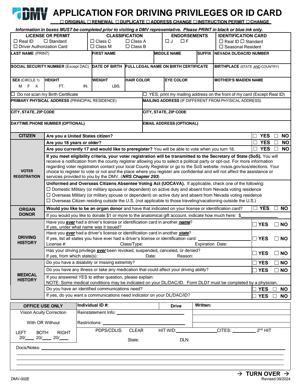
DMV-002EN – Application for Driving Privileges or ID Card
Fill out nowJurisdiction: Country: United States | Province or State: Nevada
If you plan to apply for a driver’s license or identification card in Nevada, you will likely encounter the DMV-002EN – Application for Driving Privileges or ID Card. This document is the starting point for most licensing and identification transactions with the Nevada Department of Motor Vehicles.
The DMV-002EN – Application for Driving Privileges or ID Card gathers your personal information, residency details, and eligibility declarations. It allows the state to evaluate whether you qualify for driving privileges or a state-issued ID card.
You may complete this form when applying for the first time, renewing, replacing a lost card, or updating your information. The form connects your identity to the credential you are requesting.
Before you begin filling it out, it helps to understand what the form is for, what information it requires, and how it is used. This guide walks you through the key points so you can approach the completion process with clarity.
What is DMV-002EN – Application for Driving Privileges or ID Card?
Clear definition
The DMV-002EN – Application for Driving Privileges or ID Card is an official state form used to request a Nevada driver’s license, instruction permit, or identification card. It serves as your formal application to receive or modify a government-issued credential related to driving or identification.
The document collects identifying details such as your full legal name, date of birth, Social Security information, and residential address. It also includes questions about your driving history, physical condition, and legal status to determine eligibility.
When you sign this form, you confirm that the information you provided is accurate. The state relies on your answers to process your application and issue the appropriate credential.
Who typically uses this form?
You may use this form if you are applying for your first Nevada driver’s license. This includes new drivers, people moving to Nevada from another state, or individuals who previously did not hold a license.
You also use it when applying for a Nevada identification card. This applies if you do not drive but need a government-issued ID for banking, employment, housing, or travel-related purposes.
Existing license holders may complete the form when renewing an expired license, replacing a lost or stolen card, or updating information such as a name change or new address. In some cases, individuals seeking to change license classifications or endorsements may also need to submit this document.
Parents or guardians may become involved when a minor applies for driving privileges. In those situations, additional signatures or consent sections may be required within the same form.
Why might you need this form?
You need this form whenever you want the Nevada Department of Motor Vehicles to issue or reissue a driving credential or ID card in your name. It acts as your official request and personal declaration.
Without a completed application, the DMV does not have the required information to evaluate your eligibility. The form allows the agency to verify your identity, residency, and legal presence, which are central to issuing a credential.
The form also documents your certifications. For example, you typically confirm that you understand traffic laws, that your statements are true, and that you meet medical or vision standards where applicable.
In many cases, the form becomes part of your official DMV record. That means the information you provide can be referenced in future renewals, investigations, or administrative reviews.
Typical real-life scenarios
- You recently moved to Nevada and need to transfer your out-of-state driver’s license. The DMV-002EN – Application for Driving Privileges or ID Card allows you to provide your updated Nevada address and request a state-issued license.
- You are a teenager applying for your first instruction permit. The form captures your personal information and may include a section for parental consent before you begin the licensing process.
- You lost your wallet, and your Nevada driver’s license was inside. To obtain a replacement card, you complete the same application form to confirm your identity and request a duplicate.
- You recently changed your legal name due to marriage, divorce, or court order. The form allows you to request a new license or ID card reflecting your updated legal name.
- You no longer drive but need an official ID for employment paperwork. You use the form to apply for a Nevada identification card instead of a driver’s license.
- You are renewing your license after it expired. Even if much of your information has not changed, you may still complete the form to confirm your details and eligibility.
When would you use DMV-002EN – Application for Driving Privileges or ID Card?
You use this form whenever you are starting or updating a formal relationship with the Nevada DMV related to driving or identification. The most common time is during an initial application.
If you are applying for a learner’s permit, a standard driver’s license, or a commercial license, the application process generally begins with this document. It serves as the foundation for testing, documentation review, and credential issuance.
You may also use the form when renewing an existing credential. Even if the renewal process is streamlined, the form helps confirm that your information remains accurate and current.
When requesting a duplicate card due to loss, theft, or damage, the form is used to verify your identity and issue a replacement. This ensures that the credential is not issued to someone else using your name.
If you are updating personal details such as your address, name, or gender marker, the form allows the DMV to adjust its records and issue a revised card. In these situations, supporting documents are commonly required alongside the application.
The form may also be part of reinstatement procedures if your driving privileges were suspended or revoked. In those cases, it works together with other requirements, such as fees or proof of insurance.
Legal characteristics of DMV-002EN – Application for Driving Privileges or ID Card
This document is an official government application. Its validity depends on complete and accurate information, proper identification, and compliance with state requirements.
For the application to be effective, it must typically be filled out in full, signed, and submitted according to DMV procedures. Missing sections, incomplete answers, or illegible handwriting may delay processing.
Providing incorrect information can create serious issues. Inaccuracies may result in rejection of the application, additional review, or administrative action. The DMV relies on your statements to assess eligibility, including residency and legal presence.
Some questions on the form address medical conditions or driving history. These sections help determine whether additional evaluations or restrictions are necessary. Omitting required disclosures can affect the outcome of your application.
High-level differences may exist between states regarding documentation standards, REAL ID compliance, and eligibility criteria. Nevada’s requirements may not match those of other states, even though application forms serve similar purposes nationwide.
It is important to understand what this form does not do. It does not automatically grant you driving privileges. Approval depends on meeting all applicable testing, documentation, and fee requirements. The form is one step in a larger administrative process.
It also does not replace other required documents. Proof of identity, residency, and other supporting records are typically reviewed alongside the application.
Is it legally binding?
The DMV-002EN – Application for Driving Privileges or ID Card is not a contract between you and another private party. However, it does carry legal significance.
When you sign the form, you are generally certifying that the information you provided is true and correct. False statements may lead to penalties, denial of your application, or other administrative consequences.
Your signature may also confirm that you understand certain obligations, such as complying with traffic laws and maintaining required insurance if you operate a vehicle. In that sense, your declarations are legally meaningful.
The form becomes part of your official DMV record once submitted and accepted. This means it can be referenced in future proceedings related to your driving privileges.
Although it is not legally binding in the same way as a contract, it is a formal sworn application. The accuracy and honesty of your responses are essential to its validity.
How to fill out DMV-002EN – Application for Driving Privileges or ID Card
Step 1 – Select the Type of Credential You Are Applying For
Begin by identifying whether you are applying for a driver’s license, instruction permit, identification card, renewal, replacement, or update. The form typically provides checkboxes or sections for different credential types.
Read each option carefully before marking your selection. Your choice determines how the DMV processes your application and what additional requirements may apply.
Step 2 – Provide Your Full Legal Name
Enter your full legal name exactly as it appears on your identity documents. This usually includes your first name, middle name, and last name.
If you have had a name change, ensure that the name on the form matches your current legal name. Supporting documentation is often required to confirm any change.
Step 3 – Enter Your Date of Birth and Personal Identifiers
Provide your date of birth in the format requested. You may also be asked for your Social Security number or other identifying number.
Write clearly and double-check each digit. Errors in these fields can delay verification and processing.
Step 4 – List Your Residential Address
Enter your physical residential address in Nevada. This is generally not a post office box.
Make sure the address is complete, including apartment or unit numbers if applicable. The DMV uses this information to establish residency and to mail your credential if necessary.
Step 5 – Provide Mailing Address if Different
If your mailing address differs from your residential address, complete the separate mailing section.
Ensure that mail can be reliably delivered to this address. An incorrect mailing address may delay receipt of your card.
Step 6 – Answer Citizenship or Legal Presence Questions
The form typically asks about your citizenship or lawful presence in the United States. Answer these questions truthfully.
These responses determine what supporting documents you must present. Incomplete or inconsistent answers can result in additional review.
Step 7 – Disclose Previous Licenses
Indicate whether you have held a driver’s license in Nevada or another state. Provide details as requested, such as the issuing state and license number if known.
This information helps the DMV review your driving history and confirm your eligibility.
Step 8 – Respond to Medical and Vision Questions
You may be asked about medical conditions that could affect your ability to drive safely. Read each question carefully.
Answer fully and accurately. If additional evaluation is required, the DMV may provide instructions for further steps.
Step 9 – Review Organ Donor or Other Designations
The form may include optional sections for organ donor designation or other acknowledgments.
Read these sections carefully before making a selection. Your choice may be reflected on your issued credential.
Step 10 – Read the Certification Statement
Before signing, review the certification section at the end of the application. This statement usually confirms that all information provided is true and complete.
Take a moment to verify every section of the form. Corrections are easier to make before submission.
Step 11 – Sign and Date the Form
Sign your name in the designated area using your legal signature. Enter the date of signing.
If the applicant is a minor, a parent or guardian may need to sign in the appropriate section. Ensure all required signatures are present.
Step 12 – Submit the Form with Required Documents and Fees
Present the completed application along with the required identity, residency, and eligibility documents. Fees are typically due at the time of submission.
Once submitted, the DMV will review your application, verify your information, and proceed with testing or credential issuance as applicable.
Legal terms you might encounter in DMV-002EN – Application for Driving Privileges or ID Card
- Legal Presence: This refers to your lawful status in the United States. On this form, you must confirm that you are a citizen, permanent resident, or otherwise authorized to be in the country. You will usually need to provide documents that match the status you select.
- Proof of Identity: These are documents that verify who you are. The form requires information that must match your identity documents exactly, including your full legal name and date of birth. If your name has changed, you may need supporting records.
- Residential Address: This is the physical place where you live. It cannot be a post office box. The address you provide becomes part of your official driving record and is used to determine eligibility and mailing jurisdiction.
- Mailing Address: This is where you want to receive correspondence if it is different from your home address. You must clearly indicate if the mailing address differs. Official notices, renewal reminders, or card deliveries will go here.
- Organ Donor Designation: This is your voluntary choice to be listed as an organ donor. By selecting this option on the form, you authorize the agency to mark your record and card accordingly. Your decision may also be shared with a donor registry.
- Certification Statement: This is the section where you declare that all information you provided is true and correct. By signing, you confirm that you understand the penalties for false statements. This statement makes your signature legally meaningful.
- Signature Under Penalty of Perjury: This phrase means you are legally promising the information is accurate. Providing false details can lead to fines, license suspension, or criminal charges. Your handwritten or authorized electronic signature activates this declaration.
- Previous License Disclosure: This section asks about driver’s licenses or ID cards you have held in other states or under other names. The agency uses this information to check your driving history and prevent duplicate records. You must list all relevant prior credentials.
- Medical Disclosure: This refers to questions about physical or medical conditions that could affect your ability to drive safely. You must answer honestly. Some answers may require additional medical evaluation before your driving privilege is approved.
- REAL ID Compliance: If you apply for a federally compliant credential, you must provide additional documentation. The form may ask you to indicate whether you want a compliant or standard card. Your selection determines what documents you must submit.
FAQs
What effective date applies when I submit this document?
The effective date is generally the date your application is processed and approved, not the day you fill it out at home. Your driving privilege or identification status becomes active only after acceptance. Check your receipt or temporary credential for the exact start date.
Do I need to sign the DMV-002EN – Application for Driving Privileges or ID Card in front of someone?
In most cases, you sign this form in the presence of an authorized staff member when you submit it in person. Your signature must match your identification documents. Do not sign it early if instructions say it must be witnessed at submission.
What happens if my name on this form does not exactly match my supporting documents?
The name you enter must match your primary identity document exactly. If it does not, your application can be delayed or rejected. If you have changed your name, you must provide legal proof of that change so the record can be updated correctly.
Can I correct a mistake after I submit the form?
If you notice an error before processing is complete, you should contact the office immediately. Once processed, corrections may require a new application and possibly additional fees. Review every entry carefully before signing to avoid delays.
What documents do I need to attach or bring with this document?
You must bring proof of identity, legal presence, and residency that matches the information you entered. The exact documents depend on the type of credential you selected. If you are applying for a compliant credential, expect stricter documentation requirements.
How do I know if my application has been accepted?
You will typically receive a receipt or temporary document confirming submission. Final acceptance occurs after your information is verified. If approved, your card is produced and sent to the mailing address you provided.
Will my old license or ID be canceled automatically?
If you are replacing or renewing a credential, your previous card is generally invalidated once the new one is issued. If you reported a lost or stolen card, the old record is marked accordingly. This prevents duplicate active credentials under your name.
What changes in the public record when I file this form?
When you submit DMV-002EN – Application for Driving Privileges or ID Card, your official driving or identification record is created or updated. This may include your address, donor status, and license classification. The information becomes part of your motor vehicle record once approved.
Checklist: Before, During, and After DMV-002EN – Application for Driving Privileges or ID Card
Before
- Review which type of credential you need (new, renewal, replacement, upgrade).
- Gather original identity and residency documents that match your legal name.
- Confirm your current residential address and mailing address.
- Check whether you need documents for a name change.
- Review medical history questions so you can answer accurately.
- Verify whether you want a compliant or standard credential.
- Prepare payment for required fees.
- Confirm office hours and whether an appointment is required.
During
- Print clearly and use your full legal name as shown on your documents.
- Double-check your date of birth and identification numbers before moving on.
- Answer all citizenship and legal presence questions truthfully.
- Disclose all previous licenses or identification cards.
- Read each medical question carefully before responding.
- Review your organ donor selection before confirming.
- Carefully read the certification statement.
- Sign only when instructed and in the correct location.
After
- Obtain a receipt or temporary credential before leaving.
- Confirm that your mailing address is correct on the receipt.
- Track the expected delivery timeframe for your card.
- Store your receipt in a safe place until the card arrives.
- Update your address with other agencies if needed.
- Safely dispose of or surrender any invalidated cards.
- Review your new card immediately upon arrival for accuracy.
- Report any printing errors promptly.
Common mistakes to avoid with DMV-002EN – Application for Driving Privileges or ID Card
- Mistake: Writing a nickname instead of your full legal name, which happens when people use everyday names, leading to processing delays or rejection, and forgetting to match the exact name on identity documents.
- Mistake: Providing a post office box as a residential address because it feels more secure, resulting in application denial since a physical address is required, and forgetting to distinguish between residential and mailing addresses.
- Mistake: Skipping prior license disclosures due to assuming old licenses no longer matter, which can trigger record conflicts or fraud concerns, and forgetting to list all states where you were licensed.
- Mistake: Guessing on medical questions to move quickly through the form, which can cause serious legal consequences or suspension if false information is discovered, and forgetting that answers are given under penalty of perjury.
- Mistake: Signing the form before reviewing it carefully because you feel rushed, leading to locked-in errors that require a new application, and forgetting that your signature certifies everything is accurate.
- Mistake: Failing to bring required supporting documents due to assuming copies are enough, which results in wasted trips and delays, and forgetting to verify document requirements in advance.
- Mistake: Choosing a compliant credential without having the necessary extra documentation, which causes rejection at the counter, and forgetting to confirm document standards beforehand.
- Mistake: Not checking the final printed card for errors because you trust the process, which can create long-term record issues, and forgetting to review the card immediately upon receipt.
What to do after filling out DMV-002EN – Application for Driving Privileges or ID Card
Once you complete the form, pause before submitting it. Review each section slowly. Compare your entries against your identity documents. Small errors can cause major delays.
- Step 1: Make a clear copy or take a clear photo of the completed form for your records.
- Step 2: Organize your supporting documents in the order they may be requested.
- Step 3: Confirm the fee amount and accepted payment methods.
- Step 4: Submit the form in person if required and present your documents to the reviewing official.
- Step 5: Sign the form in the presence of the authorized staff member if instructed.
- Step 6: Obtain a receipt or temporary credential as proof of submission.
- Step 7: Verify that your personal details are correct on any temporary document.
- Step 8: Monitor your mail for the official card within the stated processing timeframe.
- Step 9: Store your new card securely once it arrives.
- Step 10: Destroy or surrender any old or invalid card to prevent misuse.
Keep your receipt until you receive your permanent card. If your card does not arrive within the expected period, contact the issuing office with your receipt information. If you move before receiving the card, update your address immediately to prevent delivery issues.
After you receive your card, review every detail. Check spelling, classification, restrictions, and expiration date. If anything is incorrect, act quickly. Correcting errors early is easier than fixing a long-standing record issue.
Finally, keep your information current. If your address, name, or legal status changes in the future, you will need to update your record. Accurate records protect your driving privileges and reduce complications later.
Disclaimer: This guide is provided for informational purposes only and is not intended as legal advice. You should consult a legal professional.