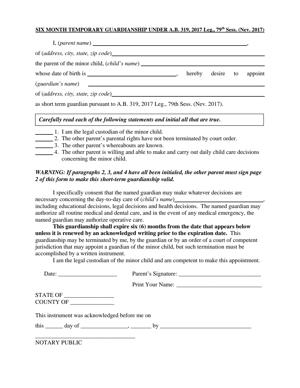
Six Month Temporary Guardianship Under A.B. 319, 2017 Leg., 79th Sess. (Nev. 2017)
Fill out nowJurisdiction: Country: United States | Province or State: Nevada
The Six Month Temporary Guardianship Under A.B. 319, 2017 Leg., 79th Sess. (Nev. 2017) is a court document used in Nevada to appoint a temporary guardian for a limited period. It allows someone to step in and make decisions for another person who cannot manage their own affairs.
This form is often used in urgent or short-term situations. It gives the proposed guardian legal authority for up to six months. After that period, the authority typically ends unless extended or replaced by another court order.
If you are filling out this document, you are likely trying to protect someone who is vulnerable. That may be a minor child or an adult who is unable to make safe decisions because of incapacity. The court reviews the filing to decide whether temporary guardianship is necessary.
Understanding how this document works helps you avoid delays. Courts expect clear, accurate information. Small mistakes can slow down approval or lead to rejection.
What is Six Month Temporary Guardianship Under A.B. 319, 2017 Leg., 79th Sess. (Nev. 2017)?
Clear definition
Six Month Temporary Guardianship Under A.B. 319, 2017 Leg., 79th Sess. (Nev. 2017) is a Nevada District Court filing used to request or confirm a short-term guardianship. It authorizes a guardian to act on behalf of a protected person for a period not exceeding six months.
A temporary guardianship is different from a permanent guardianship. It is designed for immediate needs. The court grants limited authority to address urgent concerns such as health care, housing, education, or financial protection.
This document is part of a legal process. It does not create guardianship on its own. A judge must review the request and issue an order before the guardianship becomes effective.
Who typically uses this form?
This form is typically used by family members, close relatives, or other interested persons seeking to protect a child or adult. In many cases, a parent, grandparent, sibling, or adult child files the paperwork.
It may also be used when a public guardian or another responsible adult seeks temporary authority. The person filing is often referred to as the petitioner. The person who would be protected under the guardianship is commonly called the proposed protected person or ward.
People who use this form are usually responding to a sudden change. That change may involve illness, injury, absence of a parent, or concerns about safety.
Why might you need this form?
You may need this form when someone cannot safely manage personal or financial matters, and waiting for a permanent guardianship would create risk. Temporary guardianship can provide immediate structure and oversight.
In some situations, there is a medical emergency. A hospital may require a legally authorized decision-maker. Without a guardian, important treatment could be delayed.
In other cases, a minor may be left without proper supervision. A temporary guardian can enroll the child in school, access medical care, and make day-to-day decisions.
The form may also be used to prevent financial harm. If someone is being exploited or cannot manage money responsibly, a temporary guardian can step in to stabilize the situation.
Typical real-life scenarios
- A parent is hospitalized unexpectedly and cannot care for a child. A relative files for temporary guardianship so the child has a legally recognized caregiver for school and medical purposes.
- An elderly adult suffers a sudden stroke and loses decision-making ability. A family member seeks temporary authority to manage medical care and protect bank accounts while a longer-term plan is considered.
- A person with a cognitive disability experiences a crisis. Immediate supervision is needed to ensure safe housing and compliance with treatment.
- A minor’s parents are unavailable due to incarceration, deployment, or other emergency circumstances. A trusted adult asks the court for temporary guardianship to provide stability.
- A vulnerable adult is being financially exploited. Temporary guardianship may allow someone to stop harmful transactions and safeguard assets until the court reviews a permanent arrangement.
When would you use Six Month Temporary Guardianship Under A.B. 319, 2017 Leg., 79th Sess. (Nev. 2017)?
You would use this document when there is urgency. The situation must typically require immediate attention that cannot wait for the full guardianship process.
Temporary guardianship is commonly requested at the beginning of a broader guardianship case. It may also be used when circumstances suddenly change during an existing case.
If you are a parent facing a short-term inability to care for your child, this form may be part of the process to ensure legal coverage. If you are an adult child caring for an incapacitated parent, you may use it to gain authority to act quickly.
Courts generally expect a clear explanation of why temporary authority is needed. The need must relate to safety, health, or protection of property. It is not designed for convenience or routine caregiving.
The six-month limit reflects its temporary nature. It is meant to bridge a gap, not replace a full guardianship order when long-term authority is required.
Legal characteristics of Six Month Temporary Guardianship Under A.B. 319, 2017 Leg., 79th Sess. (Nev. 2017)
This document is a formal court filing. It must be completed accurately and submitted to the appropriate Nevada District Court. The court reviews the information before issuing any order.
For the guardianship to be effective, a judge must sign an order granting temporary authority. Simply filling out and submitting the paperwork does not create legal power.
The form typically requires identifying information about the proposed guardian and the protected person. It may also require details about the emergency, the type of authority requested, and the duration of the need.
Common problems that lead to delay include incomplete sections, inconsistent names or dates, missing signatures, and failure to explain the urgency clearly. Courts look for specific facts rather than general statements.
Temporary guardianship does not permanently remove a person’s rights. It is limited in time and scope. It also does not automatically resolve disputes between family members. If multiple people object, the court may require a hearing.
While guardianship laws vary from state to state, this document is specific to Nevada. Other states may use different forms, time limits, or procedures. The six-month duration is tied to Nevada law under A.B. 319.
Is it legally binding?
Once the court approves the request and issues an order, the temporary guardianship becomes legally binding. The guardian then has the authority described in the court order.
The authority is limited to what the judge grants. Some temporary guardianships cover only personal decisions, such as medical care and living arrangements. Others may include financial powers. The exact scope depends on the court’s findings.
The guardianship remains in effect only for the time stated in the order, up to six months. It may end sooner if the court modifies or terminates it. When the period expires, the authority generally stops unless extended through another legal process.
Because the authority comes from a court order, third parties such as schools, banks, and medical providers often rely on certified copies of that order before recognizing the guardian’s power.
How to fill out Six Month Temporary Guardianship Under A.B. 319, 2017 Leg., 79th Sess. (Nev. 2017)
Step 1 – Review the caption and court information
Start at the top of the document. Enter the correct Nevada District Court name and county. Fill in the case number if one has already been assigned. Make sure the names of the petitioner and the proposed protected person match other court documents exactly.
Step 2 – Identify the proposed protected person
Provide the full legal name, date of birth, and current address of the person who needs protection. Double-check spelling and numbers. Inconsistent information can cause delays or confusion in court records.
Step 3 – Identify the proposed guardian
Enter your full legal name and contact information if you are seeking an appointment. If someone else is the proposed guardian, provide their details accurately. The court needs enough information to confirm identity and eligibility.
Step 4 – Describe the emergency or urgent circumstances
Explain clearly why temporary guardianship is necessary. Focus on specific facts. Include dates, events, and risks. Avoid vague statements. The judge must understand why waiting would place the person at risk.
Step 5 – State the powers requested
Indicate whether you are asking for authority over personal decisions, financial matters, or both. Be precise about what actions need to be taken during the six-month period. The court may limit authority to what is reasonably necessary.
Step 6 – Provide information about relatives and interested persons
List close relatives or other legally interested individuals as required by the form. Accurate contact details are important because notice may need to be provided. Missing names can delay the process.
Step 7 – Review required declarations or affirmations
Many court forms include a statement that the information provided is true under penalty of perjury. Read this section carefully. Ensure all facts are accurate before signing.
Step 8 – Sign and date the document
Sign your name where indicated. Use the date of actual signing. If the form requires notarization or additional signatures, complete those steps before submission.
Step 9 – Prepare the document for filing
Make copies as needed for the court and for your records. Confirm that all required pages are included and in the correct order. Check for missing attachments or blank sections.
Step 10 – Submit to the appropriate Nevada District Court
File the completed document with the correct court clerk’s office. After submission, monitor the case for any hearing dates, additional requirements, or court orders related to the temporary guardianship.
Legal terms you might encounter in Six Month Temporary Guardianship Under A.B. 319, 2017 Leg., 79th Sess. (Nev. 2017)
- Proposed Protected Person: This is the adult or minor who needs a guardian. The form will ask for this person’s full legal name, date of birth, and current address. Make sure the name matches their identification and any prior court filings.
- Proposed Guardian: This is the person asking to be appointed. The document requires detailed information about this individual, including contact information and relationship to the protected person. The court reviews this section closely to decide if the appointment is appropriate.
- Temporary Guardianship: This is a short-term court order that gives someone authority to act on another person’s behalf. This document, it is limited to a six-month period. The order does not automatically continue beyond that timeframe.
- Emergency Circumstances: The form asks you to explain why immediate action is necessary. These are specific facts that show the protected person faces harm, neglect, or loss if a guardian is not appointed quickly. Vague statements are not enough; the court expects clear, detailed reasons.
- Letters of Guardianship: These are official documents issued by the court after approval. They prove that the guardian has legal authority. Banks, doctors, and other institutions often require certified copies of these letters before they will recognize the guardian’s power.
- Interested Persons: These are relatives or others who must be notified about the guardianship request. The form usually requires you to list names and contact information. Failing to identify all required individuals can delay or invalidate the process.
- Scope of Authority: This describes what the guardian is allowed to do. The document may separate authority over personal decisions, financial matters, or both. The court can limit powers to only what is necessary.
- Affidavit or Declaration: This is a sworn statement included in or attached to the form. When you sign it, you confirm that everything is true to the best of your knowledge. Providing false information can result in penalties.
- Bond: In some cases, the court may require the guardian to obtain a bond. This is a financial guarantee that protects the protected person’s assets. The document may ask whether a bond should be required.
- Expiration Date: This is the date when the temporary guardianship automatically ends. The six-month period begins from the court’s order, not from the date you filled out the form. You must track this date carefully.
FAQs
How do I know when the six-month period actually starts?
The six-month period begins on the date the judge signs the order, not the day you prepared or filed the paperwork. Check the signed order for the exact date. You should also look at the expiration language in the order so you can calendar when the authority ends.
What information must match exactly in this document?
Names, addresses, and dates of birth should match identification records and any previous court filings. If you spell a name differently or use a nickname in one section and a full legal name in another, the clerk may reject the filing or ask for corrections. Double-check every page before submission.
Do I need to attach other papers to Six Month Temporary Guardianship Under A.B. 319, 2017 Leg., 79th Sess. (Nev. 2017)?
You often need supporting documents, such as a petition, medical statements, or notices to interested persons. Review the checklist provided by the court clerk to confirm required attachments. Missing attachments can delay acceptance or prevent the judge from reviewing your request.
Who is allowed to sign this form?
The proposed guardian signs the main petition or declaration. Some documents may also require notarization or additional signatures. Make sure the signature line is completed in the correct place and that you sign using your full legal name.
What happens if the clerk rejects my filing?
If the clerk finds missing information or formatting problems, they may return the paperwork for correction. Review any written notice carefully and fix each issue listed. Resubmit the corrected documents promptly to avoid losing time in an emergency situation.
Will this guardianship show up in the public record?
Court guardianship proceedings generally become part of the court record. That means the case number, names, and certain filings may be accessible. Sensitive information may be protected, but you should assume that the case itself is part of the public docket.
Can the powers granted be limited to certain decisions?
Yes. This document allows you to describe the specific powers requested. The judge may approve all, some, or only limited authority, depending on what is necessary to protect the individual.
What if the protected person objects to the temporary appointment?
If the person objects, the court may schedule a hearing to review the concerns. You must be prepared to explain the urgent circumstances and why immediate authority is needed. The judge will decide whether the appointment should move forward or be modified.
Checklist: Before, During, and After Six Month Temporary Guardianship Under A.B. 319, 2017 Leg., 79th Sess. (Nev. 2017)
Before
- Confirm the full legal name and identifying details of the proposed protected person.
- Gather documents that support the emergency, such as medical records or incident reports.
- Identify and list all required interested persons with accurate contact information.
- Review prior court cases involving the same individual, if any.
- Decide whether you are requesting authority over personal matters, financial matters, or both.
- Prepare a clear written explanation of the urgent circumstances.
- Check whether a bond may be required and gather financial details if needed.
During
- Complete every section of the form without leaving required blanks.
- Use consistent names and dates throughout the document.
- Attach all required supporting documents in the correct order.
- Sign and date all declarations in the proper places.
- Make copies before filing.
- File the documents with the correct District Court location.
- Pay any required filing fee or submit a fee waiver request if applicable.
After
- Obtain file-stamped copies for your records.
- Calendar the expiration date of the six-month period.
- Deliver copies of the order or letters to banks, doctors, or care providers as needed.
- Provide notice of the appointment to interested persons if required.
- Keep detailed records of actions you take as guardian.
- Monitor whether a full guardianship petition needs to be filed before expiration.
- Update the court if your contact information changes.
Common mistakes to avoid with Six Month Temporary Guardianship Under A.B. 319, 2017 Leg., 79th Sess. (Nev. 2017)
- Mistake: Leaving sections blank because you are unsure of the answer, which often happens under stress, can lead to rejection by the clerk, so do not forget to review each page and complete or mark every required field.
- Mistake: Providing vague statements about emergencies, which happens when you assume the urgency is obvious, can cause the judge to deny the request, so do not forget to include specific dates, events, and risks.
- Mistake: Failing to notify all interested persons, which often occurs when family relationships are strained, can delay the case or invalidate the order, so do not forget to list every required relative.
- Mistake: Using inconsistent names or spellings, which happens when you copy information from memory instead of identification, can create record confusion, so do not forget to match official documents exactly.
- Mistake: Forgetting to sign or notarize required declarations, which often happens when assembling multiple forms, can result in immediate rejection, so do not forget to check every signature line.
- Mistake: Assuming the guardianship continues automatically beyond six months, which happens when you focus only on the emergency, can leave the protected person without legal coverage, so do not forget to track the expiration date.
- Mistake: Not keeping copies of filed documents, which can occur during a crisis, can make it difficult to prove authority later, so do not forget to store stamped copies safely.
- Mistake: Ignoring bond requirements, which sometimes happens when financial details seem secondary, can delay issuance of letters, so do not forget to address any bond instructions in order.
What to do after filling out Six Month Temporary Guardianship Under A.B. 319, 2017 Leg., 79th Sess. (Nev. 2017)
Once you have completed the paperwork, pause and review it carefully. Check every page for signatures, dates, and attachments. Make sure the names are consistent and legible. Small errors can slow down an urgent request.
- Step 1: Make at least two complete copies of everything you plan to file.
- Step 2: Organize the documents in the order required by the District Court.
- Step 3: File the originals with the clerk of the appropriate Nevada District Court, either in person or through the court’s accepted filing method.
- Step 4: Pay the filing fee or submit an approved fee waiver application.
- Step 5: Obtain file-stamped copies showing the case number and filing date.
- Step 6: Attend any scheduled hearing and bring copies of all filed documents.
- Step 7: If the judge signs the order, request certified copies of the Letters of Guardianship.
- Step 8: Provide certified copies to institutions that require proof of your authority.
- Step 9: Keep a dedicated folder with all court documents, correspondence, and receipts.
- Step 10: Track the expiration date and decide whether to seek a longer-term guardianship before the six months end.
After the court grants the temporary guardianship, act within the scope of authority granted. Do not exceed the powers listed in the order. If you need additional authority, you must request it formally.
Maintain clear records of decisions, expenses, and communications. This protects you and shows that you are acting responsibly. If circumstances change, such as an improvement in the protected person’s condition, be prepared to inform the court.
Staying organized and proactive helps you fulfill your responsibilities and prevents gaps in legal authority once the six-month period ends.
Disclaimer: This guide is provided for informational purposes only and is not intended as legal advice. You should consult a legal professional.