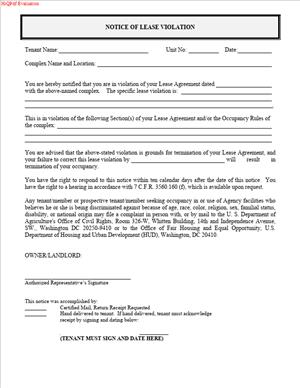
MO-Notice of Lease Violation
Fill out nowJurisdiction: Country: United States | Province or State: Missouri
The MO-Notice of Lease Violation is a written document used to formally notify a tenant that they have not followed the terms of a lease agreement. It creates a clear record of what happened and what part of the agreement is involved.
If you are a landlord or property manager working with rental housing in Missouri, this form helps you document a problem before taking further action. It is commonly used in properties connected to Missouri USDA Rural Development programs, where written notice procedures are often required.
If you are a tenant, you may receive the MO-Notice of Lease Violation when the landlord believes you broke a lease rule. The form explains the issue and outlines what needs attention.
This document matters because rental agreements are legal contracts. When one side believes the contract has been violated, written notice is often the first formal step in addressing the situation. Without clear notice, later actions may become more complicated.
Understanding how the MO-Notice of Lease Violation works helps you complete it correctly and avoid common mistakes during signing or submission.
What is MO-Notice of Lease Violation?
Clear definition
The MO-Notice of Lease Violation is a formal written notice that informs a tenant that they have violated one or more terms of their rental agreement. It identifies the specific lease provision involved and describes the conduct or condition that led to the notice.
This document is not the same as an eviction order. It does not remove someone from the property. Instead, it serves as written documentation that a lease violation occurred and that corrective action may be required.
In properties associated with Missouri USDA Rural Development programs, written notice requirements are often structured and specific. The MO-Notice of Lease Violation helps ensure the landlord follows those procedural steps before considering further action.
The form typically includes information about the tenant, the rental unit, the date, a description of the violation, and any timeframe related to correcting the issue.
Who typically uses this form?
Landlords use the MO-Notice of Lease Violation when they believe a tenant has broken a rule in the lease. This can include private owners of qualifying properties, property managers, or housing administrators.
Property managers handling USDA Rural Development housing often use this document as part of compliance procedures. Many housing programs require written documentation before escalating a dispute.
Tenants do not usually prepare this form. Instead, they receive it. However, understanding the form helps tenants respond appropriately and keep records of communication.
Housing authorities or administrative staff may also rely on this document when reviewing tenant conduct or file history. It becomes part of the tenant’s rental record.
Why might you need this form?
You may need the MO-Notice of Lease Violation when a tenant fails to follow a lease term. Common examples include late rent payments, unauthorized occupants, property damage, or prohibited activities.
The form creates a written record. Verbal warnings can be misunderstood or forgotten. A written notice clearly states the issue and the date it was identified.
For properties connected to federal rural housing programs, written documentation may be part of the required procedure. The form helps demonstrate that proper notice was given before further steps were considered.
You might also use the document to give the tenant an opportunity to correct the problem. In many situations, a notice of violation is intended to address the issue before it escalates.
Typical real-life scenarios
- A tenant repeatedly pays rent after the due date, even though the lease states a specific deadline. The landlord documents the pattern and issues the MO-Notice of Lease Violation to formally address the late payments.
- A tenant allows an unauthorized person to move into the unit. The lease may limit occupancy or require written approval for additional residents. The landlord uses the form to document the issue and reference the specific lease clause.
- A property inspection reveals damage beyond normal wear and tear. The landlord identifies the damage and cites the lease section requiring tenants to maintain the unit in good condition.
- A tenant keeps a pet in a building where pets are restricted or require approval. The landlord uses the notice to describe the violation and refer to the relevant agreement language.
- In another case, neighbors report repeated noise disturbances. The lease may include quiet enjoyment provisions. The landlord documents the complaints and issues the notice to address the conduct.
When would you use MO-Notice of Lease Violation?
You would use the MO-Notice of Lease Violation after identifying behavior or conditions that conflict with the written lease. The key factor is that the issue relates directly to a specific term in the rental agreement.
Landlords often use this form after informal communication has not resolved the issue. For example, a landlord may have spoken with the tenant about excessive noise. If the conduct continues, the written notice provides a formal record.
The document may also be used immediately for more serious violations. Damage to property, safety concerns, or prohibited activities might lead to prompt written notice without prior informal warning.
Property managers working within regulated housing programs often use this form as part of a structured process. The agreement and program guidelines may require documented notice before advancing to lease termination steps.
You may also see this form used during periodic inspections. If an inspection identifies conditions that breach the lease, the landlord may issue a notice referencing the findings.
Timing matters. The notice is typically used after the violation occurs but before pursuing termination or court proceedings. It serves as an intermediate step that documents the issue and communicates expectations.
Legal characteristics of MO-Notice of Lease Violation
The MO-Notice of Lease Violation functions as a formal communication tied to a contract. Its strength comes from clarity, accuracy, and proper delivery.
For the document to be effective, it generally needs to identify the tenant, the rental unit, and the specific lease provision involved. Vague language can create confusion. Clear references to the agreement help establish context.
Dates are important. The notice usually includes the date it was issued and may reference the date of the violation. In regulated housing programs, timing requirements can affect how the notice is evaluated.
Proper delivery is another key element. Some agreements describe acceptable delivery methods, such as personal delivery or mailing. Following the method described in the lease or program guidelines helps ensure the notice is recognized as valid communication.
Common problems include incomplete information, incorrect tenant names, wrong unit numbers, or failure to cite the lease section involved. These errors can weaken the document’s effectiveness.
The MO-Notice of Lease Violation does not automatically end the lease. It does not remove the tenant. It does not authorize law enforcement action. It is a notice, not a court order.
Jurisdictional differences can affect how notices are treated in later proceedings. While this form applies in Missouri, specific procedures may vary depending on the type of housing and whether federal program rules apply. Regulated housing often has additional notice requirements compared to private market rentals.
Another characteristic is recordkeeping. The notice typically becomes part of the tenant’s file. Accurate completion and signing support clear documentation if questions arise later.
Is it legally binding?
The MO-Notice of Lease Violation is not a contract by itself. It does not create new lease terms. Instead, it enforces or references existing terms in the rental agreement.
It becomes legally meaningful because it documents an alleged breach of contract. If the lease states certain conduct is prohibited, and the notice identifies that conduct, the document shows that the landlord formally communicated the issue.
Its binding effect depends on context. If a tenant signs acknowledging receipt, that signature usually confirms delivery, not agreement with the claim. The lease itself remains the primary binding document.
If the matter escalates to further action, the notice may be reviewed as part of the record. Its accuracy and completeness can influence how it is viewed. However, the notice alone does not decide outcomes.
In regulated housing, compliance with required notice procedures can affect whether later steps are considered proper. That is why the document’s structure and completion matter.
How to fill out the MO-Notice of Lease Violation
Step 1 – Identify the property and tenant
Begin by entering the full legal name of the tenant as it appears on the lease agreement. If more than one tenant signed the lease, include each name listed in the agreement.
Provide the complete address of the rental unit. Include the unit number if applicable. Accuracy here prevents confusion about which property is involved.
This section connects the notice directly to the correct rental agreement and tenant file.
Step 2 – Enter the date of the notice
Write the date the MO-Notice of Lease Violation is being prepared or issued. This date helps establish a timeline.
Make sure the date is clear and complete, including month, day, and year. The timeline may matter if the lease or housing program describes specific notice periods.
The date also helps both parties track communication and responses.
Step 3 – Reference the lease agreement
Locate the relevant section of the lease that relates to the violation. On the form, identify that section by number, title, or description as provided in the agreement.
Be specific. For example, if the lease includes a section on occupancy limits, identify that section rather than referring broadly to “lease terms.”
This step ties the notice directly to the written agreement. It shows that the issue is not arbitrary but based on an existing provision.
Step 4 – Describe the violation clearly
Use clear, factual language to explain what occurred. Include dates, times, and specific conduct where possible.
Avoid emotional language. Focus on observable facts. For example, state that rent was received on specific dates after the due date, or that an inspection on a certain date revealed particular damage.
Clarity here reduces misunderstanding. The goal is to explain what happened in a way that relates directly to the lease provision identified earlier.
Step 5 – State any required corrective action or timeframe
If the form includes space to describe corrective action, indicate what issue needs attention. This may involve stopping certain conduct, removing unauthorized occupants, or addressing property conditions.
Include any timeframe referenced in the lease or program guidelines, if applicable. The timeframe should match the terms of the agreement or applicable procedures.
This section communicates what must occur next in response to the violation.
Step 6 – Include the signature and title of the issuing party
The landlord, property manager, or authorized representative completes the signature section. Sign your full name as it appears in property records or management documents.
If the form includes a title line, write your role, such as owner or property manager. This clarifies your authority to issue the notice.
Add the date of signing if it differs from the preparation date. Consistent dating supports accurate records.
Step 7 – Document the method of delivery
If the MO-Notice of Lease Violation includes a section for delivery details, indicate how the notice was provided. This may include personal delivery, posting, or mailing, depending on the lease terms.
Record the date of delivery. If mailing is used, note the mailing date.
Keeping a copy of the completed document in the tenant’s file supports consistent documentation practices and maintains a clear record of communication.
Legal terms you might encounter in MO-Notice of Lease Violation
- Lease Agreement: This is the written contract between the landlord and tenant that sets the rules for renting the property. In this form, you will reference the lease agreement by date and sometimes by section number. The violation you describe must tie directly back to a term in this agreement.
- Breach: A breach is a failure to follow a term of the lease. The notice explains how the tenant breached the agreement, such as not paying rent or violating occupancy rules. You must clearly state what action or inaction caused the breach.
- Cure Period: This is the amount of time given to fix the violation. The form may require you to state a deadline by which the tenant must correct the issue. Be specific about the date, not just the number of days.
- Termination: Termination means ending the lease agreement. If the violation is not corrected within the stated timeframe, the notice may warn that the lease will terminate. The document should make clear whether termination is immediate or conditional.
- Material Noncompliance: This refers to a serious violation that affects health, safety, property condition, or key lease obligations. When you describe the issue, you should explain why it rises to this level. This helps justify the seriousness of the notice.
- Service of Notice: Service is how the notice is delivered to the tenant. The form may include a section where you record whether you mailed, hand-delivered, or otherwise served the notice. Accurate documentation of service protects you later.
- Effective Date: This is the date the notice officially starts. It may be the date you sign it or the date it is delivered. Make sure the timeline for corrective action runs from the correct effective date.
- Authorized Agent: An authorized agent is someone legally allowed to act on behalf of the landlord, such as a property manager. If you are not the property owner, your authority should be clear. Sign the notice in the capacity listed in the lease or management agreement.
- Tenant Record: This is the internal file that contains the lease, payment history, prior notices, and related documents. The information in this form should match the tenant record exactly. Inconsistent details can create confusion or disputes.
FAQs
Do I need to quote the exact lease section in the MO-Notice of Lease Violation?
You should identify the specific section or paragraph of the lease that was violated. This makes your notice clear and harder to challenge. If the lease is organized by numbered sections, copy the number and short title exactly as written. Double-check that the wording in your notice matches the lease language.
What date should I list as the effective date of this document?
Use the date the notice is signed unless your form or internal policy states that it becomes effective upon delivery. If timing matters for a cure period, count from the delivery date. Record both the signature date and the delivery date in your file so your deadlines are clear.
How detailed should my description of the violation be?
Be specific and factual. Include dates, times, and what happened. Avoid emotional language or assumptions. If the violation involves unpaid rent, list the exact amount due and the months affected. If it involves conduct, describe the behavior and when it occurred.
What if the tenant’s name on the lease is slightly different from what I have on file?
Use the name exactly as it appears on the signed lease. If you also have an updated legal name, you can include it in parentheses, but do not replace the original lease name. Consistency prevents confusion about who is being notified.
Do I need to attach documents to this form?
Attach supporting documents if they help clarify the violation. This might include a rent ledger, prior written warnings, inspection reports, or photographs. Label each attachment and keep copies in the tenant’s file.
Who is allowed to sign this notice?
The property owner or an authorized agent may sign. Make sure the signer’s title is clearly stated, such as “Owner” or “Property Manager.” If you are signing as an agent, confirm that your authority is documented in your management agreement or internal records.
What happens if the tenant fixes the problem before the deadline?
If the issue is fully corrected within the stated timeframe, document the correction in writing. Update your tenant record to show compliance. You may keep the original MO-Notice of Lease Violation in the file, but note that the violation was cured.
Does this document get filed with a court or agency?
In most situations, this form is delivered to the tenant and kept in your records rather than filed immediately. However, it may later be used as evidence if further action becomes necessary. Make sure your copy is complete, signed, and shows how and when it was delivered.
Checklist: Before, During, and After MO-Notice of Lease Violation
Before
- Review the signed lease agreement and confirm the exact clause that was violated.
- Verify the tenant’s full legal name as listed on the lease.
- Confirm the property address, including unit number.
- Gather evidence such as payment records, inspection notes, or written complaints.
- Check prior communications to ensure the issue has not already been resolved.
- Confirm the correct deadline or cure period you plan to provide.
- Make sure you have the authority to issue the notice.
- Prepare copies of any attachments you plan to include.
During
- Enter the full property address exactly as it appears in the lease.
- Insert the tenant’s name without abbreviations or nicknames.
- State the date of the notice clearly.
- Reference the specific lease section that was violated.
- Describe the violation in clear, factual language.
- State the corrective action required.
- Provide a clear deadline with a specific calendar date.
- Sign and print your name and title.
- Complete the section documenting how the notice will be delivered.
After
- Make at least two copies of the signed notice.
- Deliver the notice using your chosen method and document the date.
- Keep proof of delivery, such as a mailing receipt or signed acknowledgment.
- Place a complete copy in the tenant’s file.
- Calendar the cure deadline so you do not miss follow-up.
- Monitor whether the tenant takes corrective action.
- Document any communication related to the violation.
- Update your internal records once the deadline passes.
- Prepare next steps if the violation is not corrected.
Common mistakes to avoid with MO-Notice of Lease Violation
- Mistake: Writing a vague description of the violation because you assume the tenant “knows what they did,” which can lead to disputes or claims of unfair notice; do not forget to include dates, amounts, and specific conduct.
- Mistake: Listing the wrong deadline due to miscounting days, which can invalidate your timeline and delay further action; do not forget to calculate the cure period carefully and confirm the calendar date.
- Mistake: Using a nickname or shortened tenant name because it is familiar, which can create confusion about who was notified; do not forget to match the name exactly as it appears on the lease.
- Mistake: Failing to document how the notice was delivered because you assume delivery is obvious, which can weaken your position later; do not forget to complete and retain proof of service.
- Mistake: Forgetting to sign or include your title, often due to rushing, which may raise questions about authority; do not forget to sign, print your name, and state your role clearly.
- Mistake: Not attaching supporting documents when the violation involves money or property condition, which can make your claim look unsupported; do not forget to include and label relevant attachments.
- Mistake: Sending the notice to the wrong address because the tenant recently moved units, which can delay or invalidate service; do not forget to confirm the correct rental unit and mailing address.
- Mistake: Ignoring internal record updates after issuing the notice, which leads to inconsistent files and missed deadlines; do not forget to calendar follow-up dates and update the tenant record.
What to do after filling out the MO-Notice of Lease Violation
Once you complete the notice, your focus shifts to proper delivery and documentation. A well-prepared notice only works if you handle the next steps carefully and consistently.
Start by reviewing the entire document one more time. Check names, dates, lease references, and deadlines. Make sure every blank is filled in. Confirm that your signature and title are included.
- Step 1: Make at least two complete copies of the signed notice, including all attachments.
- Step 2: Deliver the original notice using your chosen method, such as hand delivery or mail, and record the exact date of delivery.
- Step 3: Complete any proof of service section or prepare a separate written statement showing how and when delivery occurred.
- Step 4: Place one full copy, along with proof of delivery, in the tenant’s file.
- Step 5: Enter the cure deadline on your calendar and set a reminder a few days before it expires.
- Step 6: Monitor the situation to see whether the tenant takes corrective action within the allowed timeframe.
- Step 7: Document all communication from the tenant related to the notice, including emails, letters, or in-person conversations.
- Step 8: Inspect or verify compliance if the violation involves property condition, occupancy, or other physical issues.
- Step 9: Update your internal records to reflect whether the violation was cured or remains outstanding.
- Step 10: Prepare your next written step if the violation is not corrected, using your records to ensure consistency.
Keep everything organized. Store the notice, attachments, delivery confirmation, and follow-up notes together. Clear records protect you if questions arise later. When you treat each notice as part of a documented process, you reduce confusion and strengthen your position.
Disclaimer: This guide is provided for informational purposes only and is not intended as legal advice. You should consult a legal professional.