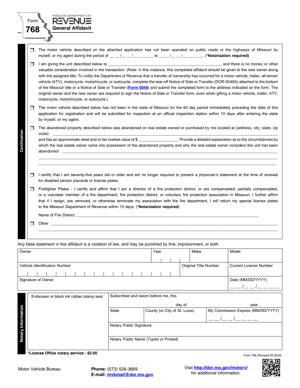
Form 768 – General Affidavit
Fill out nowJurisdiction: Country: United States | Province or State: Missouri
Form 768 – General Affidavit is a written statement where you swear that certain facts are true. You sign it under oath. That means you are formally declaring the information is accurate to the best of your knowledge.
This form is commonly used in administrative matters handled by the Missouri Department of Revenue. It allows you to explain facts that are not already shown in official records. You are putting your statement in writing so the agency can rely on it.
If you are filling out Form 768 – General Affidavit, you are likely trying to support a request, correct a record, or confirm specific information. The form becomes part of an official file. It may be reviewed by agency staff when making a decision.
Understanding what this document does is important before you sign it. An affidavit is not just a casual explanation. It is a sworn statement that can carry legal consequences if the information is false.
What is Form 768 – General Affidavit?
Clear definition
Form 768 – General Affidavit is a sworn written statement used to declare facts to the Missouri Department of Revenue. You complete the form to certify that certain information is true. You sign it in the presence of a notary public.
An affidavit is different from a simple letter. When you sign an affidavit, you are swearing under oath. The notary confirms your identity and witnesses your signature. The notary does not verify your facts, but confirms that you signed voluntarily.
This form does not create a contract. It records your sworn version of events or facts. The department may use it to clarify details related to tax, motor vehicle, title, or registration matters.
Who typically uses this form?
Individuals most often use this form when dealing with vehicle titles, registration issues, or tax-related matters. For example, a vehicle owner might use it to explain missing documents or confirm ownership details.
Business owners may also use the form. A company representative might complete it to confirm business information or explain a transaction that affects records with the department.
Heirs or family members sometimes use it when handling property or vehicle matters after someone’s death. The affidavit can help explain the chain of ownership or confirm facts that are not otherwise documented.
In some cases, buyers or sellers of vehicles complete the form to clarify the circumstances of a sale. The department may request a sworn statement when the paperwork is incomplete or inconsistent.
Why might you need this form?
You may need this form when official records do not fully reflect your situation. The department might require a written explanation before processing your request.
Sometimes paperwork is lost, damaged, or never created. An affidavit can help fill in gaps. It gives the agency a sworn statement to rely on when deciding whether to approve a correction or issue a title.
The form may also be used to correct errors. If information on a title or registration is wrong, you may need to explain how the mistake happened. Your sworn statement helps document that explanation.
In other cases, the department may request this form directly. If you receive a notice asking for additional information, Form 768 – General Affidavit may be one way to provide it in a formal, acceptable format.
Typical real-life scenarios
- You sold a vehicle, but the buyer never completed the title transfer. Later, you receive notices related to that vehicle. You might use this form to state when you sold it and to whom.
- A vehicle title was signed incorrectly. There is no simple correction process available. You may complete an affidavit explaining the error and confirming the intended transaction.
- You inherited a vehicle, but certain documents are missing. The department may require a sworn statement describing the circumstances and confirming your relationship to the prior owner.
- A clerical mistake resulted in incorrect information being entered into department records. You may use the affidavit to clearly explain what information is correct and why.
- You are applying for a specific tax exemption or adjustment. The department requests a written explanation of facts supporting your eligibility. The affidavit provides that explanation under oath.
When would you use Form 768 – General Affidavit?
You would use Form 768 – General Affidavit when the Missouri Department of Revenue requires a sworn statement to support an application, correction, or clarification. It is often used when standard forms do not fully capture your situation.
If you are submitting paperwork for a vehicle title or registration and something is missing or inconsistent, the department may ask for this form. Your affidavit helps explain the discrepancy.
If you are responding to a written request from the department, the form may be listed as an acceptable way to provide additional information. In that situation, it becomes part of your official submission.
Business representatives may use it when corporate records do not match state records. For example, if ownership details or transaction dates need clarification, an affidavit can document those facts.
Estates and family members handling property matters may also use it when formal probate documents are not required, but factual confirmation is still needed. The affidavit supplies that confirmation in sworn form.
Legal characteristics of Form 768 – General Affidavit
Form 768 – General Affidavit is a sworn statement made under oath. Its legal effect comes from your signature and the notary’s acknowledgment. By signing, you are affirming that the information is true.
For an affidavit to be effective, it must clearly state facts. Vague or incomplete statements can create confusion. The department relies on specific, factual information rather than opinions or conclusions.
Common problems include leaving blanks, failing to sign in front of a notary, or providing inconsistent details. If names, dates, or identification numbers do not match other records, the affidavit may raise additional questions.
Different states may have different affidavit formats or requirements. In Missouri, affidavits submitted to a state agency generally require notarization. Without proper notarization, the document may not be accepted.
This form does not automatically grant approval of your request. It does not replace required supporting documents unless the department allows it. It also does not resolve disputes between private parties on its own.
Is it legally binding?
Yes, in the sense that you are making a sworn statement under oath. When you sign Form 768 – General Affidavit before a notary, you are affirming the truth of your statements.
If the information is knowingly false, there can be serious consequences. An affidavit is not an informal note. It carries weight because it is sworn.
However, the form does not bind the department to approve your request. The agency still reviews your submission and decides based on applicable rules and the information provided.
The affidavit binds you to the truth of your statement. It does not create contractual obligations between you and the department. Its purpose is to formally document facts for official review.
How to fill out Form 768 – General Affidavit
Step 1 – Review the form before writing
Read the entire form from top to bottom. Identify the sections that request your name, address, and the specific facts you are swearing to. Make sure you understand what information is being requested before you begin writing.
Step 2 – Enter your personal or business information
Provide your full legal name as it appears on official identification. Include your current address and any other identifying details requested. If you are signing on behalf of a business, include the business name and your title or role.
Step 3 – Clearly state the facts
In the main statement section, write a clear and detailed description of the facts. Use specific dates, names, vehicle identification numbers, account numbers, or other relevant details. Focus on factual statements rather than opinions.
Write in complete sentences. Avoid leaving out important context that explains why the affidavit is needed. The goal is to give the department a clear understanding of the situation.
Step 4 – Review for accuracy and consistency
Read your completed statement carefully. Confirm that all names, dates, and identification numbers match other documents you are submitting. Check for spelling errors or missing information.
Make sure there are no blank spaces left unintentionally. If a section does not apply, follow the form’s instructions on how to indicate that.
Step 5 – Sign in the presence of a notary
Do not sign the affidavit until you are in front of a notary public. Bring valid identification. The notary will verify your identity and watch you sign.
After you sign, the notary will complete the notarization section. This usually includes the notary’s signature, seal, and the date.
Step 6 – Submit the completed form
Once notarized, attach the affidavit to the related application or supporting documents. Ensure it is included with the rest of your submission to the Missouri Department of Revenue.
Keep a copy of the signed and notarized affidavit for your records. This helps you reference what was stated if questions arise later.
Legal terms you might encounter in Form 768 – General Affidavit
- Affiant: The affiant is the person who makes the sworn statement. In this document, that is you. Your full legal name must appear exactly as it does on your government-issued identification, because you are the one legally responsible for the truth of the statements.
- Notary Public: A notary public is an authorized official who verifies your identity and witnesses your signature. The notary completes a section of the form after you sign. Without the notary’s signature and seal, the affidavit is not properly executed.
- Sworn Statement: A sworn statement is a written declaration made under oath. By signing, you are formally stating that the information is true to the best of your knowledge. False statements can lead to penalties.
- Perjury: Perjury means knowingly making false statements under oath. When you sign this form, you are acknowledging that providing incorrect information on purpose can result in legal consequences. This is why accuracy is critical.
- Jurisdiction: Jurisdiction refers to the authority of a particular government agency or state to accept and rely on your affidavit. The document is designed for use with the appropriate state authority, and your statements must relate to matters within that authority’s scope.
- Identification: Identification refers to the proof of identity you present to the notary. This is usually a government-issued photo ID. The name on your ID must match the name you enter on the affidavit.
- Material Fact: A material fact is an important detail that affects the outcome of the issue addressed in your statement. Only include facts that are directly relevant. Irrelevant information can cause confusion or delay.
- Exhibit or Attachment: An exhibit or attachment is a document you include to support your sworn statement. If you reference records, receipts, titles, or other paperwork, clearly label them and mention them in your affidavit.
- Execution Date: The execution date is the date you sign the affidavit in front of the notary. This date may be used by the agency to determine when your sworn statement became effective.
FAQs
Do I need to sign Form 768 – General Affidavit in front of a notary?
Yes. You must sign it in the physical presence of a notary public. The notary verifies your identity, watches you sign, and then completes the notarial section with their signature and seal. If you sign it before meeting the notary, you may have to complete a new document.
What information should I include in my sworn statement?
Include clear, factual details about the situation you are addressing. Focus on names, dates, identification numbers, and specific events. Avoid opinions or unnecessary background. The agency reviewing this document needs concrete facts it can rely on.
Can I correct a mistake after I have signed the document?
If you notice a mistake before notarization, you can correct it neatly and initial the change if appropriate. If the document has already been notarized, you generally should not alter it. Instead, prepare a new affidavit so there is no question about authenticity.
Does the effective date matter?
Yes. The effective date is usually the date you sign in front of the notary. That date may affect processing timelines or determine when your sworn statement is considered valid. Always confirm that the date written matches the day you actually appear before the notary.
What happens after I submit this form?
The receiving agency will review the statements and any attachments. If the information supports your request or explanation, it may update its records or continue processing your transaction. If something is unclear, you may be contacted for clarification or additional documentation.
Do I need to attach supporting documents?
If your statement refers to specific documents, you should attach copies. Clearly mention each attachment in your written statement so the reviewer knows what it supports. Do not send original documents unless specifically required.
Can someone else sign on my behalf?
Generally, you must sign your own sworn statement. If you are signing in a representative capacity, you must clearly state your authority and ensure the name and role are written correctly. The notary will confirm the identity of the person who actually signs.
Will filing Form 768 – General Affidavit change official records?
It can, depending on the purpose. This document is often used to clarify facts so an agency can correct or update information in its system. Make sure the names, numbers, and details you provide exactly match the records you want corrected to avoid delays.
Checklist: Before, During, and After Form 768 – General Affidavit
Before
- Review the entire form to understand what facts you must state.
- Gather all related documents, such as identification numbers and supporting records.
- Confirm the correct spelling of names and accuracy of dates.
- Prepare a clear written summary of the facts you plan to include.
- Check that your government-issued ID is valid and unexpired.
- Make copies of any documents you plan to attach.
- Ensure you understand why the affidavit is required for your transaction.
During
- Print or write clearly using black or blue ink.
- Enter your full legal name exactly as shown on your ID.
- State facts in chronological order when possible.
- Avoid crossing out large sections; rewrite if necessary.
- Attach labeled copies of supporting documents.
- Do not sign until you are in front of the notary.
- Verify the notary completes all required fields, including date and seal.
After
- Make a complete copy of the signed and notarized affidavit for your records.
- Confirm all attachments are included before submission.
- Submit the document using the required method, such as mail or in person.
- Track delivery if you are mailing the document.
- Keep proof of submission or receipt confirmation.
- Monitor your mail or email for follow-up communication.
- Store your copy in a safe place with related records.
Common mistakes to avoid with Form 768 – General Affidavit
- Mistake: Signing before meeting the notary, which happens when you try to save time, but it can invalidate the notarization and force you to complete a new form; do not forget to wait and sign in the notary’s presence.
- Mistake: Using a nickname or shortened name because it feels informal, which can create record mismatches and delays; do not forget to use your full legal name exactly as it appears on your ID.
- Mistake: Including opinions or emotional explanations instead of clear facts, which happens when you are frustrated, but it can confuse reviewers; do not forget to focus on specific, verifiable details.
- Mistake: Leaving out key identifiers like account numbers or vehicle information because you assume the agency can look them up, which can slow processing; do not forget to include all relevant reference numbers.
- Mistake: Forgetting to attach documents you reference in the statement, which happens when paperwork is gathered at the last minute, but it weakens your affidavit; do not forget to label and include each attachment.
- Mistake: Altering the form after notarization to fix small errors, which can make the document appear tampered with and lead to rejection; do not forget that major corrections require a new affidavit.
What to do after filling out Form 768 – General Affidavit
Once your affidavit is signed and notarized, your next steps matter just as much as the content itself. Proper follow-through helps avoid delays and repeat visits.
- Step 1: Review the completed document one more time to confirm all pages are present and legible.
- Step 2: Make at least one full copy of the signed and notarized affidavit, including attachments.
- Step 3: Organize your copy with related paperwork so you can quickly reference it if questions arise.
- Step 4: Submit the original document using the required method, such as in person or by mail, depending on your situation.
- Step 5: If mailing, use a method that provides tracking so you can confirm delivery.
- Step 6: Keep any receipt, confirmation number, or stamped acknowledgment you receive.
- Step 7: Allow reasonable processing time before following up. Processing times can vary depending on workload and the complexity of your request.
- Step 8: Respond promptly if the agency contacts you for clarification or additional documentation.
- Step 9: Once your matter is resolved, update your personal records to reflect any corrected or confirmed information.
- Step 10: Store your affidavit and related documents in a secure place for future reference.
Being organized after submission protects you. If questions arise months later, you will have a complete record of what you stated and when you submitted it.
Disclaimer: This guide is provided for informational purposes only and is not intended as legal advice. You should consult a legal professional.