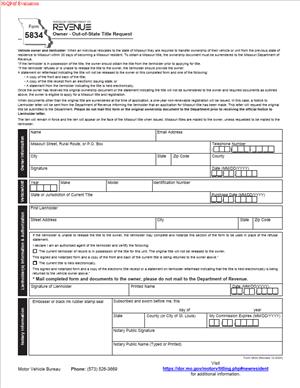
Form 5834 – Owner – Out-of-State Title Request
Fill out nowJurisdiction: Country: United States | Province or State: Missouri
Form 5834 – Owner – Out-of-State Title Request is used when you need the Missouri Department of Revenue to handle a vehicle title issue involving another state. You are usually asking Missouri to request, confirm, or process a title record that is not currently in Missouri’s system.
You might be moving to Missouri, buying a vehicle that was last titled elsewhere, or resolving a title problem that crosses state lines. This form helps start that process in an official way.
If you are filling out Form 5834 – Owner – Out-of-State Title Request, you are likely trying to register or title a vehicle in Missouri but cannot move forward without documentation from another state. The form gives Missouri permission and information to communicate about that title.
Understanding what the form does before you complete it can prevent delays. Small errors in vehicle information or ownership details often lead to rejected or stalled requests.
What is Form 5834 – Owner – Out-of-State Title Request?
Clear definition
Form 5834 – Owner – Out-of-State Title Request is a written request submitted by a vehicle owner asking Missouri to obtain or verify a title record from another state. It is part of the administrative process for transferring or confirming ownership when a vehicle’s official title was issued outside of Missouri.
The form typically collects identifying details about the vehicle and the current owner. This allows the Missouri Department of Revenue to locate the correct out-of-state record and coordinate with the issuing state.
It does not replace a vehicle title. Instead, it supports the process of issuing or transferring a Missouri title by addressing gaps in documentation.
Who typically uses this form?
You would use this form if you are the current owner of a vehicle and the title is held, issued, or recorded in another state. Most often, the person completing the form is an individual owner who recently moved to Missouri or purchased a vehicle from another state.
In some cases, co-owners listed on the out-of-state title may need to be involved. If the title lists more than one owner, the information on the request must match those ownership details.
Dealers and lienholders may also encounter similar processes, but this specific form is designed for an owner making the request. The person signing is usually the person whose name appears on the existing title record.
Why might you need this form?
You might need this form if you cannot present a valid out-of-state title when applying for a Missouri title. For example, the title may be lost, held by a lienholder, or not yet transferred into your name.
You may also need it if Missouri requires direct confirmation from the previous state before issuing a new title. This can happen when ownership history, lien status, or title branding must be verified.
If there is a delay in receiving your physical title from another state, this form can begin the process rather than waiting indefinitely. It helps Missouri confirm whether a valid title exists and what information is attached to it.
Typical real-life scenarios
- You move to Missouri from another state and bring your vehicle with you. When you try to title it in Missouri, you realize your previous state’s title is missing. You complete the form so Missouri can request title information directly from that state.
- You purchase a vehicle from a private seller who has recently moved. The seller says the title is from another state and has not yet been reissued locally. You need Missouri to verify the title record before transferring ownership into your name.
- Your vehicle was financed, and the lienholder is located in a different state. The title is still recorded there. The form may be used to coordinate confirmation of the existing title and lien details.
- You inherited a vehicle that was titled in another state. You now need to establish ownership in Missouri. The form helps initiate communication about the prior title record so the transfer process can move forward.
When would you use Form 5834 – Owner – Out-of-State Title Request?
You would use this form during the title application process in Missouri when something about the out-of-state title is missing or incomplete. It is often part of a larger submission that includes an application for title, identification, and possibly proof of ownership.
If you cannot produce the original out-of-state title document, this form may help fill that gap. It can also be relevant when the title is not yet in your name, but you have a bill of sale or other proof of transfer.
Timing matters. The form is generally used before a Missouri title is issued. It supports the review process and helps prevent the application from being denied due to missing out-of-state documentation.
You might also use it when Missouri requires written authorization to contact another state about your vehicle record. By signing the form, you provide identifying details and confirm your role as the owner.
If there are discrepancies between your paperwork and the out-of-state record, this form may be part of resolving those inconsistencies. For example, differences in the vehicle identification number or owner name may need clarification through official channels.
Legal characteristics of Form 5834 – Owner – Out-of-State Title Request
Form 5834 – Owner – Out-of-State Title Request is an administrative request. It becomes effective when it is properly completed, signed by the owner, and submitted as part of a title-related filing with the Missouri Department of Revenue.
For the form to be accepted, the information must match existing records as closely as possible. This includes the full vehicle identification number, correct owner names, and accurate details about the prior state of title. Errors in these areas often cause delays or rejections.
Signatures are important. If the out-of-state title lists multiple owners, all required parties may need to be reflected in the request. Inconsistent names, missing signatures, or incomplete fields can result in the form being returned for correction.
Each state has its own title system. While many states share similar processes, the exact steps and timelines for confirming a title may differ. Missouri may rely on the other state’s response before completing the title issuance.
This form does not transfer ownership by itself. It does not create a new title or remove a lien automatically. It supports the process by requesting information or documentation necessary for Missouri to act.
It also does not resolve disputes about ownership. If there is a conflict over who owns the vehicle, that issue must typically be addressed through separate procedures. The form assumes that you are the rightful owner, making a request related to your vehicle.
Is it legally binding?
The form is legally significant because you are making a formal statement as the vehicle owner. By signing, you confirm that the information provided is accurate to the best of your knowledge.
While it is not a contract between you and another private party, it is an official filing with a state agency. False or incorrect information can affect the outcome of your title application.
Its binding nature relates to the truthfulness of your statements and the authorization you give Missouri to request title information. Once submitted, it becomes part of your vehicle’s title record process.
However, the form does not guarantee that a Missouri title will be issued. It only initiates or supports the information-gathering step required before a final decision is made.
How to fill out Form 5834 – Owner – Out-of-State Title Request
Step 1 – Identify the vehicle
Enter the full vehicle identification number exactly as it appears on the vehicle and any available documents. Include the year, make, and model. Double-check each character in the VIN. A single incorrect digit can prevent the record from being located.
Step 2 – Provide owner information
Write your full legal name as it appears on the out-of-state title or ownership record. Include your current mailing address and any other contact details requested. If there are co-owners listed on the prior title, make sure those names are reflected as required on the form.
Step 3 – State the prior title jurisdiction
Indicate the state where the vehicle was last titled. Be precise. If the vehicle has been in more than one state, use the state that issued the most recent title. This helps Missouri direct the request correctly.
Step 4 – Explain the reason for the request
Complete any section asking why the out-of-state title information is needed. Keep your explanation clear and factual. For example, note that the title is lost, held by a lienholder, or needed for Missouri titling purposes.
Step 5 – Review for accuracy
Read through the entire form before signing. Confirm that the VIN, owner names, and prior state information are consistent with your other documents. Correct any spelling errors or missing fields to reduce processing delays.
Step 6 – Sign and date the form
Sign your name in the space provided using your legal signature. Enter the date of signing. If multiple owners are required to sign, ensure each person signs in the appropriate place. Once signed, the form is ready to be submitted as part of your title application process.
Legal terms you might encounter in Form 5834 – Owner – Out-of-State Title Request
- Certificate of Title: This is the official document that proves ownership of a vehicle. In this form, you are requesting action related to a title issued outside the state. You must accurately reference the existing title information so the record can be located and verified.
- Out-of-State Title: This refers to a vehicle title issued by another state. The form centers on this document. You will need to provide details from that prior title, including the issuing state and title number, if available.
- Vehicle Identification Number (VIN): The VIN is a unique 17-character code assigned to your vehicle. This form requires you to enter it exactly as it appears on the vehicle and the prior title. A single incorrect digit can delay processing.
- Registered Owner: This is the person or entity currently listed as the legal owner on the title. The name you enter must match the name shown on the existing title. If ownership has changed, additional documentation may be required.
- Lienholder: A lienholder is a lender or entity that has a financial interest in the vehicle. If there is an active loan, the lienholder may hold the physical title. The form may require you to disclose lien information so that records can be updated properly.
- Assignment of Title: This is the section on a title where ownership is transferred from one party to another. If the out-of-state title has been assigned, you need to confirm whether the assignment is complete and properly signed.
- Odometer Disclosure: This is a written statement of the vehicle’s mileage at the time of transfer. While not always part of this request form itself, title transactions often require accurate mileage reporting. Be sure any related documents reflect consistent mileage.
- Signature Certification: When you sign the form, you are certifying that the information is true and correct. Your signature confirms that you are authorized to make the request. False statements can result in penalties or rejection of the request.
- Record Verification: This refers to the process of matching the information you provide with existing vehicle records. The department will use the VIN, owner name, and prior state details to verify accuracy before acting on your request.
FAQs
What information do I need from my out-of-state title to complete this document?
You need the vehicle identification number, the exact owner’s name as shown on the title, the title number if available, and the state that issued it. Pull the physical title or an official copy before you start. Do not rely on memory or registration cards alone, because small differences in spelling or numbers can cause rejection.
Do I need the original out-of-state title when submitting Form 5834 – Owner – Out-of-State Title Request?
In most cases, you should have access to the original title because the details must match exactly. If a lienholder holds the original, confirm the title number and ownership details with them before submitting this form. The processing office may require the original or additional documentation depending on your situation.
What if my name is spelled differently on the prior title than on my current identification?
Use the name exactly as it appears on the title in the owner information section. If your legal name has changed, you may need to provide documentation that explains the difference. Make sure supporting documents are consistent so the record can be matched without delay.
Can someone else sign this form on my behalf?
Only someone with legal authority can sign for you. If you are not signing personally, the signer must have documented authority, such as a power of attorney. The signature must clearly indicate the capacity in which the person is signing, so the request is not rejected.
What happens after I submit this document?
The information you provided will be reviewed against existing vehicle records. If everything matches, the request will be processed, and the title record will be updated or issued as requested. If there are inconsistencies, you may receive a notice asking for clarification or additional documents.
How do I know if my submission was accepted?
You should receive confirmation through the normal processing method, which may include a receipt, written notice, or issuance of a new title document. Keep copies of everything you submitted so you can reference the VIN and submission date if you need to follow up.
Do I need to complete this form if I already transferred my registration?
Registration and title are separate records. Even if you updated your registration, the title record may still need action. This form addresses the ownership document itself, not just license plates or registration status.
What if there is a lien listed on the out-of-state title?
If a lien is active, the lienholder may need to release it before a new title can be issued. Confirm whether a release document is required and ensure it matches the VIN exactly. Incomplete lien information is a common reason for delays.
Checklist: Before, During, and After Form 5834 – Owner – Out-of-State Title Request
Before
- Locate the original out-of-state title or an official copy.
- Verify the VIN directly from the vehicle dashboard or door frame.
- Confirm the exact spelling of the owner’s name on the title.
- Gather lienholder information, if any.
- Check for any prior assignments on the title.
- Ensure you have documentation for any name changes.
- Review instructions carefully for required attachments.
During
- Enter the VIN carefully, double-checking each character.
- Write the owner’s name exactly as shown on the title.
- Provide the issuing state and title number accurately.
- Explain the reason for the request clearly and briefly.
- Confirm all required fields are completed.
- Review signature requirements before signing.
- Sign and date the form in the correct location.
After
- Make a complete copy of the signed form for your records.
- Attach any required supporting documents.
- Submit the form using the approved filing method.
- Keep proof of submission, such as a receipt or tracking number.
- Monitor for written confirmation or returned documents.
- Respond promptly to any requests for additional information.
- Store the new title document in a secure location.
Common mistakes to avoid with Form 5834 – Owner – Out-of-State Title Request
- Mistake: Entering the VIN incorrectly because you copied it from memory, which leads to record mismatches and delays; do not forget to verify it directly from the vehicle and compare it to the title.
- Mistake: Using a nickname or shortened name instead of the exact legal name on the title, which causes processing rejection; do not forget to match the title word for word.
- Mistake: Leaving sections blank because you think they do not apply, which can result in the form being returned; do not forget to review each field and confirm whether it requires an entry.
- Mistake: Forgetting to include lien release documentation, often because you assume the loan is already paid off in the system, which can block issuance of a clear title; do not forget to obtain written proof of lien satisfaction.
- Mistake: Signing in the wrong place or failing to date the form, usually due to rushing, which can invalidate the request; do not forget to check the signature line carefully.
- Mistake: Submitting without keeping copies, which makes it harder to resolve disputes or follow up; do not forget to scan or photocopy everything before sending it.
What to do after filling out Form 5834 – Owner – Out-of-State Title Request
Once you complete the form, slow down and review it one more time. Errors caught now are much easier to fix than errors discovered after submission.
- Step 1: Compare the VIN on the form to the VIN on the vehicle and the out-of-state title.
- Step 2: Confirm the owner’s name matches the prior title exactly, including middle initials and suffixes.
- Step 3: Check that all required attachments are included, such as lien releases or name change documents.
- Step 4: Make a full copy of the signed form and every attachment for your records.
- Step 5: Submit the form using the accepted filing method, whether in person or by mail, and follow all submission instructions.
- Step 6: Obtain proof of submission, such as a dated receipt or delivery confirmation.
- Step 7: Track the expected processing time and mark a reminder on your calendar.
- Step 8: Respond promptly if you receive a notice requesting additional information or corrections.
- Step 9: Once you receive confirmation or a new title document, review it immediately for accuracy.
- Step 10: Store the updated title in a secure location, such as a safe or locked file, and update your personal vehicle records.
Staying organized is key. Keep a folder, physical or digital, that contains the completed form, copies of the prior title, proof of submission, and any correspondence. This record will help you quickly resolve questions about ownership or title status in the future.
If you later sell or transfer the vehicle, accurate title records will make that process smoother. Taking a few extra minutes now to ensure everything is correct can prevent weeks of delay later.
Disclaimer: This guide is provided for informational purposes only and is not intended as legal advice. You should consult a legal professional.