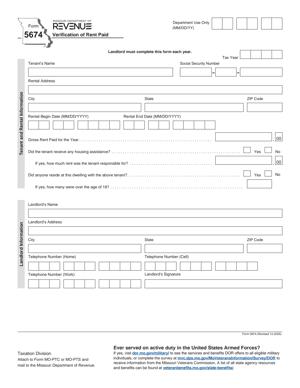
Form 5674 – Verification of Rent Paid
Fill out nowJurisdiction: Country: United States | Province or State: Missouri
Form 5674 – Verification of Rent Paid is a document used to confirm how much rent you paid during a specific tax year. It is often connected to state tax filings and credits related to property taxes. If you are preparing your Missouri state tax return and claiming a credit tied to rent, this form helps support your claim.
You may be asked to complete this form if you rented your home and want to claim a property tax credit available to certain residents. The form verifies the amount of rent you paid and includes details about your landlord and the rental property.
This document matters because tax credits can lower the amount of tax you owe or increase your refund. If the information about your rent is missing or unclear, your credit may be delayed or denied. Form 5674 – Verification of Rent Paid helps confirm that your claim matches the rental history.
You might fill out this form yourself and then have your landlord complete and sign part of it. In many cases, both the tenant and the landlord provide information. The completed form is then submitted with your Missouri income tax filing or kept for records, depending on the situation.
If you are self-represented and preparing your own return, understanding what this form asks for can save time. It also reduces the risk of errors that could slow down processing.
What is Form 5674 – Verification of Rent Paid?
Clear definition
Form 5674 – Verification of Rent Paid is a Missouri Department of Revenue form used to confirm the total rent paid by a tenant during a specific calendar year. It serves as written verification that rent was paid for a particular property and for a certain period.
The form typically includes the tenant’s name, the address of the rental property, the total amount of rent paid, and the landlord’s name and signature. It acts as supporting documentation for tax purposes rather than as a lease or rental agreement.
This form does not create a rental relationship. It only documents that one already existed and that rent payments were made.
Who typically uses this form?
Tenants who rented a home, apartment, or other dwelling in Missouri during the tax year often use this form. It is commonly used by individuals seeking a property tax credit based on rent paid.
Landlords are also involved. They usually complete a portion of the form to verify the amount of rent received and confirm the rental details. This may include private landlords as well as property management companies.
In some cases, caregivers or family members assisting an elderly or disabled tenant may help gather the information and coordinate with the landlord. The key participants are the tenant claiming the credit and the person or entity that received the rent.
Why might you need this form?
You may need this form if you are claiming a Missouri property tax credit as a renter. The state may require proof of the total rent paid during the year to calculate your eligibility and credit amount.
Without verification, your tax filing may be incomplete. The credit calculation often depends on the total rent paid, so accurate reporting is important.
This form can also help resolve questions if the state reviews your return. Having a signed verification from your landlord provides written confirmation of the rent amount and rental period.
Even if not submitted immediately, the form can serve as documentation if you are asked to provide proof later.
Typical real-life scenarios
- You rented an apartment for the entire year and want to claim a property tax credit on your Missouri tax return. You complete your portion of the form and ask your landlord to verify the total rent paid.
- You moved during the year and rented two different properties. You may need separate verification for each address, covering the specific months you lived at each location.
- You live in a senior housing community and pay monthly rent. To claim a credit, you request that the housing office complete and sign the verification form for the year.
- You rent from an individual landlord who does not provide annual statements. Instead of relying on personal records alone, you use this form to obtain formal confirmation of the total amount paid.
- You share a rental home with roommates. If you are claiming a credit based only on your portion of the rent, the form may need to reflect your share and the time you lived there.
When would you use Form 5674 – Verification of Rent Paid?
You would use Form 5674 – Verification of Rent Paid when preparing your Missouri state income tax return and claiming a renter-related property tax credit. It is most often used during tax season, after the end of the calendar year.
The form becomes relevant once you determine that you meet the income and residency requirements for the credit. At that point, you need documentation showing how much rent you paid during the year.
You may also use the form if the state requests additional documentation after reviewing your tax filing. In that situation, it serves as supporting proof rather than as part of the initial submission.
If you lived in more than one rental property during the year, you might use multiple forms. Each form would correspond to a different address and landlord.
Tenants who paid rent for only part of the year may still use the form. The document can reflect partial-year occupancy and prorated rent amounts.
Landlords use the form when a tenant asks them to verify rent paid. Their role is to confirm the accuracy of the information and provide a signature.
Legal characteristics of Form 5674 – Verification of Rent Paid
Form 5674 – Verification of Rent Paid is an official state tax document. Its effectiveness depends on accurate, complete information and proper signatures. Missing fields or unclear amounts can cause processing delays.
The form generally requires identifying details for both the tenant and the landlord. This may include names, addresses, and tax identification information. If these details do not match other records, the filing may be questioned.
Accuracy is critical. The total rent paid must reflect actual payments for the specific tax year. Overstating or understating the amount can affect the credit calculation and may trigger a follow-up review.
Common problems include unsigned forms, incorrect property addresses, and mismatched dates. Forms that do not clearly show the rental period may be considered incomplete.
In Missouri, this form relates to a state tax credit. Other states may have similar but different forms. The structure and requirements can vary by jurisdiction. The Missouri version is specific to the Missouri Department of Revenue.
This document does not replace a lease. It does not prove legal ownership of property. It also does not resolve disputes between tenants and landlords. Its purpose is limited to verifying rent paid for tax purposes.
Is it legally binding?
Form 5674 – Verification of Rent Paid can carry legal weight because it is signed and submitted in connection with a tax filing. When you and your landlord sign the form, you are affirming that the information is accurate to the best of your knowledge.
Providing false information on a tax-related document can have legal consequences. The form is part of a tax process, and statements made on it may be treated as official representations.
However, the form does not create new legal obligations between you and your landlord. It does not change the terms of your lease. It simply records what already occurred during the rental period.
Its binding nature relates to the truthfulness of the information provided, not to the rental relationship itself.
How to fill out Form 5674 – Verification of Rent Paid
Step 1 – Enter the tenant’s personal information
Start by filling in your full legal name as it appears on your tax return. Include your current mailing address and any other identifying details requested on the form. Make sure the information matches your Missouri income tax filing.
If the form asks for a Social Security number or other identification number, enter it carefully and double-check for accuracy. Errors in identifying information can delay processing.
Step 2 – Provide the rental property address
Enter the complete address of the rental property for which you are claiming rent paid. This should include the street number, street name, apartment or unit number if applicable, city, state, and ZIP code.
If you lived at more than one address during the year, complete a separate form for each property, unless the form clearly allows multiple addresses.
Step 3 – State the rental period
Indicate the exact dates you rented the property during the tax year. This may include the full year from January through December or only specific months.
Be precise about move-in and move-out dates if you did not occupy the property for the entire year. The rental period should align with the rent amount you report.
Step 4 – Enter the total rent paid
Calculate the total amount of rent you paid for the rental period during the tax year. Include only rent payments, not utility bills, security deposits, or other fees unless the form specifically instructs otherwise.
Use your payment records, receipts, or bank statements to determine the correct total. Enter the amount clearly and review your math before moving on.
Step 5 – Landlord information
Provide the full name of your landlord or the property management entity that received your rent. Include the landlord’s address and any other identifying information requested.
This information allows the state to verify that the rental payments were made to a legitimate property owner or manager.
Step 6 – Landlord verification and signature
Give the form to your landlord to complete their portion. The landlord will confirm the total rent received and verify the rental period.
The landlord must sign and date the form where indicated. Without this signature, the verification may be considered incomplete.
Step 7 – Review the completed form
After the landlord signs, review the entire form. Confirm that all fields are filled in, dates are correct, and amounts match your records.
Check that both you and the landlord have signed and dated the document if required. Make sure there are no blank sections that were meant to be completed.
Step 8 – Submit or retain with your tax filing
Attach the completed form to your Missouri income tax return if required, or keep it with your records if you are instructed to retain it. Ensure that it corresponds to the tax year for which you are claiming the credit.
Store a copy for your records in case questions arise later about your rent payments or credit calculation.
Legal terms you might encounter in Form 5674 – Verification of Rent Paid
- Tenant: The person who rented and occupied the property. In this document, you are usually the tenant requesting verification. Your name must match your tax return and other official records.
- Landlord: The individual or business entity that owns the rental property and collects rent from you. The landlord completes and signs the verification section. The form relies on the landlord’s certification of the amounts you paid.
- Rental Property Address: The full street address of the unit you rented, including apartment or unit number. This identifies the exact location connected to the rent payments. Accuracy matters because it ties your payment history to a specific property.
- Rental Period: The dates during which you occupied the property and paid rent. This may be a full calendar year or part of a year. The period listed must match the time frame relevant to your tax filing.
- Total Rent Paid: The full amount of rent you actually paid during the stated rental period. This does not include utilities or security deposits unless specifically required. The number should reflect only rent payments made and received.
- Certification: A formal statement by the landlord that the information provided is true and correct. When the landlord signs, they are confirming the accuracy of the rent amount and dates. This carries legal weight because it supports a tax-related claim.
- Signature: The handwritten or legally accepted electronic signature of the landlord. A signature shows that the landlord reviewed and approved the information. An unsigned document may not be accepted.
- Tax Year: The specific year for which you are reporting income and claiming any rent-related credit or benefit. The rental period listed should correspond to this year. Mismatched years can delay processing.
- Supporting Documentation: Additional records such as rent receipts, canceled checks, or a lease agreement. While not always submitted with this document, you may need them if the information is questioned. Keep them in case you must confirm details later.
FAQs
What if my landlord refuses to complete or sign this form?
You cannot complete the landlord’s certification yourself. This document requires the landlord’s verification of the rent you paid. If the landlord refuses, you should gather alternative proof such as receipts, canceled checks, or bank statements and consider requesting written confirmation. An unsigned form may not be accepted for processing.
Can I submit Form 5674 – Verification of Rent Paid with estimated rent amounts?
No. You should only report the exact amount of rent you actually paid during the stated period. Estimates can cause discrepancies with your tax filing and may trigger a request for clarification. Review your lease and payment records before entering the total.
Do I include utilities, late fees, or a security deposit in the total rent paid?
Only include the base rent you paid for occupying the property unless the instructions specifically state otherwise. Utilities, parking fees, and deposits are usually separate from rent. Check your lease to separate rent from other charges before calculating the total.
What if I moved during the year and rented more than one place?
You generally need a separate verification for each rental address. Each landlord must confirm the rent paid for the period you lived at that property. Make sure the rental periods do not overlap and that the totals reflect only the months you occupied each unit.
Does the rental period have to match the full tax year?
Not always. If you moved in or out during the year, the rental period can cover only part of the year. The key is that the dates on this document align with the portion of the year you actually rented and paid rent.
What happens if my name on this document does not exactly match my tax return?
Inconsistent names can cause processing delays. The name listed should match your tax filing and identification records. If you recently changed your name, ensure all documents reflect the same version or include documentation that explains the change.
Can a property manager sign instead of the owner?
Yes, if the property manager is authorized to act on behalf of the landlord. The person signing should have the authority to verify rent payments. Their title or role should be clear so the verification is not questioned.
How do I know if my submission was accepted?
Acceptance usually depends on whether the information is complete and matches your tax return. If there is a problem, you may receive a notice requesting clarification or additional documents. Keep a copy of the completed Form 5674 – Verification of Rent Paid so you can respond quickly if needed.
Checklist: Before, During, and After Form 5674 – Verification of Rent Paid
Before
- Confirm the correct tax year you are filing for.
- Gather your lease agreement for the rental period.
- Collect rent receipts, bank statements, or canceled checks.
- Verify your landlord’s current contact information.
- Confirm the exact move-in and move-out dates.
- Check that your name matches your tax records.
- Review prior tax filings to ensure consistency.
- Clarify with your landlord who will sign the form.
During
- Print clearly or type all information.
- Enter the full rental property address, including unit number.
- List the correct rental period without gaps or overlaps.
- Calculate total rent paid using actual payment records.
- Exclude non-rent charges from the total.
- Provide accurate landlord details.
- Ensure the landlord reviews the completed information.
- Confirm the landlord signs and dates the form.
After
- Make a copy of the signed document for your records.
- Attach it to your tax return if required.
- Store supporting documents with the copy.
- Double-check that the amounts match your tax filing.
- Monitor for any follow-up correspondence.
- Respond promptly if additional verification is requested.
- Keep the form and records for several years.
- Update your personal records to reflect submission.
Common mistakes to avoid with Form 5674 – Verification of Rent Paid
- Mistake: Listing estimated rent instead of actual payments, which happens when you do not review receipts, leading to discrepancies and possible delays; do not forget to total only documented payments.
- Mistake: Including utilities or deposits in the rent total because they appear on the same invoice, which can inflate the reported amount and cause rejection; do not forget to separate base rent from other charges.
- Mistake: Using the wrong rental period due to memory errors, which creates mismatches with your lease and tax year; do not forget to verify the exact move-in and move-out dates.
- Mistake: Submitting the document without a landlord’s signature because you are in a hurry, which can make it invalid; do not forget that certification requires an authorized signature.
- Mistake: Misspelling your name or listing a different version than on your tax return, which may delay processing; do not forget to match your official records exactly.
- Mistake: Forgetting to keep a copy because you assume it will not be needed again, which leaves you unprepared if questions arise; do not forget to store a complete copy with supporting documents.
- Mistake: Providing incomplete landlord information, often due to outdated contact details, which may prevent verification; do not forget to confirm current and accurate information.
- Mistake: Combining rent from multiple properties on one form, which confuses the record of payments; do not forget to use separate verifications for each address.
What to do after filling out Form 5674 – Verification of Rent Paid
Once the form is complete and signed, your focus shifts to proper submission and recordkeeping. Treat this as part of your tax file, not a standalone document. Organization now prevents stress later.
- Step 1: Review every entry one more time for accuracy, including names, dates, and totals.
- Step 2: Confirm the landlord’s signature and date are present and legible.
- Step 3: Make at least one clear copy for your personal records.
- Step 4: Attach the document to your tax return if it must be submitted together.
- Step 5: If filing electronically, follow the instructions for submitting supporting documents.
- Step 6: Store the original signed form in a safe place with your lease and payment records.
- Step 7: Mark your calendar to watch for any correspondence related to your filing.
- Step 8: Respond quickly if you receive a request for clarification or additional proof.
- Step 9: Keep all related documents organized by tax year.
- Step 10: Update your personal financial records to reflect that the verification was completed and submitted.
After submission, monitor your tax processing status. If you receive a notice questioning the rent amount, compare it to your copy of the form and your payment records before responding. Clear documentation makes it easier to resolve issues.
Keep the document for future reference. Tax authorities may review past filings, and having organized records supports your position. A complete and accurate verification helps ensure that your rent information is properly reflected in your tax matters.
Disclaimer: This guide is provided for informational purposes only and is not intended as legal advice. You should consult a legal professional.