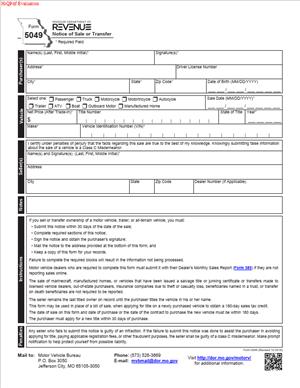
Form 5049 – Notice of Sale or Transfer
Fill out nowJurisdiction: Country: United States | Province or State: Missouri
Form 5049 – Notice of Sale or Transfer is a document used to report that ownership of a vehicle or certain titled property has changed. In Missouri, this filing is connected to records maintained by the Department of Revenue.
If you are selling a vehicle, trading it in, or otherwise transferring ownership, this form creates an official record of that change. It tells the state that you are no longer the owner as of a specific date.
Many people complete Form 5049 – Notice of Sale or Transfer when they want to protect themselves from future liability. Once the vehicle is out of your possession, you do not want tickets, toll violations, or other issues linked back to you.
This form matters because state records often continue to show the last titled owner until a new title is issued. Filing this notice helps close the loop on your side of the transaction.
You are likely reading this because you are about to complete the form and want to understand what information it requires and how it works. The sections below walk you through what it is, when it is used, and how to fill it out carefully.
What is Form 5049 – Notice of Sale or Transfer?
Clear definition
Form 5049 – Notice of Sale or Transfer is a written notice submitted to the Missouri Department of Revenue to report that a vehicle has been sold, assigned, gifted, or otherwise transferred to another party.
It is not the title itself. It does not replace signing over the certificate of title. Instead, it serves as a separate notification that ownership has changed as of a certain date.
The form typically includes details about the seller, the buyer, and the vehicle. This may include names, addresses, vehicle identification number (VIN), and the date of sale or transfer.
When completed and submitted, it updates the state’s internal record to reflect that you reported the transfer. It creates a paper trail tied to a specific vehicle and date.
Who typically uses this form?
The most common user is a private vehicle owner who has just sold a car, truck, motorcycle, or other titled vehicle. After signing over the title, that person completes this form to notify the state.
Dealers may also handle similar notifications as part of their transaction process. However, private individuals are often responsible for filing the notice when they sell directly to another person.
You might also use this form if you transfer ownership to a family member, give a vehicle as a gift, or move ownership into or out of a business name.
In some situations, a personal representative or other authorized person may complete the form when handling an estate or similar matter involving a vehicle.
Why might you need this form?
You may need this form to protect yourself from future problems tied to a vehicle you no longer own. State databases can lag behind real-life transactions.
If a buyer delays retitling the vehicle, the previous owner may still appear in state records. During that time, automated systems may connect parking tickets, toll violations, or other notices to the last recorded owner.
Filing Form 5049 – Notice of Sale or Transfer documents the date you transferred the vehicle. That date can become important if questions arise later.
The form also helps maintain accurate state records. Clear ownership records support proper registration, taxation, and enforcement processes.
Typical real-life scenarios
- You sell your car to a neighbor for cash. You both sign the title and exchange payment. After the buyer drives away, you complete the notice to formally report the sale.
- You trade in your vehicle at a dealership when purchasing a new one. Even if the dealer handles paperwork, you may want to understand how the transfer is recorded and whether a notice is filed.
- You give a vehicle to your adult child. Although no money changes hands, ownership still transfers. The form can document the date and parties involved.
- You sell a motorcycle online to someone from another part of Missouri. You meet, sign the title, and complete a bill of sale. Filing the notice helps ensure the state records reflect the transfer date.
- You move a vehicle from your personal name into a business entity. Even though you control both, it is still a legal change in ownership. The notice reflects that shift.
- You handle a vehicle as part of settling a family member’s estate. Once the vehicle is transferred to a new owner, the change can be reported through this filing.
When would you use Form 5049 – Notice of Sale or Transfer?
You generally use this form right after a vehicle is sold or otherwise transferred. Timing matters because the purpose is to document the transfer date as accurately as possible.
If you have just signed the certificate of title over to another person, this is typically when you prepare and submit the notice. It works alongside the title transfer, not in place of it.
You might also use the form if a vehicle is donated or gifted. Even without payment, the change in legal ownership is significant.
If you no longer have possession of the vehicle and want to formally notify the state that it is no longer yours, this document is commonly used for that purpose.
In some cases, a lender payoff and sale occur at the same time. Once ownership passes to the buyer, the seller may complete this notice to clarify the end of their ownership interest.
People sometimes realize months later that a buyer never retitled the vehicle. In that situation, submitting the form can help establish when you parted with the vehicle, though specific outcomes depend on the facts and timing.
If you are the buyer, you generally focus on applying for a new title and registration. The notice of sale or transfer is more often associated with the seller’s side of the transaction.
Legal characteristics of Form 5049 – Notice of Sale or Transfer
This form is an official state document. Its effectiveness depends on accurate and complete information. Missing or incorrect details can delay processing or reduce its usefulness.
To be valid, the form usually requires clear identification of the vehicle. The VIN is critical. An error in even one character can cause the notice to be linked to the wrong record or rejected.
The names and addresses of the parties must match the transaction details. If the seller’s name does not align with the name on the title, that mismatch can create complications.
The date of sale or transfer is also a key element. This date establishes when your responsibility as owner ended, at least from a reporting standpoint.
High-level differences can exist between states in how notices of sale are treated. Some states impose strict deadlines, while others focus more on title processing. In Missouri, the form is tied to the state’s vehicle titling and registration system.
This document does not transfer ownership by itself. Signing and delivering the title is what typically conveys ownership. The notice is a reporting mechanism.
It also does not cancel insurance automatically. Insurance cancellation is usually handled separately through your insurer.
The form does not erase prior obligations tied to the period when you owned the vehicle. It mainly addresses future issues that arise after the transfer date.
Common problems include illegible handwriting, incomplete buyer information, or failure to sign where required. These issues can reduce the clarity or effectiveness of the filing.
If the form is submitted with inconsistent dates compared to the title or bill of sale, that inconsistency can raise questions. Keeping dates aligned across documents helps maintain a clear record.
Is it legally binding?
Form 5049 – Notice of Sale or Transfer is legally significant as an official notice to a state agency. By signing it, you are typically affirming that the information provided is true and correct to the best of your knowledge.
It does not function as a contract between you and the buyer. The sales agreement or signed title governs the transfer of ownership. The notice simply reports that transfer.
Once submitted and accepted, it becomes part of the state’s records. That record can be referenced if disputes arise about when ownership changed.
Its legal effect is tied to accurate reporting. If the information is false or misleading, the form may not provide the protection you expect and could create additional problems.
In short, it is legally meaningful as a statement to the state, but it does not replace other required steps in the sale or transfer process.
How to fill out Form 5049 – Notice of Sale or Transfer
Step 1 – Review the Entire Form Before Writing
Start by reading the entire form from top to bottom. This gives you a clear picture of the information required and helps you gather documents before you begin.
Have the vehicle title, bill of sale if available, and any buyer contact information nearby. Double-check the VIN directly from the vehicle or title to reduce errors.
Understanding each section in advance helps you complete the form in one sitting and avoid corrections.
Step 2 – Enter Vehicle Information
Locate the section that asks for vehicle details. This typically includes the vehicle identification number, year, make, and model.
Write the VIN carefully, character by character. Many VINs contain both letters and numbers that look similar. Take your time to ensure accuracy.
Include any additional identifying details requested. These details connect your notice to the correct vehicle record in the state system.
Step 3 – Provide Seller Information
In the seller section, enter your full legal name as it appears on the title. If there are multiple owners listed on the title, include all required names.
Provide your current mailing address. This allows the agency to contact you if there are questions about the submission.
If the form asks for a driver’s license number or other identifying information, enter it exactly as shown on your identification document.
Ensure the information matches what appears on the title. Inconsistencies can slow processing.
Step 4 – Provide Buyer Information
Enter the buyer’s full name as provided at the time of sale. Accuracy here is important because it links the vehicle to the next owner.
Include the buyer’s address if the form requests it. Use the address given during the transaction.
If more than one buyer is listed on the title transfer, provide all required names in this section.
Even though you are not responsible for the buyer’s future filing, clear information helps complete the ownership chain in state records.
Step 5 – Enter the Date of Sale or Transfer
Locate the section asking for the date the vehicle was sold or transferred. Use the exact date the title was signed over or possession changed hands.
Write the date in the format requested on the form. Be consistent with the date shown on the title and any bill of sale.
This date is central to the notice. It establishes when you reported the end of your ownership.
Take a moment to confirm the date before moving forward. An incorrect date can create confusion later.
Step 6 – Review for Accuracy and Completeness
Before signing, read through every field you completed. Check names, numbers, and the VIN again.
Make sure no required sections are left blank. If a section does not apply, follow any instructions on the form for indicating that.
Confirm that handwriting is legible. If the form is filled out electronically, ensure all entries are clear and properly formatted.
A careful review reduces the chance that the notice will be rejected or questioned.
Step 7 – Sign and Date the Form
Sign your name in the designated signature area. Use the same form of your name that appears on the title.
Add the date of signing if required. This may be different from the date of sale.
Your signature confirms that the information provided is true to the best of your knowledge. Do not sign until you have verified all entries.
If multiple sellers are listed, each person may need to sign, depending on the instructions on the form.
Step 8 – Submit the Form as Directed
Follow the submission instructions provided on the form. This may include mailing it to a specific address or delivering it to an appropriate office.
Ensure that you use the correct version of the form and send it to the correct destination listed in the instructions.
If mailing, consider keeping a copy of the completed document for your records. A copy can help you reference the information later if needed.
After submission, retain any confirmation or proof of delivery associated with your filing.
Step 9 – Keep Your Records Organized
Store a copy of the completed form along with the bill of sale and any related paperwork. Keep these documents in a safe place.
Organized records make it easier to respond if questions arise about the sale or transfer date.
Having all documents together also helps if you need to reference the transaction for tax, insurance, or personal record purposes.
Taking a few extra minutes to file your paperwork properly can save time and stress in the future.
Legal terms you might encounter in Form 5049 – Notice of Sale or Transfer
- Transferor: This is the person or entity who is giving up ownership of the vehicle. In this document, you are the transferor if you are the seller. Your legal name must match the name that appears on the vehicle title.
- Transferee: This is the person or entity receiving ownership of the vehicle. You will list the buyer’s full legal name and address. The details you enter here are used to show who took control of the vehicle after the sale date.
- Vehicle Identification Number (VIN): The VIN is a unique 17-character code assigned to the vehicle. You must enter it exactly as it appears on the title or registration. Even one incorrect digit can cause the notice to be rejected or misapplied.
- Date of Sale: This is the exact calendar date when ownership changed hands. It is not the date you complete the form unless both events happened on the same day. This date establishes when your responsibility for the vehicle ends.
- Odometer Reading: This is the vehicle’s mileage at the time of sale. Some transactions require this information for recordkeeping. Make sure the number reflects the actual reading on the dashboard at transfer.
- Legal Owner: This refers to the person or entity listed on the title as the official owner. If more than one owner is listed, all required owners may need to sign. The names on this form should match the title exactly.
- Lienholder: A lienholder is a lender or financial institution that has a financial interest in the vehicle. If a lien exists, it may affect how the transfer is processed. You must be clear about whether the lien has been satisfied before the sale.
- Signature: Your signature confirms that the information provided is true and accurate. By signing, you certify that you are the lawful owner or authorized representative. An unsigned form may not be accepted.
- Notice: In this context, a notice is a formal statement filed with a government agency. It informs the agency that a change in ownership occurred. Filing this notice helps update official records and limit your future liability.
- Record of Sale: This is the official documentation that shows the vehicle changed owners. The completed form becomes part of the state’s record. It helps clarify who is responsible for the vehicle after the listed sale date.
FAQs
What information do I need in front of me before I start filling this document out?
You should have the vehicle title, the VIN, the exact date of sale, the buyer’s full legal name and address, and the current odometer reading. Check that the name on the title matches your identification. If there are multiple owners listed, confirm who must sign before you begin.
What if I made a small mistake while completing this form?
Do not ignore it. If you have not submitted it yet, complete a new, clean copy to avoid confusion. If it has already been filed, you may need to submit a corrected notice so the record reflects the accurate VIN, date, or buyer information.
Does this form transfer the title to the buyer?
No. This document notifies the state that you sold or transferred the vehicle. The title transfer is a separate process that the buyer typically completes to register the vehicle in their name.
What happens if I do not file Form 5049 – Notice of Sale or Transfer?
If you do not file it, the state’s records may still show you as the owner. That can create problems if the vehicle is involved in traffic violations, parking tickets, towing, or accidents after the sale. Filing the notice helps show the exact date your ownership ended.
How do I know if the agency accepted my submission?
After you submit this document, look for confirmation such as a receipt, stamped copy, or other acknowledgment. If you file electronically, save the confirmation number or email. Keep proof that you submitted it in case questions arise later.
What if the buyer’s name on this form does not exactly match their identification?
Use the buyer’s full legal name as it appears on their government-issued identification. Avoid nicknames or shortened versions. Incorrect spelling or missing middle initials can cause mismatches in the public record.
Do all owners listed on the title need to sign this document?
If multiple owners are listed on the title, check how the names are connected, such as with “and” or “or.” If joint owners are required to act together, each must sign. Make sure every required signature is included before submission.
Can I file this document after the sale date has already passed?
Yes, but you should file it as soon as possible. Enter the actual date the vehicle changed hands, not the date you are completing the form. The recorded sale date determines when your responsibility for the vehicle ended.
Checklist: Before, During, and After Form 5049 – Notice of Sale or Transfer
Before
- Confirm the vehicle title is in your name.
- Locate the full 17-character VIN.
- Verify the buyer’s full legal name and current address.
- Record the exact date of sale.
- Write down the odometer reading at the time of transfer.
- Check whether a lien has been released, if applicable.
- Review how many owners are listed on the title.
- Make sure you have valid identification available.
During
- Print clearly using black or blue ink if completing by hand.
- Enter the VIN carefully, double-checking each character.
- Match your name exactly to the title.
- Enter the buyer’s information without abbreviations.
- Provide the correct date of sale.
- Review each field before moving to the next.
- Ensure all required owners sign.
- Confirm the signature matches the printed name.
After
- Make a full copy of the completed form for your records.
- Submit the form using the accepted filing method.
- Keep any proof of submission or confirmation.
- Store your copy with the bill of sale and title records.
- Monitor mail for any follow-up notice.
- Update your personal records to show the vehicle was sold.
- Cancel or adjust insurance coverage as appropriate.
- Keep documents in a safe place for future reference.
Common mistakes to avoid with Form 5049 – Notice of Sale or Transfer
- Mistake: Entering an incorrect VIN because of a typo or misreading a character, which can cause the notice to apply to the wrong vehicle or be rejected, so do not forget to compare the VIN to the title character by character.
- Mistake: Using a nickname or incomplete legal name for the buyer because it seems informal or faster, which can create record mismatches and processing delays, so do not forget to use the full legal name exactly as shown on identification.
- Mistake: Listing the wrong sale date because you are filling out the form days later, which can affect liability timelines, so do not forget to enter the actual date ownership changed hands.
- Mistake: Forgetting a required signature when multiple owners are listed, which can make the submission invalid, so do not forget to check the title and obtain every necessary signature.
- Mistake: Leaving sections blank because they seem unimportant, which can lead to rejection or requests for correction, so do not forget to complete every required field clearly.
- Mistake: Failing to keep a copy after submission because you assume it will not be needed, which leaves you without proof of notice, so do not forget to make and store a complete copy for your records.
- Mistake: Submitting the form late because you think the buyer is responsible for all paperwork, which can leave you exposed to liability, so do not forget that filing the notice is your responsibility as the seller.
- Mistake: Ignoring confirmation of acceptance because you assume filing is automatic, which can result in unresolved record issues, so do not forget to verify that your submission was received and processed.
What to do after filling out Form 5049 – Notice of Sale or Transfer
Once you complete the form, your next steps matter just as much as the information you entered. The goal is to make sure the change in ownership is properly recorded and that you have proof of it.
- Step 1: Review the entire document one final time for accuracy.
- Step 2: Make at least one clear copy of the signed form for your records.
- Step 3: Submit the original form using the approved filing method, such as mail, in person, or any authorized electronic system.
- Step 4: Obtain proof of submission, such as a dated receipt, confirmation page, or tracking information.
- Step 5: Store your copy together with the bill of sale and any title transfer documents.
- Step 6: Check your mail or account notifications for confirmation that the notice was processed.
- Step 7: Update your personal records to show the vehicle is no longer in your name.
- Step 8: Adjust or cancel your insurance coverage for the sold vehicle once the transfer is complete.
- Step 9: Keep all sale-related documents for several years in case questions arise about tickets, tolls, taxes, or accidents tied to the vehicle.
- Step 10: Respond promptly if the agency contacts you about missing or unclear information so the public record stays accurate.
These steps protect you. They create a clear paper trail showing when you transferred ownership. If an issue comes up later, you will have organized, dated proof that you acted properly and on time.
Disclaimer: This guide is provided for informational purposes only and is not intended as legal advice. You should consult a legal professional.