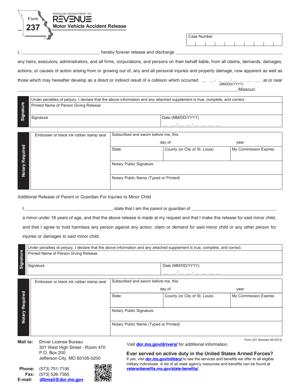
Form 237 – Motor Vehicle Accident Release
Fill out nowJurisdiction: Country: United States | Province or State: Missouri
If you are resolving a car accident claim in Missouri, you may come across Form 237 – Motor Vehicle Accident Release. This document is used when one party agrees to release another party from further claims related to a specific motor vehicle accident.
Form 237 – Motor Vehicle Accident Release is often part of settling property damage or injury claims. It confirms that payment or another form of compensation has been accepted. In exchange, the injured or affected party agrees not to pursue additional claims arising from the same incident.
You are likely reviewing this form because money has changed hands, or is about to. Before signing, it helps to understand what the document does and what rights it affects. Once signed, it can limit your ability to seek more compensation for the same accident.
This guide explains what the form is, when it is used, and how to complete it clearly and accurately. The goal is to help you understand what you are filling out and why each section matters.
What is Form 237 – Motor Vehicle Accident Release?
Clear definition
Form 237 – Motor Vehicle Accident Release is a written agreement that documents the settlement of claims resulting from a motor vehicle accident. It states that one party, often called the “releasor,” releases another party, often called the “releasee,” from further liability related to the accident described in the form.
In simple terms, it is a promise. You acknowledge that you have received something of value, usually money, and in return, you agree not to bring additional claims for damages connected to that specific crash.
The form typically identifies the date of the accident, the people or entities involved, and the amount paid. It may also describe the vehicles and outline the scope of the release, such as whether it covers property damage, personal injury, or both.
Who typically uses this form?
This form is commonly used by drivers involved in an accident. It may also be used by vehicle owners if they are different from the drivers.
Insurance companies often prepare or request this document when settling a claim. However, private individuals can also use it when resolving a claim directly, without insurance involvement.
It may also be signed by passengers who are receiving compensation. In some situations, a business that owns a vehicle involved in the accident may be a party to the release.
Anyone who is giving up the right to pursue further legal action related to the accident is a potential signer of this form.
Why might you need this form?
You may need this form to finalize a settlement. Without a written release, a payment does not automatically prevent future claims. The release creates a record that the dispute has been resolved.
It protects the person or entity making the payment. Once the document is signed, they have written proof that the other party agreed not to sue or seek additional compensation for the same incident.
It also clarifies expectations. Both sides can see what is being resolved and what is not. This can reduce misunderstandings later.
In some situations, a release may be required before certain administrative matters are completed. For example, resolving liability questions may affect how accident reports or records are handled.
Typical real-life scenarios
- You were involved in a minor rear-end collision. The other driver’s insurance company agrees to pay for your vehicle repairs. Before issuing the check, they ask you to sign a release confirming that you will not pursue additional property damage claims related to that accident.
- You and another driver decide to settle privately. The damage is limited to a dented bumper. The other driver offers a set amount of money to cover repairs. You both sign a release so that neither of you brings further claims after payment is made.
- You were injured in an accident and received medical treatment. After negotiations, you accept a lump-sum settlement for your medical bills and related expenses. As part of the agreement, you sign a release covering all personal injury claims arising from the crash.
- A vehicle owned by a small business was involved in an accident with a delivery truck. The parties agree on compensation for the damaged vehicle. The business signs a release confirming that it will not pursue further property damage claims connected to the incident.
- In each situation, the release documents that the matter has been resolved and closes the claim between the named parties.
When would you use Form 237 – Motor Vehicle Accident Release?
You would use this form when a claim related to a motor vehicle accident has been settled, and the parties want written confirmation of that settlement. It is typically used after the amount of compensation has been agreed upon.
This can occur after negotiations between drivers. It may also follow discussions between insurance adjusters and claimants. Once both sides agree on payment terms, the release is signed as part of finalizing the agreement.
The form is often used when payment is made in a single lump sum. It may also be used when a check is issued with the understanding that cashing it is part of the settlement process.
You might encounter this form if you are the person receiving money for damage or injury. You might also see it if you are the one paying and want assurance that the matter will not continue.
It is generally used before closing out a claim file. In practice, the release becomes part of the record showing that the dispute was resolved without further legal action.
Legal Characteristics of Form 237 – Motor Vehicle Accident Release
A motor vehicle accident release is a contract. For it to be effective, certain basic elements of a contract must exist. There must be an offer, acceptance, and something of value exchanged between the parties. In accident cases, the payment of money usually satisfies this requirement.
The document must clearly identify the parties involved. Names should be spelled correctly and match other official records related to the accident. If a business is involved, its legal name should be used.
The accident must be described with enough detail to distinguish it from other incidents. This usually includes the date and location. Vague descriptions can create confusion about what is being released.
Signatures are essential. Each person giving up rights must sign the document. In some cases, signatures may need to be witnessed or notarized, depending on how the document will be used or recorded.
Problems often arise when the scope of the release is unclear. For example, a release that covers “all claims” may include both known and unknown injuries. If the wording is broad, it can limit future claims even if new issues appear later.
Another common issue is signing before fully understanding the extent of damages. Once signed, it can be difficult to reopen the claim. That is why accuracy and clarity in the document matter.
In Missouri, as in many states, courts generally enforce clear and voluntary releases. However, a release may be challenged if there was fraud, misrepresentation, or lack of capacity to sign. These are fact-specific situations and depend on the circumstances surrounding the signing.
It is also important to understand what this form does not do. It does not determine fault by itself. It does not erase an accident record. It does not automatically handle insurance reporting requirements. Its primary purpose is to release claims between the named parties.
Is it legally binding?
Yes, a properly completed and signed motor vehicle accident release is generally legally binding. It is treated as a contract between the parties.
For it to be binding, the signing must be voluntary. Each party must understand that they are agreeing to give up certain rights in exchange for compensation. If both sides sign and consideration is exchanged, the agreement is typically enforceable.
If a dispute later arises, a court may review the document’s language. Clear, specific wording strengthens enforceability. Ambiguous or incomplete terms can create room for disagreement.
Capacity also matters. The person signing must be legally capable of entering into a contract. If a minor or someone without legal authority signs, additional steps may be required for the release to be effective.
When properly executed, the release can serve as a strong defense against later claims related to the same accident.
How to fill out Form 237 – Motor Vehicle Accident Release
Step 1 – Identify the document
Start by confirming that you have the correct form. The title should read Form 237 – Motor Vehicle Accident Release. Review the entire document before writing anything so you understand the sections you will complete.
Step 2 – Enter the accident details
Locate the section asking for information about the accident. Provide the exact date of the collision. Include the city, county, or specific location where it occurred, if requested.
Make sure these details match any accident reports or insurance records. Consistency reduces confusion and helps link the release to the correct incident.
Step 3 – Identify the parties
Enter the full legal names of all parties involved in the release. This typically includes the person receiving payment and the person or entity being released from further claims.
If a business is involved, use its full registered name. If more than one person is giving up claims, each name should appear clearly in the designated area.
Step 4 – Describe the consideration
Find the section that states what is being given in exchange for the release. This is often a dollar amount. Write the amount clearly and accurately.
If the form requires words as well as numbers, complete both. Double-check that the written amount matches the numeric amount. Errors in this section can cause disputes later.
Step 5 – Review the scope of the release
Read the paragraph that explains what claims are being released. This may refer to property damage, personal injury, or all claims arising from the accident.
Ensure the accident described matches the one you intend to settle. Confirm that the release applies only to the specific incident listed in the document.
Step 6 – Provide additional identifying information
Some versions of the form may request addresses, driver’s license numbers, or vehicle information. Fill in these fields carefully.
Use current and accurate information. This helps clearly identify the individuals and vehicles connected to the accident.
Step 7 – Sign and date the form
Sign your name exactly as it appears in the document. Add the date of signing in the space provided.
If multiple parties are releasing claims, each person must sign. If the form includes space for witnesses or a notary, complete those sections as required before finalizing the document.
Step 8 – Distribute and retain copies
After all signatures are completed, make copies for each party. Keep your copy in a safe place along with any related settlement documents or proof of payment.
Having a complete, signed copy ensures you have a clear record of the agreement and the terms that resolved the motor vehicle accident claim.
Legal terms you might encounter in Form 237 – Motor Vehicle Accident Release
- Release: A release is a written agreement where one party gives up the right to make further claims against another party. This document, it confirms that the injured party accepts a settlement and will not pursue additional compensation related to the accident described. It is the core purpose of the form.
- Releasor: The releasor is the person who is giving up their rights. On this form, that is typically the person who suffered damage or injury is agreeing not to make further claims. You must clearly identify the releasor by full legal name and address.
- Releasee: The releasee is the person or party being released from liability. This could be the other driver, vehicle owner, or another responsible party. The form requires accurate identification so there is no confusion about who is protected by the release.
- Consideration: Consideration is what you receive in exchange for signing the release. Usually, this is a specific dollar amount. The form will include a blank where you state the exact amount paid as settlement.
- Liability: Liability refers to legal responsibility for damages or injuries. By signing this document, the releasor agrees to release the releasee from liability related to the specific accident described.
- Claim: A claim is a demand for payment or compensation due to damages or injuries. This form addresses any existing or potential claims arising from the motor vehicle accident listed in the document.
- Damages: Damages include financial losses such as vehicle repairs, medical bills, lost wages, and other accident-related costs. The release typically covers all known and unknown damages related to the incident.
- Date of Loss: The date of loss is the date the accident occurred. This detail is critical because the release applies specifically to that event. Entering the wrong date can create confusion about what is being settled.
- Notarization: Notarization is the process by which a notary public verifies the identity of the person signing the document. Some releases require notarized signatures to be accepted. If required, the notary will complete a section confirming the signature was properly witnessed.
- Full and Final Settlement: This phrase means the payment resolves the matter completely. Once signed, the releasor cannot seek additional money for the same accident. It signals that the agreement closes the dispute entirely.
FAQs
Do I need to file Form 237 – Motor Vehicle Accident Release with the Missouri Department of Revenue?
In many situations, this document is submitted to the Missouri Department of Revenue to show that a claim related to a motor vehicle accident has been settled. You should confirm whether a submission is required in your situation and make sure all sections are complete before sending it. If filing is necessary, include any required attachments and keep proof of delivery.
What date should I list on this document?
You will usually need to enter two key dates: the date of the accident and the date you sign the document. The accident date must match the actual incident being settled. The signing date reflects when the release becomes effective. Double-check both for accuracy before signing.
What happens if I leave out the settlement amount?
The settlement amount is part of the consideration. If you leave it blank, the document may be unclear or rejected. Write the full dollar amount exactly as agreed, and confirm it matches any payment records or checks issued.
Do both parties have to sign this form?
Typically, the person giving up the claim must sign. In some cases, the party being released may also sign to acknowledge the agreement. Review the signature lines carefully and ensure each required person signs in the correct place.
Should the names on this form match other accident records?
Yes. The names should match driver’s licenses, vehicle titles, insurance records, and any official accident reports. Even small spelling differences can cause delays or questions. Verify each name before you finalize the document.
What if the payment has not been made yet?
You should clearly understand whether payment will be made before or after signing. Some people sign only after receiving funds. If payment is still pending, confirm the payment method and timing, and make sure it aligns with what is written in this document.
Can I change information after I sign?
Once signed, changes are difficult. If you notice an error before filing or distributing copies, it is safer to complete a new form rather than crossing out information. Alterations can raise questions about authenticity and acceptance.
Does this document affect future claims for injuries I discover later?
If the language states that it is a full and final settlement, you generally give up the right to pursue additional compensation for the same accident, even if new issues appear later. Read the scope of the release carefully and confirm that you understand what rights you are giving up before signing.
Checklist: Before, During, and After Form 237 – Motor Vehicle Accident Release
Before
- Confirm that a settlement amount has been agreed to by all parties.
- Gather the correct legal names and current addresses of everyone involved.
- Locate the exact accident date and verify it against official records.
- Review any prior accident reports for consistency.
- Confirm whether notarization is required.
- Make sure payment terms are clear and documented.
- Check whether submission to a state agency is necessary.
During
- Write all names exactly as they appear on official identification.
- Enter the accident date accurately.
- Fill in the full settlement amount without leaving blanks.
- Review the scope of the release to understand what claims are covered.
- Ensure all required parties sign in the correct places.
- Sign using your usual legal signature.
- Have a notary witness the signature if required.
After
- Make copies of the fully signed document for your records.
- Provide copies to the other party involved.
- Submit the form to the appropriate agency if required.
- Confirm receipt if you submit it by mail or in person.
- Store the document with your accident and settlement records.
- Keep proof of payment with the release.
- Update any internal or insurance records to reflect the settlement.
Common mistakes to avoid with Form 237 – Motor Vehicle Accident Release
- Mistake: Leaving blanks in key fields because you plan to fill them in later, which happens when you are rushing, can result in rejection or disputes, so do not forget to complete every required section before signing.
- Mistake: Misspelling names or using nicknames because they seem informal and easier, which can create identity confusion and delays, so do not forget to match names exactly to official identification.
- Mistake: Listing the wrong accident date due to memory errors, which may invalidate the release for the correct incident, so do not forget to confirm the date against official records.
- Mistake: Signing before confirming payment details because you assume payment will follow, which can weaken your position if payment is delayed, so do not forget to clarify and document payment timing.
- Mistake: Failing to check whether notarization is required because you assume a signature is enough, which may cause the document to be rejected, so do not forget to verify witnessing requirements.
- Mistake: Altering the document after signing because you notice a typo, which can raise authenticity concerns, so do not forget to complete a new form if corrections are needed.
- Mistake: Not keeping a copy for your records because you think the other party will store it, which leaves you without proof of settlement, so do not forget to retain a complete signed copy.
- Mistake: Assuming the release covers only vehicle damage when the language includes all injuries and losses, which can limit future claims, so do not forget to read the full scope carefully.
What to do after filling out Form 237 – Motor Vehicle Accident Release
Once you complete the form, your next steps matter just as much as the information you entered. You want to protect yourself and ensure the agreement is properly documented.
- Step 1: Review the entire document one more time for accuracy and completeness.
- Step 2: Confirm that all required signatures are present and dated correctly.
- Step 3: Make at least two copies of the signed form.
- Step 4: Provide a copy to the other party for their records.
- Step 5: Attach proof of payment, such as a copy of the settlement check, to your file copy.
- Step 6: Determine whether the form must be submitted to the Missouri Department of Revenue.
- Step 7: If submission is required, send it using a method that provides confirmation of delivery.
- Step 8: Keep any confirmation receipt or acknowledgment of acceptance.
- Step 9: Store the signed document in a safe place with other accident-related records.
- Step 10: Update any related records, such as internal files or insurance claim notes, to show the claim has been resolved.
After submission, monitor for any communication from the state agency or the other party. If you receive confirmation that the document has been processed, keep that notice with your records.
If you later reference the accident for title transfers, insurance matters, or other official purposes, this document serves as proof that the matter was settled. Organized recordkeeping now will save you time and stress later.
Disclaimer: This guide is provided for informational purposes only and is not intended as legal advice. You should consult a legal professional.