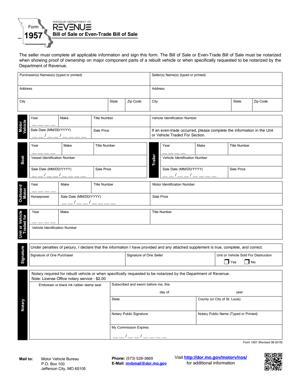
Form 1957 – Bill of Sale or Even-Trade Bill of Sale
Fill out nowJurisdiction: Country: United States | Province or State: Missouri
Form 1957 – Bill of Sale or Even-Trade Bill of Sale is a document used in Missouri to record the transfer of ownership of certain property, most commonly motor vehicles or similar titled items. It creates a written record of a sale or an even trade between two private parties.
If you are buying or selling a vehicle in a private transaction, this form helps show the details of that deal. It captures who is involved, what is being transferred, and the value exchanged. That information can be important when registering or titling the property.
This document is especially useful when money changes hands or when two parties swap property without cash. In both cases, it provides a clear summary of what each side agreed to give and receive.
For self-represented individuals, the form offers structure. Instead of drafting your own agreement from scratch, you fill in specific fields. That reduces confusion and helps make sure key information is not left out.
Because this form is issued by the Missouri Department of Revenue, it is designed to fit into the state’s vehicle and title record system. That makes it easier to use during registration or title processing.
What is Form 1957 – Bill of Sale or Even-Trade Bill of Sale?
Clear definition
Form 1957 – Bill of Sale or Even-Trade Bill of Sale is a standardized written record of a sale or trade of personal property, typically a motor vehicle, in Missouri. It documents the identities of the buyer and seller, a description of the property, and the terms of the transaction.
In a sale, the form shows the purchase price paid for the property. In an even trade, it reflects that two items were exchanged and may indicate their agreed-upon values. The form creates a paper trail of the transaction date and basic terms.
It does not replace a certificate of title. Instead, it supports the transfer by confirming the financial and factual details of the deal.
Who typically uses this form?
Private sellers often use this form when they sell a vehicle directly to another individual. This includes situations where the seller is not a licensed dealer.
Private buyers may also use the form as proof of what they paid or what they traded. This can matter for tax purposes or when completing title and registration paperwork.
People who trade vehicles or other titled property with each other also use the even-trade version of the document. It helps show that each side gave something of value.
In some cases, family members transferring property may use the form to document the transaction terms, especially if money is involved.
Why might you need this form?
You may need this form to show the purchase price of a vehicle. That figure can affect sales tax calculations when you apply for title and registration.
You might also need it if there is ever a question about when ownership changed. The form lists the transaction date, which can help clarify responsibility for insurance, tickets, or damage.
If the title is incomplete or unclear, a bill of sale may help fill in missing details. It does not fix title problems, but it can provide supporting information.
For an even trade, the form helps show that no cash was exchanged, or that any difference in value was handled in a specific way. This can help prevent later disagreements about what was agreed upon.
Typical real-life scenarios
- You sell your used car to a neighbor for a set price. You both sign the form to document the agreed amount and the date of sale.
- You trade your motorcycle for another person’s truck. No cash changes hands. You use the even-trade section to record both vehicles and their agreed-upon values.
- You buy a vehicle from a private party and want written confirmation of the price you paid. The signed form gives you a record to keep with your files.
- You transfer a vehicle to a relative and accept a small payment in return. The form records the amount paid and the vehicle details.
- You resolve a dispute about who owned a vehicle on a specific date. The signed and dated document shows when the transfer occurred.
When would you use Form 1957 – Bill of Sale or Even-Trade Bill of Sale?
You typically use this form at the time of a private sale or trade. It is completed when both parties agree to transfer ownership and before or at the same time as handing over the vehicle and payment.
It is commonly used when the buyer and seller meet in person to complete the deal. Both parties review the information, confirm the vehicle details, and sign the document.
If you are applying for a title after purchasing a vehicle from an individual, you may include the completed form with your other paperwork. It supports the information listed on the title application.
In an even trade, the form is used once both parties have agreed on the exchange terms. It helps clarify what each person is giving up and receiving.
If there is any concern about misunderstandings, completing the form at the time of the transaction helps create a shared written record. It can reduce disputes about price, condition, or timing.
Legal characteristics of Form 1957 – Bill of Sale or Even-Trade Bill of Sale
This form functions as a written contract between the parties. It sets out the basic terms of a sale or trade. For it to be effective, the information provided must be accurate and complete.
The document generally includes the full names and addresses of the buyer and seller. It also requires a detailed description of the vehicle or property, such as the year, make, model, and vehicle identification number. Errors in these details can create problems during title processing.
The purchase price or agreed value must be clearly stated. Leaving this blank or writing inconsistent amounts can lead to questions or delays. Clear handwriting and consistent information help avoid confusion.
Both parties usually sign the form. Without signatures, the document may not carry the same weight as evidence of an agreement. Unsigned or partially completed forms can be rejected or questioned.
This form does not transfer title by itself. In Missouri, ownership of a motor vehicle is generally transferred through the proper assignment of the certificate of title. The bill of sale supports that process but does not replace it.
The form also does not guarantee the condition of the vehicle. Unless specific language is added elsewhere, it mainly records the transaction details. It does not serve as a warranty document.
Is it legally binding?
In general, a bill of sale can be legally binding if it contains the essential elements of a contract. That usually includes an offer, acceptance, consideration, and clear identification of the parties and property.
When both parties sign Form 1957 – Bill of Sale or Even-Trade Bill of Sale and exchange value, it often reflects a valid agreement. The written document helps show that both sides agreed to the stated terms.
However, enforceability can depend on accuracy and completeness. If key information is missing or incorrect, it may weaken the document’s usefulness as evidence.
The form is strongest when it matches the information on the vehicle title and other related documents. Consistency across documents reduces the risk of disputes or processing issues.
How to fill out Form 1957 – Bill of Sale or Even-Trade Bill of Sale
Step 1 – Identify the type of transaction
Start by confirming whether the transaction is a sale or an even trade. Review the form sections and focus on the part that matches your situation. This ensures you complete the correct fields for your agreement.
Step 2 – Enter seller information
Provide the full legal name and address of the seller. Make sure the information matches the name listed on the certificate of title. Accurate details help connect the form to the official ownership record.
Step 3 – Enter buyer information
Fill in the full legal name and address of the buyer. Use complete and current information. This identifies who is receiving ownership under the agreement.
Step 4 – Describe the vehicle or property
Enter all the requested details about the vehicle. This often includes the year, make, model, body style, and vehicle identification number. Double-check each character in the identification number to avoid errors.
Step 5 – State the purchase price or trade value
If it is a sale, write the total purchase price agreed upon. If it is an even trade, list the agreed value of each item being exchanged. Be consistent with any other documents related to the transfer.
Step 6 – Record the date of the transaction
Enter the exact date when the sale or trade takes place. This date marks the point at which the parties agreed to transfer ownership. It can be important for tax and registration timing.
Step 7 – Review all information for accuracy
Before signing, both parties should read the completed form carefully. Check names, addresses, identification numbers, and amounts. Correct any mistakes clearly and neatly to prevent confusion later.
Step 8 – Sign the form
Have the seller sign where indicated. The buyer may also sign, depending on the form layout. Signatures confirm that each party agrees with the information written on the document.
Step 9 – Distribute copies
After signing, ensure each party has a copy for their records. Keep the document in a safe place with other vehicle and transaction paperwork.
Legal terms you might encounter in Form 1957 – Bill of Sale or Even-Trade Bill of Sale
- Seller: The person or business transferring ownership of the vehicle or property. In this document, the seller must provide their full legal name and address exactly as they appear on the current title. If the seller’s name does not match the title, the transfer can be delayed or rejected.
- Buyer: The person or business receiving ownership. The buyer’s full legal name and address must be written clearly. This information will be used to update ownership records, so spelling and formatting matter.
- Even Trade: An exchange where two parties swap vehicles or property without additional money changing hands. On this form, you must still state the agreed value of each item, even if no cash is paid. That value can affect taxes and registration.
- Purchase Price: The amount paid for the vehicle or property. This figure is recorded on the form and may be used to calculate taxes or fees. You should write the exact amount agreed upon, not an estimate.
- Vehicle Identification Number (VIN): A unique 17-character code assigned to a vehicle. This number must be copied exactly as it appears on the vehicle and title. A single incorrect character can cause serious processing problems.
- Odometer Reading: The mileage shown on the vehicle’s odometer at the time of sale. Recording the correct mileage helps document the vehicle’s condition and prevents disputes. You must enter the number carefully and indicate whether it reflects actual mileage.
- Consideration: The value exchanged in a transaction. In a sale, this is usually money. An even trade, it includes the fair value of each vehicle or item exchanged.
- Assignment of Ownership: The act of transferring rights in the vehicle or property from the seller to the buyer. By signing this document, the seller confirms that they are giving up ownership and that the information provided is accurate.
- Lien: A legal claim against a vehicle or property due to an unpaid debt. If a lien exists, ownership cannot be fully transferred until it is released. You must ensure any lien issues are resolved before completing the transfer.
- Signature Certification: The signed confirmation by the parties that the information provided is true and correct. Signing this form is a legal act. False information can lead to penalties or void the transaction.
FAQs
Do I need to complete Form 1957 – Bill of Sale or Even-Trade Bill of Sale if I already signed over the title?
You may still need this form to clearly document the sale price or confirm that the transaction was an even trade. The title shows ownership transfer, but this document records key details such as consideration, date of sale, and vehicle information. If any information is missing or unclear on the title, this form helps fill that gap.
What date should I enter as the transaction date?
Enter the actual date when ownership changed hands. This is usually the day you delivered the vehicle and received payment or exchanged property. The date you sign should match the date of transfer unless you signed on different days, in which case you should use the true transfer date.
What if the seller’s name on this document does not exactly match the title?
The names should match exactly, including middle initials and suffixes. If they do not, processing may be delayed. You may need additional documentation to explain the difference, such as proof of a legal name change. Always check the title before completing this document.
Do both parties need to sign this form?
In most cases, yes. The seller’s signature confirms the transfer, and the buyer’s signature confirms acceptance of the terms. Review the signature section carefully and ensure all required parties sign in the correct places. Missing signatures are a common reason forms are rejected.
How do I handle an even trade with no cash involved?
You must still list the agreed value of each vehicle or item. Even if no money changes hands, this document requires you to state the fair value. Be clear and consistent in how you describe the trade so there is no confusion about what was exchanged.
What happens if I make a mistake while filling it out?
Avoid using correction fluid or crossing out information in a way that makes the form hard to read. If you make a significant error, it is usually better to complete a new copy. Inaccurate or altered information can cause delays or questions about the transaction.
Do I need to attach any additional documents?
You may need to attach supporting documents if there are special circumstances, such as multiple owners, a lien release, or additional identification. Check that all required paperwork is complete and consistent with the information entered on this form before submission.
Will this document update the public ownership record by itself?
This document records the transaction details, but it does not automatically update the ownership record unless it is properly submitted with the required title and related documents. Make sure you confirm what must be filed and verify that the transfer has been processed.
Checklist: Before, During, and After Form 1957 – Bill of Sale or Even-Trade Bill of Sale
Before
- Confirm that the seller’s name matches the current title exactly.
- Locate the correct VIN on the vehicle and the title.
- Verify the current odometer reading.
- Check whether there is any outstanding lien on the vehicle.
- Agree in writing on the purchase price or trade value.
- Gather valid identification for both parties.
- Ensure you have a clean, readable copy of the form.
During
- Write all names exactly as they appear on official identification.
- Enter the full VIN without skipping or guessing characters.
- Record the accurate odometer reading at the time of transfer.
- Clearly state the purchase price or fair trade value.
- Fill in the correct date of the transaction.
- Review each section before moving to the next.
- Have all required parties sign in the designated spaces.
- Print clearly to avoid misinterpretation.
After
- Make at least one copy for the seller and one for the buyer.
- Attach the form to the title and any lien release documents.
- Submit the required paperwork to the appropriate office if needed.
- Confirm that ownership records have been updated.
- Store your copy in a safe place with related documents.
- Update your insurance coverage if you are the buyer.
- Remove or transfer license plates if required.
- Keep proof of submission or receipt confirmation.
Common mistakes to avoid with Form 1957 – Bill of Sale or Even-Trade Bill of Sale
- Mistake: Writing a nickname instead of the full legal name because it feels informal, which can lead to processing delays and record mismatches; do not forget to copy the name exactly as shown on the title or identification.
- Mistake: Entering the wrong VIN due to copying it quickly from memory, which can invalidate the document and cause rejection; do not forget to verify each character directly from the vehicle and title.
- Mistake: Listing “even trade” without stating the fair value, which happens when parties assume no cash means no value is needed, and can result in tax calculation issues; do not forget to include the agreed dollar amount.
- Mistake: Leaving the odometer section blank because you think it is optional, which can create legal concerns about mileage disclosure; do not forget to record the exact reading at transfer.
- Mistake: Forgetting one party’s signature due to rushing the meeting, which can make the form unenforceable; do not forget to check every required signature line before separating.
- Mistake: Using correction fluid or heavy cross-outs after making errors, which can make the document look altered and suspicious; do not forget that completing a fresh copy is often safer.
- Mistake: Failing to check for an active lien because you assume the loan was paid off, which can block the transfer; do not forget to obtain written lien release documentation.
- Mistake: Misstating the transaction date to match convenience instead of reality, which can cause timing disputes about taxes or liability; do not forget to use the true date ownership changed hands.
What to do after filling out Form 1957 – Bill of Sale or Even-Trade Bill of Sale
Once you complete the form, your job is not finished. You need to make sure the transfer is properly documented, submitted, and reflected in official records.
- Step 1: Review the entire form one more time for spelling, numbers, and signatures.
- Step 2: Make clear, legible copies for both the buyer and the seller.
- Step 3: Attach the completed form to the vehicle title and any required supporting documents.
- Step 4: Confirm whether the buyer or seller is responsible for submitting the paperwork.
- Step 5: Submit the documents through the proper channel, such as in person or by mail, as required.
- Step 6: Obtain proof of submission, such as a stamped copy or receipt.
- Step 7: Follow up to confirm that the ownership record has been updated.
- Step 8: Store your copy of the completed form with related records, such as payment receipts or lien releases.
- Step 9: If you are the buyer, register the vehicle and secure appropriate insurance coverage.
- Step 10: If you are the seller, remove any association with the vehicle in your personal records and confirm you are no longer listed as the owner.
Keep your copy of the completed document in a secure place. Ownership questions can arise months or even years later. A clear, signed record protects you if there is a dispute about payment, mileage, or the date of transfer.
If anything changes after signing, such as discovering an error, address it quickly. It is easier to correct documentation immediately than after records are finalized. Acting promptly helps prevent penalties, confusion, and future administrative problems.
Disclaimer: This guide is provided for informational purposes only and is not intended as legal advice. You should consult a legal professional.