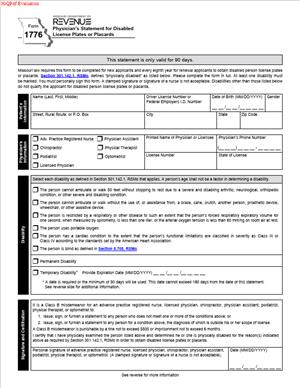
Form 1776 – Physician’s Statement for Disabled License Plates or Placards
Fill out nowJurisdiction: Country: United States | Province or State: Missouri
If you are applying for disabled license plates or a parking placard in Missouri, Form 1776 – Physician’s Statement for Disabled License Plates or Placards is a key part of the process. This document connects your medical condition to your eligibility for disability parking privileges.
Form 1776 – Physician’s Statement for Disabled License Plates or Placards is completed by a licensed medical professional. It confirms that you meet the state’s definition of a qualifying disability. Without it, your application for disabled plates or a placard is incomplete.
You do not fill out this form alone. Your role is to provide accurate personal information and bring the document to your healthcare provider. The provider reviews your condition and certifies whether it qualifies under Missouri’s standards.
This form matters because disabled parking privileges are limited and regulated. The state relies on a medical certification to ensure that parking accommodations are reserved for people who genuinely need them.
Understanding what this document does and how to complete it properly can help you avoid delays or rejection of your application.
What is Form 1776 – Physician’s Statement for Disabled License Plates or Placards?
Clear definition
Form 1776 – Physician’s Statement for Disabled License Plates or Placards is a medical certification form issued by the Missouri Department of Revenue. It is used to verify that a person has a qualifying disability that affects mobility or other defined physical functions.
The form documents specific information about your medical condition. It includes details about whether the disability is temporary or permanent and whether it meets Missouri’s eligibility standards for disabled parking privileges.
This is not the actual application for plates or placards. It is a supporting document. You typically submit it along with the required application form and any applicable fees.
Who typically uses this form?
You use this form if you are seeking disabled license plates for a vehicle registered in your name or a disabled parking placard for personal use.
People who commonly use this form include individuals with limited mobility, chronic respiratory conditions, cardiac conditions, neurological impairments, or other medical issues that restrict walking.
Parents or legal guardians may also use this form on behalf of a minor child with a qualifying disability. In that case, the child is the person with the disability, but the adult manages the paperwork.
Healthcare professionals also use this form in their professional role. Physicians, physician assistants, nurse practitioners, chiropractors, podiatrists, and other authorized providers complete and sign the medical certification portion.
Why might you need this form?
You may need this form if your condition makes it difficult to walk long distances without rest, assistance, or significant pain.
You may also need it if you require the use of a wheelchair, cane, crutches, brace, prosthetic device, or another assistive device for mobility.
Some medical conditions that are not visibly apparent may still qualify. Severe lung disease, certain heart conditions, or neurological impairments can limit your ability to walk even if you do not use a mobility aid.
If you are requesting a temporary placard due to a short-term injury, such as a broken leg or recent surgery, the form allows your provider to indicate that the condition is temporary and estimate how long it is expected to last.
Typical real-life scenarios
- You recently had knee replacement surgery and are using a walker during recovery. Walking across a large parking lot causes pain and instability. Your surgeon completes the form to certify that you qualify for a temporary placard during recovery.
- You have a chronic heart condition that significantly limits your endurance. Even short walks cause shortness of breath. Your cardiologist documents the condition on the form, confirming that it meets the state’s criteria.
- Your child has a neurological condition that affects muscle control and balance. You transport your child to school and medical appointments. A pediatric specialist completes the form to support your application for disabled license plates.
- You live with advanced arthritis that restricts your range of motion and causes severe pain when walking. Your primary care provider completes the form to confirm that the condition is permanent and meets the required standards.
- In each of these examples, the form serves as official medical verification. It links the medical diagnosis to the legal eligibility requirements for disabled parking privileges.
When would you use Form 1776 – Physician’s Statement for Disabled License Plates or Placards?
You use this form when applying for disabled license plates for a vehicle registered in your name. The plates are typically used when the person with the disability owns or regularly operates the vehicle.
You also use the form when applying for a disabled parking placard. A placard is usually transferable between vehicles and can be displayed when you are a passenger in someone else’s car.
If you are renewing a temporary placard because your condition continues beyond the original expected recovery period, you may need a new medical certification. In that situation, your provider would complete a new Form 1776 – Physician’s Statement for Disabled License Plates or Placards.
You might also use the form if your medical condition has changed. For example, a temporary condition may become permanent, or a permanent condition may worsen and require updated documentation.
Healthcare providers use the form when certifying that a patient meets the eligibility standards. They review the legal criteria listed on the form and determine whether the patient’s condition qualifies.
You would not use this form for general medical records, insurance claims, or employment accommodations. Its purpose is limited to supporting a request for disabled parking privileges under Missouri law.
Legal characteristics of Form 1776 – Physician’s Statement for Disabled License Plates or Placards
This form has legal significance because it supports a government-issued benefit. The information provided must be accurate and truthful. False statements can result in denial of the application and potential penalties.
For the form to be effective, it must be completed by an authorized medical professional. The provider must sign the document and, in most cases, include their license number and contact information. Incomplete provider information is a common reason for rejection.
The form must clearly indicate whether the disability is permanent or temporary. If this section is left blank or marked inconsistently, processing may be delayed.
Legibility matters. If handwritten entries cannot be read, the Department of Revenue may return the submission or request clarification.
The form does not grant parking privileges by itself. It is one part of the overall application process. You must submit it along with the appropriate application and meet any other administrative requirements.
While eligibility standards are generally defined by state law, specific wording and documentation requirements can vary by jurisdiction. The criteria used in Missouri may not be identical to those in other states. If you move or apply elsewhere, a new certification may be required.
The form also does not guarantee approval. The state reviews the entire submission to confirm that all requirements are met.
Is it legally binding?
Form 1776 – Physician’s Statement for Disabled License Plates or Placards is not a contract between you and the state. It does not create ongoing legal obligations like an agreement would.
However, it is a formal, signed certification. The healthcare provider is attesting that, in their professional judgment, you meet the state’s medical criteria. That certification carries legal weight.
Because the provider signs the form under professional standards, intentionally providing false information could have professional consequences. Similarly, knowingly submitting inaccurate information can affect your eligibility.
Once accepted, the form supports the issuance of disabled plates or a placard. Those items are subject to rules about proper use. Misuse of a placard or plates may lead to fines or revocation, even if the original medical certification was valid.
In that sense, the form is part of a regulated process. It is not a contract, but it plays a critical role in establishing your legal eligibility for specific parking privileges.
How to fill out Form 1776 – Physician’s Statement for Disabled License Plates or Placards
Step 1 – Review the form before writing anything
Start by reading the entire document from top to bottom. Identify which sections are for you and which are for your medical provider. This prevents you from filling out areas that are meant for professional certification.
Check that you have the most recent version of the form. Using an outdated version can cause processing delays.
Step 2 – Enter your personal information
Complete the section that asks for your full legal name. Use the same name that appears on your vehicle registration or identification.
Provide your current residential address. Make sure it matches the address you use for vehicle registration or state records, if applicable.
Include any requested identifying information, such as your date of birth or driver’s license number. Write clearly to avoid errors in processing.
If you are applying on behalf of a minor or dependent adult, ensure the person with the disability is listed as the applicant, even if you are handling the paperwork.
Step 3 – Indicate the type of request
Some versions of the form include a section to identify whether you are applying for disabled license plates or a placard. Mark the appropriate option if required.
If the form distinguishes between permanent and temporary disability, review your understanding of your condition before meeting with your provider. The final determination is made by the medical professional, but knowing your request helps guide the discussion.
Do not guess about the duration of a temporary disability. That information is completed by the provider based on medical judgment.
Step 4 – Schedule an appointment with your medical provider
Bring the partially completed form to a licensed healthcare provider authorized to certify disabilities. This may include a physician, physician assistant, nurse practitioner, chiropractor, podiatrist, or another qualified professional.
Explain that you are requesting certification for disabled license plates or a placard. The provider will evaluate whether your condition meets the defined criteria listed on the form.
Be prepared to discuss how your condition limits your ability to walk or function in daily activities. The provider may review your medical records before completing the certification.
Step 5 – Ensure the provider completes the medical certification section
The provider will indicate the nature of your disability based on the options listed. This may involve checking specific qualifying conditions or describing the limitation.
If your condition is temporary, the provider will usually state the expected duration. This helps determine how long a temporary placard may be valid.
Confirm that the provider signs and dates the form. An unsigned form is not valid.
Check that the provider includes their license number and any required contact details. Missing professional information is a frequent cause of rejected submissions.
Step 6 – Review the completed form for accuracy
Before leaving the appointment, review the form carefully. Make sure your name and other personal details are correct.
Verify that the disability status is clearly marked as permanent or temporary, if applicable.
Confirm that all required signatures are present and that the date is current. Corrections made after signing may require a new signature.
Step 7 – Make a copy for your records
Create a copy of the fully completed and signed form before submitting it. This gives you a record of what was certified and when.
Keeping a copy can be helpful if there are questions later about the submission or if you need to reference the information for renewal.
Store the copy in a safe place with your vehicle or personal records.
Step 8 – Submit the form with your application
Submit the completed Form 1776 – Physician’s Statement for Disabled License Plates or Placards along with the required application for plates or a placard.
Include any required fees and supporting documents specified in the application instructions. Incomplete submissions may be returned.
After submission, processing times can vary. Once approved, you will receive your disabled plates or placard, which must be used according to the rules governing disabled parking privileges.
Legal terms you might encounter in Form 1776 – Physician’s Statement for Disabled License Plates or Placards
- Medical Certification: This is the section your licensed medical provider completes. It confirms that you have a qualifying disability and describes whether it is temporary or permanent. The accuracy of this certification determines whether your application will be accepted.
- Permanent Disability: A condition that is not expected to improve significantly. On this form, the provider indicates that your mobility limitation is ongoing. This affects the type and duration of the placard or plate you may receive.
- Temporary Disability: A condition expected to improve over time. The provider must usually include an expected recovery date. This date affects how long your placard will be valid.
- Licensed Medical Provider: The healthcare professional authorized to complete and sign the medical section. This may include a physician or other qualified practitioner permitted under state rules. The licensing status and signature are required for the document to be accepted.
- Certification Date: The date your provider signs the medical section. This date is important because the issuing authority may require the document to be recent. An outdated certification can lead to rejection.
- Applicant Information: The section where you provide your name, address, and identifying details. This information must match your identification and vehicle registration records. Inconsistent information can delay processing.
- Placard: A removable parking permit displayed inside your vehicle. It allows you to use designated disabled parking spaces. Placards are issued to a person, not a specific vehicle.
- Disabled License Plate: A special license plate issued for a specific vehicle. Unlike a placard, it is attached to one registered vehicle. You must ensure the vehicle information matches your registration.
- Attestation: A formal statement that the information provided is true. When you sign the form, you are confirming that the details are accurate. False statements can lead to penalties or denial.
- Issuing Authority: The government agency that reviews and processes your application. They determine whether the form meets all requirements. If something is missing, they may return or reject your submission.
FAQs
Who is allowed to complete and sign the medical section of this form?
Only a licensed medical provider authorized under state rules can complete the medical certification section. You cannot fill out that portion yourself. Make sure the provider includes their license information, signature, and the date, because incomplete provider details are a common reason applications are rejected.
Does the medical certification need to be recent when I submit Form 1776 – Physician’s Statement for Disabled License Plates or Placards?
Yes. The certification date must usually be within a specific time frame before submission. If the provider signed it months ago, the issuing office may not accept it. Always check the date next to the provider’s signature before you file the document.
What information must match exactly between this document and my other records?
Your full legal name, residential address, and any identification numbers should match your driver’s license or state ID. If you are applying for a disabled license plate, the vehicle details must match the current registration. Even small differences, such as a missing middle initial, can slow processing.
Can I submit this document without completing every section?
No. All required sections must be filled out before submission. If you leave required fields blank, the issuing authority may return the paperwork unprocessed. Review each line carefully, including checkboxes, signatures, and dates.
What happens if my provider forgets to indicate whether my condition is temporary or permanent?
The application may be delayed or denied because the issuing office needs that information to determine the type and duration of the permit. If the condition type is not clearly marked, you will likely need to return to your provider for clarification. Double-check that the correct box is selected before you leave the appointment.
Do I need to attach anything else when I submit this form?
In many cases, this document must be submitted along with a separate application for disabled plates or placards. You may also need identification or vehicle registration details if requesting a plate. Review the full application packet to confirm you are including all required documents.
Will my medical details become part of a public record?
The medical certification is reviewed by the issuing agency to determine eligibility. However, only the fact that a disabled placard or plate was issued typically appears in vehicle or permit records. Specific medical diagnoses are generally not displayed on the placard or plate itself.
What should I do if my condition changes after I submit the form?
If your condition improves or worsens, you may need to update your permit status. For example, a temporary condition that becomes permanent may require new certification. In that case, you would complete a new Form 1776 – Physician’s Statement for Disabled License Plates or Placards reflecting the updated medical status.
Checklist: Before, During, and After Form 1776 – Physician’s Statement for Disabled License Plates or Placards
Before
- Confirm you are eligible to apply for a disabled placard or plate.
- Gather your identification and vehicle registration information.
- Review the entire form to understand which sections you complete and which your provider completes.
- Check whether you need an appointment for medical certification.
- Verify that your provider is authorized to complete the certification.
- Prepare a list of your mobility limitations to discuss with your provider.
- Confirm whether you are applying for a temporary or permanent permit.
- Review any additional forms required for submission.
During
- Print clearly in black or blue ink if completing by hand.
- Enter your full legal name exactly as it appears on your identification.
- Provide your current residential address, not a mailing shortcut or nickname.
- Select the correct type of request, such as a placard or a license plate.
- Review each checkbox before marking it.
- Ensure your provider completes every required medical field.
- Confirm the provider signs and dates the certification section.
- Verify the provider includes license information where required.
After
- Review the entire form for missing signatures or blank fields.
- Make a clear copy of the completed document for your records.
- Assemble any additional required applications or fees.
- Submit the paperwork through the appropriate method.
- Track when and how you submitted the documents.
- Watch for confirmation or returned mail.
- Store your copy in a safe place.
- Display your placard properly once issued.
Common mistakes to avoid with Form 1776 – Physician’s Statement for Disabled License Plates or Placards
- Mistake: Leaving required fields blank because you assume they are optional, which often happens when instructions are skimmed; this can lead to rejection or processing delays, so do not forget to review every line before submission.
- Mistake: Submitting an outdated medical certification because the appointment occurred too early; this can cause the application to be denied, so do not forget to check the signature date before filing.
- Mistake: Providing a name or address that does not match official identification, often due to recent moves or name changes; this may result in processing holds, so do not forget to update your records first.
- Mistake: Failing to confirm that the provider selected temporary or permanent status, which happens during rushed appointments; this omission can require a second visit, so do not forget to review the checked boxes before leaving.
- Mistake: Forgetting to sign the applicant section because attention is focused on the medical portion; unsigned forms are typically invalid, so do not forget your own signature and date.
- Mistake: Sending the medical statement without the required accompanying application, which can occur when forms are downloaded separately; this may result in incomplete processing, so do not forget to assemble the full packet.
- Mistake: Illegible handwriting that makes names or numbers unclear, often due to rushed completion; unclear entries can delay approval, so do not forget to print neatly.
- Mistake: Assuming a placard transfers automatically to a new vehicle when applying for plates, which can cause confusion in registration records; this may affect your driving privileges, so do not forget to confirm how your permit type applies to your vehicle.
What to do after filling out Form 1776 – Physician’s Statement for Disabled License Plates or Placards
Once the form is fully completed and signed, your next focus is proper submission and follow-through. Small oversights at this stage can delay approval.
- Step 1: Review the completed form one final time, line by line, checking for missing signatures, dates, or unchecked boxes.
- Step 2: Make at least one clear copy of the entire document for your personal records.
- Step 3: Gather any required companion application forms for disabled plates or placards.
- Step 4: Confirm whether a fee applies to your request and prepare payment if required.
- Step 5: Submit the documents through the accepted method, such as in person or by mail, following the official instructions provided with the application packet.
- Step 6: If submitting in person, request confirmation or a receipt showing the date your paperwork was accepted.
- Step 7: If submitting by mail, consider using a trackable method and keep proof of mailing.
- Step 8: Monitor your mail for confirmation, approval, or requests for additional information.
- Step 9: Respond promptly if the issuing office contacts you about corrections or missing information.
- Step 10: Once you receive your placard or plates, follow all display and use rules to avoid fines or misuse concerns.
Keep your copy of the completed form and any correspondence in a safe place. You may need it for renewals, replacements, or future updates if your medical condition changes. Staying organized now makes future renewals faster and less stressful.
Disclaimer: This guide is provided for informational purposes only and is not intended as legal advice. You should consult a legal professional.