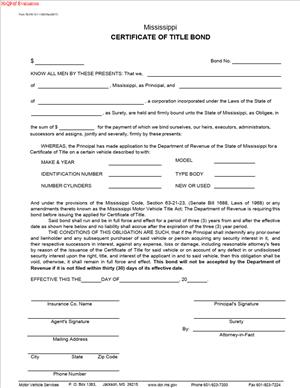
Form 7801610 – Certificate of Title Bond
Fill out nowJurisdiction: Country: United States | Province or State: Mississippi
The Form 7801610 – Certificate of Title Bond is a document used when you need to secure a vehicle title but cannot provide the standard proof of ownership. It works alongside a surety bond to help establish your claim to a vehicle. In Mississippi, this form is part of the process handled through the state’s motor vehicle title system.
You typically encounter this form when a vehicle title is missing, damaged, or was never properly transferred into your name. Without a valid title, you cannot complete registration or legally transfer ownership. This document helps fill that gap in certain situations.
If you are about to complete Form 7801610 – Certificate of Title Bond, you are likely trying to correct a title issue. The form supports your application for a bonded title. It sets out the bond details that protect prior owners or lienholders if ownership is later disputed.
This filing matters because vehicle titles establish legal ownership. When the paperwork trail is incomplete, the bond and this form create a financial guarantee. That guarantee provides a level of protection to the state and to anyone who might claim an interest in the vehicle.
Understanding what this form does will help you avoid delays. Errors or missing information can lead to rejection. Careful completion supports smoother processing of your title application.
What is Form 7801610 – Certificate of Title Bond?
Clear definition
Form 7801610 – Certificate of Title Bond is a bond document connected to a bonded vehicle title application. It records the agreement between you, the surety company, and the state. The bond guarantees payment up to a stated amount if someone later proves a valid ownership claim against the vehicle.
This document is not the vehicle title itself. It does not transfer ownership on its own. Instead, it supports your request for the state to issue a bonded title when the usual ownership documents are unavailable.
The form identifies key details. These typically include the vehicle description, the bond amount, the principal’s name, and the surety’s information. It creates a written record of the financial guarantee tied to that specific vehicle.
Who typically uses this form?
You may use this form if you purchased a vehicle but did not receive a properly assigned title. This can happen in private sales where the paperwork was incomplete or lost.
You might also use it if you inherited a vehicle and the title cannot be located. In some cases, older vehicles change hands multiple times without proper documentation, leaving gaps in the ownership chain.
Individuals who restore abandoned or long-stored vehicles may also encounter this situation. When no clear title exists, a bonded title process may be available.
Businesses can also use this form in limited situations. For example, a small dealer or repair facility that acquired a vehicle through unpaid charges may need to resolve title issues before transferring ownership.
Why might you need this form?
You need this form when the standard title proof is missing, and the state requires a bond as a condition of issuing a new title. The bond reduces financial risk to others while allowing you to move forward.
Without a valid title, you generally cannot register the vehicle or legally sell it. The bonded title process can create a path to obtain a usable title document.
The bond amount is often based on the vehicle’s value. This ensures that if a legitimate owner appears, there is financial protection up to that amount.
By completing this form accurately, you help show that you are taking formal steps to address the ownership gap. It becomes part of your overall submission to the appropriate motor vehicle authority.
Typical real-life scenarios
- You buy a used car from a private seller. The seller promises to mail the title, but never does. Months pass, and you cannot reach them. When you try to register the car, you learn you need proof of ownership. A bonded title process may be available, and this form becomes part of that process.
- You find a classic vehicle stored in a family member’s garage. The title was lost decades ago. No clear record of transfer exists. To legally restore and register the vehicle, you may need to apply for a bonded title and submit this bond form.
- You purchase a vehicle at an estate sale. The executor does not have access to the original title paperwork. Instead of abandoning the purchase, you explore the bonded title option, which includes completing this document.
- You repair a vehicle that was abandoned on private property. After following the required notice procedures, you may be eligible to apply for the title. If documentation remains incomplete, the bonding process may apply, and this form helps secure the required bond.
When would you use Form 7801610 – Certificate of Title Bond?
You would use this form during the bonded title application process. It is not a routine document for standard vehicle purchases. It only applies when normal proof of ownership is unavailable.
Typically, you begin by contacting the relevant motor vehicle office to determine eligibility for a bonded title. If a bond is required, you obtain a surety bond in the amount specified. Form 7801610 – Certificate of Title Bond documents the bond agreement.
The timing matters. You complete this form after securing the bond but before submitting your full title application package. It becomes part of your filing and is reviewed alongside your other documents.
The people involved usually include you as the applicant, the surety company issuing the bond, and the state agency processing titles. Each party has a defined role. You are the principal on the bond. The surety backs your obligation. The state is typically the obligee.
This form is used only for the specific vehicle described in it. If you are dealing with more than one vehicle, each generally requires its own bond and related paperwork.
Legal characteristics of Form 7801610 – Certificate of Title Bond
This document functions as a surety bond agreement. It creates a financial obligation tied to a vehicle title application. The bond amount is usually set based on the vehicle’s value, often at a multiple of that value.
For the bond to be effective, it must accurately identify the vehicle. This includes the vehicle identification number, year, make, and model. Any mismatch between the bond and the title application can delay processing.
The bond must also reflect correct names. Your name should match the name used in the title application. Inconsistent spelling or missing middle initials can create administrative issues.
Signatures are critical. The principal and the surety must sign where required. Some versions of the form may require notarization. Missing signatures or seals commonly lead to rejection.
This form does not erase prior ownership claims. If someone later proves a legal right to the vehicle, they may have a claim against the bond up to the bond amount. The bond is a financial safeguard, not a guarantee that no dispute will arise.
Requirements can vary by state. In Mississippi, the form is tied to the state’s vehicle title procedures. Other states may use different form numbers or formats, even though the concept of a bonded title is similar.
The bond generally remains in effect for a defined period. During that time, it protects against valid ownership claims. After the required period passes without dispute, the bonded title may convert into a standard title, depending on the state’s process.
Is it legally binding?
Yes, Form 7801610 – Certificate of Title Bond is legally binding once properly completed and executed. It represents a contractual agreement between you and the surety, made for the benefit of the state and potential claimants.
When you sign as the principal, you agree to the bond’s terms. If a valid claim is paid by the surety, you are typically responsible for reimbursing the surety under your agreement with them.
The surety’s signature and seal confirm that the company guarantees payment up to the bond amount under the stated conditions. Without these elements, the bond is not effective.
However, the form itself does not determine final ownership. It supports the state’s decision to issue a bonded title. The legal effect comes from both the bond agreement and the state’s acceptance of your title application.
How to fill out Form 7801610 – Certificate of Title Bond
Step 1 – Identify the vehicle
Enter the full vehicle description exactly as it appears in available records. This usually includes the year, make, model, and vehicle identification number. Double-check the VIN for accuracy, as even a single incorrect character can cause rejection.
Step 2 – Enter the principal’s information
Provide your full legal name and address as the applicant. Use the same name that appears on your title application and identification documents. Consistency across all paperwork helps avoid processing delays.
Step 3 – State the bond amount
Insert the bond amount required for your application. This amount is often based on the vehicle’s appraised or assigned value. Ensure the figure matches the amount issued by the surety company.
Step 4 – Provide surety information
The surety company completes its section with its legal name and business details. This part confirms that the company is backing the bond. Review the information to ensure it matches the bond documents you received.
Step 5 – Review the bond terms
Read through the bond language carefully. Confirm that the vehicle details, bond amount, and names are correct. Make sure there are no blank spaces where information is required.
Step 6 – Sign where required
Sign the form in the designated area as the principal. Your signature indicates agreement with the bond terms. If notarization is required, sign in the presence of a notary and ensure the notary section is fully completed.
Step 7 – Confirm surety execution
Verify that the surety has signed and, if required, affixed its seal. The bond is not valid without proper execution by the surety. Check that all signatures are dated.
Step 8 – Attach to your title application
Include the completed Form 7801610 – Certificate of Title Bond with your bonded title application and supporting documents. Ensure all related forms reference the same vehicle and applicant information before submission.
Legal terms you might encounter in Form 7801610 – Certificate of Title Bond
- Principal: The principal is the person applying for the bonded title. In this document, that is you. Your full legal name must appear exactly as it will appear on the vehicle title application.
- Surety: The surety is the company that issues the bond and guarantees payment if a valid claim arises. The surety’s legal name, address, and authorized signature appear on the bond. Without a properly executed surety section, the bond is not valid.
- Obligee: The obligee is the party protected by the bond. In this context, it is the state agency responsible for issuing titles. The bond promises payment to the obligee for the benefit of any person with a proven ownership claim.
- Bond Amount (Penal Sum): This is the maximum dollar amount the surety may have to pay if a valid claim is made. The amount is usually based on the vehicle’s value. It must match the amount required for your title application.
- Vehicle Identification Number (VIN): The VIN is the unique 17-character code assigned to your vehicle. The VIN listed on the bond must exactly match the VIN on your title application and any inspection paperwork. Even a single incorrect character can delay approval.
- Condition of the Bond: This section explains when the bond applies and what triggers payment. It typically states that if someone proves a superior ownership interest, the bond covers losses up to the penal sum. Read this section so you understand your obligations.
- Effective Date: The effective date is when the bond becomes active. It may be the date the surety signs or a specific date listed in the bond text. Your title application must align with this date.
- Term of Bond: Some title bonds remain in effect for a fixed number of years. The term tells you how long the bond stays active before it expires or can be released. You should know this timeframe because it affects how long the vehicle title is considered bonded.
- Claim: A claim is a formal demand for payment under the bond. It can occur if another person proves they have a valid ownership interest in the vehicle. The bond protects that person, but you remain financially responsible to the surety if it pays out.
FAQs
What happens if I enter the wrong VIN on this form?
If the VIN does not match your inspection record and title application exactly, the filing office may reject your paperwork. Even a small typo can cause a delay. Double-check all 17 characters against the vehicle itself and your supporting documents before you sign.
How do I know what bond amount to enter?
The bond amount is typically based on the vehicle’s appraised or stated value. You must confirm the required amount before the surety prepares the bond. The number printed in the penal sum section must match the required amount for Form 7801610 – Certificate of Title Bond, or your application may not be accepted.
Who is allowed to sign this document?
You sign as the principal. The surety must also sign through an authorized representative, often with a power of attorney attached. Make sure both signatures appear where indicated and that any required seals are included before submission.
Can I change information after the bond is issued?
You generally cannot make handwritten corrections to a completed bond. If you discover an error in your name, VIN, or bond amount, contact the surety to issue a corrected bond. Submitting an altered document can lead to rejection.
Does this document give me ownership of the vehicle?
No. This document does not create ownership by itself. It supports your application for a bonded title. The actual proof of ownership comes from the title issued by the state after your paperwork is approved.
What date should I list as the effective date?
The effective date is usually set by the surety when the bond is executed. Confirm that the date printed on the bond matches your filing timeline. Do not assume the effective date is the same as the day you submit your title application.
What attachments should I include with Form 7801610 – Certificate of Title Bond?
You typically attach this bond to your title application packet. Confirm that your vehicle inspection, identification, and any required value documentation are included. Missing attachments can delay processing even if this document is complete.
Will this bond change the public record for my vehicle?
Yes. When a bonded title is issued, the title record will reflect that it is bonded for a certain period. After the bond term ends and if no valid claims arise, the bonded notation may be cleared according to the agency’s process.
Checklist: Before, During, and After Form 7801610 – Certificate of Title Bond
Before
- Confirm that you truly need a bonded title due to missing or defective ownership documents.
- Verify the exact legal spelling of your name for consistency across all paperwork.
- Locate and physically inspect the VIN on the vehicle.
- Obtain the correct vehicle value used to calculate the bond amount.
- Gather your title application and any inspection or appraisal documents.
- Confirm identification requirements for signing.
- Review the bond form to understand each blank you must complete.
During
- Enter the VIN carefully, checking each character against the vehicle.
- Print your full legal name exactly as it appears on your identification.
- Confirm the bond amount matches the required value.
- Review the surety’s name and address for completeness.
- Check that the effective date is clearly stated.
- Ensure the bond includes all required signatures.
- Confirm that any power of attorney attachment from the surety is included.
- Avoid making handwritten corrections or cross-outs.
After
- Make a complete copy of the signed bond for your records.
- Attach the bond to your title application packet.
- Submit the packet using the accepted filing method.
- Track your submission if a receipt or confirmation number is provided.
- Store copies in a safe place for the duration of the bond term.
- Check your issued title to confirm the VIN and your name are correct.
- Note the bond term end date for future reference.
Common mistakes to avoid with Form 7801610 – Certificate of Title Bond
- Mistake: Entering an incorrect VIN because you copied it from memory instead of the vehicle, which can lead to rejection and delays; do not forget to verify all 17 characters directly from the vehicle.
- Mistake: Using a nickname or abbreviated name, which happens when people rush the form and results in mismatched records; do not forget to use your full legal name exactly as on your identification.
- Mistake: Listing the wrong bond amount due to a misunderstanding of the vehicle’s value, which can cause the filing office to refuse the application; do not forget to confirm the required penal sum before issuance.
- Mistake: Submitting the bond without the surety’s proper signature or attached authorization, which occurs when documents are separated during printing and leads to invalidation; do not forget to check for all required signatures and attachments.
- Mistake: Making handwritten corrections after the bond is issued, often because of small typos, which can cause rejection; do not forget to request a corrected bond instead of altering the original.
- Mistake: Forgetting to keep copies, which happens when you focus only on submission and later leaves you without proof of terms; do not forget to retain a full copy for the entire bond period.
What to do after filling out Form 7801610 – Certificate of Title Bond
Once the bond is fully signed and complete, your next focus is proper submission and recordkeeping. Treat this as part of a larger title application process, not a standalone document.
- Step 1: Make at least one clear copy of the fully executed bond, including any attached power of attorney.
- Step 2: Review your entire title application packet to confirm the VIN, your name, and the bond amount are consistent across all documents.
- Step 3: Assemble the bond with the rest of your required paperwork in the correct order.
- Step 4: Submit the complete packet using the approved filing method, whether in person or by mail.
- Step 5: Obtain proof of submission, such as a stamped copy, receipt, or tracking confirmation.
- Step 6: Monitor the status of your title application and respond promptly if additional information is requested.
- Step 7: When you receive the issued title, check that the vehicle details and your ownership information are accurate.
- Step 8: Note any bonded designation printed on the title and record the date when the bond term is expected to end.
- Step 9: Store the original bond copy and your issued title in a secure location.
- Step 10: Keep all related paperwork together so you can easily respond if a claim or question arises during the bond term.
Stay organized for the entire duration of the bond. If a claim is ever made, you will need immediate access to your documentation. Clear records protect you and help resolve any ownership disputes efficiently.
Disclaimer: This guide is provided for informational purposes only and is not intended as legal advice. You should consult a legal professional.