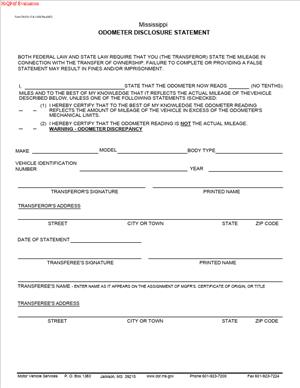
Form 78015178 – Odometer Disclosure Statement
Fill out nowJurisdiction: Country: United States | Province or State: Mississippi
The Form 78015178 – Odometer Disclosure Statement is a document used to record a vehicle’s mileage at the time of ownership transfer. If you are buying or selling a vehicle in Mississippi, you may be required to complete this form as part of the title process. It focuses on one key detail: the odometer reading.
This form exists to protect both buyers and sellers. Mileage affects a vehicle’s value, safety expectations, and maintenance planning. Recording it accurately helps prevent disputes later.
You will typically complete this form when transferring ownership of a car, truck, or certain other motor vehicles. It is often submitted along with title paperwork. The information you provide becomes part of the official record.
If you are about to fill it out, you need to understand what information is required, how to report mileage correctly, and what your signature means. Accuracy matters, and small mistakes can delay processing.
What is Form 78015178 – Odometer Disclosure Statement?
Clear definition
Form 78015178 – Odometer Disclosure Statement is a written declaration of a vehicle’s mileage at the time it changes ownership. It captures the odometer reading and confirms whether that reading reflects the vehicle’s actual mileage.
The form typically includes details about the vehicle, the seller, the buyer, and the mileage status. It may also ask you to indicate if the mileage is actual, exceeds mechanical limits, or is not the actual mileage.
This document is designed to create a clear record. It reduces the risk of odometer fraud and ensures that the mileage disclosure is formally acknowledged by the parties involved.
Who typically uses this form?
Sellers most commonly complete the mileage disclosure section. This includes private individuals, dealerships, and other entities transferring ownership of a vehicle.
Buyers also play a role. They review the mileage statement and usually sign to confirm receipt of the disclosure. Their signature shows they were informed of the odometer reading at the time of transfer.
In some cases, agents may complete the form on behalf of a seller or buyer. For example, a dealership employee or authorized representative may sign if they have proper authority.
Lenders, title clerks, and administrative staff may handle the submission of the form, but the responsibility for accurate mileage disclosure generally rests with the transferor.
Why might you need this form?
You may need this form when selling a used vehicle. It helps document the mileage at the time you hand over ownership.
You may also need it when buying a vehicle. It provides written confirmation of the mileage represented to you.
State agencies often require an odometer disclosure when processing a title transfer. Without it, the title application may be delayed or rejected.
The form also serves as a safeguard. If a dispute arises later about mileage, the completed document can show what was disclosed at the time of sale.
Typical real-life scenarios
- You sell your personal car to a neighbor. During the title transfer, you complete the odometer disclosure to record the exact mileage on the dashboard. Both of you sign the form as part of the transaction.
- You purchase a used truck from a small dealership. The dealership provides an odometer disclosure statement showing the mileage. You review it and sign to acknowledge the reading before submitting the title paperwork.
- You inherit a vehicle and later transfer it to another family member. Even though no money changes hands, a mileage disclosure may still be required as part of the ownership transfer process.
- You trade in your vehicle when buying another one. The dealership records the odometer reading on the required disclosure form to document the mileage at the time of trade-in.
- You move to Mississippi and transfer an out-of-state vehicle title into your name. Depending on the circumstances, you may need to provide a mileage disclosure as part of the title process.
When would you use Form 78015178 – Odometer Disclosure Statement?
You generally use this form at the time of vehicle ownership transfer. This includes sales, trades, gifts, and certain other transfers.
The most common situation is a private sale between individuals. When you sell your vehicle directly to another person, the mileage disclosure becomes part of the paperwork exchanged during the sale.
Dealership transactions also involve mileage disclosure. In that setting, the form may be integrated into other sales documents, but the core information remains the same: vehicle details, mileage reading, and signatures.
In some cases, the form is required only for certain types of vehicles. For example, newer vehicles or vehicles below a certain age threshold often require formal mileage disclosure, while older vehicles may be exempt. The exact rules can vary based on federal and state requirements.
You may also encounter this form during title corrections or reassignments. If a title needs to be reissued or corrected, the mileage disclosure may need to be reaffirmed or clarified.
If you are acting as an executor, trustee, or authorized representative transferring a vehicle on behalf of someone else, you may complete this form in that representative capacity.
The key timing point is this: the disclosure is made at the moment ownership changes. It reflects the odometer reading at that specific time, not days or weeks later.
Legal characteristics of Form 78015178 – Odometer Disclosure Statement
This form has legal significance because it documents a factual representation of mileage. Odometer fraud is treated seriously under federal and state law. The written disclosure helps establish accountability.
For the form to be effective, it typically must be completed in full. Required fields such as vehicle identification number (VIN), make, model, year, mileage reading, and signatures need to be clear and legible.
Accuracy is critical. Recording an incorrect digit in the mileage, transposing numbers in the VIN, or leaving required sections blank can cause rejection during title processing. Inconsistent information between the disclosure and the title application can also create delays.
Signatures matter. The seller’s signature confirms the mileage statement. The buyer’s signature usually confirms receipt of that statement. Missing signatures are a common reason forms are returned.
In many jurisdictions, mileage must be disclosed in a specific way. For example, you may need to check a box indicating whether the mileage is actual, exceeds mechanical limits, or is not the actual mileage. Failing to select the correct option can undermine the purpose of the document.
This form does not replace the certificate of title. It works alongside title documents. The odometer disclosure records mileage, while the title transfers legal ownership.
The form also does not guarantee the mechanical condition of the vehicle. It only addresses mileage disclosure. It does not create warranties about engine performance, accident history, or maintenance.
High-level rules about mileage disclosure are influenced by federal standards. However, states may have different administrative procedures, formatting requirements, or exemptions for older vehicles. That means the context of submission can vary, even though the core purpose remains consistent.
If the form is altered after signing, its validity may be questioned. Cross-outs, white-out, or handwritten changes without proper acknowledgment can lead to rejection or requests for a new document.
Is it legally binding?
Yes, the mileage disclosure on this form is generally legally binding in the sense that it represents a formal statement of fact. When you sign it, you are affirming that the information provided is true to the best of your knowledge.
The seller’s signature typically certifies the accuracy of the odometer reading and the selected mileage status. Providing false information can have legal consequences, especially if done knowingly.
The buyer’s signature usually confirms that the disclosure was received. It does not mean the buyer guarantees the mileage is correct, but it shows acknowledgment of what was represented at the time of transfer.
The binding nature of the document comes from the written certification and signature. It becomes part of the official transaction record connected to the vehicle’s title history.
How to fill out Form 78015178 – Odometer Disclosure Statement
Step 1 – Enter the vehicle information
Begin by filling in the vehicle’s basic details. This typically includes the year, make, model, and vehicle identification number. Copy the VIN carefully from the vehicle or existing title document. A single incorrect character can cause processing issues.
Check that the information matches the title exactly. Differences between documents may delay the submission.
Step 2 – Record the odometer reading
Locate the current mileage on the vehicle’s odometer. Write the full reading exactly as shown. Do not round up or estimate.
If the odometer includes tenths of a mile, follow the form’s instructions about whether to include or exclude the decimal. Enter the numbers clearly and legibly to avoid confusion.
Step 3 – Indicate the mileage status
Select the statement that describes the mileage condition. Common options include confirming that the mileage reflects the actual mileage, stating that it exceeds the mechanical limits, or declaring that it is not the actual mileage.
Read each option carefully before choosing. The selection should reflect the true condition of the odometer reading at the time of transfer.
Step 4 – Provide seller information
Enter the seller’s full legal name and address as requested. If there are multiple sellers listed on the title, each may need to be identified.
Make sure the name matches the name shown on the title document. Consistency across documents helps avoid administrative delays.
Step 5 – Seller signature and date
The seller signs and dates the form in the designated area. The date should reflect the actual date of transfer or the date the disclosure is made.
Use a consistent signature that matches other transaction documents. An incomplete or missing signature can invalidate the disclosure.
Step 6 – Provide buyer information
Enter the buyer’s full legal name and address in the spaces provided. Confirm the spelling and accuracy before finalizing the form.
The buyer’s information should align with the title application to ensure smooth processing.
Step 7 – Buyer signature and date
The buyer signs and dates the form to acknowledge receipt of the mileage disclosure. This step confirms that the buyer was informed of the odometer reading at the time of transfer.
Check that all required fields are complete before submitting the form with the rest of the title paperwork. Once everything is filled out clearly and signed, the document is ready to be included in the ownership transfer submission.
Legal terms you might encounter in Form 78015178 – Odometer Disclosure Statement
- Transferor: This is the person or entity transferring ownership of the vehicle. In this document, the transferor is usually the seller. The transferor must provide the odometer reading and sign to certify that the mileage is accurate to the best of their knowledge.
- Transferee: This is the person or entity receiving ownership of the vehicle. The transferee is typically the buyer. The transferee reviews the mileage disclosure and signs to acknowledge the information provided.
- Odometer Reading: This is the number shown on the vehicle’s odometer at the time of sale or transfer. You must record the exact digits displayed, without rounding. The reading documents the vehicle’s mileage at the moment of ownership change.
- Actual Mileage: This means the odometer reading reflects the true distance the vehicle has traveled. When you select this option, you are certifying that, to your knowledge, the mileage is correct and has not been altered.
- Not Actual Mileage: This indicates that the odometer reading does not reflect the true mileage. This may apply if you know the odometer has been tampered with or replaced, and the true mileage cannot be confirmed.
- Mileage Exceeds Mechanical Limits: This applies to older vehicles with odometers that roll over after reaching their maximum number, such as 99,999 miles. If the vehicle has exceeded that limit, you must mark this option to show that the displayed number is not the total lifetime mileage.
- Certification: This is your formal statement that the information you entered is true and correct. By signing, you are making a legal declaration about the accuracy of the mileage disclosure.
- Vehicle Identification Number (VIN): The VIN is a unique 17-character code assigned to each vehicle. You must enter it exactly as it appears on the vehicle and title. Even one incorrect character can cause processing delays or rejection.
- Date of Transfer: This is the actual date ownership changes hands. It is usually the same date the bill of sale and title are signed. The date anchors the mileage disclosure to a specific point in time.
- Assignment of Title: This refers to the section of the vehicle title where ownership is officially transferred. The odometer disclosure often accompanies or is integrated with the title assignment to ensure the mileage is recorded at transfer.
FAQs
Do I need to complete this form if the mileage is already written on the vehicle title?
You must check whether the title includes a compliant odometer disclosure section. If it does not, or if it is incomplete, you still need to complete this document. The mileage disclosure must be clearly recorded, signed, and dated at the time of transfer to be valid.
What if I make a mistake while writing the odometer reading?
Do not use correction fluid or scribble over the number. If you make a mistake, complete a new form so the mileage is clear and legible. Altered numbers can cause rejection during processing and may raise concerns about accuracy.
Who signs first, the buyer or the seller?
The seller typically completes the vehicle and mileage sections and signs first to certify the reading. The buyer then reviews the information and signs to acknowledge it. Both signatures should be dated to reflect the actual transfer date.
Can I use Form 78015178 – Odometer Disclosure Statement for any vehicle?
This form is generally used when a vehicle transfer requires a written mileage disclosure. Some vehicles, such as certain older models, may be exempt from mileage reporting requirements. Before completing it, confirm whether the vehicle qualifies for an exemption and whether the title already includes a disclosure section.
What should I do if the odometer has been replaced?
If the odometer was replaced and does not show the vehicle’s true mileage, you must select the option indicating the mileage is not actual. You should not guess the total miles. The form records what is currently displayed and your knowledge about its accuracy.
Does the mileage on this document have to match the title exactly?
The mileage listed here should reflect the reading at the time of transfer. If the title already lists an earlier reading, that is normal. What matters is that this document accurately states the mileage on the date you sign it and that all numbers are written clearly and consistently.
What happens if the buyer refuses to sign?
Without the buyer’s acknowledgment, the transfer paperwork may be considered incomplete. This can delay title processing. Both parties should review the form together to avoid disputes before signing.
Where is this form submitted after it is signed?
The completed Form 78015178 – Odometer Disclosure Statement is typically submitted along with the title transfer documents to the appropriate state processing office. It is not usually filed by itself. Make sure it stays attached to the rest of the transfer paperwork so it is processed correctly.
Checklist: Before, During, and After Form 78015178 – Odometer Disclosure Statement
Before
- Confirm the vehicle requires a separate odometer disclosure.
- Locate the current title and verify the VIN matches the vehicle.
- Physically check the odometer reading in the vehicle.
- Ensure the odometer is functioning and readable.
- Gather full legal names and addresses of buyer and seller.
- Verify the correct date of transfer.
- Check whether the vehicle qualifies for a mileage exemption.
During
- Write the VIN carefully, character by character.
- Enter the exact odometer reading without rounding.
- Select the correct mileage status option.
- Print names clearly and legibly.
- Use consistent dates across all transfer documents.
- Review the completed entries before signing.
- Sign using your legal signature.
- Have both parties sign on the same day if possible.
After
- Make a copy for the seller’s records.
- Make a copy for the buyer’s records.
- Attach the document to the title paperwork.
- Submit all documents together for processing.
- Confirm that the mileage appears correctly on the new title.
- Store your copy in a safe place.
- Keep related documents, such as the bill of sale, together.
Common mistakes to avoid with Form 78015178 – Odometer Disclosure Statement
- Mistake: Writing an estimated mileage instead of the exact number because you did not check the odometer directly, which can lead to rejected paperwork or accusations of misrepresentation, so always record the precise digits shown.
- Mistake: Transposing numbers in the VIN due to copying too quickly, which may delay processing or invalidate the disclosure, so double-check each character before signing.
- Mistake: Forgetting to mark the mileage status box because it seems obvious, which leaves the certification incomplete and may cause rejection, so never skip the checkbox section.
- Mistake: Using white-out or altering the mileage after writing it incorrectly, which raises red flags about tampering, so start over with a clean form if you make an error.
- Mistake: Signing on different dates without noticing the mismatch, which creates confusion about the official transfer date, so confirm that both parties use the same date.
- Mistake: Assuming the title’s mileage section is enough without verifying compliance, which can result in incomplete records, so always confirm whether a separate disclosure is required.
- Mistake: Leaving printed names illegible because you relied only on signatures, which may slow processing if officials cannot identify the parties, so print names clearly alongside signatures.
What to do after filling out Form 78015178 – Odometer Disclosure Statement
Once the document is complete and signed, your job is not finished. You need to make sure it is properly handled and recorded with the rest of the ownership transfer paperwork.
- Step 1: Review the entire form one more time for legibility, accuracy, and complete signatures.
- Step 2: Compare the VIN and mileage with the vehicle and title to confirm consistency.
- Step 3: Make at least one clear copy for each party before submitting the original.
- Step 4: Attach the original form to the vehicle title and any required transfer documents.
- Step 5: Submit the full packet to the appropriate processing office handling title transfers.
- Step 6: Request confirmation that your paperwork was received and accepted.
- Step 7: Monitor the status of the title transfer to ensure it is completed.
- Step 8: When the new title is issued, verify that the recorded mileage matches what you disclosed.
- Step 9: Store your copy of the signed disclosure with the bill of sale and transfer records.
- Step 10: Update your personal records to reflect the date of sale or purchase and the disclosed mileage.
Keep your copy for several years. Mileage disclosures can become important if questions arise about the vehicle’s history. Clear, organized records protect both buyers and sellers and reduce the risk of future disputes.
Disclaimer: This guide is provided for informational purposes only and is not intended as legal advice. You should consult a legal professional.