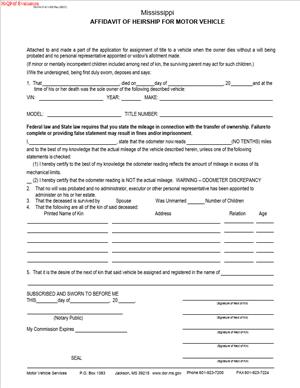
Form 78014178 – Affidavit of Heirship for a Motor Vehicle
Fill out nowJurisdiction: Country: United States | Province or State: Mississippi
If you are handling a vehicle after someone has passed away, you may come across Form 78014178 – Affidavit of Heirship for a Motor Vehicle. This document is used to help transfer ownership of a motor vehicle when the registered owner has died, and no formal probate process is being used.
You are likely looking at this form because you need to move the title into your name or another heir’s name. The vehicle cannot legally change hands without proper paperwork. This form helps establish who is entitled to the vehicle.
The Form 78014178 – Affidavit of Heirship for a Motor Vehicle is commonly used when the estate is small or when the vehicle is the only significant asset. It allows heirs to confirm their relationship to the deceased and their right to the vehicle.
Filling out the form correctly matters. Errors or missing details can delay the transfer. Understanding what the document does and how it works will make the process smoother.
What is Form 78014178 – Affidavit of Heirship for a Motor Vehicle?
Clear definition
Form 78014178 – Affidavit of Heirship for a Motor Vehicle is a sworn statement used to identify the legal heirs of a deceased vehicle owner. It allows those heirs to claim ownership of the vehicle without going through a full probate proceeding when certain conditions are met.
An affidavit is a written statement made under oath. By signing this document, you are declaring that the information provided is true. The form is submitted as part of the title transfer process.
This form focuses only on the motor vehicle. It does not address bank accounts, real estate, or other property owned by the deceased.
Who typically uses this form?
You might use this form if you are a surviving spouse, adult child, or other close relative of the person who owned the vehicle. It is often used when there is no formal will being probated, or when probate is not required for the estate.
Heirs who agree on how the vehicle will be handled commonly rely on this form to simplify the transfer. In many situations, one heir completes the document with the cooperation of the others.
The form may also be used by a person who plans to sell the vehicle after transferring it into their name as an heir.
Why might you need this form?
When the registered owner of a vehicle dies, the title does not automatically transfer. Even if you have possession of the car, the legal ownership remains in the deceased person’s name until it is properly changed.
You may need this form to retitle the vehicle in your name. Without it, you may not be able to register, insure, or sell the vehicle.
This form can be helpful when there is no court-issued document appointing a personal representative. It provides a way to show the state who the rightful heirs are.
Typical real-life scenarios
- A surviving spouse wants to keep the family car. The vehicle is titled only in the deceased spouse’s name. Instead of opening a probate case, the surviving spouse completes the affidavit to transfer the title.
- An adult child inherits a vehicle from a parent who did not leave a will. The other siblings agree that the child may take the car. The affidavit is used to document the agreement and allow the transfer.
- Several siblings inherit a vehicle together. They decide to sell it and split the proceeds. One sibling completes the form, listing all heirs, so the title can be transferred and then sold.
- A vehicle is discovered among the deceased person’s property months after their death. No probate was opened because the estate was small. The heirs use the affidavit to handle the vehicle separately.
When would you use Form 78014178 – Affidavit of Heirship for a Motor Vehicle?
You would generally use this form when a vehicle owner has died, and there is no active probate case appointing an executor or administrator. It is often used when the estate is small and limited to personal property such as a car or truck.
If there is no court order naming a personal representative, the motor vehicle agency may require proof of heirship. This form serves that purpose. It identifies the deceased person, lists the heirs, and explains how they are related.
You may also use the form when all heirs agree on who will receive the vehicle. Cooperation among heirs helps avoid disputes and delays.
In some situations, there is a will, but no probate has been opened. The affidavit may still be used if the vehicle transfer does not require court involvement. The exact process can vary depending on the circumstances of the estate.
If a personal representative has already been appointed by a court, a different process may apply. In that case, the court-issued documents are typically used to transfer the vehicle instead of an affidavit of heirship.
Legal characteristics of Form 78014178 – Affidavit of Heirship for a Motor Vehicle
This form is a sworn statement. That means the person signing it is affirming that the information is true under penalty of perjury. The accuracy of the details is essential.
For the form to be effective, it must be fully completed. Required fields typically include the name of the deceased, date of death, vehicle information such as make and vehicle identification number, and the names of all heirs.
The affidavit is commonly required to be signed in the presence of a notary. Notarization confirms the identity of the person signing and adds a layer of formality to the document.
Incomplete information, inconsistent names, or incorrect vehicle details often cause delays or rejection. For example, if the vehicle identification number does not match the title record, the submission may be returned.
Different states have different rules for transferring vehicles after death. Some require small estate affidavits or probate documents instead. In Mississippi, this specific form is designed for motor vehicles and works within the state’s title system.
It is important to understand what the form does not do. It does not resolve disputes among heirs. It does not determine inheritance rights beyond the vehicle. It also does not replace a will or court order for other types of property.
Is it legally binding?
Yes, the affidavit is legally binding in the sense that you are making a sworn statement. By signing it, you are confirming that the listed heirs and facts are accurate to the best of your knowledge.
If the information is false, there may be legal consequences. Because it is signed under oath, intentional misstatements can lead to penalties.
However, the form itself does not create ownership out of thin air. It documents what you are claiming to be the rightful inheritance. If another heir challenges the claim, the matter may need to be resolved separately.
When properly completed and accepted, the form supports the transfer of title. The legal effect comes from both the sworn statement and the approval of the title transfer process.
How to fill out Form 78014178 – Affidavit of Heirship for a Motor Vehicle
Step 1 – Enter the deceased owner’s information
Begin by writing the full legal name of the deceased as it appears on the vehicle title. Include the date of death and any other identifying information requested on the form. Accuracy is critical. The name should match the existing title record exactly.
Step 2 – Provide vehicle details
Enter the complete vehicle description. This typically includes the year, make, model, and vehicle identification number. You may also need to provide the current title number and license plate information. Double-check each number before moving on.
Step 3 – List all legal heirs
Identify all heirs of the deceased person, not just the one who plans to receive the vehicle. Include full names and their relationship to the deceased. Even if only one heir will ultimately take ownership, the form usually requires disclosure of everyone who has a potential interest.
Step 4 – Explain how the vehicle will be transferred
State clearly who will receive the vehicle. If multiple heirs are transferring their interest to one person, this should be reflected in the document. The language should make it clear whether ownership is going to one heir or shared among several.
Step 5 – Confirm the absence of probate, if required
Indicate whether a probate case has been opened for the estate. If no personal representative has been appointed, the form may require you to confirm that fact. Answer this section carefully and consistently with the rest of the information provided.
Step 6 – Review the affidavit statements
Read the certification language at the end of the form. This section explains that you are swearing that the information is true. Take a moment to review every detail in the document before signing. Errors are easier to correct before notarization.
Step 7 – Sign in the presence of a notary
Sign the form only when you are in front of a notary if notarization is required. Bring valid identification. The notary will complete their section, apply a seal, and confirm the date of signing.
Step 8 – Prepare the form for submission
After signing and notarizing, attach any required supporting documents. This may include a copy of the death certificate and the original vehicle title. Keep copies of everything for your records before submitting the paperwork as part of the title transfer process.
Legal terms you might encounter in Form 78014178 – Affidavit of Heirship for a Motor Vehicle
- Affiant: The affiant is the person who signs and swears to the truth of the statements in this document. On this form, the affiant is usually one of the heirs or someone with direct knowledge of the family history. By signing, you are stating under oath that the information about the deceased owner and heirs is accurate.
- Decedent: The decedent is the person who passed away and owned the vehicle. The form requires you to list the decedent’s full legal name and date of death. This information must match the death certificate and vehicle records.
- Heir: An heir is a person legally entitled to inherit property when someone dies. In this document, you must list every heir, not just the one who will receive the vehicle. The form relies on complete and accurate identification of all heirs.
- Intestate: Intestate means the person died without a valid will. This document is commonly used when there is no will covering the vehicle. You may need to confirm that no probate proceeding is pending.
- Probate: Probate is the court process for handling a deceased person’s estate. If probate has already started, this document may not be appropriate for transferring the vehicle. The form may ask you to confirm that no administration of the estate is underway.
- Motor Vehicle Identification Number (VIN): The VIN is the unique 17-character code assigned to the vehicle. You must enter it exactly as shown on the title or registration. Even one incorrect digit can delay or reject the transfer.
- Notary Public: A notary public is an official authorized to witness signatures and administer oaths. This document must be signed in front of a notary. The notary verifies your identity and confirms that you signed voluntarily.
- Oath or Affirmation: An oath or affirmation is a formal promise that the statements in the document are true. By signing, you accept legal responsibility for the accuracy of the information. False statements can lead to penalties.
- Title Transfer: Title transfer is the process of changing the vehicle’s legal ownership in state records. This document supports that process by identifying the rightful heir. It does not automatically transfer the title; it supports the application to do so.
FAQs
Do I need to file Form 78014178 – Affidavit of Heirship for a Motor Vehicle with a court?
No. This document is generally submitted to the state agency that handles vehicle titles, not to a court. You complete it, have it notarized, and submit it along with the title application and required attachments. It becomes part of the vehicle’s ownership record, not a court file.
What information must match exactly with the death certificate and title?
The decedent’s full legal name and date of death must match the death certificate. The vehicle details, including the VIN and year, make, and model, must match the existing title or registration. If names are spelled differently or initials are used inconsistently, you may need additional documentation to explain the difference.
What if one of the heirs does not agree to transfer the vehicle?
This document requires full disclosure of all heirs. If there is disagreement, the agency may refuse to process the transfer based on this document alone. In that situation, the matter may need to be resolved before ownership can be changed, and you should not leave out an heir to avoid a dispute.
Can I use this document if probate has already started?
If a probate case is open, the vehicle is usually handled through that process. This form is typically intended for situations where no probate administration is pending. You must confirm the estate status before relying on this document.
Do all heirs have to sign this form?
The form generally requires the person making the affidavit to sign before a notary. However, all heirs must be identified, and in some cases, additional signatures may be required on related title transfer documents. Read each signature line carefully and confirm whether joint ownership is being created.
What attachments should I include when submitting Form 78014178 – Affidavit of Heirship for a Motor Vehicle?
You typically need a certified copy of the death certificate, the current vehicle title if available, and a completed title application. If the title is lost, you may need a replacement title form. Review the submission instructions so you do not miss required supporting documents.
When does the ownership change become effective?
The ownership change is reflected when the state agency processes and approves the title transfer. Signing this document does not by itself change the public record. The effective date is tied to the issuance of a new title in the heir’s name.
What happens if the information in this document is later found to be incorrect?
If errors are discovered, the agency may reject the transfer or require a corrected affidavit. In serious cases, false statements can create legal liability. You should review every entry carefully before signing under oath.
Checklist: Before, During, and After Form 78014178 – Affidavit of Heirship for a Motor Vehicle
Before
- Obtain a certified copy of the death certificate.
- Locate the original vehicle title or confirm it is lost.
- Verify the exact VIN from the vehicle or title.
- Identify every legal heir under applicable inheritance rules.
- Confirm that no probate case is open for the estate.
- Gather contact information and legal names for all heirs.
- Check whether there are liens listed on the title.
During
- Enter the decedent’s name exactly as shown on the death certificate.
- Copy the VIN carefully, character by character.
- List all heirs completely, without omissions.
- State clearly how the vehicle will be transferred.
- Review each statement before signing.
- Sign only in the presence of a notary public.
- Ensure the notary completes their section fully and stamps the document.
After
- Make copies of the signed and notarized document.
- Attach the death certificate and title application.
- Submit the full packet to the appropriate vehicle agency.
- Pay any required title transfer fees.
- Track confirmation of acceptance or processing.
- Keep the new title in a safe place once issued.
- Update insurance coverage to reflect the new owner.
Common mistakes to avoid with Form 78014178 – Affidavit of Heirship for a Motor Vehicle
- Mistake: Leaving out an heir because you believe they are not entitled to the vehicle, which happens when families assume informal agreements control inheritance, leading to rejected transfers or disputes; do not forget to list every legal heir even if only one will receive ownership.
- Mistake: Entering an incorrect VIN due to copying it from memory or an old document, which can cause processing delays or denial; do not forget to verify the VIN directly from the vehicle or current title.
- Mistake: Signing before meeting with the notary, which happens when you try to save time, resulting in an invalid notarization; do not forget to sign only in the notary’s physical presence.
- Mistake: Using a nickname or shortened version of the decedent’s name, which often leads to record mismatches; do not forget to match the exact legal name shown on the death certificate and title.
- Mistake: Assuming the affidavit alone transfers ownership, which can delay insurance updates and registration; do not forget to complete and submit the separate title application.
- Mistake: Failing to check for an existing lien, which happens when paperwork is incomplete, leading to refusal to issue a clear title; do not forget to confirm whether a lender must release its interest first.
- Mistake: Omitting required attachments such as the certified death certificate, which causes processing holds; do not forget to assemble all supporting documents before submission.
- Mistake: Providing inconsistent information about probate status, which may trigger additional review; do not forget to confirm and state accurately whether any estate administration is pending.
What to do after filling out Form 78014178 – Affidavit of Heirship for a Motor Vehicle
Once you complete and notarize the document, your focus shifts to proper submission and record updates. The affidavit supports your request, but the title transfer process finalizes the ownership change.
- Step 1: Make at least two clear copies of the signed and notarized document for your records.
- Step 2: Assemble all required attachments, including the certified death certificate and current title.
- Step 3: Complete the separate vehicle title application in the name of the heir who will receive ownership.
- Step 4: Confirm that any lien listed on the existing title has been released in writing.
- Step 5: Submit the full packet to the appropriate state vehicle office, either in person or by mail if permitted.
- Step 6: Pay all required fees and obtain a receipt or confirmation of submission.
- Step 7: Monitor the processing status and respond promptly to any request for additional information.
- Step 8: Once the new title is issued, review it carefully to ensure the name and vehicle details are correct.
- Step 9: Update the vehicle registration, if required, to reflect the new owner’s information.
- Step 10: Notify the insurance company and adjust the policy so coverage matches the new titled owner.
- Step 11: Store the new title and copies of all submitted documents in a secure location.
- Step 12: Inform other heirs that the transfer is complete to maintain transparency and avoid future misunderstandings.
Taking these steps ensures the vehicle is properly transferred, recorded, and insured. Careful follow-through protects you from future disputes and administrative problems.
Disclaimer: This guide is provided for informational purposes only and is not intended as legal advice. You should consult a legal professional.