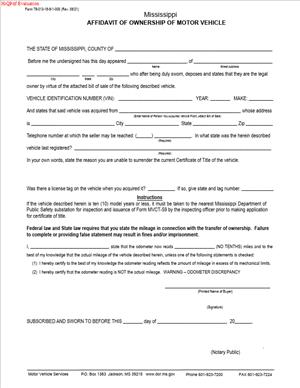
Form 78013188 – Affidavit of Ownership of Motor Vehicle
Fill out nowJurisdiction: Country: United States | Province or State: Mississippi
Form 78013188 – Affidavit of Ownership of Motor Vehicle is a sworn written statement used to confirm who owns a specific vehicle. You complete it when formal proof of ownership is missing, unclear, or needs clarification. It allows you to state, under oath, that you are the lawful owner of the vehicle described in the document.
This form is commonly connected to title and registration matters. It is typically handled through the state’s motor vehicle authority. In Mississippi, it relates to processes overseen by the Department of Revenue.
If you are about to fill out this form, you likely need to prove ownership without having a standard title document available. The form helps create an official record of your claim to the vehicle.
Because this is an affidavit, you are making a sworn statement. That means the information you provide must be complete and accurate. False statements can create serious legal problems.
Understanding what the form does and what it does not do will help you complete it correctly and avoid delays.
What is Form 78013188 – Affidavit of Ownership of Motor Vehicle?
Clear definition
Form 78013188 – Affidavit of Ownership of Motor Vehicle is a sworn declaration that identifies a motor vehicle and states who owns it. An affidavit is a written statement confirmed by oath or affirmation. By signing it, you are formally declaring that the facts in the document are true to the best of your knowledge.
This form typically includes identifying details about the vehicle, such as the year, make, model, and vehicle identification number (VIN). It also includes your name and contact information as the person claiming ownership.
The document does not automatically create ownership. Instead, it provides sworn evidence of ownership when standard proof, such as a certificate of title, is unavailable or incomplete.
Who typically uses this form?
You may use this form if you are an individual who bought a vehicle but did not receive a proper title. It may also be used by someone who inherited a vehicle and needs to confirm ownership before transferring or registering it.
Vehicle sellers sometimes use it to clarify ownership before completing a transfer. In some cases, business owners who operate vehicles under a company name may use the affidavit to clarify who legally owns the vehicle.
Financial institutions, insurance representatives, or state officials may request this form when ownership documentation is unclear. The person completing it is usually the individual claiming legal ownership.
Why might you need this form?
You might need this form if the original title was lost and cannot be replaced immediately. It can also be required when a title was never properly issued or transferred.
If a vehicle was purchased many years ago and paperwork was not completed correctly, this affidavit may help establish a record of ownership. It may also be relevant when a vehicle was abandoned, gifted, or transferred without formal documentation.
Sometimes clerical errors in previous filings create gaps in the record. In those situations, the affidavit helps explain and correct the ownership history.
Typical real-life scenarios
- You purchase a used vehicle from a private seller, but the seller cannot locate the original title. You still need to register the vehicle in your name. An affidavit may be part of the process to confirm your ownership claim.
- A family member passes away and leaves you a vehicle. The title may still be in their name. You may need to submit a sworn statement explaining how you came into possession of the vehicle.
- You restored an older vehicle that had been sitting unused for years. The paperwork may be incomplete or outdated. An affidavit can help establish a clear ownership trail before you seek a new title.
- You received a vehicle as a gift from someone who never completed the formal transfer. The affidavit may help clarify that the vehicle was transferred to you, even if the original documentation was not properly filed.
When would you use Form 78013188 – Affidavit of Ownership of Motor Vehicle?
You would use this form when there is a gap in the official ownership record. Most often, this happens during title applications, title corrections, or registration filings.
If you are applying for a new title and cannot provide the previous title, this affidavit may be part of your submission. It can support your explanation of how you acquired the vehicle.
You might also use it when transferring ownership to another person. Before the transfer can occur, the state may need confirmation that you are the lawful owner.
In some situations, the form is used alongside other documents. These may include bills of sale, prior registrations, or inheritance papers. The affidavit adds a sworn statement to support those materials.
The timing matters. This form is generally submitted during a filing process with the appropriate state office. It is not usually a standalone document. Instead, it supports a larger application or request.
If you are unsure why the form is required in your situation, it usually relates to incomplete or missing ownership records.
Legal characteristics of Form 78013188 – Affidavit of Ownership of Motor Vehicle
This form is an affidavit, which means it is made under oath. For it to be effective, it generally must be signed in the presence of a notary or other authorized official. The notary verifies your identity and confirms that you signed voluntarily.
The document must clearly identify the vehicle. Errors in the VIN, year, or model can lead to rejection. Even a small mistake in the VIN can cause delays because it uniquely identifies the vehicle.
Your name must match your identification and any related filings. Inconsistent spelling, missing middle initials, or different name formats can raise questions about authenticity.
The form typically requires a clear explanation of how you obtained the vehicle. Vague statements can lead to follow-up requests. The reviewing authority may look for a logical timeline of ownership.
Different states may have different formatting or notarization requirements. In Mississippi, the form is associated with state vehicle title processes. Even so, requirements can change over time, and procedures may vary depending on the situation.
It is important to understand what this form does not do. It does not replace a title by itself. It does not automatically register the vehicle. It does not guarantee approval of your ownership claim. It serves as sworn supporting evidence within a larger administrative process.
Is it legally binding?
Yes, an affidavit is legally binding in the sense that you are making a sworn statement under oath. By signing, you confirm that the information provided is true to the best of your knowledge.
Because it is sworn, false statements can carry legal consequences. This is what gives the document its weight. Government offices rely on the fact that you are attesting to the truth under penalty of perjury.
However, being legally binding does not mean it automatically settles disputes. If someone challenges your ownership, the affidavit may be considered as evidence, but it does not prevent further review or investigation.
The legal effect of the affidavit depends on how it is used. In administrative settings, it supports your filing. In a dispute, it may serve as part of the evidence considered. Its strength depends on accuracy, completeness, and consistency with other records.
How to fill out Form 78013188 – Affidavit of Ownership of Motor Vehicle
Step 1 – Review the entire form before writing
Read through the entire document from start to finish. Notice the information requested, including vehicle details, ownership history, and signature requirements. Make sure you have supporting documents nearby, such as prior registration cards or bills of sale. Reviewing first helps you avoid inconsistent answers.
Step 2 – Enter your full legal name and contact information
Write your full legal name exactly as it appears on your government-issued identification. Include your current address and any other contact details requested. Consistency is important. The name you enter should match related vehicle or title documents whenever possible.
Step 3 – Identify the vehicle accurately
Provide the complete vehicle description. This usually includes the year, make, model, body type, and vehicle identification number. Copy the VIN carefully from the vehicle or existing paperwork. Double-check each character. A single incorrect digit can delay processing.
Step 4 – State how you acquired the vehicle
Explain clearly how the vehicle came into your possession. Include relevant dates and the name of the person or entity from whom you obtained it, if known. Keep your explanation factual and chronological. Avoid unnecessary detail, but make sure the timeline makes sense.
Step 5 – Describe any missing or unavailable title information
If the original title is lost, never issued, or cannot be obtained, state that clearly. Provide a brief explanation of the circumstances. For example, you may explain that the prior owner misplaced the title or that the vehicle was transferred without formal documentation. Clarity reduces follow-up questions.
Step 6 – Review your statements for accuracy and completeness
Before signing, read every line again. Confirm that names, dates, and numbers are correct. Make sure your explanation is consistent with any attached documents. Correct errors neatly if allowed, or complete a new form if necessary to avoid confusion.
Step 7 – Sign the affidavit in the presence of a notary
Do not sign the document until you are in front of a notary or other authorized official, if notarization is required. Bring proper identification. The notary will verify your identity and witness your signature. After you sign, the notary will complete their portion of the form.
Step 8 – Attach any required supporting documents and submit
Gather any additional documents that support your ownership claim. This may include bills of sale, prior registrations, or related paperwork. Submit the completed affidavit along with these materials as part of your title or registration filing process. Ensure all pages are included and legible before submission.
Legal terms you might encounter in Form 78013188 – Affidavit of Ownership of Motor Vehicle
- Affiant: This is you, the person making the sworn statement. When you sign this document, you become the affiant and confirm that the information you provide about the vehicle and your ownership is true. Your printed name and signature must match your identification.
- Notary Public: A notary is an authorized official who verifies your identity and witnesses your signature. This form requires notarization, which means you must sign it in front of a notary. The notary will complete a section confirming you appeared and swore to the truth of your statements.
- Sworn Statement: This is a written declaration made under oath. By signing this affidavit, you are stating under penalty of law that the facts about the vehicle’s ownership are accurate. False information can lead to legal consequences.
- Vehicle Identification Number (VIN): The VIN is the unique 17-character code assigned to your vehicle. You must enter it exactly as it appears on the vehicle and any available paperwork. Even one incorrect character can delay processing or cause rejection.
- Chain of Ownership: This refers to the sequence of transfers from one owner to the next. If you do not have a title, you may need to explain how the vehicle moved from the last titled owner to you. Clear details help establish that you are the lawful owner.
- Lien: A lien is a legal claim against the vehicle for unpaid debt, usually from a lender. If a lien exists, it must be disclosed. You may need to provide information about whether the lien has been satisfied before ownership can be fully recognized.
- Supporting Documentation: These are additional papers that back up your claim of ownership. Examples may include bills of sale, repair receipts, registration documents, or correspondence. The form may require you to attach copies to support your affidavit.
- Odometer Reading: This is the mileage shown on the vehicle at the time you complete the form. While not always required in an affidavit, mileage may appear in related title or registration processes. Record it accurately if requested.
- Penalty of Perjury: This phrase means you are legally responsible for the truth of your statements. If you knowingly provide false information, you may face fines or other legal penalties. Read every statement carefully before signing.
FAQs
What information must exactly match my identification?
Your full legal name and address on this document should match your government-issued identification. The notary will check your ID before witnessing your signature. If your name is abbreviated or spelled differently from your ID, it may delay acceptance. Make sure the name you print and sign is consistent throughout the form.
Do I need the exact VIN, and where can I find it?
Yes. You must enter the complete and correct 17-character VIN. You can usually find it on the driver’s side dashboard near the windshield, on the driver’s door frame, and on prior registration or insurance documents. Double-check every character before submitting this form.
What if I never received a title from the previous owner?
Use this document to explain how you acquired the vehicle and why the title is unavailable. Provide dates, names, and any written proof you have, such as a bill of sale. The clearer your explanation, the easier it is for officials to understand the chain of ownership. Attach copies of any supporting paperwork.
Do I need to list liens even if I think they are paid off?
Yes. If you know a lien existed, disclose it and state whether it has been satisfied. If you have a lien release document, attach a copy. This helps prevent disputes and ensures the ownership record is accurate.
When does the affidavit become effective?
The affidavit becomes effective once you sign it before a notary, and it is properly submitted and accepted. The signature date is important because it shows when you swore to the facts. Make sure the notary section is fully completed on the same day you sign.
Can someone else sign Form 78013188 – Affidavit of Ownership of Motor Vehicle for me?
Generally, you must sign it yourself as the person claiming ownership. If someone is signing on your behalf, they must have proper legal authority, such as a valid power of attorney. The name and capacity of the signer should be clearly stated, and supporting authorization documents may need to be attached.
What attachments should I include with this form?
Include copies of any documents that support your ownership claim, such as a bill of sale, prior registration, lien release, repair invoices, or correspondence with the previous owner. Do not send original documents unless specifically required. Clear copies help avoid processing delays.
How will I know if Form 78013188 – Affidavit of Ownership of Motor Vehicle was accepted?
After submission, you should receive confirmation through the normal processing method used for vehicle title or registration matters. This may include a receipt, updated registration, or a new title document. If you do not receive confirmation within a reasonable time, follow up with the appropriate office and keep your submission records available.
Checklist: Before, During, and After Form 78013188 – Affidavit of Ownership of Motor Vehicle
Before
- Gather your government-issued photo identification.
- Locate the complete and correct VIN on the vehicle.
- Collect any bills of sale, prior registrations, or lien releases.
- Confirm the full legal name you will use matches your ID.
- Review the vehicle details (year, make, model, body type).
- Check whether any liens exist or previously existed.
- Read the entire form to understand each statement.
- Make copies of all supporting documents.
During
- Print clearly using black or blue ink if completing by hand.
- Enter your full legal name exactly as shown on your ID.
- Write the VIN carefully, character by character.
- Provide accurate dates of purchase or transfer.
- Explain clearly how you acquired the vehicle.
- Disclose any missing title information honestly.
- Attach copies of supporting documents.
- Sign only in the presence of a notary.
- Ensure the notary completes every required section.
After
- Make a full copy of the signed and notarized affidavit.
- Make copies of all attached supporting documents.
- Submit the form using the required filing method.
- Keep proof of submission, such as a receipt.
- Track the status of your application if possible.
- Store your copy in a safe place with vehicle records.
- Review any correspondence you receive for next steps.
- Update your personal vehicle records once processed.
Common mistakes to avoid with Form 78013188 – Affidavit of Ownership of Motor Vehicle
- Mistake: Entering an incorrect VIN because you copied it from memory instead of the vehicle; this causes processing delays or rejection, so do not forget to verify every character directly from the vehicle or official paperwork.
- Mistake: Signing before meeting with the notary because you want to save time; this invalidates the notarization, so do not forget to wait and sign in the notary’s presence.
- Mistake: Leaving out prior lien information because you believe it was paid; this can create ownership disputes, so do not forget to disclose any known liens and attach releases if available.
- Mistake: Using a nickname or shortened name instead of your legal name; this can cause identity mismatches, so do not forget to match your name exactly to your identification.
- Mistake: Failing to attach supporting documents because you assume the affidavit alone is enough; this may slow review, so do not forget to include clear copies of proof.
- Mistake: Providing vague explanations about how you acquired the vehicle; this raises questions about the chain of ownership, so do not forget to include dates, names, and details.
- Mistake: Submitting original documents without keeping copies; this leaves you without proof if something is lost, so do not forget to make and keep complete copies.
- Mistake: Ignoring follow-up notices after submission because you assume everything is approved; this can stall your title process, so do not forget to respond promptly to any requests.
What to do after filling out Form 78013188 – Affidavit of Ownership of Motor Vehicle
Once you complete and notarize the affidavit, your focus shifts to proper submission and recordkeeping. Small follow-up steps make a big difference in avoiding delays.
- Step 1: Review the entire notarized document for completeness. Confirm that your signature, the date, and the notary’s seal and signature are present and clear.
- Step 2: Make at least one full copy of the signed affidavit for your personal records.
- Step 3: Make copies of every supporting document you are submitting with the affidavit.
- Step 4: Organize the affidavit and attachments in a logical order, with the affidavit on top.
- Step 5: Submit the paperwork through the appropriate submission method, whether in person or by mail, as required for vehicle title matters.
- Step 6: Obtain proof of submission, such as a stamped receipt or mailing confirmation, and store it with your copy.
- Step 7: Monitor for confirmation that your ownership documentation has been processed, such as updated registration or a title document.
- Step 8: Respond quickly if you receive a request for additional information or clarification.
- Step 9: Once ownership is recognized, update your insurance and any personal records to reflect your status as the owner.
- Step 10: Keep the affidavit and related documents in a secure place with your vehicle’s permanent records.
Staying organized protects you. If questions arise later about how you obtained the vehicle, you will have clear documentation showing what you declared and when. Careful follow-through helps ensure your ownership record is accurate and complete.
Disclaimer: This guide is provided for informational purposes only and is not intended as legal advice. You should consult a legal professional.