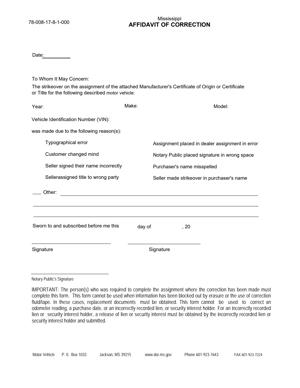
Form 78008178 – Affidavit of Correction
Fill out nowJurisdiction: Country: United States | Province or State: Mississippi
Form 78008178 – Affidavit of Correction is used to fix errors in an official record that has already been filed. In Mississippi, this form is commonly connected to vehicle or title records handled through the Department of Revenue.
You use this document when information on a previously issued record is wrong and needs to be corrected without starting over. It helps clarify mistakes such as misspelled names, incorrect numbers, or other clerical errors.
This form matters because official records must match the facts. Even a small typo can delay a sale, transfer, registration, or other transaction. An affidavit of correction provides a formal way to explain and fix the mistake.
If you are filling out this form, you are likely trying to resolve a problem that is blocking paperwork. Understanding what the form does and how to complete it clearly can save time and prevent further delays.
What is Form 78008178 – Affidavit of Correction?
Clear definition
Form 78008178 – Affidavit of Correction is a sworn written statement used to correct errors on an existing official record. It does not replace the original document. Instead, it explains what was wrong and states the correct information.
An affidavit is a statement made under oath. By signing this form, you are confirming that the correction you are making is true and accurate to the best of your knowledge.
The form becomes part of the official file. It connects the incorrect information to the corrected version so the record can be updated or clarified.
Who typically uses this form?
This form is often used by vehicle owners, buyers, sellers, or lienholders. It may also be used by individuals who discover an error after submitting a title or registration document.
Dealers and businesses sometimes use it when paperwork contains minor mistakes. For example, a dealership may need to correct a typographical error in a name or identification number.
In some cases, a previous owner may complete the affidavit if the error originated from their portion of the paperwork. The person who made the mistake is often the one who explains and corrects it.
Why might you need this form?
You might need this form if a government office identifies an error and cannot process your transaction. The issue could be as simple as one incorrect digit in a vehicle identification number.
You may also discover the mistake yourself. For example, you might notice your name is spelled incorrectly on a title certificate.
Without a correction, the inaccurate information can create problems. It may prevent a transfer of ownership, delay registration, or interfere with record matching in state systems.
The affidavit provides a structured way to fix the issue without canceling the entire filing.
Typical real-life scenarios
You sell a vehicle and later learn that the buyer’s name was written incorrectly on the title assignment. The mistake prevents the buyer from completing registration. An affidavit of correction can clarify the correct spelling.
A vehicle identification number is missing a digit on the submitted paperwork. Because the number does not match state records, the application is placed on hold. The affidavit explains the clerical error and provides the correct number.
A lien release was recorded with an incorrect date. The lender submits a correction to ensure the record reflects the proper timeline.
An owner’s middle initial was left out, causing confusion between two individuals with similar names. The affidavit connects the correct full legal name to the existing record.
In each of these situations, the underlying transaction is valid. The problem is limited to an error in how the information was recorded.
When would you use Form 78008178 – Affidavit of Correction?
You use this form after a document has already been completed and submitted, but before or after the state has processed it. The key factor is that the original document contains incorrect information.
It is commonly used when a title, registration application, or related filing cannot be processed due to inconsistencies. The state may notify you that a correction is required before moving forward.
You may also use it during a vehicle sale or transfer if both parties discover a mistake in the assignment section of a title. Instead of voiding the entire transaction, the affidavit can clarify the intended information.
In some situations, the correction is made shortly after signing. In others, it may be discovered months later when a new transaction is attempted.
The person completing the affidavit is often the individual who made the error. However, it can also be completed by someone with direct knowledge of the mistake and the correct information.
This form is not meant for changing ownership terms or renegotiating a deal. It addresses factual errors, not new agreements.
Legal characteristics of Form 78008178 – Affidavit of Correction
This document is a sworn statement. Its effectiveness depends on accurate information and proper completion. It typically requires the person signing to declare that the correction is true.
Because it is an affidavit, it usually must be signed in the presence of a notary public. The notary verifies the identity of the signer and witnesses the signature.
Common reasons for rejection include incomplete sections, unclear explanations, missing signatures, or corrections that go beyond clerical errors. If the form attempts to change essential terms of a transaction, it may not be accepted as a simple correction.
Different states may have different procedures for correcting vehicle records. In Mississippi, this form is associated with state revenue and motor vehicle processes. The specific format and filing steps are tied to that system.
It is important to understand what the form does not do. It does not create a new title by itself. It does not transfer ownership independently. It does not resolve disputes between parties. Its function is limited to correcting inaccurate information on an existing record.
Is it legally binding?
Yes, in the sense that it is a sworn statement. When you sign the affidavit under oath, you are legally affirming that the information you provide is accurate.
Because it is sworn, knowingly providing false information can carry legal consequences. The seriousness of the affidavit is what gives it weight in correcting official records.
However, it is not a contract between parties. It does not create new rights or obligations beyond correcting the record. Its binding effect relates to the truthfulness of the statement, not to forming a new agreement.
The document becomes part of the official record once accepted. At that point, it serves as the formal explanation for the correction.
How to fill out Form 78008178 – Affidavit of Correction
Step 1 – Review the original document
Before you start, carefully review the document that contains the error. Identify exactly what is wrong. Compare it to reliable information such as identification documents or the vehicle identification number on the vehicle itself.
Make sure the issue is a correctable error rather than a change in terms. This form is intended for factual corrections, not for rewriting agreements.
Step 2 – Enter identifying information
At the top of the form, you will typically provide information that identifies the record being corrected. This may include details such as the vehicle identification number, title number, or registration information.
Write the information clearly and exactly as it appears on the original record. Any mismatch can cause further delays.
Step 3 – Identify the person making the correction
The form will ask for the name and contact information of the person completing the affidavit. Enter your full legal name as it appears on official identification.
If you are correcting a name, make sure you clearly distinguish between the incorrect version and the correct version. Avoid abbreviations unless they are part of the official name.
Step 4 – Describe the error
In the section that asks about the mistake, explain what was written incorrectly. Be specific. For example, state that a digit in the vehicle identification number was incorrect, or that a last name was misspelled.
Do not provide unnecessary background. Focus on the exact error as it appears in the record.
Clarity is important. The reviewer should be able to see both the incorrect information and the corrected version without confusion.
Step 5 – Provide the correct information
After identifying the mistake, write the correct information clearly. Double-check spelling, numbers, and dates.
Take your time with this section. A second error on a correction form can create additional complications.
Make sure the corrected information matches official documents or the physical details of the vehicle, if applicable.
Step 6 – Review the entire form
Read the completed form from start to finish. Confirm that all sections are filled in and that the explanation is consistent.
Check for missing signatures or blank lines. Incomplete forms are often rejected.
Ensure that the information on this form matches the original document, except for the specific correction you are making.
Step 7 – Sign in the presence of a notary
Because this is an affidavit, it typically must be signed in front of a notary public. Do not sign the form in advance unless the instructions clearly allow it.
Bring valid identification to the notary. The notary will verify your identity and witness your signature.
The notary will complete their portion of the form, including their signature and seal.
Step 8 – Submit the form with any required documents
After notarization, submit the completed Form 78008178 – Affidavit of Correction as directed in the filing process you are completing. It is often attached to the original or related paperwork.
Keep a copy for your records. Having a copy can help if questions arise later about the correction.
Once submitted, the affidavit becomes part of the official record and supports the corrected information moving forward.
Legal terms you might encounter in Form 78008178 – Affidavit of Correction
- Affiant: The affiant is the person who swears that the information in the affidavit is true. On this form, that is you or the person authorized to make the correction. Your name must match your identification, and you must sign in front of a notary.
- Notary Public: A notary public is an official who verifies your identity and witnesses your signature. The notary completes a section of the form, signs it, and applies a seal or stamp. Without proper notarization, the affidavit may be rejected.
- Jurisdiction: This refers to the authority under which the affidavit is made. The form may state the state and county where it is signed. This matters because the notary’s commission must be valid in that location.
- Original Document: This is the record you are correcting, such as a title, registration, or tax-related filing. You must clearly identify it by number, date, and names exactly as they appear. Any mismatch can delay processing.
- Material Error: A material error is a significant mistake that affects the accuracy of the official record. Examples include incorrect names, identification numbers, or vehicle details. Minor spelling issues may still need correction if they affect matching in official systems.
- Clerical Error: A clerical error is a simple mistake made during typing or recording, such as a transposed number. This form is often used to fix these types of errors. You must clearly describe what was wrong and what the correct information should be.
- Supporting Documentation: These are documents you attach to prove the correction. Examples may include a copy of the original record, identification, or other official paperwork. Providing clear copies helps the reviewing office confirm your request.
- Oath or Affirmation: When you sign the affidavit, you are swearing or affirming that the information is true. This statement gives the document legal weight. False statements can carry penalties.
- Effective Date: This is the date the correction takes effect. In many cases, the correction relates back to the date of the original document. You should check whether the form asks you to state a specific date.
- Record Amendment: A record amendment is the official update made to correct the public record. Once accepted, the agency adjusts its files to reflect the corrected information. This ensures future documents match the accurate details.
FAQs
What information do I need from the original record before completing this form?
You need the exact details as they appear on the original record, including names, identification numbers, dates, and document or title numbers. Do not rely on memory. Compare your copy line by line so you can clearly state what was incorrect and what the correct information should be.
Who is allowed to sign the Form 78008178 – Affidavit of Correction?
The person who made the error or who has legal authority over the original record usually signs. This may be the owner, seller, or an authorized representative. The name you sign must match your identification, and you must have authority connected to the original transaction or filing.
Does this document change ownership or just fix a mistake?
This document is used to correct errors, not to transfer ownership or create a new transaction. It updates inaccurate information in an existing record. If ownership needs to change, a different form or process is usually required.
What if I do not have a copy of the original document?
You should request a copy from the agency or office that issued or recorded it before completing this form. You need the exact wording and numbers from the original record. Guessing or estimating details can cause rejection.
How detailed should I be when describing the error?
Be specific and direct. State exactly what was written incorrectly and provide the precise correction. For example, note that a number was transposed or a middle initial was omitted, and then clearly show the correct version as it should appear.
When does the correction become official?
The correction becomes official after the completed and notarized Form 78008178 – Affidavit of Correction is submitted and accepted by the appropriate office. Acceptance may be confirmed by a stamped copy, receipt, or updated record. Until then, the original information remains on file.
Do I need to attach proof of the correct information?
In many cases, yes. If you are correcting a name, number, or other key detail, attach documents that support the change. Clear copies of identification or related paperwork help reviewers verify that the correction is accurate.
What happens if the agency rejects this form?
If this document is rejected, you will usually receive notice explaining the reason. Common issues include missing notarization, incomplete sections, or mismatched information. You can correct the problem and resubmit with the required changes.
Checklist: Before, During, and After Form 78008178 – Affidavit of Correction
Before
- Obtain a complete copy of the original record you are correcting.
- Highlight the exact error and confirm the correct information.
- Gather supporting documents that prove the correction.
- Confirm who has legal authority to sign the affidavit.
- Check that your identification is current and matches the name you will sign.
- Review the form instructions carefully.
- Verify whether any fees apply.
- Confirm where and how the completed form must be submitted.
During
- Print clearly or type your information to avoid new errors.
- Enter names and numbers exactly as they appear on the original record.
- Describe the error in a clear, specific sentence.
- Provide the corrected information in full, not just the changed portion.
- Double-check every number for transposed digits.
- Complete all required sections; do not leave blanks.
- Review the form from top to bottom before signing.
- Sign only in the presence of a notary public.
- Ensure the notary completes and stamps their section fully.
After
- Make at least two copies of the signed and notarized affidavit.
- Attach all required supporting documents.
- Submit the form using the approved method (in person or by mail).
- Keep proof of submission, such as a receipt or tracking number.
- Monitor for confirmation or updated documentation.
- Follow up if you do not receive acknowledgment within a reasonable time.
- Store your copy in a safe place with the original record.
- Update your internal records to match the corrected information.
Common mistakes to avoid with Form 78008178 – Affidavit of Correction
- Mistake: Describing the error vaguely because you assume the agency will understand; this happens when people rush, but it can lead to rejection or delays, so do not forget to state exactly what was wrong and what the correct information is.
- Mistake: Signing before meeting with a notary because it seems faster; this often results in an invalid notarization, so do not forget to wait and sign in front of the notary.
- Mistake: Using nicknames or shortened names instead of the legal name on the original record; this happens out of habit and can cause mismatches, so do not forget to copy the name exactly as recorded.
- Mistake: Leaving sections blank because they seem unimportant; this can cause processing delays, so do not forget to complete every required field or write “N/A” if appropriate.
- Mistake: Failing to attach supporting documents due to oversight; this may lead to rejection, so do not forget to include clear copies that verify the correction.
- Mistake: Transposing numbers again while trying to fix a transposed number; this happens easily with long identification numbers, so do not forget to double-check each digit carefully.
- Mistake: Submitting the affidavit to the wrong office because of confusion about responsibility; this can delay your correction, so do not forget to confirm the correct submission location in advance.
- Mistake: Not keeping a copy for your records because you assume the agency will keep track; this can create problems later, so do not forget to store a complete copy in a safe place.
What to do after filling out Form 78008178 – Affidavit of Correction
Once you complete and notarize the affidavit, your next focus is proper submission and recordkeeping. A correction is only effective after it is accepted and processed. Treat this step as seriously as completing the form itself.
Start by reviewing the entire packet. Confirm that the affidavit is signed, dated, and notarized. Make sure all attachments are included and legible. Check that names and numbers on your supporting documents match what you wrote in the correction.
- Step 1: Make at least two full copies of the signed and notarized affidavit, including all attachments.
- Step 2: Organize the documents in a logical order, with the affidavit on top and supporting documents behind it.
- Step 3: Confirm the correct submission method, whether in person or by mail, and prepare any required payment if applicable.
- Step 4: If mailing, use a method that provides tracking so you can confirm delivery.
- Step 5: If submitting in person, request a stamped or dated copy as proof of receipt.
- Step 6: Mark your calendar to follow up if you do not receive confirmation within the expected timeframe.
- Step 7: Once processed, review any updated record carefully to confirm the correction was made accurately.
- Step 8: Store the updated record together with your copy of the affidavit in a secure place.
- Step 9: Update your personal or business files so all internal records match the corrected information.
- Step 10: Inform any other parties who rely on the corrected record, if relevant, so they can update their records as well.
Keep everything organized. If questions arise later, you will be able to show exactly what was submitted and when. Good recordkeeping protects you and prevents the same issue from happening again.
Disclaimer: This guide is provided for informational purposes only and is not intended as legal advice. You should consult a legal professional.