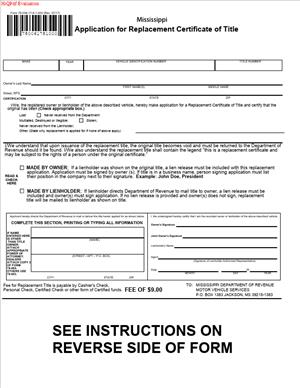
Form 78006178 – Application for Replacement Certificate of Title
Fill out nowJurisdiction: Country: United States | Province or State: Mississippi
The Form 78006178 – Application for Replacement Certificate of Title is used in Mississippi to request a new vehicle title when the original has been lost, damaged, or destroyed. If you are about to fill it out, you are likely trying to fix a practical problem: you need a valid title, and you do not have one.
A vehicle title is an official record of ownership. Without it, you may have trouble selling your vehicle, transferring it, refinancing it, or proving that you own it. This form allows you to ask the state to issue a replacement document.
You might be filling this out after misplacing paperwork, dealing with water or fire damage, or discovering that your title was never properly delivered. Whatever the reason, the goal is the same. You need a clean, readable, official replacement certificate.
This guide walks you through what the form does, when it is used, and how to complete it clearly and accurately. It focuses on what matters when you are actually sitting down to complete the filing.
What is Form 78006178 – Application for Replacement Certificate of Title?
Clear definition
Form 78006178 – Application for Replacement Certificate of Title is a written request submitted to the Mississippi Department of Revenue asking for a duplicate vehicle title. It replaces an original certificate that is no longer available or usable.
The replacement title serves the same function as the original. It identifies the vehicle, lists the registered owner or owners, and shows any recorded lienholders. Once issued, it becomes the controlling ownership document for that vehicle.
This form does not create new ownership. It simply reissues the existing ownership record in document form.
Who typically uses this form?
Most people who use this form are vehicle owners whose original title has been lost, stolen, or damaged. If your name is listed as the owner on record, you may need this form to obtain another copy.
Lienholders, such as financial institutions, may also be involved if a lien is recorded on the vehicle. In some cases, the lienholder may hold the title and request a replacement if the original was lost while in its possession.
Dealers, family members handling an estate, or individuals preparing to transfer a vehicle often encounter situations where a replacement title is necessary before the next step can move forward.
Why might you need this form?
You may need this form if you cannot physically produce your title when required. Many vehicle transactions depend on presenting a valid certificate of title.
If your title was destroyed in a flood, fire, or other accident, a damaged document may not be accepted for official use. A replacement provides a clean, legible record.
If the title was lost during a move or misplaced over time, you may not discover the issue until you attempt to sell or transfer the vehicle. At that point, the replacement process becomes necessary.
A replacement title may also be needed if a previously issued title was never received by mail and cannot be located.
Typical real-life scenarios
- You decide to sell your car and find a buyer. When you search your records, you realize the title is missing. Without it, you cannot complete the transfer. A replacement application allows you to move forward.
- Your vehicle title was stored in the glove compartment, and the vehicle was later damaged in an accident. The paperwork was destroyed. To settle ownership matters, you apply for a duplicate.
- You refinance your vehicle, and the lender requests confirmation of the title record. If the document cannot be located, a replacement is required before processing continues.
- A family member passes away, and you are handling the estate. When reviewing the vehicle records, you discover the original title cannot be found. A replacement is necessary before the vehicle can be transferred or sold.
- You receive notice that your original title was issued but never delivered. After confirming it is not in your possession, you apply for a replacement to ensure you have proof of ownership.
When would you use Form 78006178 – Application for Replacement Certificate of Title?
You use this form when the original certificate of title is unavailable, but the ownership record itself has not changed. The key factor is that the vehicle is already titled in Mississippi, and the information on record remains accurate.
This form is commonly used before a sale, donation, or trade-in. Buyers generally expect a valid title at closing. Without one, the transaction may be delayed or canceled.
You may also use it when correcting practical problems caused by document damage. If the title is torn, illegible, or partially destroyed, it may not be accepted for official transactions.
If you are the current owner listed in the state records and simply need another copy, this form is typically the starting point. If ownership has changed or needs to be corrected, a different filing may be required.
In situations involving a recorded lien, the timing of this form may depend on whether the lien is still active. The presence of a lien can affect how the replacement is issued and to whom it is delivered.
Legal characteristics of Form 78006178 – Application for Replacement Certificate of Title
This form functions as a formal request to the state agency that maintains vehicle title records. It does not transfer ownership, add or remove a lien, or correct unrelated errors. Its purpose is limited to reissuing the existing title information.
For the replacement to be processed, the information you provide must match the state’s records. Differences in names, vehicle identification numbers, or lien information can delay or prevent approval.
The form typically requires identifying details such as the vehicle identification number, make, model, and year. It also requires the owner’s name and contact information. Missing or inconsistent data is a common reason for rejection.
Signatures are critical. The state relies on the signature to confirm that the person requesting the duplicate has the authority to do so. If ownership is listed in multiple names, all listed owners may need to sign, depending on how the names appear on the title record.
High-level differences can exist between states regarding duplicate titles. Some states issue electronic titles only, while others issue paper certificates. In Mississippi, the replacement process generally results in a new certificate reflecting the same ownership details already on file.
This form does not clear liens, resolve disputes, or correct ownership errors. If there is a disagreement about who owns the vehicle, a replacement title will not settle that dispute. It simply reflects the existing record.
Is it legally binding?
The form itself is a sworn request for a government record. When you sign it, you are confirming that the information provided is accurate to the best of your knowledge.
The replacement title that results from an approved application carries legal significance. It serves as official evidence of ownership and is relied upon in sales, transfers, and lien recordings.
However, the application does not create a contract between private parties. Its legal effect is administrative. It updates the state’s documentation by issuing a new certificate based on the existing ownership record.
If the information submitted is false or incomplete, the application may be rejected or could create complications. Accuracy is essential because the state relies on your written statements when issuing the duplicate certificate.
How to fill out Form 78006178 – Application for Replacement Certificate of Title
Step 1 – Identify the vehicle
Begin by entering the full vehicle identification number exactly as it appears on the vehicle or prior records. Include the make, model, and year. Double-check every character in the VIN. A single incorrect digit can prevent the system from matching your request to the correct record.
Step 2 – Provide current owner information
Write the full legal name of the owner or owners as listed on the original title record. Include the current mailing address where the replacement certificate should be sent. Make sure the names match the state’s record, including middle initials or suffixes if they were originally included.
Step 3 – Indicate lien information
If there is an active lien on the vehicle, list the lienholder’s name as shown on the existing title record. If no lien exists, indicate that clearly in the space provided. The presence or absence of a lien affects how the replacement title is processed and delivered.
Step 4 – State the reason for replacement
Select or write the reason you are requesting a duplicate title, such as lost, stolen, or destroyed. Keep the explanation consistent with your situation. This section helps document why the original certificate is no longer available.
Step 5 – Review for accuracy
Before signing, read every line of the completed form. Confirm that the VIN, owner names, and lien details are correct. Check that all required fields are filled in and that there are no blank sections where information is expected.
Step 6 – Sign and date the application
Sign your name exactly as it appears in the owner section. If multiple owners are listed, ensure each required person signs according to how the ownership is recorded. Add the date of signing in the designated area.
Step 7 – Submit the form with any required fee
Prepare the completed application for submission according to the instructions provided with the form. Include any required payment in the accepted format. Once submitted, the request will be reviewed and, if approved, a replacement certificate of title will be issued based on the existing record.
Legal terms you might encounter in Form 78006178 – Application for Replacement Certificate of Title
- Certificate of Title: This is the official document that proves legal ownership of a motor vehicle. On this form, you are asking the state to issue a new certificate because the original was lost, stolen, destroyed, or damaged. The replacement carries the same ownership information as the original unless other authorized changes are processed separately.
- Vehicle Identification Number (VIN): The VIN is a unique 17-character code assigned to your vehicle. You must enter it exactly as it appears on the vehicle and prior registration or title records. Even one incorrect character can delay or reject your application because the VIN is how the state confirms the correct vehicle.
- Registered Owner: This refers to the person or entity listed in state records as the legal owner of the vehicle. The name you enter must match the name already on file unless a separate ownership transfer has occurred. If multiple owners are listed, all required parties may need to sign.
- Lienholder: A lienholder is a lender or other party that has a legal claim against the vehicle until a debt is paid. If a lien is active, the replacement title may be issued to the lienholder rather than directly to you. The form asks you to disclose current lien information so the state can confirm who is entitled to receive the replacement document.
- Release of Lien: This is written confirmation that a lienholder no longer has a claim on the vehicle. If your records show a lien, but it has been paid off, you may need proof of release before a clear replacement title can be issued. Without this, the replacement title may still reflect the lien.
- Duplicate Title: This term is often used interchangeably with “replacement title.” It means a new certificate issued to replace one that is lost, stolen, mutilated, or otherwise unavailable. The duplicate does not create new ownership; it simply replaces the prior document in state records.
- Odometer Reading: Some title-related forms require the current mileage of the vehicle. If requested, you must provide an accurate reading from the vehicle’s odometer at the time you complete the form. False mileage statements can create serious legal and resale problems.
- Signature Certification: By signing the form, you are certifying that the information you provided is true and correct. Your signature may need to match the name as it appears in state records. In some cases, additional identity verification may be required.
- Application Fee: A replacement title typically requires a processing fee. The fee must be submitted in the correct amount and format. If the payment is incorrect or missing, your application will not be processed.
- Record Verification: This refers to the state’s process of checking your submitted information against existing vehicle records. If details such as the VIN, owner name, or lien status do not match, your request may be delayed until discrepancies are resolved.
FAQs
What if I do not know my vehicle’s VIN while completing this form?
You must locate the exact VIN before submitting this document. Check your current vehicle registration card, insurance paperwork, or the metal plate on the dashboard or driver’s side door frame. Enter all 17 characters carefully. If the VIN does not match state records exactly, your application will likely be rejected or held for review.
Do all listed owners have to sign the Form 78006178 – Application for Replacement Certificate of Title?
If more than one owner appears in state records, you need to check how the names are connected. If the record shows joint ownership requiring both signatures, each listed owner must sign. If only one signature is legally sufficient under the way ownership is recorded, then only that party needs to sign. Review the ownership format on your prior title or registration before signing.
What happens if there is still a lien on the vehicle?
You must list the lienholder’s correct legal name and address exactly as it appears in official records. If the lien is still active, the replacement title may be sent directly to the lienholder. If you believe the loan is paid off, confirm that a lien release has been properly recorded before submitting this form.
Can I use this document to change the owner’s name or transfer ownership?
This form is meant to replace an existing certificate, not to change ownership. If you recently sold or bought the vehicle, a separate transfer process is usually required. Submitting this form alone will not update the ownership record to a new person.
What reason should I select for requesting a replacement?
Choose the option that accurately describes what happened to the original title, such as lost, stolen, or destroyed. Be truthful and consistent with your situation. Providing inaccurate information can delay processing and may require additional explanation or documentation.
How do I make sure my name matches state records?
Write your full legal name exactly as it appears on your most recent title or registration. Do not add nicknames or abbreviations unless they already appear in the official record. If you recently changed your name, make sure the change has been updated in vehicle records before filing this document.
What if I made a mistake on the form before submitting it?
If you notice an error before filing, correct it neatly according to the form’s instructions or complete a new copy. Do not submit a form with crossed-out or unreadable information unless corrections are clearly allowed. If you discover a mistake after submission, you may need to contact the processing office and possibly file a new application.
How will I know when my replacement title has been issued?
Processing times vary. After submission, you should receive the replacement certificate by mail at the address listed, or it may be sent to the lienholder if one is recorded. If a significant amount of time passes without receiving it, verify that your mailing address on the form was accurate and that your application was accepted for processing.
Checklist: Before, During, and After Form 78006178 – Application for Replacement Certificate of Title
Before
- Locate your vehicle registration card or prior title copy.
- Confirm the exact VIN directly from the vehicle if possible.
- Verify how the owner’s name appears in official records.
- Check whether a lienholder is listed on your vehicle record.
- Confirm that any lien has been formally released, if applicable.
- Gather valid identification that matches the owner’s name.
- Confirm the correct application fee amount and acceptable payment method.
- Make sure your mailing address is current and complete.
During
- Print or type all information clearly and legibly.
- Enter the VIN carefully, checking each character twice.
- Write the owner’s name exactly as recorded, without variations.
- Provide complete lienholder information if a lien exists.
- Select the accurate reason for requesting a replacement.
- Review every field before signing.
- Sign in the correct place using your legal name.
- Date the form accurately on the day you sign it.
After
- Make a full copy of the completed and signed form for your records.
- Keep a copy of any lien release documentation submitted.
- Submit the application using the approved filing method.
- Retain proof of payment, such as a receipt or transaction confirmation.
- Monitor your mail for the replacement certificate.
- Store the new title in a secure location once received.
- Update your personal records to reflect the replacement issuance.
- Confirm that the information on the new title is accurate upon arrival.
Common mistakes to avoid with Form 78006178 – Application for Replacement Certificate of Title
- Mistake: Entering the wrong VIN because you copied it from memory instead of the vehicle, which leads to processing delays or rejection; always verify directly from the vehicle or official documents and double-check each character.
- Mistake: Using a nickname or shortened name, which happens when people assume minor differences do not matter; mismatched names can cause the application to be flagged, so do not forget to match the exact legal name on record.
- Mistake: Ignoring an existing lien, often because the loan was paid off informally; this can result in the replacement being issued to the lienholder, so do not forget to confirm and document lien release status.
- Mistake: Submitting the wrong fee amount due to outdated information, which can stop processing; do not forget to verify the current fee before sending payment.
- Mistake: Forgetting to sign and date the form, which commonly occurs when multiple pages are involved; unsigned forms are not processed, so do not forget to complete the signature certification section.
- Mistake: Providing an outdated mailing address because you recently moved; this can cause the title to be mailed to the wrong location, so do not forget to confirm your current address before submitting.
What to do after filling out Form 78006178 – Application for Replacement Certificate of Title
Once you have completed the form, pause before submitting it. A careful review now can prevent weeks of delay later. Read every line slowly. Confirm that the VIN, owner name, and mailing address are accurate and complete.
- Step 1: Make a clear copy of the signed form for your personal records.
- Step 2: Attach any required supporting documents, such as a lien release if one applies.
- Step 3: Confirm the correct payment amount and include it in the approved format.
- Step 4: Submit the application through the authorized submission method, whether by mail or in person.
- Step 5: Obtain and keep proof of submission, such as a receipt or mailing confirmation.
- Step 6: Mark your calendar with the submission date to track expected processing time.
- Step 7: Monitor your mail carefully for the replacement certificate or any official correspondence.
- Step 8: If you receive a notice requesting additional information, respond promptly and provide exactly what is requested.
- Step 9: When the replacement certificate arrives, review it immediately to confirm that all details are correct.
- Step 10: Store the new title in a secure, dry location separate from your vehicle.
After you receive the replacement certificate, treat it as your official proof of ownership. Do not keep it in your car. Keep it in a safe place where you store other important documents. If you later sell or transfer the vehicle, you will need this document to complete the transaction properly.
If you discover any errors on the new certificate, act quickly. Contact the issuing authority and follow the correction process. Delays in correcting title information can complicate future sales, transfers, or registration updates.
Staying organized now saves time later. Keep copies of your application, payment proof, and the replacement title together. That way, if questions arise in the future, you can show exactly when and how the replacement was issued.
Disclaimer: This guide is provided for informational purposes only and is not intended as legal advice. You should consult a legal professional.