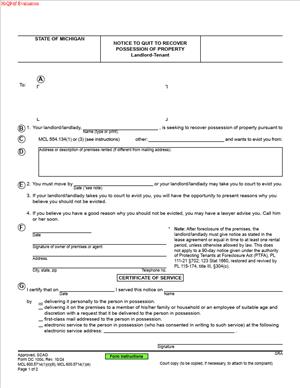
Form DC 100c – Notice to Quit to Recover Possession of Property (Landlord-Tenant)
Fill out nowJurisdiction: Country: United States | Province or State: Michigan
Form DC 100c – Notice to Quit to Recover Possession of Property (Landlord-Tenant) is a written notice used in Michigan to start the process of ending a tenancy and recovering possession of rental property. It is a formal document that tells a tenant that the landlord wants them to move out.
If you are about to fill out this form, you are likely dealing with a rental situation that has gone wrong. This may involve unpaid rent, a lease violation, or another issue that affects the tenancy. The form is often the first official step before a court case.
This document matters because it creates a clear record. It shows that notice was given and explains why the landlord is asking the tenant to leave. Courts often look closely at whether this notice was prepared and delivered properly.
For self-represented landlords, understanding this form helps you avoid delays. Small mistakes can slow down the eviction process. Knowing what each section means makes the completion process more straightforward.
For tenants, recognizing this form helps you understand what is happening. It signals that the landlord is seeking to recover possession of the property and may file a court case if the issue is not resolved.
What is Form DC 100c – Notice to Quit to Recover Possession of Property (Landlord-Tenant)?
Clear definition
Form DC 100c – Notice to Quit to Recover Possession of Property (Landlord-Tenant) is a written notice that a landlord gives to a tenant to end a rental agreement and demand that the tenant move out. It is part of the Michigan court system’s landlord-tenant process.
The form identifies the rental property, the tenant, and the reason for the notice. It also states the time period the tenant has before further action may be taken. This document is often required before a landlord can file a court complaint to recover possession.
It does not remove the tenant by itself. Instead, it serves as a formal warning and an opportunity for the tenant to respond, correct the issue, or vacate the property.
Who typically uses this form?
This form is typically used by landlords. A landlord may be an individual property owner, a management company, or another entity that rents out residential property.
Property managers sometimes complete the form on behalf of the owner. In that case, the person signing usually identifies their role.
Tenants do not use this form to end a tenancy. It is specifically designed for situations where the landlord seeks to recover possession of the rental unit.
Court clerks and judges also review this form later if a case is filed. That means the information written on it may become part of the court record.
Why might you need this form?
You might need this form if a tenant has not paid rent. Nonpayment is one of the most common reasons landlords begin the notice process.
You may also use it if a tenant has violated the lease. This could include unauthorized occupants, damage to the property, or other breaches of the rental agreement.
In some situations, the tenancy is month-to-month, and the landlord wants to end it. The form provides a structured way to give written notice.
Without proper notice, a court may not allow a landlord to move forward with an eviction case. The form helps establish that notice was given before filing.
Typical real-life scenarios
- A tenant misses several rent payments and does not respond to reminders. The landlord decides to begin the formal process and completes this notice to demand payment or possession.
- A tenant keeps a pet in a building that prohibits animals. After prior warnings, the landlord issues this notice citing a lease violation and sets a deadline for compliance or moving out.
- A month-to-month rental arrangement no longer works for the landlord. The landlord uses the form to give the required notice period to terminate the tenancy.
- A tenant causes repeated disturbances that affect other residents. The landlord uses the notice to address the behavior and begin the process of ending the tenancy if it continues.
- A tenant stays after the lease has expired without signing a new agreement. The landlord may use the form to clarify that the tenancy is ending and that possession of the property is required.
When would you use Form DC 100c – Notice to Quit to Recover Possession of Property (Landlord-Tenant)?
You would use this form when you want to formally notify a tenant that their right to occupy the property is ending. It is commonly used before starting a court eviction case.
In many landlord-tenant disputes, written notice is an early required step. This applies in situations involving unpaid rent, lease violations, or termination of certain types of tenancies.
Landlords often use this form after informal efforts have failed. For example, they may have spoken with the tenant or sent reminders. When those steps do not resolve the issue, a formal notice creates a clear record.
If you plan to file a complaint in the Michigan district court to recover possession, this notice is often part of the required process. The court may ask for details about when and how the notice was given.
The timing matters. The notice must usually be given before filing the court case. Using the form at the correct stage helps prevent dismissal or delay.
Tenants encounter this form when a landlord has decided to move from discussion to formal action. It signals that the matter may proceed to court if not resolved.
Legal characteristics of Form DC 100c – Notice to Quit to Recover Possession of Property (Landlord-Tenant)
This form is structured to meet Michigan court requirements for landlord-tenant cases. It includes spaces for names, addresses, reasons for the notice, and the time allowed before further action.
For the notice to be effective, it generally needs to be complete and accurate. Incorrect names, wrong property addresses, or unclear reasons can create problems later in court.
Service of the notice is also important. The landlord typically needs to deliver it in a way that can be explained or proven if questioned. Courts often look at how and when the tenant received it.
Different reasons for recovery of possession may involve different notice periods. The form allows the landlord to specify the applicable time frame. Choosing the wrong reason or timeline can lead to delay.
The form does not decide the case. It does not automatically remove a tenant. Only a court order can require a tenant to leave if they do not move out voluntarily.
It also does not address claims for money beyond what is stated. If a landlord seeks unpaid rent or damages, those issues are usually handled in a court complaint after proper notice.
Is it legally binding?
Form DC 100c – Notice to Quit to Recover Possession of Property (Landlord-Tenant) is a formal legal notice, but it is not a court judgment. It becomes legally significant because it is part of the required process before filing an eviction case.
When properly completed and delivered, it establishes that the landlord has given notice under Michigan law. This can affect whether a court allows the case to proceed.
It does not bind the tenant to move out immediately. Instead, it sets out a deadline. If the tenant does not comply or respond within that time, the landlord may choose to file a court action.
Once the matter goes to court, the judge reviews whether the notice met legal requirements. If it did not, the case may be delayed or dismissed, and the process may need to start again.
How to fill out Form DC 100c – Notice to Quit to Recover Possession of Property (Landlord-Tenant)
Step 1 – Identify the court and case information
At the top of the form, fill in the name of the district court where the property is located. Include the court address if the form requests it. If a case number has not yet been assigned, that space may remain blank until filing.
Step 2 – Enter the tenant’s full name
Write the full legal name of each tenant listed on the lease. If there are multiple tenants, include all names. Accurate spelling matters because this information may later appear in a court filing.
Step 3 – Provide the rental property address
Enter the complete address of the rental unit. Include the street number, street name, apartment or unit number if applicable, city, and ZIP code. This ensures there is no confusion about which property is involved.
Step 4 – State the reason for the notice
Select or write the reason you are seeking to recover possession. The form typically includes options such as nonpayment of rent, termination of tenancy, or lease violation. Choose the option that matches your situation and provide clear details where space is provided.
Step 5 – Specify the notice period
Indicate the number of days given to the tenant to comply or move out. The length of time depends on the reason stated in the notice. Write the deadline clearly so the tenant understands the timeframe.
Step 6 – Include rent details if applicable
If the notice involves unpaid rent, fill in the amount owed and the period it covers. Be precise about dates and totals. This information may later be reviewed by the court.
Step 7 – Sign and date the form
The landlord or authorized agent signs the form. Print your name clearly below your signature if the form provides space. Add the date you are signing, as this often relates to the notice period.
Step 8 – Complete the certificate of service
After delivering the notice to the tenant, fill out the section that explains how and when it was served. Indicate the method used and the date of delivery. This creates a written record that notice was given.
Step 9 – Keep a copy for your records
Make a copy of the completed and signed form for your files. If the matter proceeds to court, you may need to provide this document as part of your filing or bring it to a hearing.
Legal terms you might encounter in Form DC 100c – Notice to Quit to Recover Possession of Property (Landlord-Tenant)
- Premises: This means the rental property you are seeking to recover. On this document, it refers to the full address of the leased property, including unit number if applicable. You must describe it clearly so there is no confusion about which property is involved.
- Possession: Possession refers to the legal right to occupy and control the property. This form is about demanding that the tenant return possession to you. It does not automatically remove the tenant; it starts the formal process.
- Notice Period: The notice period is the amount of time you give the tenant to fix the issue or move out. The length depends on the reason for the notice. You must clearly state when the notice expires so the tenant understands the deadline.
- Forfeiture: Forfeiture means the tenant may lose the right to continue the lease because of a violation. If the notice is based on a breach, this term signals that the lease can end if the problem is not corrected within the allowed time.
- Nonpayment: Nonpayment refers to unpaid rent. If this is the reason for the notice, you must state the exact amount owed. The amount should match your records and exclude unrelated fees unless allowed under the lease.
- Breach of Lease: A breach of lease is a violation of a lease term, such as unauthorized occupants or property damage. When you select this reason, you should describe the specific conduct. Vague statements make enforcement harder later.
- Termination of Tenancy: This means ending a month-to-month or other periodic tenancy without alleging wrongdoing. The form records that you are ending the rental relationship after proper notice. The tenant must leave by the date listed.
- Certificate of Service: This section confirms how and when the notice was delivered to the tenant. It is critical because the timeline usually starts on the date of service. You must complete this section accurately.
- Agent: An agent is someone authorized to act for the landlord, such as a property manager. If you sign as an agent, your authority should be clear. The name on the form should match the lease or ownership records.
FAQs
How do I know which reason to select on Form DC 100c – Notice to Quit to Recover Possession of Property (Landlord-Tenant)?
Look at your lease and your records before you choose a reason. If rent is unpaid, confirm the exact amount and the due dates. If there is a lease violation, identify the specific clause and the date of the violation. The reason you select controls the notice period and what the tenant must do to avoid further action, so make sure it matches your facts.
What date should I list as the termination or move-out date?
You must count the full notice period starting from the date the notice is served, not the date you signed it. Check your calendar carefully and include weekends and holidays unless your rules say otherwise. Write the exact final date by which the tenant must pay, fix the issue, or move out. An incorrect date can delay the process.
Do I need to attach proof of unpaid rent or lease violations to this document?
This document itself usually does not require attachments, but you should have proof ready. Keep a rent ledger, copies of the lease, and any written warnings. If you later file a court case, you may need to present those documents. Make sure the amounts and facts on this form match your records exactly.
Who is allowed to sign this form?
The landlord or an authorized agent can sign. If you are an agent, confirm that your authority is documented in a management agreement or similar record. The signature should match the name printed on the form. An unsigned notice may not be enforceable.
How should I list multiple tenants on the notice?
List every adult tenant named on the lease. Use full legal names as they appear in the rental agreement. If you leave someone out, that person may not be bound by the notice. Double-check spelling to ensure consistency with the lease and your records.
What happens if the tenant pays the full rent after receiving this form?
If the notice is based on nonpayment and the tenant pays the full amount within the allowed period, the issue may be resolved. You should confirm that the payment clears and that no balance remains. Keep written proof of the payment and update your ledger. If you accept partial payment, document what balance remains and how it affects your next steps.
What if I made a mistake after delivering this document?
If you notice an error in names, dates, or amounts, you may need to issue a new notice. Do not rely on verbal corrections. Keep a copy of the corrected document and record the new service date. The timeline typically restarts based on proper service of the corrected notice.
Does this notice become part of the public court record immediately?
This document is not automatically filed with the court when you serve it. It becomes part of the public record only if you later file a case and submit it as part of your paperwork. Until then, keep it in your private records. Accurate completion matters because it may be reviewed by a judge later.
Checklist: Before, During, and After Form DC 100c – Notice to Quit to Recover Possession of Property (Landlord-Tenant)
Before
- Review the lease agreement for relevant clauses and notice requirements
- Confirm the tenant’s full legal name and the exact property address
- Verify the amount of unpaid rent using your rent ledger
- Document any lease violations with dates and details
- Determine the correct notice period for your situation
- Gather prior written warnings or communication records
- Confirm who is authorized to sign the notice
During
- Write the full property address, including unit number
- List all tenants exactly as named in the lease
- Clearly state the reason for the notice
- Insert the correct deadline date after counting the notice period
- Double-check rent amounts for accuracy
- Sign and date the form in the appropriate section
- Complete the certificate of service with the delivery method and date
After
- Make at least two copies of the completed notice
- Deliver the notice using a method that can be documented
- Record the exact date and time of service
- Keep proof of service with your rental records
- Mark the deadline date on your calendar
- Monitor for payment or compliance within the notice period
- Update your rent ledger if payment is received
- Prepare supporting documents in case further action is needed
Common mistakes to avoid with Form DC 100c – Notice to Quit to Recover Possession of Property (Landlord-Tenant)
- Mistake: Listing the wrong tenant name because you rely on memory instead of the lease, which can cause enforcement issues later; do not forget to copy names exactly as written in the rental agreement.
- Mistake: Miscalculating the notice deadline due to counting from the signing date instead of the service date, which may invalidate the notice; do not forget to confirm the correct starting point for the timeline.
- Mistake: Stating an incorrect rent amount because your ledger is outdated, which can undermine your credibility; do not forget to reconcile payments before completing the form.
- Mistake: Failing to complete the certificate of service because you focus only on the main page, which creates proof problems; do not forget to document how and when delivery occurred.
- Mistake: Using vague language to describe a lease violation out of convenience, which makes it harder to prove later; do not forget to include specific dates and actions.
- Mistake: Accepting partial payment without written clarification, which can create confusion about remaining balances; do not forget to document what amount is still owed and how it affects the notice.
- Mistake: Forgetting to sign the form because you prepared it electronically, which may render it ineffective; do not forget to add your signature and date.
- Mistake: Serving only one of multiple tenants because you assume they share responsibility, which may limit enforcement; do not forget to address and serve all named tenants.
What to do after filling out Form DC 100c – Notice to Quit to Recover Possession of Property (Landlord-Tenant)
Once you complete the form, your focus shifts to delivery, documentation, and preparation. Accuracy and timing matter. Small administrative errors can slow you down later.
- Step 1: Make at least two clear copies of the signed notice—one for your records and one for each tenant if needed.
- Step 2: Review the certificate of service section and confirm you understand how you will deliver the notice.
- Step 3: Serve the notice using a method that allows you to verify the date of delivery.
- Step 4: Immediately record the exact date, time, and method of service in your files.
- Step 5: Calculate the deadline again and mark it on your calendar with a reminder a few days before it expires.
- Step 6: Monitor communications from the tenant, including payments, emails, or requests to discuss the issue.
- Step 7: If payment is made, issue a receipt and update your rent ledger to reflect the transaction.
- Step 8: If the tenant corrects a lease violation, document the correction with notes or photos where appropriate.
- Step 9: If the tenant does not comply by the deadline, organize all supporting documents in chronological order.
- Step 10: Keep the original notice and proof of service together in a secure file in case you need them for future proceedings.
Staying organized protects you. Keep a dedicated file for this tenancy. Include the lease, payment history, written communications, inspection notes, and a copy of the notice. Clear records reduce confusion and help you respond confidently if the matter continues.
Finally, review your internal processes. Confirm that your rent tracking system is up to date. Make notes about what triggered the notice and whether earlier communication might have prevented the issue. This helps you improve future property management practices and reduce repeat problems.
Disclaimer: This guide is provided for informational purposes only and is not intended as legal advice. You should consult a legal professional.