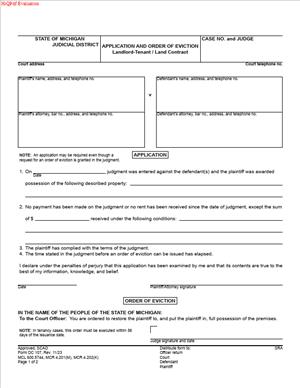
DC 107 – Application and Order of Eviction, Landlord-Tenant or Land Contract
Fill out nowJurisdiction: Country: United States | Province or State: Michigan
The DC 107 – Application and Order of Eviction, Landlord-Tenant or Land Contract is a court form used in Michigan after a landlord or land contract seller has already received a judgment for possession. It is the document that asks the court to issue an eviction order.
If you are about to fill out this form, you are likely near the end of a court case. A judge has already decided who has the legal right to possession of the property. This form moves the case from judgment to enforcement.
This document is not the same as the original complaint that started the eviction case. It comes later, after a court hearing and decision. It tells the court that the time allowed for the occupant to move has passed and that an order of eviction is now requested.
Understanding what this form does helps you avoid delays. Small mistakes can cause the court to reject your submission or require corrections. Knowing the purpose of each section makes the completion process smoother.
What is DC 107 – Application and Order of Eviction, Landlord-Tenant, or Land Contract?
Clear definition
DC 107 – Application and Order of Eviction, Landlord-Tenant or Land Contract is a Michigan court document used to request the issuance of an eviction order after a judgment for possession has been entered. It serves two connected purposes.
First, it acts as an application. The landlord or land contract seller asks the court to issue an eviction order because the occupant has not vacated the property within the time allowed.
Second, it becomes the court’s order once signed by a judge or authorized court official. After it is signed, it directs an officer to remove the occupant and restore possession to the party who won the case.
This form bridges the gap between winning the case and physically regaining control of the property.
Who typically uses this form?
This form is most often used by landlords. A landlord who has won a possession judgment in a landlord-tenant case may complete this document to request enforcement.
It is also used by land contract sellers. In a land contract situation, the seller may seek possession if the buyer defaults and the court has granted a judgment for possession.
Court clerks and judges interact with this form as part of the case record. Law enforcement officers rely on the signed order portion to carry out the eviction.
Tenants or land contract buyers do not usually complete this form. However, they may receive a copy and should understand what it means.
Why might you need this form?
You may need this form if you have already gone to court and received a judgment giving you possession of the property. The judgment alone does not physically remove the occupant.
Most judgments include a period during which the tenant or buyer can move out voluntarily. If that period has expired and the occupant remains, this form allows you to request the next step.
Without this document, there is no official eviction order directing an officer to act. The judgment confirms your right. The eviction order enforces it.
You might also need it if the court’s judgment specifically states that an order of eviction may be issued after a certain date. This form formally triggers that process.
Typical real-life scenarios
- A landlord sues a tenant for nonpayment of rent. The court enters a judgment for possession and gives the tenant ten days to pay or move. The tenant does neither. After the ten days pass, the landlord files this form to request an eviction order.
- A tenant violates lease terms by causing serious property damage. The court grants the landlord possession. The tenant remains in the unit past the move-out deadline. The landlord completes this form to begin enforcement.
- A land contract buyer falls behind on payments. The seller files a case and wins a judgment for possession. The buyer does not vacate within the time allowed. The seller uses this document to request removal.
- A tenant loses a case after holding over beyond the lease term. The court sets a specific date by which the tenant must leave. When that date passes, the landlord submits this form so the court can issue an order to restore possession.
When would you use DC 107 – Application and Order of Eviction, Landlord-Tenant, or Land Contract?
You use this form after a court has already entered a judgment for possession in your favor. It is not used at the beginning of a case.
Timing matters. Courts often require a waiting period after judgment before an eviction order can be issued. This period allows the tenant or land contract buyer time to comply with the judgment.
If the occupant files an appeal or there is a court-ordered stay, the eviction process may be paused. In those situations, this form may not be processed until the stay is lifted or the appeal is resolved.
Landlords commonly use this form when rent remains unpaid after judgment and the statutory time to cure has expired. Land contract sellers may use it when the buyer has not redeemed the property within the allowed time.
This document is part of the enforcement phase of a civil case. It connects the court’s decision to the physical act of regaining possession.
Legal characteristics of DC 107 – Application and Order of Eviction, Landlord-Tenant or Land Contract
This form becomes effective only after a valid judgment for possession has been entered. Without that prior judgment, the court will not issue an eviction order.
Accuracy is critical. The case number, party names, and property address must match the court record. Mismatches can lead to rejection or delay.
The form typically includes a statement confirming that the required waiting period has passed and that no legal barrier prevents issuance of the order. If the timing is incorrect, the court may refuse to sign it.
Once signed, the order portion authorizes a court officer or sheriff to carry out the eviction. It does not authorize the landlord to remove the tenant personally.
Different courts may have slightly different filing procedures. Some may require an in-person submission. Others may accept electronic filing. Local practices can affect processing time, but the core legal function of the form remains the same across Michigan.
This document does not determine new rights. It enforces rights already decided in the judgment. It does not change the amount owed, extend deadlines, or create new obligations beyond possession.
Is it legally binding?
The application portion is a request. It becomes legally binding when a judge or authorized official signs the order section.
Once signed, the order carries the authority of the court. Law enforcement officers rely on it to remove the occupant from the property.
For the party that won possession, the signed order confirms that enforcement may proceed through proper channels. For the occupant, it signals that the court has authorized removal if they remain on the premises.
If the form is completed incorrectly or issued before the allowed time, it may be challenged or set aside. Its legal effect depends on proper procedure and a valid underlying judgment.
How to fill out DC 107 – Application and Order of Eviction, Landlord-Tenant or Land Contract
Step 1 – Enter the court information and case details
At the top of the form, provide the name of the court, the case number, and the names of the parties exactly as they appear on the judgment. Use the same spelling and order. Include the complete property address, including unit number if applicable. These details connect the form to the correct case file.
Step 2 – Identify the judgment for possession
Locate the section that refers to the judgment date. Enter the date the court entered the judgment for possession. This confirms that a decision has already been made. Ensure the date matches the official court record.
Step 3 – Confirm that the waiting period has passed
The form typically requires you to indicate that the statutory waiting period has expired. Review the judgment to determine the date by which the occupant was required to move. Confirm that this date has passed before completing this section.
Step 4 – State that possession has not been returned
You will need to indicate that the tenant or land contract buyer has not vacated the property. This statement explains why the eviction order is being requested. Make sure the information reflects the current situation at the property.
Step 5 – Complete the application section
Fill in any remaining requested details in the application portion. This may include contact information for the party requesting the order. Write clearly and review for accuracy. Errors in names or addresses can delay issuance.
Step 6 – Sign and date the application
Sign the form where indicated for the applicant. Use the same name that appears in the case caption or confirm you are authorized to sign on behalf of the named party. Enter the date of signing. An unsigned form will not be processed.
Step 7 – Submit the form to the court clerk
File the completed form with the court that entered the judgment. Provide any required copies. After submission, the form will be reviewed and, if appropriate, presented to a judge or authorized official for signature on the order portion.
Legal terms you might encounter in DC 107 – Application and Order of Eviction, Landlord-Tenant, or Land Contract
- Writ of Eviction: This is the court’s written authorization allowing an officer to remove occupants from the property. On this form, the order section directs the officer to restore possession to the person who won the judgment. Without this writ, physical eviction cannot legally move forward.
- Judgment for Possession: This is the court’s prior decision stating who has the legal right to possess the property. You must reference the date of that judgment when completing this document. The application relies on that earlier judgment as its foundation.
- Land Contract: A land contract is a real estate purchase agreement where the buyer makes payments over time but does not receive full title until the contract is completed. This form applies not only to rental situations but also to land contract forfeiture cases where possession is at issue.
- Plaintiff: The plaintiff is the party who filed the original case seeking possession. On this form, the plaintiff (or their representative) is usually the one requesting the eviction order. The name must match the court record exactly.
- Defendant: The defendant is the party currently in possession of the property who was subject to the judgment. The defendant’s name must appear exactly as it appears in the original case. Even small spelling differences can cause delays.
- Court Officer or Bailiff: This is the authorized individual who carries out the eviction after the judge signs the order. The form instructs this officer to enforce the writ. You do not personally remove occupants; enforcement is handled by the court officer.
- Restoration of Possession: This phrase refers to returning control of the property to the plaintiff. The order section authorizes the officer to restore possession according to the judgment. It confirms the legal right to re-enter and control the premises.
- Stay of Execution: A stay temporarily pauses the enforcement of the eviction. If a stay has been granted, you cannot proceed until it expires or is lifted. You must confirm that no stay is in effect before submitting the application.
- Clerk of the Court: The clerk processes filings and issues the signed order once approved. After you complete the application portion, you submit it to the clerk for judicial review. The clerk may also collect the required issuance fee.
FAQs
How do I know if I can file this form now?
You can file only after the court has entered a judgment for possession and the required waiting period has passed. Check the judgment date and count forward the number of days stated in the judgment or court rules. Confirm that no stay of execution has been entered. If the waiting period has not expired, the clerk will not issue the order.
What date should I list for the judgment?
Use the exact date shown on the signed judgment for possession in your case file. Do not use the hearing date unless it matches the date on the written judgment. Look at the stamped or signed judgment document to avoid errors. The date must match the court’s record.
What if the defendant has partially moved out?
This document is based on whether possession has been fully returned to you. If any occupants or significant belongings remain and you do not have full control of the premises, possession has not been restored. You should state that possession has not been returned. The officer will determine the next steps when enforcing the order.
Do I need to attach a copy of the judgment?
Courts often already have the judgment in the case file, but you should bring a copy with you when filing. The clerk may review it to confirm eligibility for issuance. If the case number or judgment date on your application does not match the file, the clerk may reject it. Having the judgment on hand helps resolve questions quickly.
Who signs the DC 107 – Application and Order of Eviction, Landlord-Tenant, or Land Contract?
You sign the application section as the plaintiff or authorized representative. If you are signing on behalf of a business or property owner, make sure you have the authority to do so. The judge or magistrate signs the order portion. Do not sign in the judge’s section.
What happens after the judge signs this document?
Once signed, the order becomes enforceable by a court officer. The clerk issues it and forwards it according to court procedure. You may need to coordinate with the officer and pay an enforcement fee. The officer schedules the physical eviction if necessary.
What if the names on this form do not exactly match the judgment?
Names must match the judgment exactly as entered in the case record. Even small differences can delay issuance or enforcement. Review the spelling, middle initials, and business designations carefully. Correct any mismatch before submitting the document.
Does filing this form change the public record?
Filing and issuing this form updates the case docket to show that enforcement has been requested and authorized. It does not create a new case, but it adds an enforcement step to the existing record. The issuance and execution may appear in court records. That record reflects that the court authorized restoration of possession.
Checklist: Before, During, and After DC 107 – Application and Order of Eviction, Landlord-Tenant or Land Contract
Before
- Confirm that a judgment for possession has been entered in your favor.
- Verify that the required waiting period has fully expired.
- Check that no stay of execution or appeal is pending.
- Locate the exact case number and court name from your judgment.
- Review the spelling of all party names as listed in the judgment.
- Confirm that possession has not been voluntarily returned.
- Gather a copy of the signed judgment for reference.
- Prepare payment for any issuance or enforcement fees.
During
- Enter the court name and case number exactly as shown on the judgment.
- Write the full legal names of the plaintiff and the defendant without changes.
- Insert the correct judgment date.
- State clearly that possession has not been returned.
- Complete only the application section; leave the order section for the judge.
- Sign and date the form in the correct signature area.
- Double-check for blank fields before submission.
- Submit the form to the clerk for review and processing.
After
- Confirm with the clerk that the order has been signed and issued.
- Obtain copies of the signed order for your records.
- Contact the court officer as instructed by the clerk.
- Pay any required enforcement fee promptly.
- Keep a written record of communications with the officer.
- Monitor the case docket to confirm issuance.
- Secure the property promptly once possession is restored.
- Update your internal records to reflect the change in possession.
Common mistakes to avoid with DC 107 – Application and Order of Eviction, Landlord-Tenant or Land Contract
- Mistake: Filing too early because you assume the waiting period has passed, which happens when you count from the hearing date instead of the judgment date, leading to rejection by the clerk; do not forget to verify the exact signed judgment date.
- Mistake: Misspelling a party’s name because you rely on memory, which happens often with business entities, causing delays in issuance; do not forget to copy names exactly from the court record.
- Mistake: Signing in the wrong section, which happens when you rush through the form, resulting in processing delays; do not forget that only the judge signs the order portion.
- Mistake: Ignoring a stay of execution, which can occur if you do not review the full docket, leading to improper filing and wasted fees; do not forget to confirm no stay is active.
- Mistake: Leaving blanks in required fields because you assume the court will fill them in, which can cause rejection; do not forget to complete every part of the application section.
- Mistake: Failing to coordinate with the court officer after issuance, which happens when you think the court schedules everything automatically, leading to enforcement delays; do not forget to follow up promptly.
- Mistake: Bringing no copy of the judgment to the clerk, which happens when you assume the file is instantly accessible, causing slowdowns; do not forget to keep your own copy for reference.
- Mistake: Not updating your property records after possession is restored, which happens when you focus only on removal, creating confusion later; do not forget to document the date possession was restored.
What to do after filling out DC 107 – Application and Order of Eviction, Landlord-Tenant, or Land Contract
Once you complete the application section, your next steps focus on filing, issuance, and enforcement. Stay organized. Small oversights can slow the process.
- Step 1: Make at least two copies of the completed form before filing—one for your records and one for working with the court officer.
- Step 2: File the original with the court clerk in the same court that issued the judgment for possession.
- Step 3: Pay the required issuance fee and ask the clerk how you will be notified once the judge signs the order.
- Step 4: Confirm that the judge or magistrate has signed the order section and that it has been officially issued.
- Step 5: Obtain a certified or stamped copy if required for enforcement.
- Step 6: Contact the assigned court officer or bailiff to arrange enforcement and ask about scheduling and additional fees.
- Step 7: Provide the officer with any necessary property details, such as access instructions or known safety concerns.
- Step 8: Be prepared to secure the property immediately after possession is restored. Arrange for new locks if appropriate.
- Step 9: Document the date and time possession is returned to you. Keep copies of the signed order and any enforcement paperwork.
- Step 10: Update your lease files, accounting records, or land contract records to reflect the regained possession and close out the case internally.
Throughout this process, keep all paperwork together in one file. Maintain notes of phone calls, payments, and enforcement dates. If questions arise later, clear documentation will help you show exactly what happened and when. The organization protects you and keeps the transition smooth.
Disclaimer: This guide is provided for informational purposes only and is not intended as legal advice. You should consult a legal professional.