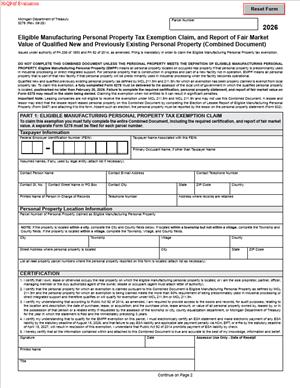
5278 – Eligible Manufacturing Personal Property Tax Exemption Claim, and Report of Fair Market Value of Qualified New and Previously Existing Personal Property (Combined Document)
Fill out nowJurisdiction: Country: United States | Province or State: Michigan
If you own or operate a manufacturing business in Michigan, you may come across the 5278 – Eligible Manufacturing Personal Property Tax Exemption Claim, and Report of Fair Market Value of Qualified New and Previously Existing Personal Property (Combined Document). This form is used to claim a property tax exemption for certain manufacturing personal property and to report the fair market value of qualified assets.
This is not a simple registration form. It combines an exemption claim with a required value report. That means you are both asking for a tax benefit and providing financial details about your equipment and other personal property.
The document is typically filed with the local assessing authority. It plays a key role in determining how your manufacturing personal property is treated for property tax purposes.
If you are about to complete this form, you need to understand what counts as eligible manufacturing personal property, what information is required, and how your reported values affect your tax status. Small errors can delay processing or affect your exemption.
This guide walks you through what the form does, when it is used, and how to approach filling it out with confidence.
What is 5278 – Eligible Manufacturing Personal Property Tax Exemption Claim, and Report of Fair Market Value of Qualified New and Previously Existing Personal Property (Combined Document)?
Clear definition
The 5278 – Eligible Manufacturing Personal Property Tax Exemption Claim, and Report of Fair Market Value of Qualified New and Previously Existing Personal Property (Combined Document) is a Michigan tax form used by manufacturing businesses to claim an exemption from personal property tax on qualifying manufacturing equipment and related assets.
It also requires you to report the fair market value of both qualified new and previously existing personal property. In other words, you are not only claiming an exemption, but also disclosing the value of the property that may fall under that exemption.
This combined structure helps local tax authorities determine whether your property meets the requirements for exemption and how it should be recorded for tax purposes.
Who typically uses this form?
This form is commonly used by manufacturing businesses that own personal property used in industrial processing or direct manufacturing activities. That can include corporations, limited liability companies, partnerships, and sole proprietorships operating in Michigan.
It is often completed by business owners, financial officers, controllers, or accounting staff. In some cases, an outside tax professional prepares the filing based on internal asset records.
The key factor is not the size of the company, but whether it owns or leases personal property used in eligible manufacturing activities within the state.
Why might you need this form?
You may need this form if your business owns machinery, equipment, tools, or other personal property used directly in manufacturing, and you want to claim the eligible manufacturing personal property exemption.
The exemption can significantly affect your property tax obligations. Without filing the proper claim, the property may be assessed and taxed as ordinary personal property.
In addition, even when an exemption applies, the reporting of fair market value is often required. The document ensures that local authorities have a record of the assets and their values, even if those assets are not subject to regular personal property tax.
Typical real-life scenarios
- A small manufacturing company purchases new production equipment to expand its operations. The equipment is used directly in assembling products. The company files this form to claim the exemption for that equipment and reports its fair market value as required.
- An established manufacturer has owned processing machinery for several years. Some of that equipment qualifies as previously existing personal property under the exemption rules. The business uses this document to report those assets and maintain its exempt status.
- A company reorganizes its structure but continues manufacturing at the same facility. Because ownership and reporting details may have changed, the form is used to ensure that the exemption claim reflects the current legal entity and asset values.
- A manufacturer acquires another company’s assets and integrates them into its production line. The newly acquired equipment must be evaluated for eligibility. The business completes the form to report the fair market value of both existing and newly qualified property.
When would you use 5278 – Eligible Manufacturing Personal Property Tax Exemption Claim, and Report of Fair Market Value of Qualified New and Previously Existing Personal Property (Combined Document)?
You would use this document during the annual personal property tax reporting cycle if your business owns eligible manufacturing personal property in Michigan.
It is typically filed when claiming the eligible manufacturing personal property exemption for the first time. It may also be used in later years to continue reporting qualifying assets and their values.
Businesses that have recently purchased or placed new manufacturing equipment into service often use the form to ensure those assets are properly classified and reported.
If your company’s asset base changes significantly due to expansion, downsizing, relocation within the state, or a change in ownership, this filing may be part of keeping your property tax records accurate.
The form is also relevant when a business transitions property from taxable status to potentially exempt status because it now meets the definition of eligible manufacturing personal property. In that situation, the claim and value report are completed together.
Legal characteristics of 5278 – Eligible Manufacturing Personal Property Tax Exemption Claim, and Report of Fair Market Value of Qualified New and Previously Existing Personal Property (Combined Document)
This document functions as a formal claim for a statutory tax exemption. It is submitted to a governmental authority and becomes part of your official tax record.
For the filing to be effective, it generally must be complete, accurate, and signed by an authorized person. The information provided must match your business records, including asset listings and valuation methods.
Common issues that lead to problems include incomplete asset descriptions, incorrect reporting of fair market value, failure to identify whether the property is new or previously existing, and missing signatures. Inconsistent information between this form and other tax filings may also raise questions.
The form does not automatically guarantee that your property will be treated as exempt. The local assessing authority reviews the submission and determines whether the reported property meets the statutory requirements.
While this document is specific to Michigan, property tax exemption structures vary across states. Other jurisdictions may require separate filings for exemption claims and value reports, or may define manufacturing personal property differently.
This form does not replace other required business tax filings. It only addresses the exemption and reporting of certain manufacturing personal property for property tax purposes.
Is it legally binding?
Yes, in the sense that it is an official tax filing submitted under penalty of perjury or similar certification language. When you sign it, you are attesting that the information is true and complete to the best of your knowledge.
Because it is part of your tax record, inaccurate or misleading statements can have legal and financial consequences. The information may be used by tax authorities in making assessment decisions.
However, the document itself is not a contract between you and the state. It does not create new rights beyond those provided by law. Instead, it serves as your formal request to apply an existing statutory exemption and to report required property values.
Its legal effect depends on proper completion, timely submission, and whether the property actually qualifies under the applicable rules.
How to fill out 5278 – Eligible Manufacturing Personal Property Tax Exemption Claim, and Report of Fair Market Value of Qualified New and Previously Existing Personal Property (Combined Document)
Step 1 – Gather your asset records
Before you begin the form, collect detailed records of all personal property used in your manufacturing operations. This includes purchase dates, original costs, asset descriptions, and current fair market values.
Separate your assets into categories such as qualified new personal property and previously existing personal property. Clear organization at this stage makes the form easier to complete accurately.
Step 2 – Identify your business information
Enter your legal business name exactly as it appears in your official records. Include your mailing address, property location, and any identifying numbers requested on the document.
Make sure the information matches other filings submitted to local or state tax authorities. Consistency helps prevent processing delays.
Step 3 – Confirm eligibility status
Review the definitions of eligible manufacturing personal property as described in the form’s instructions. Determine which assets are used directly in manufacturing or industrial processing.
Exclude property that does not meet the stated criteria. Misclassifying non-qualifying property can create issues during review.
Step 4 – Report qualified new personal property
List the assets that qualify as new personal property under the exemption rules. Provide the required details for each item or grouped category, including the fair market value as of the relevant tax day.
Use a reasonable and consistent valuation approach. The reported fair market value should reflect what a willing buyer would pay in an open market.
Step 5 – Report previously existing personal property
Complete the section that addresses previously existing qualified property. Provide the total fair market value and any additional breakdown required.
Distinguish clearly between new and previously existing property. The form treats these categories separately for reporting purposes.
Step 6 – Review totals and calculations
Check all mathematical entries. Confirm that totals match the sum of the listed property values.
Verify that figures are placed in the correct sections. Simple placement errors can affect how the submission is interpreted.
Step 7 – Complete certification and signature
Read the certification statement carefully. Enter the name and title of the person authorized to sign on behalf of the business.
Sign and date the form where indicated. An unsigned document is generally considered incomplete.
Step 8 – Prepare for submission
Make a copy of the completed form for your records. Keep supporting documentation, such as asset lists and valuation worksheets, in case questions arise.
Submit the completed document to the appropriate local assessing authority as required for the reporting year.
Legal terms you might encounter in 5278 – Eligible Manufacturing Personal Property Tax Exemption Claim, and Report of Fair Market Value of Qualified New and Previously Existing Personal Property (Combined Document)
- Eligible Manufacturing Personal Property (EMPP): This refers to personal property used more than 50% in industrial processing or direct integrated support. In this document, you claim that your equipment meets this definition. You are confirming that the property qualifies for a specific tax exemption category.
- Industrial Processing: This term describes activities that change the form, composition, or character of tangible personal property for sale. When you review your asset list, you must decide which items directly contribute to this process. Equipment used for administration or sales does not usually meet this definition.
- Qualified New Personal Property (QNP): This is generally personal property first placed in service within a certain timeframe and meeting statutory requirements. On the form, you list these assets separately from older equipment. The classification affects how the exemption applies.
- Previously Existing Personal Property (PEPP): This includes older manufacturing equipment that was already in service before the qualifying date. You must report its fair market value even though it may already be known to the assessing authority. The document combines exemption claiming with value reporting for this category.
- Fair Market Value (FMV): This is the price your property would sell for on the open market between a willing buyer and seller. On the form, you report aggregate fair market value figures for qualified property. You are not guessing; you base this on your accounting records and depreciation schedules.
- Direct Integrated Support: This covers property that supports industrial processing in a close and continuous way. Examples may include certain testing or quality control equipment located in the production area. You must determine whether each asset directly supports manufacturing or is merely incidental.
- Tax Year: This is the specific year for which you are claiming the exemption and reporting value. The form applies to a defined assessment date. Make sure the asset data you use matches that year.
- Assessor: This is the local official who reviews your claim and maintains the tax roll. Your completed document goes to this office for review. The assessor relies on the accuracy of the information you provide.
- Certification: This is your signed statement that the information is true and complete. When you sign, you are attesting under penalty that your reporting is accurate. This section gives the document legal weight.
- Combined Document: This form both claims an exemption and reports fair market value. You are not just asking for relief; you are also disclosing financial information about a qualifying property. That dual function is why accuracy is critical.
FAQs
What exactly am I claiming when I file 5278 – Eligible Manufacturing Personal Property Tax Exemption Claim, and Report of Fair Market Value of Qualified New and Previously Existing Personal Property (Combined Document)?
You are claiming that certain personal property used in your business qualifies as eligible manufacturing personal property. At the same time, you are reporting the fair market value of both qualified new and previously existing property. The claim and the value report work together. The assessor uses your reported values to adjust the tax roll while recognizing the exemption status.
How do I know which assets belong in the “qualified new” section versus the “previously existing” section?
Check the date each asset was first placed in service and whether it meets the statutory definition of new for exemption purposes. Review your fixed asset register and acquisition dates. If the property was in service before the qualifying cutoff, it typically goes in the previously existing category. Do not mix the totals. Each section requires separate reporting.
Do I need to attach depreciation schedules or asset lists to this form?
This document usually requires you to report totals, not item-by-item lists. However, you should have detailed depreciation schedules ready in case the assessor requests support. If the instructions mention attachments, include exactly what is requested. Do not assume that internal records automatically transfer; you must provide what the form requires.
Who is authorized to sign this document?
An owner, officer, or authorized representative with knowledge of the business’s property records should sign. The signer is certifying that the reported fair market value and eligibility statements are accurate. Make sure the printed name and title match your official business records. If someone signs without authority, the filing may be questioned.
What happens if my business name on this form does not exactly match the name on file with the local assessor?
Name mismatches can delay processing. Confirm that the legal entity name, any assumed name, and the tax identification details match what appears in prior filings and tax records. If your business recently changed names, ensure that the change has been formally recorded. Consistency helps prevent rejection or follow-up notices.
Is there a specific effective date I need to confirm before completing this document?
Yes. You must use the correct tax year and assessment date referenced in the form’s instructions. All reported values should reflect the status of your property as of that date. Do not include property acquired after the assessment date, or exclude property that was in service on that date. Align your numbers with the exact reporting period.
Will filing this form automatically update the public tax record for my business?
Once accepted, the information you provide can affect how your personal property is listed and taxed on the local tax roll. The assessor reviews and processes your submission before making changes. You will not see immediate updates until the review is complete. Keep a copy of what you filed in case you need to confirm reported figures later.
What should I do if I discover an error after submitting this document?
Act quickly. Contact the assessing authority to explain the mistake and ask about correction procedures. You may need to submit an amended filing or written explanation. Keep documentation showing the correct figures and why the change is necessary. Do not ignore errors, especially if they affect fair market value totals.
Checklist: Before, During, and After 5278 – Eligible Manufacturing Personal Property Tax Exemption Claim, and Report of Fair Market Value of Qualified New and Previously Existing Personal Property (Combined Document)
Before
- Review your complete fixed asset register for the relevant tax year.
- Confirm the assessment date and reporting period.
- Separate manufacturing equipment from office or non-qualifying property.
- Identify acquisition dates for each asset.
- Verify your legal business name and tax identification details.
- Confirm who has the authority to sign the document.
- Gather prior year filings for comparison.
- Check internal depreciation schedules for accuracy.
During
- Enter your business name exactly as registered.
- Double-check parcel or account numbers before writing them down.
- Report qualified new property totals in the correct section only.
- Report previously existing property totals separately.
- Use fair market value figures consistent with your records.
- Recalculate totals to ensure math accuracy.
- Review each page for completeness.
- Complete and sign the certification section.
After
- Make a full copy of the signed document for your records.
- Store supporting depreciation schedules with your copy.
- Submit the form using the required delivery method.
- Note the date of submission in your compliance calendar.
- Watch for confirmation or follow-up requests.
- Respond promptly if the assessor asks for clarification.
- Update internal tax files to reflect the reported values.
- Compare the updated tax roll to your submitted figures when available.
Common mistakes to avoid with 5278 – Eligible Manufacturing Personal Property Tax Exemption Claim, and Report of Fair Market Value of Qualified New and Previously Existing Personal Property (Combined Document)
- Mistake: Including non-manufacturing assets because they are located in the same building, which happens when you do not carefully review use percentages, leading to overstated exemption claims and possible adjustment; do not forget to verify that each asset is used more than 50% in industrial processing.
- Mistake: Mixing qualified new and previously existing property totals due to unclear asset records, which can distort reported values and trigger questions from the assessor; do not forget to separate assets by placed-in-service date.
- Mistake: Using book value instead of fair market value because it is easier to pull from accounting software, which may misstate required figures and cause corrections; do not forget to confirm that the reported numbers match the definition required on the form.
- Mistake: Leaving required identification fields blank because they seem repetitive, which can delay processing or cause rejection; do not forget to complete every line that applies to your business.
- Mistake: Having an unauthorized employee sign the certification because leadership is unavailable, which can undermine the validity of the filing; do not forget to ensure the signer has proper authority and lists their title.
- Mistake: Missing the filing deadline due to lack of calendar tracking, which can result in loss of exemption for that year; do not forget to confirm and document the due date in advance.
- Mistake: Failing to keep a copy of the submitted form because you assume records are retained elsewhere, which makes future audits or corrections harder; do not forget to store both digital and paper copies securely.
- Mistake: Not reviewing prior year filings for consistency, which can create unexplained value swings and attract scrutiny; do not forget to compare year-over-year totals before submitting.
What to do after filling out 5278 – Eligible Manufacturing Personal Property Tax Exemption Claim, and Report of Fair Market Value of Qualified New and Previously Existing Personal Property (Combined Document)
Once you complete the document, shift your focus to documentation and submission. Accuracy on paper is only part of the process. Proper handling after completion protects your exemption claim.
- Step 1: Review every page one more time for missing signatures, unchecked boxes, and math errors.
- Step 2: Confirm that the tax year and assessment date match your asset data.
- Step 3: Make at least one complete copy of the signed form for your records.
- Step 4: Assemble supporting documents, such as depreciation schedules, and store them with your copy.
- Step 5: Submit the form using the required delivery method, whether mail, in-person filing, or approved electronic submission.
- Step 6: Record the submission date and method in your compliance calendar.
- Step 7: Monitor for written confirmation, a receipt, or any notice from the assessor.
- Step 8: Respond promptly if additional information or clarification is requested.
- Step 9: When assessment notices are issued, compare the listed values to what you reported.
- Step 10: Keep the filed copy and related records organized for future tax years.
You should also update your internal property tax file to reflect the reported fair market values and exemption status. This makes next year’s filing easier. If your business acquires or disposes of equipment during the year, maintain detailed records so you are prepared for the next reporting cycle.
Consistency is key. When your reported values align with your accounting records and prior filings, the review process is smoother. Careful follow-through reduces the chance of disputes and keeps your manufacturing exemption on solid ground.
Disclaimer: This guide is provided for informational purposes only and is not intended as legal advice. You should consult a legal professional.