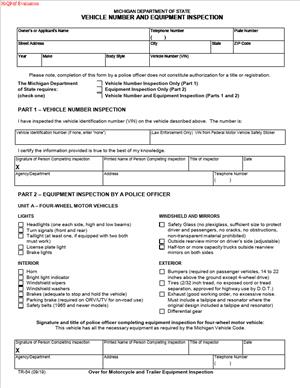
TR-54 – Vehicle Number and Equipment Inspection
Fill out nowJurisdiction: Country: United States | Province or State: Michigan
The TR-54 – Vehicle Number and Equipment Inspection is a Michigan Department of State form used to verify a vehicle’s identification number and confirm that certain equipment is present and functional. You may encounter this document when you are trying to title or register a vehicle that needs extra verification. It connects the physical vehicle to the official records.
This form focuses on two main things. First, it confirms the vehicle identification number, often called the VIN. Second, it documents the condition of required equipment, such as lights or other safety components.
If you are about to complete this form, you likely need it to move forward with a title, registration, or related filing. The inspection information becomes part of the state’s records. Accuracy matters because the details must match the vehicle and any supporting paperwork.
Understanding what this form does helps you avoid delays. When you know why the inspection is required and what information it captures, you can prepare the vehicle and your documents before submission.
What is TR-54 – Vehicle Number and Equipment Inspection?
Clear definition
TR-54 – Vehicle Number and Equipment Inspection is an official inspection document used in Michigan to record a vehicle’s VIN and confirm that required equipment is present and in working order. It is not a title or registration itself. Instead, it supports those processes.
The form documents a physical inspection. An authorized individual examines the vehicle and records specific details directly from it. This includes the VIN as it appears on the vehicle and notes about required equipment.
The completed document becomes part of a larger filing. It helps verify that the vehicle described in your paperwork is the same vehicle being presented for titling or registration.
Who typically uses this form?
You may use this form if you are a vehicle owner seeking to title or register a vehicle that requires inspection. This can include buyers of used vehicles, owners of rebuilt vehicles, or people transferring ownership under special circumstances.
Authorized inspectors also use this form. They complete the inspection section, confirm the VIN, and document equipment status. The form often requires their signature and identifying information.
Dealers and other intermediaries may encounter this document when assisting with title or registration filings. However, the inspection itself must generally be performed by someone authorized to do so.
Why might you need this form?
You may need this form when the state requires verification of a vehicle’s identity. This can happen if there is a question about the VIN, if the vehicle was previously titled in another jurisdiction, or if the vehicle has been rebuilt or restored.
It may also be required when standard documentation is not enough to confirm the vehicle’s details. For example, missing or inconsistent paperwork can trigger the need for a physical inspection.
In some cases, the form is part of a broader compliance process. The inspection helps confirm that the vehicle meets basic equipment standards before it is registered for use.
Typical real-life scenarios
- You purchase a used vehicle from a private seller. During the title transfer process, you are told that the vehicle needs a VIN and equipment inspection. The form is completed after the vehicle is physically examined.
- You restore a vehicle that was previously damaged or salvaged. Before you can register it, the vehicle must be inspected to confirm the VIN and verify that required equipment has been properly installed. The inspection details are recorded on this document.
- You bring a vehicle into Michigan from another state and need to complete local registration. If there are discrepancies or special conditions, an inspection may be required to confirm the vehicle’s identity and equipment.
- You discover that the VIN plate appears altered, damaged, or difficult to read. An inspection may be required to document the VIN as it appears and to verify that it matches supporting paperwork.
- You are working through a title correction or replacement process. If there are inconsistencies in the records, the state may require a physical inspection documented on this form before processing your request.
When would you use TR-54 – Vehicle Number and Equipment Inspection?
You would use TR-54 – Vehicle Number and Equipment Inspection when a physical verification of the vehicle is required as part of a filing. This is not a routine form for every vehicle transaction. It is typically triggered by specific circumstances.
One common situation is when applying for a title under nonstandard conditions. This may include rebuilt vehicles, certain out-of-state vehicles, or vehicles with missing or questionable documentation. The inspection provides an additional layer of confirmation.
Another situation involves discrepancies in the VIN. If the VIN on your paperwork does not clearly match the vehicle, or if the VIN plate is damaged or difficult to read, an inspection helps clarify what is physically present on the vehicle.
You may also encounter this form when correcting errors in prior records. If a previous title or registration contains incorrect information, a new inspection may be used to document the accurate details.
The form is used during a specific stage of the process. First, the vehicle is inspected. Then, the completed form is submitted along with other required documents. The inspection does not replace other filings. It supports them.
If you are acting as the vehicle owner, your role is usually to present the vehicle and provide related paperwork. If you are an authorized inspector, your role is to examine the vehicle and accurately complete the inspection portion. Each person has a distinct function in the completion of the document.
Legal characteristics of TR-54 – Vehicle Number and Equipment Inspection
This form serves as an official record of a vehicle inspection. Its effectiveness depends on accurate information and proper completion. It typically requires identifying information about the vehicle and the signature of the authorized inspector.
For the form to be accepted, the VIN recorded must match the vehicle exactly. Even a single incorrect character can create delays. The VIN must be copied carefully, directly from the vehicle, without assumptions.
Incomplete sections are a common reason for rejection or delay. Missing signatures, missing inspector credentials, or blank required fields can prevent processing. The form is intended to present a complete and clear record of the inspection.
Legibility also matters. If handwritten entries are unclear, the reviewing office may not be able to confirm the details. This can lead to requests for clarification or a repeat inspection.
High-level requirements for inspections can vary by state. While this form is specific to Michigan, other states may have different inspection documents or standards. The general concept is similar, but the format and authority of inspectors can differ.
This document does not create ownership. It does not transfer title. It does not serve as proof of registration. Instead, it supports those processes by confirming the physical characteristics of the vehicle.
The form also does not guarantee roadworthiness beyond the equipment items it documents. It records specific observations at the time of inspection. It is not a full mechanical evaluation.
Is it legally binding?
TR-54 – Vehicle Number and Equipment Inspection is legally significant because it becomes part of an official filing. The information recorded can affect whether a title or registration is issued. In that sense, it carries legal weight.
The binding aspect typically relates to the accuracy of the statements made on the form. The inspector’s signature usually confirms that the inspection was conducted and that the information recorded reflects what was observed. Providing false information can have legal consequences.
For you as a vehicle owner, signing the form may confirm that the information you provided is accurate to the best of your knowledge. The form becomes part of the state’s records and can be relied upon in future transactions involving the vehicle.
However, the form itself is not a contract between private parties. It does not create rights or obligations beyond documenting the inspection. Its legal effect comes from its role in the broader title and registration process.
How to fill out TR-54 – Vehicle Number and Equipment Inspection
Step 1 – Review the entire form before starting
Begin by reading the entire document from top to bottom. Identify which sections are for the vehicle owner and which are for the authorized inspector. This helps you avoid filling in a section that is not assigned to you.
Take note of all required fields. Look for spaces that request vehicle details, inspection findings, signatures, and dates. Understanding the layout first reduces the chance of mistakes.
Step 2 – Gather vehicle and ownership information
Collect any documents related to the vehicle before the inspection. This may include the current title, registration, or bill of sale. Having these on hand allows you to compare the VIN and other details for consistency.
Bring the vehicle itself to the inspection location in a condition that allows the VIN and equipment to be clearly viewed. If the VIN plate is obstructed, make sure it is accessible.
Step 3 – Provide basic vehicle details
Enter the vehicle information requested on the form. This commonly includes the year, make, model, and body style. Write the information exactly as it appears on your title or other official paperwork, unless instructed otherwise.
Double-check spelling and numbers. Small errors in model year or make can cause mismatches in the records. Consistency across all documents is important.
Step 4 – Locate and verify the VIN
Find the VIN on the vehicle. It is typically located on a metal plate or label attached to the vehicle body, often near the dashboard or door frame. The inspector will examine this number directly from the vehicle.
Ensure the VIN is recorded exactly as shown. Each letter and number must be correct and in the proper order. Do not rely solely on prior paperwork. The purpose of the inspection is to confirm what is physically present.
Step 5 – Complete the equipment inspection section
The authorized inspector will check required equipment items listed on the form. This may include lights, signals, and other safety-related components. Each item is typically marked to indicate whether it is present and functioning.
Allow enough time for a thorough review. The inspection is based on observation at that moment. If any equipment is not functioning, it may be noted on the form.
Step 6 – Record inspector information
The form usually requires the inspector’s name, title, and identifying details. This confirms that the inspection was performed by someone authorized. The inspector must complete this section accurately.
If you are the vehicle owner, verify that this section is filled in before leaving the inspection. Missing inspector information can delay submission.
Step 7 – Sign and date where required
Review the completed form carefully. Confirm that all entries are legible and complete. If there is a section for your signature, sign and date it as indicated.
The inspector will also sign and date the form. The date typically reflects the day the inspection was performed. Ensure that all signatures are present before proceeding to submission.
Step 8 – Submit the form with your related filing
Once the form is fully completed, include it with your title, registration, or related filing. Keep a copy for your records if possible. The completed document becomes part of your overall submission.
Make sure the information on this form matches the information on the rest of your paperwork. Consistency across all documents supports a smoother review process.
Legal terms you might encounter in TR-54 – Vehicle Number and Equipment Inspection
- Vehicle Identification Number (VIN): This is the unique 17-character number assigned to a vehicle by the manufacturer. On this form, the VIN must be physically inspected and accurately recorded. Even a single incorrect character can delay your title or registration process.
- Odometer Reading: This is the mileage displayed on the vehicle’s odometer at the time of inspection. The inspector records the reading exactly as shown. It helps confirm the vehicle’s identity and can be relevant to title accuracy.
- Make: The manufacturer of the vehicle, such as the company that produced it. You must ensure the make listed on this document matches the vehicle and any existing ownership paperwork. A mismatch can raise red flags during processing.
- Body Style: This refers to the type of vehicle, such as sedan, coupe, SUV, pickup, or motorcycle. The inspector confirms the body style as part of the physical inspection. It must match what appears on the title or application.
- Model Year: The year assigned by the manufacturer that identifies the vehicle’s production cycle. This may differ from the calendar year of sale. The inspector records the model year as shown on the vehicle documentation and VIN information.
- Inspector Certification: This is the portion where the authorized individual confirms they physically examined the vehicle and verified the Vehicle Identification Number and equipment. Their signature and credentials validate the inspection. Without proper certification, the document may be rejected.
- Equipment Compliance: This refers to the confirmation that required equipment is present and functioning, such as lights or other safety components. The inspection verifies that the vehicle meets basic equipment standards. Missing or nonworking equipment can prevent approval.
- Assigned VIN: In some cases, a vehicle may not have a standard Vehicle Identification Number or may require a state-issued number. If that applies, the form documents the assigned VIN. This becomes the official identification number for future records.
- Altered VIN: This term refers to a Vehicle Identification Number that appears damaged, modified, or tampered with. The inspector checks for signs of alteration. If suspected, the matter may require further investigation before processing continues.
FAQs
Do I need to complete every section of TR-54 – Vehicle Number and Equipment Inspection myself?
You usually complete the owner-related sections, such as your name and vehicle details, but the inspection and certification sections must be filled out by an authorized inspector. Do not sign in the inspector’s area. Review the entire document before the inspection so you know which parts are your responsibility.
What happens if the VIN on this form does not exactly match my title?
The VIN must match your title or ownership paperwork exactly, character for character. If there is a difference, the filing office may reject your paperwork until the discrepancy is resolved. Before submission, double-check the VIN on the vehicle itself and compare it carefully to your documents.
Who is allowed to sign the inspection certification section?
Only an authorized individual who is permitted to conduct vehicle inspections may complete and sign that section. If someone without proper authority signs it, the document may not be accepted. Always confirm that the inspector includes their full name, signature, and any required identification number or credentials.
Can I use this document if the VIN plate is damaged or hard to read?
If the VIN plate is damaged or difficult to read, the inspector must still verify the number through available markings on the vehicle. If the VIN cannot be clearly confirmed, additional steps may be required before the inspection can be certified. Do not guess or fill in unclear characters yourself.
Does this form expire after it is signed?
The document does not typically list an expiration date, but processing offices may expect it to reflect a recent inspection. If too much time passes between inspection and submission, you may be asked to obtain a new one. Submit your paperwork promptly after completion.
Do I need to attach other documents when submitting TR-54 – Vehicle Number and Equipment Inspection?
In most cases, yes. This form is usually submitted with a title application, registration paperwork, or other ownership documents. Make sure the names, VIN, and vehicle details match across all forms before filing.
What if I made a small mistake while filling out this document?
If you notice an error before the inspector signs, correct it neatly according to the form’s instructions. If the mistake appears in the inspection or certification section, you may need a new form completed. Avoid using correction fluid unless specifically allowed.
Will this form change my vehicle’s public record?
This document supports updates or confirmation of vehicle identification in official records. Once accepted, the verified VIN and related details become part of the state’s record for your vehicle. That record is used for future title, registration, or transfer transactions.
Checklist: Before, During, and After TR-54 – Vehicle Number and Equipment Inspection
Before
- Review your title, registration, or ownership documents for accurate vehicle details.
- Confirm the VIN on your paperwork matches the Vehicle Identification Number physically attached to the vehicle.
- Gather personal identification if required for related filings.
- Ensure the vehicle is accessible for inspection, including clear access to the VIN plate.
- Check that required equipment, such as lights, is present and functioning.
- Verify you are using the most current version of the form.
- Read through the entire document so you understand each section.
- Schedule the inspection with an authorized individual.
During
- Present the vehicle in a well-lit area for clear Vehicle Identification Number verification.
- Watch as the inspector locates and reads the Vehicle Identification Number directly from the vehicle.
- Confirm the Vehicle Identification Number is written exactly as it appears, including all letters and numbers.
- Provide accurate vehicle details when asked.
- Ensure the odometer reading is recorded correctly.
- Check that the inspector completes every required certification field.
- Verify that the inspector signs and dates the form.
- Review the completed document before leaving.
After
- Make a copy of the completed form for your records.
- Attach the inspection document to your title or registration application.
- Double-check that all vehicle information matches across documents.
- Submit the paperwork through the appropriate filing method.
- Keep proof of submission or receipt confirmation.
- Store your copy in a safe place with your vehicle records.
- Monitor the status of your related application.
- Respond promptly if you receive a request for additional information.
Common mistakes to avoid with TR-54 – Vehicle Number and Equipment Inspection
- Mistake: Copying the Vehicle Identification Number from old paperwork instead of the vehicle itself, which happens because it seems faster, but it can cause rejection if prior documents contained an error; do not forget to verify the Vehicle Identification Number directly from the vehicle.
- Mistake: Leaving small sections blank, often because they seem unimportant, which can result in processing delays; do not forget to review every line before submission.
- Mistake: Allowing someone without proper authority to sign the inspection section, usually out of convenience, which can invalidate the document; do not forget to confirm the inspector’s credentials.
- Mistake: Submitting the form long after the inspection date, which happens due to delays in gathering other paperwork, and may require a new inspection; do not forget to file promptly.
- Mistake: Failing to check that names match exactly across documents, often because of minor spelling differences, which can create identity verification issues; do not forget to ensure consistent spelling and formatting.
- Mistake: Using correction fluid or making messy edits, which happens when trying to fix quick errors, and can lead to rejection; do not forget to follow proper correction procedures or complete a new form if necessary.
- Mistake: Not reviewing the equipment section for completeness, assuming the inspector handled everything, which can result in missing information; do not forget to read the finished form before leaving.
- Mistake: Forgetting to keep a copy, which often happens during busy filing processes, and makes it harder to respond to questions later; do not forget to retain a clear copy for your records.
What to do after filling out TR-54 – Vehicle Number and Equipment Inspection
Once the inspection portion is complete and signed, your next focus is proper submission. This document usually supports another filing, such as a title or registration application. It rarely stands alone.
Start by reviewing the completed form carefully. Look at the Vehicle Identification Number, model year, make, and body style. Confirm that every character matches your other documents. Small discrepancies cause big delays.
- Step 1: Make at least one clear copy of the fully completed and signed form for your personal records.
- Step 2: Attach the original inspection document to your related application paperwork.
- Step 3: Recheck that your name appears exactly the same across all documents.
- Step 4: Confirm that any required signatures from you are present and dated.
- Step 5: Organize your paperwork in logical order so the inspection form is easy to identify.
- Step 6: Submit the full packet using the approved filing method, whether in person or by another accepted process.
- Step 7: Obtain proof of submission, such as a stamped copy or receipt confirmation.
- Step 8: Track the status of your title or registration application if tracking is available.
- Step 9: Respond quickly to any notice requesting clarification or additional documents.
- Step 10: Store your copy of the inspection form with your vehicle records for future reference.
Keep your copy even after your title or registration is issued. If you sell the vehicle or correct a future record issue, having the verified VIN inspection can help resolve questions quickly.
If your paperwork is returned for correction, compare the feedback with your copy. Identify whether the issue relates to the VIN, inspector certification, missing information, or attachment problems. Address the specific issue rather than starting from scratch unless instructed to do so.
Stay organized. A properly completed and submitted inspection form supports accurate public records for your vehicle. That accuracy protects you in future transfers, renewals, and ownership transactions.
Disclaimer: This guide is provided for informational purposes only and is not intended as legal advice. You should consult a legal professional.