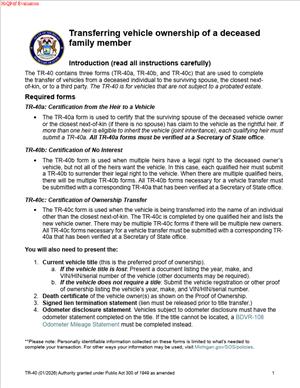
TR-40a – Certification for the Heir to a Vehicle
Fill out nowJurisdiction: Country: United States | Province or State: Michigan
TR-40a – Certification for the Heir to a Vehicle is a Michigan Department of State vehicle title form used when a vehicle owner has died and an heir is seeking to transfer the vehicle. It helps document the connection between the deceased owner, the vehicle, and the person claiming the right to receive or transfer it.
This form matters because a vehicle title is a legal ownership record. When the titled owner dies, another person usually cannot simply sign the title as if the owner were still alive. The transfer must be supported by paperwork showing why the new person has authority.
You may encounter this document while handling a family member’s vehicle after death, especially when the vehicle is part of a small estate or when formal probate may not be involved. The form is not a will, court order, or estate plan. Its purpose is narrower: it supports a vehicle title transaction by certifying heirship information for a specific vehicle.
Careful completion can reduce delays, rejected filings, and confusion among heirs, family members, and title office staff.
What is TR-40a – Certification for the Heir to a Vehicle?
Clear definition
TR-40a – Certification for the Heir to a Vehicle is a Michigan vehicle title document used to certify that a person is an heir of a deceased vehicle owner. It is connected to transferring title after the owner’s death.
The form generally asks for identifying information about the deceased owner, the vehicle, and the heir. It may also ask for statements about the estate, the relationship between the parties, and the status of other heirs or claims.
In plain terms, the document tells the title agency who died, what vehicle is involved, and who is claiming the right to the vehicle. The person signing the form is usually confirming that the information is true.
This certification is different from a normal title assignment. A normal title assignment is signed by a living owner. When the owner has died, the signature path changes. A certification form helps bridge that gap when it is accepted for the situation.
The form also helps protect the title history. A buyer, insurer, lender, towing company, or future title office may rely on the ownership record to determine who has authority over the vehicle.
Who typically uses this form?
This form is typically used by an heir of a deceased vehicle owner. An heir may be a surviving spouse, adult child, parent, sibling, or another person who may inherit based on the facts of the estate.
A personal representative, executor, or estate representative may also be involved in a vehicle transfer after death. Sometimes that person handles the title paperwork instead of an heir signing a certification. The correct paperwork often depends on whether an estate has been opened and what authority has been granted.
A surviving spouse may use this type of document when a vehicle was titled only in the deceased spouse’s name. An adult child may use it when a parent died and the vehicle is being transferred within the family. A sibling or more distant relative may be involved when closer relatives are not living or are not part of the transfer.
The form may also be relevant when the heir intends to sell the vehicle rather than keep it. The heir may need to establish authority first, then complete the sale paperwork.
Self-represented people often use this form because vehicle title transfers can happen outside a courtroom setting. Still, the form requires accuracy. It involves legal facts about death, ownership, and inheritance, even though it may look simple.
Why might you need this form?
You might need this form because a title office cannot treat a deceased owner like a living seller. The owner cannot sign the vehicle title, answer questions, or complete an ordinary transfer. The office needs another basis to update ownership records.
The form helps show that the vehicle owner has died and that you are claiming the vehicle as an heir. It may also help confirm that the vehicle is not being transferred by someone with no legal connection to the estate.
A proper title transfer creates a cleaner record. That record can matter if you later register the vehicle, insure it, sell it, donate it, scrap it, or transfer it to another family member.
The form may matter even if the vehicle is old, not running, or worth little money. A vehicle title is still an ownership record, and many later steps require proof that the person acting has authority.
Typical real-life scenarios
- A parent dies with a car titled only in that parent’s name. One adult child has been using the car and now needs to transfer it. The family may use this type of certification to connect the deceased owner, the vehicle, and the heir receiving title.
- A spouse dies unexpectedly, and the surviving spouse needs to keep using the household vehicle. The spouse may need title paperwork before registration, insurance, or a later sale can be handled smoothly.
- A person dies leaving an older pickup truck parked at a relative’s home. The vehicle may not be worth enough to justify a complicated process, but the title still must be handled. A certification for an heir may help complete the filing if the situation fits the form’s requirements.
- An adult child wants to sell a deceased parent’s vehicle to pay storage fees or settle family expenses. A buyer will usually want proper title documents. The heir may need a recognized submission before the buyer can receive clear title.
- A relative has possession of the vehicle but is not listed on the title. Possession alone usually does not prove ownership. The certification helps separate physical control of the vehicle from the legal process of transferring title.
When would you use TR-40a – Certification for the Heir to a Vehicle?
You would use TR-40a – Certification for the Heir to a Vehicle when a deceased person’s vehicle needs to be transferred to an heir through a title transaction. The key event is the death of the titled owner. The key task is updating the vehicle ownership record.
This form is often considered when there is no living owner available to sign the title. If the deceased person was the only named owner, the transfer usually needs extra documentation. The certification helps explain who is stepping into the ownership process.
You may use it when you are trying to title the vehicle in your own name as an heir. This may happen when you plan to keep and use the vehicle. Once the title record is updated, related tasks like registration and insurance may be easier.
You may also use it when the vehicle will be sold. A buyer usually needs confidence that the person signing transfer paperwork has authority. The certification may support the chain of title before or during the sale process.
The form can also be useful when the estate is small, and the vehicle is one of the few assets. Vehicle title procedures often provide specific forms for these common situations. That does not make the facts unimportant; it simply gives you a structured way to present them.
A surviving spouse may encounter the form when the vehicle was not jointly titled. Joint title, survivorship language, estate papers, and heirship certification can work differently. The right path often depends on the title record and estate facts.
An adult child may use the form when a parent died, and no court-appointed estate representative is handling the vehicle. A sibling or more distant relative may use it when closer relatives are not living or are not involved. These situations require extra care because heirship can become less obvious.
The form is not limited to passenger cars. Vehicle title forms may involve cars, trucks, motorcycles, trailers, or other titled vehicles, depending on the vehicle category. The vehicle identification details must match the specific item being transferred.
You would not typically use this document while the titled owner is alive. A living owner usually signs the title or other transfer paperwork directly.
You also may not use this form when a court order, personal representative document, or other estate authority controls the vehicle transfer. In some estates, a court-appointed person handles the transfer rather than an heir certification.
If there are disagreements among family members, the form may not resolve them by itself. A title agency records vehicle ownership based on the paperwork presented. It does not generally decide complex inheritance disputes in the same way a court might.
If a lender has a lien on the vehicle, the certification may not remove that lien. A title transfer and a lien release are separate issues.
If the vehicle was co-owned, use of the form can depend on how the names appear on the title. Some co-ownership arrangements allow the surviving owner to proceed differently. Others may require estate or heir documentation.
Timing can matter. Delays may create storage charges, registration issues, insurance gaps, or sale problems. Completing the correct form accurately can help avoid repeated trips or returned paperwork.
Legal characteristics of TR-40a – Certification for the Heir to a Vehicle
TR-40a – Certification for the Heir to a Vehicle has legal significance because it is used in an official vehicle title process. When someone signs the form, they are usually making factual statements about a deceased owner, the vehicle, and heirship. Those statements support a change in ownership records.
For the document to be effective, the information must be accurate, complete, and consistent with supporting records. The deceased owner’s name should match the title record as closely as possible. The vehicle identification number should match the title and the vehicle. The heir’s name should match identification documents.
The form commonly works with other documents. A death certificate, current title, identification, lien release, or related title application may also be involved. The certification alone may not be enough if other required parts of the title transaction are missing.
Signature requirements are important. If the form calls for a signature, the person signing is confirming the truth of the statements on the form. If notarization is required for the particular filing, the signature must be completed in the required way. Signing too early, signing in the wrong place, or leaving a required signature blank can create delays.
A common problem is a mismatch between names. The title may use a middle initial while the death record uses a full middle name. A person may have changed names after marriage or divorce. These differences may be explainable, but they can cause questions if the form does not clearly identify the same people.
Another common issue is an incorrect vehicle identification number. The VIN is long and easy to mistype. One wrong character can point to a different vehicle or make the title record impossible to locate.
Missing heir information can also cause rejection or follow-up questions. If the form asks about other heirs, skipping that section may leave the agency unable to evaluate the certification.
Unresolved liens are another frequent obstacle. A certification may help establish heirship, but it usually does not erase a lender’s recorded interest. If the title shows a lien, the title transaction may require separate proof that the lien has been released or otherwise handled.
The form does not create a will, rewrite the deceased person’s estate plan, or automatically transfer every asset. It is focused on a vehicle title matter. Other property, bank accounts, real estate, and debts may require different documents.
The form also does not guarantee that no one else can challenge the transfer. It provides a certification for the title process. If family members disagree about who is entitled to the vehicle, the document may become part of a larger dispute.
Vehicle title rules vary by state. Michigan has its own title forms and procedures. Even within Michigan, the facts can change the paperwork needed. A vehicle with a surviving co-owner, open lien, or court-administered estate may be handled differently from a lien-free vehicle titled only to the deceased.
This document is best understood as one piece of the vehicle title chain. The title chain shows how ownership moved from one person to another. When the prior owner has died, the certification helps explain the transition from the deceased owner to the heir.
Is it legally binding?
TR-40a – Certification for the Heir to a Vehicle can be legally meaningful when it is completed, signed, and accepted as part of a vehicle title transaction. The person signing is certifying facts for an official ownership record.
It may be binding in the sense that the signer is responsible for the statements made on the document. If the statements are false or incomplete, the resulting title transaction may be questioned.
The form’s effect depends on the surrounding facts. It is more likely to function as intended when the deceased person was the titled owner, the signer is an appropriate heir, the vehicle is correctly identified, and required supporting documents are provided.
Acceptance also depends on filing requirements. A completed form may still be rejected if it lacks a required signature, supporting document, fee, title application, or lien release.
The document does not bind every possible heir simply because one person signs it. If other heirs have rights or objections, those issues may exist outside the title office transaction. It also does not necessarily bind creditors, lienholders, or courts.
In practical terms, the form is an official statement of heirship for vehicle title purposes. It is not merely informational. It can affect who appears as the vehicle owner if the submission is accepted.
How to fill out TR-40a – Certification for the Heir to a Vehicle
Step 1 – Confirm the form title
Check that you are working with TR-40a – Certification for the Heir to a Vehicle and not a different Michigan vehicle title form. Using the wrong document can delay the filing.
Step 2 – Read the entire document before writing
Review every section before entering information. This helps you identify the names, dates, signatures, and vehicle details you will need.
Step 3 – Gather the vehicle title information
Locate the current title or other reliable title record. You will usually need the vehicle identification number, year, make, model, and title number if requested.
Step 4 – Enter the deceased owner’s information
Write the deceased owner’s full legal name as it appears on the title whenever possible. Include any requested date of death or identifying details.
Step 5 – Identify the heir completing the form
Enter your full legal name and any requested contact or identifying information. Use the name that matches your identification documents.
Step 6 – State your relationship to the deceased owner
Complete the section asking how you are related to the deceased person. Common relationships include spouse, child, parent, sibling, or another family connection.
Step 7 – Provide the vehicle description
Fill in the vehicle details exactly and legibly. Compare the VIN against the title and, when possible, the vehicle itself. Do not rely on memory.
Step 8 – Address estate and heirship statements
Complete any statements about the estate, heirs, or basis for transfer. If the form asks whether certain estate conditions exist, answer based on the actual facts.
Step 9 – Review any lien information
Check whether the title lists a lienholder. If a lien appears, the transfer may require separate lien documentation.
Step 10 – Attach or prepare supporting documents
Gather documents commonly connected to the filing, such as the existing title, proof of death, identification, related title application, or lien release if applicable.
Step 11 – Check for blank fields
Review the full form for empty spaces that apply to your situation. Blank required fields are a common reason for delay.
Step 12 – Sign the certification
Sign in the correct signature area using your current legal signature. If notarization or a witnessed signature is required, complete that process as instructed.
Step 13 – Date the form
Enter the signing date where requested. Use a clear month, day, and year format.
Step 14 – Make a copy for your records
Keep a copy of the completed form and related documents before submission.
Step 15 – Submit the completed title packet
Submit the certification with the other required title documents. The filing may include the title, title application, supporting proof, fees, and lien paperwork.
Legal terms you might encounter in TR-40a – Certification for the Heir to a Vehicle
- Heir: A person who may receive property from someone who has died. On this form, the heir is the person certifying a right to transfer or receive the vehicle.
- Decedent: The deceased vehicle owner. Use the name as it appears on the vehicle title unless the form asks for another version.
- Vehicle title: The ownership record for the vehicle. The title information helps the state match the form to the correct vehicle and owner.
- Vehicle identification number: The VIN is the unique number assigned to the vehicle. One wrong character can delay processing or cause rejection.
- Certification: A formal statement that the information provided is true. By signing, you confirm facts about the deceased owner, the vehicle, and your authority as an heir.
- Estate: The property and obligations left after a person dies. This form may involve statements about whether the vehicle is being handled outside a full probate process.
- Probate: A court process for managing a deceased person’s property. If there is a probate case, the title office may ask for documents that match that case.
- Lien: A legal claim against the vehicle, usually because money is still owed. A lien can prevent or complicate transfer until it is released or handled.
- Personal representative: A person appointed to handle an estate. If someone has been appointed, that person may have authority that affects who can sign vehicle paperwork.
- Odometer disclosure: A mileage statement used in many vehicle transfers. Depending on the vehicle and transaction, the title packet may require mileage information in addition to this form.
FAQs
Do I need the original title before I complete TR-40a – Certification for the Heir to a Vehicle?
You usually need the title information before completing the form correctly. The title gives the exact owner name, vehicle identification number, year, make, body style, and any lien information.
If the original title is missing, you may need to confirm whether a replacement title process or other title paperwork is required. Do not guess at the VIN or owner name from memory.
Whose name should I enter if the deceased owner used more than one name?
Enter the deceased owner’s name in a way that matches the vehicle title as closely as possible. If the title uses a middle initial, suffix, maiden name, or shortened version, copy that format where the form asks for the titled owner.
If the death record or other documents show a different version, keep those records available in case the filing office asks how the names connect.
How do I know whether I have authority to sign this form?
Review the form’s heirship statements and compare them to your situation. You need to confirm that you are signing in the correct role and that no estate arrangement changes who has authority.
If a court appointed a personal representative, or if the vehicle is being handled through probate, the signing authority may be different from a simple heir certification.
What date should I use on the form?
Use the date you actually sign the document, unless a specific field asks for another date, such as the date of death. Do not backdate the form to match the death date, title date, or sale date.
If the form includes both a date-of-death field and a signature date field, keep them separate.
What attachments should I have ready with this document?
Common supporting documents include the vehicle title, proof of the owner’s death, any lien release if the title shows a lien, and any estate or court documents that affect authority. The exact packet depends on the vehicle record and requested transfer.
Keep copies for yourself before submitting anything. If you surrender an original title, you may not receive that same paper title back.
Will this form change the public vehicle record by itself?
No. The form supports a title transaction, but the vehicle record changes only after the title packet is accepted and processed. Signing the document is only one part of the process.
You may also need the correct title application materials, fees, and supporting documents.
What happens if the VIN or title number does not match?
A mismatch can delay the transfer or cause rejection. The VIN identifies the exact vehicle. If one letter or number is wrong, the office may not be able to connect the form to the title record.
Check the VIN from more than one source if possible, such as the title, registration, and vehicle.
How will I know if the filing was accepted?
You should receive a transaction record, receipt, updated title, or other confirmation after processing. If you submit in person, ask what proof shows the packet was received. If you submit by mail or another permitted method, keep proof of mailing or delivery.
A packet can be received but later rejected if information is missing or inconsistent. Keep your copies until the updated title record is complete.
Checklist: Before, During, and After TR-40a – Certification for the Heir to a Vehicle
Before
- Confirm you are using the current TR-40a form for vehicle heir certification.
- Locate the original title or best available title record.
- Verify the deceased owner’s full legal name as shown on the title.
- Gather proof of death.
- Check whether the title lists a lienholder.
- Confirm whether probate, a court appointment, or an estate representative affects who may sign.
- Identify known heirs before making heirship statements.
- Review whether additional title application, fee, tax, or odometer paperwork is needed.
- Make sure your identification information is current.
During
- Copy the VIN exactly.
- Enter the vehicle year, make, model, and body style from the title record.
- Use the deceased owner’s title name unless instructed otherwise.
- State your relationship to the deceased owner accurately.
- Read each estate statement before checking or completing it.
- Do not leave required fields blank.
- Review lien information before signing.
- Sign only after all factual statements are complete.
- Date the form with the actual signing date.
After
- Make a complete copy of the signed form.
- Copy supporting documents you plan to submit.
- Assemble the title packet as instructed.
- Confirm the allowed filing method.
- Keep any receipt, transaction confirmation, mailing proof, or tracking information.
- Follow up if you do not receive an updated title or notice within the expected time.
- Review the new title or record for spelling, VIN accuracy, and lien status.
- Update insurance, estate records, sale records, or family records after completion.
- Store the accepted paperwork with other vehicle and estate documents.
Common mistakes to avoid with TR-40a – Certification for the Heir to a Vehicle
- Mistake: Entering a VIN from memory. Always compare the VIN against the title and the vehicle when possible.
- Mistake: Using a nickname for the deceased owner. Use the name shown on the title.
- Mistake: Signing before reading the estate statements. Your signature certifies the facts stated on the form.
- Mistake: Ignoring a lien shown on the title. A lien may block or complicate the transfer until released.
- Mistake: Leaving relationship or heir fields incomplete. State the required heir information clearly.
- Mistake: Mixing up the date of death and the signature date. Put each date in the correct field.
- Mistake: Submitting the form without the full title packet. The certification alone may not transfer ownership.
- Mistake: Failing to keep copies. Copy the signed form and supporting documents before submission.
- Mistake: Overlooking other heirs. Possession of the vehicle does not always mean legal authority.
- Mistake: Assuming acceptance is immediate. Wait for confirmation or the updated title record before relying on the transfer.
What to do after filling out TR-40a – Certification for the Heir to a Vehicle
After completing the form, treat it as one part of a larger title packet. The goal is not only to sign the certification, but to help the title office update the vehicle ownership record correctly. Before submitting, review the packet as if you were the person processing it. The name, VIN, death information, lien status, and signer identity should connect without guesswork.
Make copies before surrendering originals. This is especially important for the signed certification, existing title, proof of death, lien release, and any estate documents. If you mail the packet or leave it with an office, your copies may be the only records you have while processing is pending.
- Step 1: Review the signed form one final time for blank fields, unreadable handwriting, and mismatched names.
- Step 2: Compare the vehicle identification number on the form with the title, registration, and vehicle if available.
- Step 3: Confirm the deceased owner’s name matches the title record or that you have documents showing any name variation.
- Step 4: Add the original title or required title paperwork to the packet. If the original title is missing, confirm what replacement or alternative paperwork is needed.
- Step 5: Include proof of the owner’s death if required. Make sure the name on that document can be connected to the title name.
- Step 6: Include any lien release if the title shows a lien that has been paid or must be cleared.
- Step 7: Add any related title application, odometer disclosure, tax form, fee payment, or identification documentation required for the transfer.
- Step 8: Choose the allowed submission method. If submitting in person, bring the full packet and identification. If another method is allowed, use a trackable option and keep proof of delivery.
- Step 9: Save confirmation that the packet was received, such as a receipt, transaction number, stamped copy, or delivery confirmation.
- Step 10: Wait for processing before assuming the vehicle record has changed. The transfer is complete only when the updated record or new title reflects the accepted transaction.
- Step 11: Review the new title or confirmation as soon as you receive it. Check the owner name, VIN, vehicle description, lien status, and any notation.
- Step 12: Update related records after the transfer is complete, including insurance, estate notes, sale paperwork, storage records, and your personal file.
If the packet is rejected, read the rejection notice carefully. Many problems are fixable, such as a missing signature, wrong date, missing lien release, or unclear name match. Keep the rejected packet, notice, and resubmission copies together.
If you plan to sell, gift, register, insure, or dispose of the vehicle, wait until you understand what the accepted title record allows. A signed heir certification does not always complete every later step. The next transaction may require its own signatures, title assignment, sale price entry, odometer statement, or registration documents.
Finally, store the accepted documents where you can find them again. Keep the signed certification copy, submission proof, final title, and supporting records together. If the vehicle is later sold or questioned, you will be able to show how it moved from the deceased owner’s title record to the current ownership record.
Disclaimer: This guide is provided for informational purposes only and is not intended as legal advice. You should consult a legal professional.