TR-34 – Certification Statement
Fill out nowJurisdiction: Country: United States | Province or State: Michigan
If you are preparing to submit paperwork to the Michigan Department of Motor Vehicles, you may come across the TR-34 – Certification Statement. This document is used to formally confirm that certain information you are providing is true and accurate.
The TR-34 – Certification Statement is not a long or complicated form, but it carries weight. By signing it, you are making an official declaration. That declaration can affect how your vehicle record, title, or related filing is processed.
You might see this form attached to other motor vehicle documents. It often accompanies an application, correction request, or ownership-related submission. It acts as your written confirmation that the details you are providing are correct to the best of your knowledge.
If you are filling it out on your own, it helps to understand what you are certifying and why it matters. A small mistake on a certification form can delay processing or create follow-up questions. Knowing what each part means makes the process smoother.
This guide explains what the form is, when it is used, and how to complete it carefully and accurately.
What is TR-34 – Certification Statement?
Clear definition
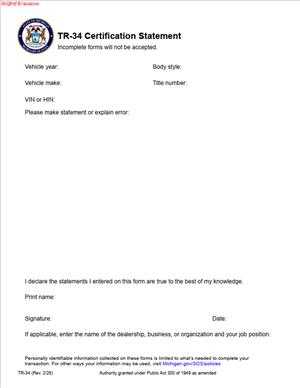
The TR-34 – Certification Statement is a written declaration submitted to the Michigan motor vehicle authority. It confirms that the information connected to a related filing is true and complete.
In simple terms, it is your formal statement that what you are saying in another document is accurate. Instead of relying only on the main application or request, the agency requires this separate certification to reinforce the truthfulness of the information.
A certification statement differs from a general form because it focuses on verification. You are not just providing details. You are affirming that those details are correct.
This form typically includes identifying information, a description of what is being certified, and your signature. Your signature is what makes the statement official.
Who typically uses this form?
This form is commonly used by vehicle owners. If you are correcting information on a title or registration, you may be asked to complete it.
Buyers and sellers of vehicles may also use it. For example, if certain facts about a transfer need confirmation, a certification statement may be required.
Dealership representatives sometimes complete the form on behalf of customers. In those cases, the person signing must have authority to certify the information.
Individuals handling estate matters or vehicle transfers after a death may encounter this form. If specific facts about ownership or eligibility need to be confirmed, a certification statement can be part of the process.
Business entities that own vehicles may also use it. An authorized representative signs on behalf of the company to confirm the accuracy of the information submitted.
Why might you need this form?
You may need this form when the motor vehicle agency requires written verification beyond the main application. This often happens when there is a discrepancy, correction, or unusual circumstance.
For example, if information on a title does not match other records, the agency may require a certification. The statement provides formal confirmation that the updated information is accurate.
You might also need it if certain documentation is unavailable. In some situations, the agency accepts a certification statement to clarify or confirm specific facts when standard documents cannot be provided.
The form can also serve as an added layer of accountability. By signing it, you are acknowledging that you understand the seriousness of the declaration.
Typical real-life scenarios
- You recently discovered that your name is misspelled on your vehicle title. When requesting a correction, the agency may require you to submit a certification confirming the correct spelling and stating that the information you are providing is accurate.
- You are transferring a vehicle between family members. Certain details about ownership history may need confirmation. A certification statement may be used to verify those details.
- You are replacing a lost title and need to confirm that the information about the vehicle, such as the vehicle identification number, is correct. The form may be part of the submission package.
- You are resolving a clerical error that occurred during a previous filing. The agency may ask for a signed certification to clarify what the correct information should have been.
- You are handling a vehicle transfer as part of an estate. When confirming facts about ownership or entitlement, a certification statement may be required to support the related filing.
- You are submitting documents on behalf of a business. The agency may require a certification from an authorized representative confirming that the information provided on the company’s behalf is true.
- In each of these situations, the form serves the same purpose. It creates a clear, signed record that the information provided is accurate.
When would you use TR-34 – Certification Statement?
You would use TR-34 – Certification Statement when the Michigan motor vehicle authority requires formal verification of information connected to a vehicle record. This often happens during corrections, replacements, or transfers.
If you are correcting an error on a title or registration, the agency may request this certification as part of the process. The form helps confirm that the correction you are requesting reflects the true and accurate information.
If you are submitting a replacement title request due to loss or damage, you may encounter this form. It can be used to verify that the details about the vehicle and ownership are correct.
In ownership transfers, especially when circumstances are not straightforward, the agency may require a certification statement. This can apply to private sales, family transfers, or business-to-individual transfers.
You might also use the form when standard documentation is incomplete or inconsistent. The certification provides written confirmation to resolve questions about the record.
Individuals acting in representative roles, such as executors or authorized business agents, may use this form to confirm that they have provided accurate information in their filings.
In general, you use this form when the agency needs your formal written assurance. It is not used for routine filings unless specifically required.
Legal characteristics of TR-34 – Certification Statement
A certification statement has legal significance because it is a signed declaration. By signing, you are affirming that the information provided is true to the best of your knowledge.
For the form to be effective, it must be complete and legible. Required fields must be filled in. Names, dates, and identifying details must match the related documents.
Your signature is essential. An unsigned certification is typically considered incomplete. In some cases, a printed name without a signature is not sufficient.
Accuracy is critical. If the information on the certification does not match the accompanying documents, the agency may reject the filing or request clarification.
Common reasons for problems include missing information, mismatched vehicle identification numbers, incorrect owner names, or incomplete dates. Even small inconsistencies can delay processing.
In Michigan, motor vehicle certification forms are part of official state records once submitted. This means the information becomes part of the administrative record for that vehicle.
The form does not replace other required documents. It supports them. If the underlying application is incomplete or incorrect, the certification alone does not fix those issues.
The form also does not transfer ownership by itself. It does not create a contract between buyer and seller. It serves only as a verification of facts related to another filing.
High-level procedures for certification statements are similar across many states. However, the specific form number, content, and submission requirements can vary. In Michigan, the TR-34 – Certification Statement is tailored to that state’s motor vehicle processes.
Is it legally binding?
A certification statement is generally considered legally binding in the sense that you are making a formal declaration. When you sign, you are attesting that the information is true.
This does not mean it creates a contract between parties. Instead, it creates a record of your sworn or affirmed statement to a government agency.
If information on the certification is knowingly false, it can lead to administrative consequences. The agency may reject the filing, correct the record, or take further action consistent with its procedures.
The binding nature comes from the act of signing and submitting the statement as part of an official filing. Your signature indicates that you understand the seriousness of the declaration.
At the same time, the certification only applies to the facts stated in the form. It does not expand beyond what is written. It confirms specific information connected to a particular submission.
Understanding this helps you approach the form carefully. You are not just filling in blanks. You are formally confirming the accuracy of what you provide.
How to fill out TR-34 – Certification Statement
Step 1 – Review the entire form before writing
Start by reading the entire TR-34 – Certification Statement from top to bottom. This gives you a clear picture of what information is required.
Look for sections that reference related documents. Make sure you have those documents available. This may include a title, registration, or other vehicle-related paperwork.
By reviewing first, you reduce the chance of making corrections later.
Step 2 – Enter your identifying information
Provide your full legal name exactly as it appears on the related vehicle record or application. If you are signing on behalf of a business, include the business name and your title or role.
Write your address and any other required contact details clearly. Use complete and consistent information.
If there are multiple owners or parties involved, confirm whether each person must complete a separate certification or whether all names must be listed on one form.
Step 3 – Identify the vehicle accurately
Locate the section that asks for vehicle details. This typically includes the vehicle identification number, make, model, and possibly the year.
Copy this information directly from the official document. Do not rely on memory.
Check each character of the vehicle identification number carefully. A single incorrect digit can cause processing delays.
Step 4 – State the information you are certifying
Read the certification statement language closely. It will describe what you are confirming, such as the accuracy of certain facts or corrections.
If the form includes a space to explain details, write clearly and concisely. Stick to factual information.
Avoid adding unrelated information. Focus only on what the form is asking you to certify.
Step 5 – Review for consistency
Before signing, compare the completed certification with the related application or document.
Make sure names, dates, and vehicle details match exactly. Look for spelling differences or number errors.
Confirm that all required sections are filled in. Blank fields can result in the form being considered incomplete.
Step 6 – Sign and date the form
Sign your name in the designated signature area. Use your usual legal signature.
Enter the date of signing in the format requested on the form. The date should reflect when you actually sign the document.
If you are signing as an authorized representative, ensure your title or capacity is clearly indicated if the form provides space for it.
Step 7 – Attach the form to the related submission
Once completed and signed, include the certification statement with the application or filing it supports.
Arrange the documents in a clear and organized manner. Place the certification behind or with the related paperwork as required.
Check one final time that all pages are included before submitting the full packet to the appropriate office.
Legal terms you might encounter in TR-34 – Certification Statement
- Certification: A certification is your formal written statement that certain facts are true. When you sign this document, you are declaring that the information you provide is accurate to the best of your knowledge. The agency relies on your certification instead of requiring additional proof in some situations.
- Affirmation: An affirmation is a solemn promise that your statements are true. It has the same legal effect as an oath, even if you are not swearing before a notary. By signing, you are affirming that your statements are truthful.
- Penalty of Perjury: This phrase means you could face legal consequences if you knowingly provide false information. When you see this language on the form, take it seriously. It signals that your statements are being treated as sworn testimony.
- Vehicle Identification Number (VIN): The VIN is a unique 17-character code assigned to a vehicle. This document often requires you to list the Vehicle Identification Number exactly as it appears on the vehicle and title. Even a single incorrect character can cause delays or rejection.
- Registered Owner: The registered owner is the person listed in official records as responsible for the vehicle. If you are not the registered owner, you must be clear about your relationship to the vehicle and your authority to make statements about it.
- Authorized Representative: An authorized representative is someone allowed to act on behalf of another person or entity. If you sign in this capacity, you may need to indicate your title or relationship and ensure your authority matches existing records.
- Material Fact: A material fact is an important detail that could affect a decision about the vehicle’s title, registration, or record. This document is used to clarify or confirm such facts. Leaving out a material fact can create serious problems later.
- Department Records: These are the official files maintained by the motor vehicle agency. When you submit this form, the information may be added to or used to update those records. Accuracy matters because future transactions will rely on what is recorded.
- Supporting Documentation: These are additional papers attached to support your statement. Examples might include copies of titles, bills of sale, or identification. If your certification refers to another document, you must attach it when required.
FAQs
What exactly am I certifying when I sign this document?
You are certifying that the specific statements written on the form are true and correct. That usually includes identifying details about the vehicle, such as the Vehicle Identification Number and ownership information, and a clear explanation of the fact you are confirming. Before you sign, read the statement section carefully and make sure every detail matches the documents in your possession.
Do I need a notary to complete the TR-34 – Certification Statement?
In many cases, this document does not require notarization because it already includes penalty of perjury language. Check the signature section to see if a notary block is present. If there is no space for a notary, you typically just sign and date it yourself, but you must still treat it as a sworn statement.
What if I make a mistake while filling it out?
If you notice the mistake before submitting, complete a new, clean copy. Avoid crossing out information unless the form instructions specifically allow corrections. Messy edits can cause processing delays or rejection because the agency must be able to read every entry clearly.
How do I know if I am authorized to sign?
Look at how the vehicle is titled. If your name appears as the owner in the official record, you can usually sign for yourself. If the vehicle is owned by a business or another person, you must have proper authority, such as being an officer of the company or holding written authorization, and you should indicate your title next to your signature.
What happens to the information after I submit this form?
The agency reviews your certification and may add the information to the vehicle’s official record. If accepted, it can correct or clarify existing data. Future transactions involving the vehicle will rely on what is recorded, so accuracy now prevents complications later.
Can I attach extra pages if there is not enough space for my explanation?
Yes, if the space provided is too small, you can attach an additional sheet. Clearly label it with the vehicle’s Vehicle Identification Number and your name so it can be matched to the correct file. Make sure you reference the attachment in the main form so the reviewer knows to read it.
Will this document change the ownership of the vehicle?
This document typically clarifies or certifies facts rather than transferring ownership by itself. If ownership is changing, a separate title transfer document is usually required. Make sure you understand whether this form is supporting a transfer or simply correcting information.
How can I confirm that my submission was accepted?
After filing, watch for confirmation such as a receipt, updated registration, or corrected title record. If you do not receive anything within a reasonable time, contact the agency and be ready to provide the VIN and the date you submitted the document. Keep your copy so you can reference exactly what you certified.
Checklist: Before, During, and After TR-34 – Certification Statement
Before
- Review the vehicle’s current title and registration for exact name and Vehicle Identification Number details.
- Confirm your legal authority to sign, especially if acting for someone else or a business.
- Gather any supporting documents mentioned in the certification statement.
- Read the entire form once without writing anything.
- Verify that all names match government-issued identification.
- Check whether the form requires attachments or additional explanation pages.
- Make sure you understand the specific fact you are certifying.
During
- Print clearly in blue or black ink if completing by hand.
- Enter the Vehicle Identification Number carefully, character by character.
- Use full legal names without nicknames.
- Complete every required field and avoid leaving blanks.
- Attach additional pages if your explanation does not fit.
- Review the penalty of perjury language before signing.
- Sign and date the form in the correct section.
After
- Make a complete copy of the signed form and all attachments.
- Submit the document using the approved filing method.
- Keep proof of submission, such as a receipt or confirmation number.
- Monitor your mail or online account for updates.
- Verify that the vehicle record reflects the corrected information.
- Store your copy in a safe place with other vehicle records.
- Update any personal or business records affected by the change.
Common mistakes to avoid with TR-34 – Certification Statement
- Mistake: Entering an incorrect Vehicle Identification Number because you copied it from memory instead of the vehicle or title, which leads to rejection or misfiled records, so do not forget to verify every character directly from an official source.
- Mistake: Signing without reading the certification language because you are in a hurry, which can expose you to penalties if something is inaccurate, so do not forget to review each statement carefully before signing.
- Mistake: Leaving sections blank because they seem unimportant, which can delay processing or cause the form to be returned, so do not forget to complete every required field or clearly mark items as not applicable if allowed.
- Mistake: Failing to attach supporting documents referenced in your explanation, which can result in incomplete review, so do not forget to include copies of all required paperwork.
- Mistake: Using a nickname or different name format than what appears on the title, which creates record mismatches, so do not forget to use your full legal name exactly as shown in official records.
- Mistake: Assuming this form transfers ownership by itself, which can leave a transaction legally incomplete, so do not forget to complete any separate title transfer documents if ownership is changing.
- Mistake: Submitting the form without keeping a copy, which leaves you without proof of what you certified, so do not forget to make and store a complete copy before filing.
- Mistake: Allowing someone without proper authority to sign, which can invalidate the submission, so do not forget to confirm that the signer’s authority matches the vehicle’s ownership record.
What to do after filling out TR-34 – Certification Statement
Once you complete the form, pause before submitting it. Review everything one more time. Compare your entries to the vehicle title, registration, and any identification documents. Small inconsistencies can cause delays.
- Step 1: Make at least one full copy of the signed form and all attachments for your records.
- Step 2: Confirm the correct submission method, whether in person, by mail, or through another approved channel.
- Step 3: Assemble your packet in a logical order, with the form on top and supporting documents behind it.
- Step 4: If submitting in person, bring identification and any related vehicle documents in case questions arise.
- Step 5: If mailing, use a method that provides delivery confirmation so you know it arrived.
- Step 6: Keep any receipt, tracking number, or stamped copy as proof of submission.
- Step 7: Mark your calendar to check the status if you do not receive confirmation within a reasonable time.
- Step 8: Review the updated vehicle record, title, or registration once processed to ensure the correction or certification was applied properly.
- Step 9: Store your copy of the completed TR-34 – Certification Statement with your permanent vehicle records.
- Step 10: Update your personal or business files if the certification affects insurance, accounting records, or internal logs.
Following through after submission is just as important as filling out the form correctly. Good recordkeeping protects you if questions come up later. Treat this document as part of your permanent vehicle file.
Disclaimer: This guide is provided for informational purposes only and is not intended as legal advice. You should consult a legal professional.