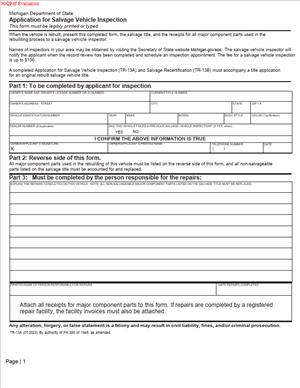
TR-13A – Application for Salvage Vehicle Inspection
Fill out nowJurisdiction: Country: United States | Province or State: Michigan
TR-13A – Application for Salvage Vehicle Inspection is a Michigan Department of State vehicle form used when a salvage vehicle must be inspected before it can move forward in the title process. If you are preparing this form, you are likely dealing with a vehicle that was damaged, repaired, rebuilt, or otherwise classified in a way that requires additional review.
This form matters because a salvage vehicle is not treated the same as a regularly titled vehicle. The inspection process helps confirm the vehicle’s identity, repair history, parts information, and eligibility for the next title step.
You may encounter this document if you bought a salvage vehicle, rebuilt a damaged vehicle, repaired a vehicle for resale, or are helping someone complete a title-related submission. It is commonly used by private owners, rebuilders, repair facilities, dealers, and title support staff.
The form connects the vehicle, the applicant, and the inspection event. Missing details, inconsistent vehicle information, incomplete receipts, or title mismatches can delay the inspection or create problems with the filing.
Before you begin, gather the vehicle title information, vehicle identification number, applicant details, repair records, and receipts for major parts. Having these materials nearby makes completion easier and reduces avoidable errors.
What is TR-13A – Application for Salvage Vehicle Inspection?
Clear definition
TR-13A – Application for Salvage Vehicle Inspection is a Michigan Department of State form used to apply for an inspection of a salvage vehicle. The inspection is generally part of the process for determining whether a repaired or rebuilt salvage vehicle can proceed toward a different title status.
A salvage vehicle is usually a vehicle that has been damaged, declared a total loss, or assigned a salvage title because of its condition or history. The reason may involve an insurance claim, accident damage, flood damage, theft recovery, fire damage, or another title-branding event.
The form gives the inspection authority key information about the applicant and vehicle. It connects the vehicle being inspected to its title record, vehicle identification number, and repair history. This matters because salvage inspections focus on both the physical vehicle and the paperwork behind it.
The document may ask for the applicant’s name, address, vehicle year, make, body style, vehicle identification number, and title information. It may also relate to repair documents and receipts, especially where major component parts were replaced.
TR-13A is not the inspection itself. It is the application used to request or support the inspection process. The vehicle still has to be reviewed through the applicable Michigan salvage inspection procedure.
Who typically uses this form?
Private vehicle owners commonly use this form when they have purchased a salvage vehicle and repaired it for personal use. For example, you may buy a damaged car, complete repairs, and then need an inspection before taking the next title step.
Repair shops and rebuilders may also use the form when they work on vehicles with salvage titles. In those cases, the business may help organize repair records, replacement parts information, and ownership documents.
Vehicle dealers may encounter this document when handling salvage or rebuilt vehicles as inventory. The form can help create a record that the vehicle was presented for the required inspection process before a later sale or title transaction.
Insurance-related situations may also lead to this form. A vehicle may become salvage after an accident, flood, theft recovery, fire, or other event. Once repaired, an inspection application may be part of getting the vehicle back into a title pathway.
Some people use the form with help from a title clerk, repair professional, office staff member, or family member. Even if someone helps complete it, the information still needs to match the vehicle and supporting records.
Why might you need this form?
You might need this form because a salvage title alone usually does not function like a regular title for road use or resale. A salvage vehicle often needs additional review before it can be retitled in a way that reflects its repaired condition.
The inspection process helps verify that the vehicle identification number matches the paperwork. It may also help confirm that major parts used in the repair are documented. This can reduce fraud, prevent stolen parts from entering the title stream, and create a clearer record for future owners.
You may need this form if a title office, inspector, dealer, or repair facility tells you that an inspection application is required. In many cases, the form acts as the bridge between the repair stage and the title-processing stage.
The form can also protect the accuracy of the vehicle record. If the wrong vehicle identification number, title number, or owner information is submitted, the problem may follow the vehicle into later transactions. Careful completion helps avoid delays.
Salvage and rebuilt vehicles often receive closer review than ordinary vehicles because the vehicle’s history affects safety, ownership, value, insurance, and future transfer. The application helps document the process clearly.
Typical real-life scenarios
- You bought a damaged vehicle from an auction and repaired it. The vehicle has a salvage title, and you now want to move forward with the inspection process. The form identifies you as the applicant and connects the repaired vehicle to the inspection request.
- You own a vehicle that was declared a total loss after a collision. Instead of giving up the vehicle, you repaired it. Before the vehicle can move forward in the title process, the inspection application may be used to start or support the required review.
- You operate a repair business and restored a vehicle for a customer. The customer needs salvage inspection paperwork completed with accurate vehicle details and repair information. The form helps organize the filing before the inspection appointment or submission.
- You purchased a theft-recovered vehicle that was missing major parts. After replacing those parts, you may need to show where they came from and present the vehicle for inspection.
- You inherited or received a vehicle that already had a salvage title. Even if you were not involved in the original damage or repair work, the inspection process may still require current information, title details, and available repair records.
- You are preparing a rebuilt vehicle for sale. A buyer may want evidence that the vehicle went through the proper process. The application itself is not a guarantee of condition, but it is part of the official inspection path.
When would you use TR-13A – Application for Salvage Vehicle Inspection?
You would use TR-13A – Application for Salvage Vehicle Inspection when a salvage vehicle is ready to be presented for inspection as part of a Michigan title-related process. This usually happens after repairs are complete enough for the vehicle to be reviewed.
You may use it after buying a vehicle with a salvage title and making repairs. The form begins or supports the inspection request by giving the reviewing office or inspector the vehicle’s identifying information and your applicant details.
You may also use it when a vehicle was damaged and later rebuilt by a repair facility. In that situation, the applicant may be the vehicle owner, a business representative, or another authorized person involved in the title transaction.
This form commonly appears after collision repairs, theft recovery repairs, flood-related repairs, fire repairs, or major component replacement. The common thread is that the vehicle’s title history requires more than a standard title filing.
You might also use it when a vehicle has already been repaired but still carries a salvage title. The form does not erase the vehicle’s history. Instead, it helps support the process that determines whether the vehicle can receive a title status reflecting its repaired condition.
If you are preparing documents for a vehicle sale, this form may come up before the sale is completed. A seller may need the vehicle inspected before transferring it in the way the buyer expects. A buyer may also ask about the status of the inspection process before purchasing.
The form may be relevant when the vehicle identification number must be verified against the title and the physical vehicle. Salvage inspections often focus on whether the vehicle presented is the same vehicle described in the paperwork.
You may also encounter this form if title paperwork has been rejected or delayed because the vehicle needs salvage inspection documentation. In that case, the form helps provide the missing application record for the next review.
Timing matters. The form is generally used when the vehicle is ready for inspection, not when repairs are still uncertain. If key repairs are incomplete or parts records are missing, the application may be harder to process.
The form may also be used when a vehicle enters Michigan’s title process with a salvage history from another state. Title brands and inspection requirements differ by state, so prior paperwork should be reviewed carefully before submission.
Legal characteristics of TR-13A – Application for Salvage Vehicle Inspection
TR-13A – Application for Salvage Vehicle Inspection is a government vehicle form. Its legal importance comes from its role in the Michigan title and inspection process. It records the applicant’s request and provides official information about a specific salvage vehicle.
For the form to work properly, the information usually needs to be complete, accurate, and consistent with supporting documents. The vehicle identification number is especially important. A single incorrect character can create a mismatch with the title record.
The applicant information also matters. The name and address on the form commonly need to align with the person or entity connected to the vehicle transaction. If the applicant is a business, the business name may need to match other records used in the filing.
The vehicle description should be handled carefully. Year, make, model, body style, title number, and identification number connect the form to the vehicle being inspected and to the title record already on file.
Supporting documentation can affect whether the application moves forward smoothly. Receipts for major parts, title documents, ownership records, and repair information may be relevant. If the paperwork does not explain how the vehicle was repaired or where key parts came from, the inspection process may be delayed.
Common problems include missing signatures, incomplete fields, unreadable handwriting, incorrect vehicle identification numbers, altered documents, and mismatched names. Problems can also arise when receipts do not identify parts clearly or appear to belong to a different vehicle.
A form may also run into issues if the vehicle is not ready for inspection. Salvage inspection is not only a paperwork event. The vehicle may need to be physically available and identifiable, and the repair condition may be relevant to the review.
Jurisdiction differences can matter because title brands and salvage inspection procedures are not identical across the United States. A vehicle branded as salvage, rebuilt, nonrepairable, flood, or total loss in one state may be handled differently in another. When a vehicle crosses state lines, the paperwork history can become more complex.
The form does not, by itself, prove that the vehicle is safe, roadworthy, insurable, or free of defects. It also does not guarantee that the vehicle will qualify for a rebuilt title or any particular title outcome. It is an application connected to an inspection process.
The form also does not replace ownership documents. If you do not have proper title paperwork or proof of ownership, the inspection application alone usually cannot solve that gap. Ownership and inspection are related, but they are not the same thing.
The document also does not remove the vehicle’s history. Even after inspection, a vehicle that was salvage may continue to carry a branded history. Title brands often remain important to buyers, insurers, lenders, and future title offices.
Accuracy is important because vehicle title records can affect future transfers. Incorrect information can create problems later when you try to register, insure, sell, or transfer the vehicle. Careful completion helps create a clearer chain of documentation.
Is it legally binding?
TR-13A – Application for Salvage Vehicle Inspection can have legal effect because it is an official application used in a government vehicle process. When you sign or submit it, the information you provide may become part of the vehicle’s official record.
The form is not a private contract between two people. It does not work like a sale agreement, repair agreement, or warranty. Instead, it functions as a formal filing connected to inspection and title administration.
Its practical effect depends on the accuracy of the information, the applicant’s signature, and the way the form is submitted and processed. A completed and accepted form may support an inspection record. An incomplete or inaccurate form may not.
When you sign a government form, you are commonly confirming that the information provided is true to the best of your knowledge. False, altered, or misleading information can create serious problems in a vehicle title process.
Submitting the form does not require the inspecting authority to approve the vehicle. The application requests or supports the inspection. The inspection result and title outcome depend on the review process and supporting facts.
How to fill out TR-13A – Application for Salvage Vehicle Inspection
Step 1 – Review the form title and purpose
Confirm that you are using the application for a salvage vehicle inspection. The title of the document should match the inspection process you are preparing for. This helps prevent using a general title form when a salvage inspection application is needed.
Step 2 – Identify the applicant
Enter the name of the person or business applying for the inspection. Use the same name that appears on related ownership or title documents when applicable. If a business is involved, use the legal or recorded business name rather than an informal nickname.
Step 3 – Add the applicant’s contact information
Provide the applicant’s address and other requested contact details. Use a current mailing address where notices or returned documents can be received. If the form asks for a phone number, use a number where the applicant or responsible contact can be reached.
Step 4 – Enter the vehicle identification number
Carefully enter the vehicle identification number exactly as it appears on the vehicle and title paperwork. Check every character before moving on. The VIN is one of the most important entries because it ties the application to one specific vehicle.
Step 5 – Provide the vehicle description
Fill in the vehicle’s year, make, model, body style, and any other requested description fields. Use the information from the title and vehicle records rather than memory.
Step 6 – Include title information
Add the title number, title state, or other title details requested by the form. If the vehicle has a Michigan salvage title, use the information shown on that title. If the vehicle came from another state, make sure the title information matches the out-of-state document.
Step 7 – Describe the salvage or rebuilt status
Complete any fields that ask about the vehicle’s salvage status, damage history, or rebuilt condition. Keep the description factual and consistent with the title record and repair documents. Avoid guessing about damage causes if the records do not support the answer.
Step 8 – Organize repair and parts information
If the form or inspection process asks about repairs or replacement parts, gather receipts and records before finalizing the application. Major component parts may need clear documentation. The names, dates, vehicle details, and part descriptions on receipts should be readable and connected to the repair work.
Step 9 – Check ownership consistency
Compare the applicant name, title documents, receipts, and vehicle information for consistency. A mismatch does not always mean the filing cannot proceed, but it can cause questions. If a name changed, a business name differs, or a receipt lists another person, identify the issue before submission.
Step 10 – Complete any certification language
Read any certification or statement section before signing. This section usually confirms that the information is accurate and that the applicant understands the nature of the request. Do not treat this as a routine formality.
Step 11 – Sign and date the application
Sign the form in the space provided and add the date if required. Use the applicant’s signature or the signature of a person authorized to act for the applicant. An unsigned application is a common reason a filing cannot move forward.
Step 12 – Review the form for missing entries
Before presenting or submitting the application, review every field for blank spaces, unclear handwriting, and inconsistent information. Pay close attention to the VIN, title number, applicant name, vehicle description, and signature.
Legal terms you might encounter in TR-13A – Application for Salvage Vehicle Inspection
- Salvage vehicle: A vehicle that has been damaged or classified in a way that causes an insurer, owner, or state record to treat it as salvage. On this form, the salvage status explains why the vehicle needs inspection before it can move toward regular use or registration.
- Salvage title: A title brand showing that the vehicle was declared salvage. When you complete this document, the title information should match the vehicle and ownership records.
- Rebuilt vehicle: A salvage vehicle that has been repaired and is being presented for inspection. The inspection helps confirm the vehicle’s identity and checks whether required repair and parts records support the rebuilt status.
- Vehicle identification number: The vehicle identification number, often called the VIN, is the unique identifying code assigned to the vehicle. One wrong character can cause rejection, delay, or a mismatch with the title record.
- Applicant: The person or business requesting the salvage vehicle inspection. If you are filling out the form for yourself, your legal name should match your ownership documents unless the form asks for a different role or representative information.
- Owner: The person or entity shown in the title or ownership record. If the applicant and owner are not the same, the reviewer may look closely at whether the applicant has authority to request the inspection.
- Title brand: A label on the title record that describes a vehicle’s history, such as salvage, rebuilt, flood, or another condition. This form uses that history to place the inspection request in the correct category.
- Parts receipts: Records showing what replacement parts were used and where they came from. They matter because salvage inspections often focus on whether major parts can be traced.
- Certification: A statement you sign to confirm that the information you provided is true and complete. The agency relies on your entries when deciding whether to process the inspection request.
- Inspection appointment: The scheduled time and place where the vehicle is reviewed after the application process is started. The form connects your vehicle, title record, and repair documents to that inspection event.
FAQs
Do I need the TR-13A – Application for Salvage Vehicle Inspection before I schedule an inspection?
You usually need this form as part of the inspection process because it identifies the applicant, vehicle, title record, and salvage or rebuilt status. Before you schedule or appear for an inspection, make sure the form is complete, signed, and supported by the documents the inspecting agency expects to review.
Whose name should I enter if the title is in one name but someone else repaired the vehicle?
Enter the name requested by the form for the applicant, and check that it is consistent with the ownership paperwork. If a repairer, buyer, business, or family member is helping, do not substitute that person’s name for the owner unless the form allows it and the person has authority to act.
What should I do if the Vehicle identification number on the title does not match the VIN on the vehicle?
Stop and compare every character before submitting the form. A mismatch can happen because of a typing error, a hard-to-read character, a replacement part, or the wrong title record. Do not guess. The form should reflect the actual vehicle and match the supporting documents as closely as possible.
Do I have to attach repair receipts or parts records?
You should gather repair and parts records before you submit or present this document. The form may not have enough space to list every detail, but the inspection process may depend on proof showing what was repaired and where major replacement parts came from.
Who signs this form?
The person signing should be the applicant or another person with authority to make the request and certify the information. Before signing, confirm that the name, address, Vehicle identification number, title number, and vehicle description are correct.
What date should I use when I sign?
Use the date you actually sign the form. Do not backdate it to match a repair date, purchase date, or title date. The signature date helps show when you certified the information.
What changes in the public vehicle record after the inspection?
The form itself starts or supports the inspection request, but the vehicle record may change only after the inspection is accepted and any required processing is completed. If the vehicle qualifies, the record may move from salvage status toward a rebuilt or road-use-eligible status, depending on the result and later title processing.
How do I know whether this document was accepted?
Look for confirmation from the agency, inspector, or office handling the request. Acceptance may be shown by an appointment, receipt, stamped copy, processed inspection paperwork, or later title action. Keep proof in case there is a delay or question about whether the form was submitted.
Checklist: Before, During, and After TR-13A – Application for Salvage Vehicle Inspection
Before
- Confirm that the vehicle needs a salvage vehicle inspection before using this form.
- Gather the current title or ownership document connected to the vehicle.
- Locate the Vehicle identification number on the vehicle and compare it with the title record.
- Collect repair invoices, parts receipts, and records for major components.
- Make sure the applicant’s name matches the ownership documents or authority paperwork.
- Find the correct mailing address, phone number, and contact details for the applicant.
- Check whether the vehicle is complete enough to be inspected.
- Review any instructions for appointment scheduling, fees, and required documents.
During
- Write the applicant’s full legal name clearly and consistently.
- Enter the VIN exactly as it appears on the vehicle and title record.
- Complete the vehicle year, make, model, body style, and other description fields.
- Add title information from the ownership document, not from memory.
- Identify the salvage or rebuilt status accurately.
- Keep repair and parts information organized so it can be matched to the vehicle.
- Read the certification language before signing.
- Sign and date only after all required fields are complete.
After
- Make a copy or scan of the completed form before submitting it.
- Keep copies of the title, repair receipts, and parts records with the form.
- Submit the form using the method required for the inspection process.
- Save any receipt, confirmation number, appointment notice, or stamped copy.
- Bring the completed form and supporting documents to the inspection if required.
- Track whether the inspection was completed, postponed, rejected, or approved.
- Update your vehicle file with the inspection result.
- Keep repair records after the inspection because they may be needed later.
Common mistakes to avoid with TR-13A – Application for Salvage Vehicle Inspection
- Mistake: Entering the VIN from memory. Always compare the Vehicle identification number on the vehicle with the VIN on the title.
- Mistake: Using a nickname or shortened business name. Use the legal name shown in the supporting records.
- Mistake: Leaving title information blank. Copy title details from the actual document.
- Mistake: Failing to organize repair and parts receipts. Group receipts by part, date, and seller.
- Mistake: Signing before checking the certification language. Your signature confirms the information.
- Mistake: Listing the wrong vehicle description. Verify the year, make, model, and body type.
- Mistake: Assuming submission means approval. Wait for confirmation or inspection results.
- Mistake: Not keeping a copy. Scan or photograph the signed form before submission.
What to do after filling out TR-13A – Application for Salvage Vehicle Inspection
After you complete the form, treat it as part of a larger inspection file. The form may be only one piece of what you need. Your file should also include the title or ownership record, repair invoices, parts receipts, identification materials, and any appointment or payment confirmation connected to the inspection.
Review the form one final time before you submit it. Focus on entries that are hardest to fix later: the Vehicle identification number, applicant name, title number, vehicle year, make, model, and signature date. A small error can slow down the inspection because the reviewer must confirm that the vehicle, title, and applicant all match.
Step 1: Make a complete copy of the signed form.
Use a scanner, clear photo, or paper photocopy. Keep the copy where you can find it quickly. If you are handling the vehicle for a business, save the copy in the vehicle’s file and label it with the VIN.
Step 2: Attach or group supporting documents.
Place the title copy, parts receipts, repair invoices, and any ownership transfer paperwork with the form. If a receipt is hard to read, make a clearer copy and keep the original available.
Step 3: Confirm the required submission method.
Some inspection processes require you to bring the form to an appointment. Others may require advance submission, review, or scheduling before the vehicle is inspected. Use the method requested by the office or inspection program handling your vehicle.
Step 4: Keep proof that you submitted or presented the form.
If you submit paperwork in person, ask whether you receive a receipt, stamped copy, or appointment record. If you send materials by mail or another delivery method, keep delivery proof. If you submit electronically, save the confirmation page or email.
Step 5: Prepare the vehicle for inspection.
The form identifies the vehicle, but the vehicle itself must be available and reviewable. Make sure the Vehicle identification number location is accessible. Remove clutter that blocks inspection points. Bring keys and documents that help explain repairs or replacement parts.
Step 6: Bring the same records you used to complete the form.
The information on the form should line up with what you present at inspection. If you entered a title number, bring that title or a copy. If you listed repaired or replaced parts, bring the receipts. If the applicant is not the titled owner, bring documents that explain the applicant’s authority.
Step 7: Track the inspection result.
After the inspection, note whether the vehicle passed, failed, or needs more information. If there is a deficiency, write down exactly what must be corrected. Keep any inspection report with your copy of the form.
Step 8: Follow up on any title or record update.
A completed inspection may not automatically give you everything needed for title or registration purposes. You may need more paperwork, fees, or proof of inspection. Keep the inspection result with your title documents until the vehicle record reflects the correct status.
Step 9: Update your internal records.
If you keep a personal vehicle file, add the completed form, inspection result, receipts, and later title documents. If you are a dealer, repairer, or business owner, update your inventory record, repair log, accounting file, and customer file as appropriate.
Step 10: Keep the documents after the vehicle is sold or transferred.
Do not throw away the inspection file once the vehicle is approved or sold. Future buyers, insurers, lenders, or government offices may ask about the salvage history or repairs. A well-kept file helps you answer questions without guessing.
Step 11: Correct problems promptly if the form is not accepted.
If the office or inspector rejects the form, ask what specific entry or document caused the issue. Fix only what is wrong. Do not create a new version with different information unless you understand why the correction is needed and can support it with records.
Step 12: Use the same vehicle information on later paperwork.
Once the form has been accepted or used for inspection, keep the Vehicle identification number, title number, owner name, and vehicle description consistent on later documents. Consistency helps prevent record mismatches when you move to the next step, such as rebuilt status processing, registration, or sale.
Disclaimer: This guide is provided for informational purposes only and is not intended as legal advice. You should consult a legal professional.