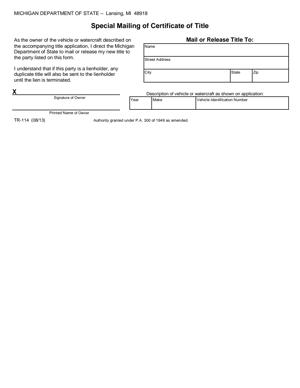
TR-114 – Special Mailing of Certificate of Title
Fill out nowJurisdiction: Country: United States | Province or State: Michigan
TR-114 – Special Mailing of Certificate of Title is a form used in Michigan to direct where a vehicle title should be mailed. When you apply for or update a vehicle title, the state normally sends it to a standard address. This form lets you request that the certificate of title be mailed to a different location.
If you are about to complete TR-114 – Special Mailing of Certificate of Title, you likely want to make sure the title reaches the correct person or address. This can matter when you have recently moved, when a lienholder is involved, or when someone else is handling paperwork for you.
The form is not long, but accuracy is critical. A mistake can delay delivery of your title or cause it to be sent to the wrong place. Once mailed, recovering or correcting a misdirected title can take time.
Understanding what the form does, and what it does not do, helps you avoid confusion. This guide walks you through its purpose, common uses, and how to complete it clearly and correctly.
What is TR-114 – Special Mailing of Certificate of Title?
Clear definition
TR-114 – Special Mailing of Certificate of Title is a Michigan Department of State document that authorizes the state to mail a vehicle’s certificate of title to a specific address that may differ from the owner’s residential address.
A certificate of title is the official document showing vehicle ownership. The state issues it after a title transfer, a new purchase, or certain corrections. By default, the title is mailed according to the information on the main title application. This form changes only the mailing destination for the physical title.
It does not transfer ownership. It does not register the vehicle. It simply instructs the state where to send the completed title document.
Who typically uses this form?
Vehicle owners commonly use this form when they want the title sent somewhere other than their home address. For example, you may prefer that the title be mailed to a business address or to a trusted third party.
Dealers may use it in transactions where the buyer requests that the title be sent directly to a lender or another designated address. In some cases, financial institutions or lienholders may be involved in coordinating where the title should be delivered.
People who have recently moved may also use the form if their address change is not yet reflected in the system. It helps ensure the document reaches a secure and current location.
Why might you need this form?
You might need this form if your mailing address differs from your legal residence on file. Titles are valuable documents. Sending them to the wrong address creates risk.
You may also need it when a vehicle is financed. In many financing situations, the lienholder has an interest in the title. Directing the mailing properly can help align with the financing arrangement.
If someone else is assisting with your vehicle paperwork, you may want the title sent directly to that person or office. This avoids extra handling and reduces the chance of loss.
Finally, you may need this form if you are managing multiple properties or businesses and want the title delivered to a location where important documents are routinely processed.
Typical real-life scenarios
- You purchase a vehicle and arrange financing through a lender. The lender requests that the title be mailed directly to them for recordkeeping. You complete the special mailing form so the state sends the certificate to the lender’s address.
- You recently moved to a new home but have not yet updated all records. You are transferring a vehicle title and want the new document mailed to your current address, not your former residence. The form allows you to provide that updated mailing address.
- You are buying a vehicle for your business. Your company maintains a separate mailing address for legal and financial documents. You request that the title be sent to the business office rather than your personal address.
- You are temporarily living out of state but maintaining vehicle records in Michigan. To avoid delays, you request that the title be mailed to your temporary address so you can receive it directly.
When would you use TR-114 – Special Mailing of Certificate of Title?
You use this form at the time you are applying for a title or processing a title-related transaction. It accompanies the main title application or related paperwork. It is not typically submitted by itself without an underlying title transaction.
You may use it during a vehicle purchase, a title transfer between private parties, or after paying off a loan when a new title is being issued. In each situation, the key factor is that a certificate of title will be generated and mailed.
Owners are the most common users. However, authorized representatives, dealers, or financial institutions may be involved in preparing or submitting the form as part of a larger transaction.
The timing matters. The special mailing request must generally be made before the title is printed and mailed. Once the state has processed and sent the document, changing the mailing address for that specific title is no longer possible through this form alone.
You may also encounter this form if a previous title was returned as undeliverable. In that case, providing a clear and accurate mailing address helps avoid a repeat issue.
Legal characteristics of TR-114 – Special Mailing of Certificate of Title
This form functions as a written authorization. It tells the issuing authority where to send an official state document. For it to be effective, the information must match the related title transaction and clearly identify the vehicle and the person requesting the mailing change.
Accuracy is essential. Incorrect vehicle identification numbers, incomplete addresses, or missing signatures can lead to rejection or delays. If the state cannot confidently link the mailing request to the correct vehicle record, it may not process the request as intended.
The form is typically valid only for the specific title transaction it accompanies. It does not create a permanent change of address for all future vehicle documents. If you later complete another transaction, you may need to provide updated mailing instructions again.
Requirements can vary slightly by state. In Michigan, the form is tailored to the Department of State’s procedures. Other states may use different documents or handle special mailing requests differently.
It is important to understand what this form does not do. It does not change ownership. It does not remove a lien. It does not update registration or license plate information. Its purpose is limited to directing the mailing of the certificate of title.
Is it legally binding?
In practical terms, the form is binding as an authorization. When properly completed and accepted, it directs the state to mail the certificate of title to the address you provide. The state relies on your signed request when issuing the document.
Your signature confirms that you are requesting the special mailing and that the information provided is accurate. If false or incorrect information is submitted, it can create administrative problems and possible legal consequences depending on the circumstances.
However, the form does not create contractual rights between private parties. It does not, by itself, transfer legal ownership or alter financial obligations. Its legal effect is limited to the administrative act of mailing the title to a designated address.
How to fill out TR-114 – Special Mailing of Certificate of Title
Step 1 – Review the related title transaction
Before filling out the form, confirm that a title application or title-related transaction is being processed. Gather the vehicle details and owner information exactly as they appear on the primary paperwork. Consistency between documents helps prevent delays.
Step 2 – Enter the vehicle information
Provide the vehicle identification details requested on the form. This often includes the vehicle identification number and may include the year, make, and model. Double-check each character in the identification number, since even a small error can misdirect the request.
Step 3 – Provide the owner’s name
Write the full legal name of the vehicle owner as it appears on the title application or existing record. If there are multiple owners, ensure the names are listed in the same order and format used in the related documents.
Step 4 – Specify the special mailing address
Clearly print the complete mailing address where the certificate of title should be sent. Include street number and name, apartment or suite number if applicable, city, state, and ZIP code. Make sure the address is accurate and able to receive mail securely.
Step 5 – Indicate any additional recipient information
If the form provides space to identify a specific recipient, such as a lienholder or business, enter that name carefully. This helps ensure the document is directed to the intended party at the designated address.
Step 6 – Review for consistency and completeness
Compare the information on this form with the related title paperwork. Confirm that names, vehicle details, and addresses match where required. Look for missing fields or unclear handwriting that could interfere with processing.
Step 7 – Sign and date the form
Sign your name in the space provided. Use the same signature style associated with the title transaction when possible. Enter the date of signing to show when the mailing request was authorized.
Step 8 – Submit with the title paperwork
Attach the completed form to the rest of your title application or supporting documents. Submit everything together according to the instructions provided for the main transaction so the special mailing request is processed at the same time.
Legal terms you might encounter in TR-114 – Special Mailing of Certificate of Title
- Certificate of Title: This is the official document that proves vehicle ownership. In this form, you are not changing ownership. You are directing where the physical certificate should be mailed after it is issued or reissued.
- Owner of Record: The owner of record is the person or entity currently listed in the state’s vehicle records. The name you provide on this form must match that record exactly, including middle initials or business designations.
- Vehicle Identification Number (VIN): The VIN is a unique 17-character code assigned to your vehicle. This number is used to match your mailing request to the correct title file. A single incorrect digit can delay processing.
- Lienholder: A lienholder is a lender or other party with a legal interest in the vehicle due to an unpaid loan. If a lien exists, the title may be mailed to the lienholder unless different instructions are properly authorized.
- Mailing Address: This is the address where you want the certificate of title sent. It may be different from the owner’s residential address on file. The form records this as a one-time special mailing instruction tied to the specific transaction.
- Title Transaction: A title transaction includes actions such as transferring ownership, correcting a title, or issuing a duplicate. This document must be submitted together with the related title paperwork. It does not stand alone.
- Authorized Signer: An authorized signer is someone legally permitted to act on behalf of the owner, such as a corporate officer or a person with power of attorney. If you sign in this capacity, your authority must be clear and consistent with the rest of the title documents.
- Processing Office: This refers to the government office handling your title paperwork. The form becomes part of the administrative record for that transaction and guides where the printed title is mailed after approval.
- Duplicate Title: A duplicate title is a reissued certificate replacing one that was lost, stolen, or damaged. If you are requesting a duplicate, this form directs where that replacement document will be sent.
FAQs
Do I need to submit TR-114 – Special Mailing of Certificate of Title by itself?
No. This document is not filed on its own. You submit it together with a related title transaction, such as a transfer or duplicate request. The mailing instruction only applies if the underlying title paperwork is accepted and processed.
What address should I enter on this form?
You should enter the exact mailing address where you want the physical certificate sent. Write it clearly and completely, including apartment or suite numbers. Double-check the postal code and spelling because the processing office will mail the title exactly as written.
Does this form change the owner’s address in the vehicle record?
No. This document does not permanently update the owner’s address in the state’s vehicle database. It only directs the mailing of the certificate connected to that specific transaction. If you need to update your official address on record, that requires a separate process.
What happens if the owner’s name on this document does not match the title application?
If the name does not match exactly, the processing office may reject or suspend the transaction. The staff uses the name to confirm that the mailing instruction belongs to the same owner listed in the title paperwork. Always copy the name exactly as it appears on the related documents.
Can I have the title mailed to someone else, like a family member?
In many cases, yes, as long as the request is clearly written and consistent with the transaction. You must provide the full name and mailing address of the recipient. Make sure the owner’s signature authorizes that special mailing instruction to avoid delays.
If there is a lien on the vehicle, will this form override the lender’s rights?
Not automatically. If a lien is recorded, the title may legally be issued to the lienholder depending on the transaction. This document cannot remove or bypass a recorded lien. Make sure you understand whether the title will be held by a lender before listing a different mailing address.
What if I make a mistake on the mailing address?
If you catch the mistake before submission, correct it neatly or complete a new form. If the document has already been submitted and processed, the certificate may be mailed to the incorrect address. You may then need to request a duplicate title and possibly complete this form again.
How do I know the special mailing request was accepted?
The mailing instruction is typically accepted as part of the overall title transaction. If the transaction is approved and processed, the certificate should be mailed according to the address you provided. If there is an issue, you may be contacted for clarification before the title is issued.
Checklist: Before, During, and After TR-114 – Special Mailing of Certificate of Title
Before
- Confirm you are completing a related title transaction that requires a certificate to be issued.
- Verify the vehicle’s Vehicle Identification Number from the vehicle itself or official paperwork.
- Check the exact spelling of the owner’s name as it appears on the title record.
- Confirm whether a lienholder is listed on the vehicle.
- Gather the full mailing address, including unit numbers and postal code.
- Determine whether you are authorized to sign for the owner.
- Review all related title documents for consistency.
During
- Write the VIN carefully and check each character.
- Enter the owner’s name exactly as shown on the title paperwork.
- Clearly print the special mailing address without abbreviations that may cause confusion.
- Include the recipient’s name if different from the owner.
- Ensure your handwriting is legible.
- Review the form line by line before signing.
- Sign and date the form in the appropriate space.
- Attach the form to the rest of the title transaction documents.
After
- Make a copy or clear photo of the completed form for your records.
- Submit the form together with the title paperwork through the proper channel.
- Keep proof of submission if available.
- Monitor your mail at the listed address.
- Inform the recipient to expect the certificate.
- Follow up if the certificate does not arrive within the expected timeframe.
- Store the certificate securely once received.
Common mistakes to avoid with TR-114 – Special Mailing of Certificate of Title
- Mistake: Writing the wrong Vehicle Identification Number because you copied it from memory; this happens often and can cause processing delays or misfiled documents, so do not forget to verify all 17 characters directly from the vehicle or official paperwork.
- Mistake: Using a nickname or shortened business name; people do this out of habit, but mismatched names can lead to rejection, so do not forget to match the owner’s legal name exactly as shown on the title documents.
- Mistake: Leaving out apartment or suite numbers; this happens when you assume the mail carrier knows the address, which can result in lost titles, so do not forget to include every part of the mailing address.
- Mistake: Assuming the form updates your permanent address; many people think this is an address change request, but it only affects one mailing, so do not forget to complete any separate address update if needed.
- Mistake: Forgetting to sign and date the form; unsigned documents are commonly rejected, which delays the entire title transaction, so do not forget to check for your signature before submission.
- Mistake: Submitting the form without the related title paperwork; this occurs when you think the mailing request stands alone, but it cannot be processed separately, so do not forget to attach it to the main transaction documents.
- Mistake: Ignoring an existing lien; people sometimes direct the title to themselves despite a recorded lien, which can conflict with lender rights, so do not forget to confirm who is legally entitled to receive the certificate.
- Mistake: Illegible handwriting; rushed completion can make addresses unclear, leading to mailing errors, so do not forget to print neatly or complete a fresh copy if needed.
What to do after filling out TR-114 – Special Mailing of Certificate of Title
Once you finish the form, your next steps matter just as much as completing it correctly. This document only works if it travels with the correct title paperwork and reaches the processing office in proper form.
Start by organizing everything related to your title transaction. Keep the mailing instruction directly behind or attached to the main title application so it is reviewed together.
- Step 1: Review the completed form for accuracy, focusing on the Vehicle Identification Number, owner’s name, and mailing address.
- Step 2: Compare the information on this form with the related title documents to ensure every detail matches.
- Step 3: Make a full copy or take clear photos of the signed document for your records.
- Step 4: Assemble the entire title transaction packet, including any required supporting documents.
- Step 5: Submit the paperwork through the appropriate submission method for title transactions.
- Step 6: Keep any receipt, confirmation, or transaction record you receive upon submission.
- Step 7: Notify the person at the special mailing address that an official certificate may arrive.
- Step 8: Monitor the expected delivery window based on typical processing times.
- Step 9: If the certificate does not arrive, gather your copy of the form and transaction details before making an inquiry.
- Step 10: Once received, store the certificate of title in a secure place such as a locked file or safe.
After the certificate arrives, confirm that it reflects the correct vehicle and ownership details. Check the Vehicle Identification Number, owner name, and any lien information printed on it. If you notice an error, act promptly to address it through the appropriate correction process.
Finally, update your personal records. If the certificate was mailed to a third party, confirm you have access to it when needed. Keep your copy of the completed TR-114 – Special Mailing of Certificate of Title with your vehicle records so you can document how and where the title was directed.
Disclaimer: This guide is provided for informational purposes only and is not intended as legal advice. You should consult a legal professional.