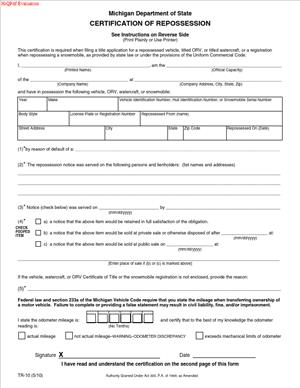
TR-10 – Certification of Repossession
Fill out nowJurisdiction: Country: United States | Province or State: Michigan
TR-10 – Certification of Repossession is a Michigan vehicle title document used after a secured party repossesses a vehicle. It helps connect the repossession to the next title-related step, such as applying for a repossession title or transferring ownership after default.
This form is most often used by lenders, finance companies, lienholders, or their authorized agents. It may also come up when a business handles vehicle recovery, resale, or title processing after a borrower falls behind on a secured loan.
The document matters because a vehicle title office usually needs a clear paper trail. A repossession changes who controls the vehicle, but the title record still needs proper documentation before the vehicle can be retitled or sold.
If you are filling out this form yourself, the main goal is accuracy. Names, vehicle details, lien information, signatures, and dates need to match the related records as closely as possible.
The form is not a general repossession notice, payment demand, or full contract between the borrower and lender. It is a certification connected to the title process after repossession has already occurred.
What is TR-10 – Certification of Repossession?
Clear definition
TR-10 – Certification of Repossession is a Michigan Department of State vehicle title form used to certify that a vehicle has been repossessed by a party with a secured interest. In plain terms, it tells the title office that the party completing the form claims the right to take title-related action because the vehicle was repossessed.
The form usually identifies the vehicle, the owner or debtor, the secured party, and the facts of the repossession. It may also require a signature confirming that the information is true. That signature is important because the form is not just a casual statement.
The certification helps the title record move from the prior owner’s name toward a repossession title or another permitted title transaction. The exact next step depends on the transaction being handled and the supporting paperwork.
This document is focused on motor vehicle title administration. It does not explain every right or duty under the loan agreement, and it does not decide disputes between the borrower and creditor.
Who typically uses this form?
A secured party commonly uses this form. A secured party is often the lender, finance company, bank, credit union, dealer-lender, or other creditor listed on the title or security paperwork.
An authorized agent may also complete or submit the form in some situations. This could include a title clerk, recovery-related representative, dealer employee, or business employee handling paperwork for the lienholder.
Dealers may encounter the form when a repossessed vehicle is being prepared for resale. The dealer may need title documents in proper order before offering the vehicle to a buyer.
Individuals may see this document if they bought a repossessed vehicle and are reviewing the title paperwork. They may also see it if they are helping a small business process a vehicle that was used as collateral.
The person completing the form usually needs access to accurate records, including the current title record, lien information, loan account details, vehicle identification number, and repossession date.
Why might you need this form?
You might need this form when a repossessed vehicle needs a title transaction. Repossession alone may not update the official title record. The filing helps support the title change or related title action.
The form can help show that the secured party is acting because of a default or similar event under a secured transaction. It gives the title office a standardized way to review the repossession claim.
You may also need it to avoid delays. If the title office receives incomplete or inconsistent repossession paperwork, the transaction may be paused, rejected, or returned for correction.
A clean certification can also help the next buyer. When a repossessed vehicle enters the resale market, the buyer generally needs a title history that supports the seller’s authority to transfer the vehicle.
This form can matter for recordkeeping as well. Businesses that handle repossessions often keep copies in their files to document what happened and when.
Typical real-life scenarios
- A borrower finances a vehicle and later stops making required payments. The lender repossesses the vehicle through its recovery process. After recovery, the lender needs to complete title paperwork before selling the vehicle. This document may be part of that title package.
- A finance company holds a lien on a vehicle, but the title remains in the borrower’s name. The company takes possession after default and needs the title record to reflect its authority. The certification helps explain why the title transaction is being requested.
- A dealership sold a vehicle under a retail installment arrangement and retained a secured interest. The buyer defaults, and the vehicle is repossessed. Before the dealership can resell it, repossession-related title documents may need to be completed correctly.
- A title clerk receives a file for a repossessed vehicle but notices that the owner name on the title does not match the loan records exactly. The clerk reviews the certification and supporting documents to make sure the filing can be prepared without obvious inconsistencies.
- A buyer purchases a vehicle from a business that acquired it after repossession. The buyer’s title transaction may depend on whether the prior repossession paperwork was accepted and properly connected to the title record.
When would you use TR-10 – Certification of Repossession?
You would generally use TR-10 – Certification of Repossession after the vehicle has already been repossessed. The document is tied to the title process that follows recovery of the vehicle.
It is commonly used when a secured party wants to obtain a title in its name after repossession. That title may then support resale, assignment, or another title transaction.
You may also see it when a vehicle is being transferred from a lienholder to a dealer, auction-related buyer, or retail buyer. The certification helps explain how the lienholder obtained authority to transfer the vehicle.
A lender may use the form when the title is still in the borrower’s name, but the lender has taken possession because of default. The title office usually needs more than possession alone to process the transaction.
A dealer or title processor may use the form as part of a larger title packet. That packet may include the existing title, lien documents, odometer information, assignments, tax documents, or other required materials.
The form may be relevant when a secured party does not have a signed title assignment from the debtor. Repossession title procedures often exist because the debtor may not voluntarily sign transfer documents after default.
You would not typically use this form before repossession occurs. It is not meant to threaten repossession, authorize a recovery agent, or notify the borrower that repossession may happen.
You also would not use it as a substitute for a properly completed title application when one is required. The certification supports the transaction, but it is usually only one part of the submission.
If more than one lienholder appears in the title history, extra care is often needed. A title office may need to understand which party has the right to act and whether prior interests have been released or addressed.
If the vehicle information is uncertain, the form may not solve that problem by itself. The vehicle identification number, year, make, and title details generally need to be confirmed before the filing is submitted.
Legal characteristics of TR-10 – Certification of Repossession
TR-10 – Certification of Repossession has legal significance because it is a signed certification used in an official title process. The person signing it is usually confirming specific facts about the repossession and the secured party’s interest in the vehicle.
For the form to work as intended, the information generally needs to match the title record and supporting documents. The secured party’s name, vehicle identification number, owner name, and dates must be consistent enough for the title office to process the filing.
A form may run into problems if it has missing signatures, incomplete vehicle details, crossed-out information, unclear corrections, or mismatched names. Even small errors can matter when they affect identity, ownership, or lien status.
Problems can also arise if the person signing does not appear to have authority. For example, a title office may question a submission if the named secured party is one company but an unrelated person signs without explanation.
Another common issue is an incorrect or incomplete vehicle identification number. Since the VIN is the main identifier for the vehicle, a single wrong character can cause rejection or delay.
The document also depends on the surrounding transaction. A completed certification does not automatically prove that every repossession step was proper. It supports a title filing by stating the facts required for that administrative process.
Jurisdictional rules can differ across states. Some states use different forms, title procedures, or supporting documents for repossessed vehicles. A Michigan form may not fit a title transaction in another state.
Even within Michigan, facts can affect the paperwork. A vehicle with a paper title, electronic lien record, missing title, out-of-state title, or multiple secured parties may require different handling.
This form does not cancel a loan balance. It does not decide whether the borrower still owes money, whether the repossession was disputed, or whether every repossession step complied with applicable law.
It also does not replace notices, account records, lien releases, title applications, or sales documents that may be needed in the broader process. The certification is one document within a larger file.
Is it legally binding?
TR-10 – Certification of Repossession can be legally meaningful because it is a signed statement submitted for an official title purpose. The signer is certifying facts that may affect vehicle ownership records.
The form may be treated as binding in the sense that the signer is responsible for the accuracy of the statements made. If the information is false or incomplete, the filing may be rejected, corrected, investigated, or challenged.
The document becomes especially important when the title office relies on it to issue or transfer title. Once accepted, it can help create a new title record connected to the repossession.
Its effect depends on proper completion, authority to sign, and consistency with the supporting documents. A signed form with incorrect parties, missing details, or conflicting records may not achieve the intended result.
The form does not become a private contract just because it is signed. It is a certification used for a vehicle title transaction. It may reflect rights from a loan agreement or security interest, but it does not create the entire secured relationship by itself.
If a borrower disputes the repossession, the form does not automatically resolve that dispute. It may still be part of the administrative record, but separate facts and documents may matter in any later review.
How to fill out TR-10 – Certification of Repossession
Step 1 – Identify the form and confirm the transaction
Confirm that you are using TR-10 – Certification of Repossession for a repossession-related title transaction in Michigan. Make sure the vehicle has already been repossessed and that the form fits the title action being requested.
Step 2 – Gather the vehicle information
Collect the vehicle identification number, year, make, model, body style, and current title details before you write anything. Copy the VIN from the title record or the vehicle itself with care. Do not rely on memory or shortened internal records.
Step 3 – Enter the owner or debtor information
Add the name of the person or business shown as the owner or debtor in the relevant records. Use the full legal name when available. If the title record uses a middle initial, business suffix, or exact company name, keep the entry consistent.
Step 4 – Enter the secured party information
Provide the name and address of the secured party connected to the repossession. This is usually the lienholder or creditor with the security interest in the vehicle. If the secured party changed names, merged, or assigned the account, the file may need records that explain the connection.
Step 5 – Describe the repossession
Complete the section that asks for repossession details, such as the date of repossession and related account or vehicle information. Use a specific date if the form requests one. The date should match the business records for the recovery whenever possible.
Step 6 – Review lien and title consistency
Compare the secured party name on the form with the lienholder information in the title record. If the title shows a different lienholder, the submission may need additional documentation to explain the difference.
Step 7 – Complete any required certification language
Read the certification statement before signing. This language usually confirms that the vehicle was repossessed and that the signer is making the statement for the title transaction. Make sure the completed facts support the certification being made.
Step 8 – Add the signer’s name and role
Enter the signer’s printed name, title, and relationship to the secured party if the form asks for that information. A clear role can help show why the signer has authority. For a business, this may be an employee, officer, manager, or authorized representative.
Step 9 – Sign and date the form
Sign the form using the required signature format and add the date of signing. The signature date should be current and readable. Avoid leaving the date blank, because an undated certification can create processing questions.
Step 10 – Check for blank fields and unclear corrections
Review the entire document before submission. Look for missing vehicle details, incomplete names, unsigned sections, unreadable handwriting, and accidental blanks. If a correction is needed, make it cleanly or prepare a fresh form.
Step 11 – Match the form to the rest of the title packet
Place the completed certification with the related title documents for the same vehicle. The names, VIN, dates, and transaction type should align across the packet. Compare any title application, assignment, lien release, odometer statement, or other document before filing.
Step 12 – Submit the completed filing
Submit the completed form as part of the repossession title transaction using the accepted submission method. Keep a copy with the records connected to the repossession. A retained copy can help if questions later arise about the title record, vehicle sale, or transaction history.
Legal terms you might encounter in TR-10 – Certification of Repossession
- Repossession: Repossession means the secured party has taken back the vehicle after a default under a security agreement. On this form, the certification tells the title office why the secured party can request title action without the debtor acting as the seller.
- Secured Party: The secured party is the lender, creditor, financing company, dealer, or other person or business with a security interest in the vehicle. This is usually the party named as lienholder on the title record. If the name has changed, supporting documents may be needed.
- Debtor: The debtor is the person who owed the obligation secured by the vehicle. In many cases, the debtor is also the titled owner. The debtor’s name on the form should match the title record, loan documents, or repossession file.
- Security Interest: A security interest is the legal interest a creditor has in the vehicle as collateral. The form relies on the idea that the creditor had a valid interest before the repossession occurred. The security interest is often shown by a lien on the vehicle title.
- Lienholder: A lienholder is the person or business listed on the vehicle title as having a lien. The lienholder is often the same as the secured party, but not always. Assignments, mergers, servicing arrangements, or name changes can create differences that need explanation.
- Certificate of Title: The certificate of title is the ownership record for the vehicle. The TR-10 is usually part of a title packet used to change or support the title record after repossession. Details such as owner, lienholder, VIN, year, make, and title number should be copied carefully.
- Vehicle Identification Number: The vehicle identification number, often called the VIN, is the unique identifying number assigned to the vehicle. A single wrong character can cause rejection, delay, or a mismatch with the title record. Compare the VIN across the title, vehicle, repossession report, and sale documents.
- Default: Default means the debtor failed to meet an obligation under the security agreement. A common example is missed payments, but default can also involve insurance, collateral protection, or other contract terms. Keep supporting default records in the file.
- Certification: A certification is a signed statement that the information on the form is true and that the signer has authority to make the statement. The title office relies on this language when processing the filing.
- Authorized Agent: An authorized agent is someone allowed to sign or submit the form for the secured party. This may be an employee, officer, recovery department representative, title clerk, or other approved representative. The signer’s role should be clear.
FAQs
What date should I use for the repossession?
Use the date the vehicle was actually repossessed, not the date you filled out the form or the date the loan went into default. Look for the recovery report, tow invoice, account notes, or internal repossession record. The date should be consistent across the file.
Who is allowed to sign TR-10 – Certification of Repossession?
The signer should be someone with authority to certify the repossession for the secured party. That may be an officer, employee, title representative, recovery department employee, or authorized agent. Confirm the signer’s name, title, and connection to the secured party.
What if the secured party name does not exactly match the title record?
Do not ignore the mismatch. Compare the title record, lien release history, assignment documents, merger documents, power of attorney, and internal account records. If the current secured party has a different name, you may need documents that explain the chain from the titled lienholder to the party signing the form.
Do I need to attach the vehicle title?
That depends on the title action requested and what documents are available. If you have the current title, include it when the process requires it. If you do not have it, check whether the filing path allows a title replacement, repossession title application, or another supporting document.
What information must match exactly across the filing packet?
The VIN is the most important item to match exactly. The year, make, owner name, secured party name, title number, and repossession date should also be consistent. Review every page as one packet before submission.
What changes in the public record after this document is accepted?
Acceptance can support a title change that reflects the repossession-related transaction. Depending on the filing, the record may change who can transfer the vehicle, who receives a new title, or how the lien and ownership information appears.
What should I do if I made a correction on the form?
Use a clean replacement form if the correction makes the information hard to read. Never leave crossed-out names, altered VIN characters, or unclear dates in a title packet. Those issues often create avoidable delays.
How will I know whether the filing was accepted?
Look for a processed title, transaction receipt, confirmation, stamped copy, account update, or other record showing the filing was completed. If the submission is rejected, read the rejection reason closely and correct the identified issue.
Checklist: Before, During, and After TR-10 – Certification of Repossession
Before
- Confirm you are using the current version of the form for the filing.
- Verify that the vehicle was actually repossessed before preparing the certification.
- Gather the title, lien record, loan account information, repossession report, and any assignment documents.
- Compare the VIN across all documents before entering it.
- Confirm the debtor’s name and address from the title record and account file.
- Confirm the secured party’s legal name and mailing address.
- Identify who has authority to sign for the secured party.
- Check whether the title packet needs a title application, title, fee, sale document, or supporting attachment.
During
- Enter the VIN exactly as it appears on the title record.
- Use the full legal names of the debtor and secured party.
- Enter the repossession date from the repossession record, not from memory.
- Make sure the secured party information matches the lienholder record or is supported by documents.
- Use readable handwriting or typed entries if available.
- Complete every required field before signing.
- Avoid unclear abbreviations, unexplained initials, and partial business names.
- Review the certification language before adding the signature.
- Sign in the correct signer capacity and include the date of signing.
After
- Make a copy or scan of the signed form before submission.
- Assemble the form with the rest of the title packet in a logical order.
- Confirm any required fees, applications, or title documents are included.
- Submit the packet using an accepted filing method.
- Track the filing until you receive acceptance, rejection, or follow-up instructions.
- Save proof of delivery, receipt, or transaction confirmation.
- Update the repossession file with the submitted version of the form.
- Update internal title, inventory, sale, or account records after processing.
- Keep any rejection notice with notes showing how the issue was corrected.
Common mistakes to avoid with TR-10 – Certification of Repossession
- Mistake: Using the wrong VIN because it was copied from a tow sheet or account note instead of the title record. Compare every VIN character before signing.
- Mistake: Listing the wrong secured party because the loan was assigned, merged, or serviced by another entity. Include or keep documents showing the connection.
- Mistake: Leaving the repossession date blank or using the form completion date. Locate the actual repossession date first.
- Mistake: Letting someone sign without clear authority. Confirm the signer’s role before submission.
- Mistake: Submitting the form without the related title documents. Match the certification to the full filing packet.
- Mistake: Using nicknames, shortened business names, or inconsistent initials. Use the name shown on the title or supporting records.
- Mistake: Making messy corrections to key fields. Prepare a clean replacement when the change affects names, dates, or the VIN.
- Mistake: Failing to keep a signed copy. Save a complete copy before filing.
- Mistake: Ignoring a rejection notice. Correct the exact mismatch or missing item identified.
- Mistake: Updating sale or inventory records before title processing is confirmed. Wait for confirmation or clearly mark the transaction as pending.
What to do after filling out TR-10 – Certification of Repossession
Once the form is complete, treat it as part of a title transaction file. Do not separate it from the documents that explain the vehicle, the lien, the repossession, and the requested title action. A title office usually reviews the packet as a whole, so a perfect form can still be delayed if the supporting documents do not line up.
Step 1: Make a complete copy of the signed form.
Save a scan or photocopy before you submit anything. Include the front and back if anything appears on both sides. Store the copy in the repossession file with the title, loan account record, repossession report, and submission materials.
Step 2: Review the full packet one more time.
Check that the VIN, year, make, debtor name, secured party name, and title number are consistent. Look for small issues such as a transposed VIN character, outdated creditor name, or missing signature date.
Step 3: Confirm whether any attachments are needed.
Attachments may include a title application, existing certificate of title, lien assignment, power of attorney, business name change document, fee payment, odometer document, or other title-related paperwork. The right attachments depend on the transaction.
Step 4: Choose the proper submission method.
Use the filing method available for the type of title transaction. That may involve in-person submission, mail, a dealer or lender title process, or another accepted channel. Keep proof of submission, especially if documents are mailed or sent through a third party.
Step 5: Include payment if fees are required.
If the title action requires a fee, make sure the payment amount and method match the filing requirements. A correct form can still be rejected or held if payment is missing or incorrect. Keep a receipt or transaction confirmation.
Step 6: Track the filing after submission.
Do not assume the transaction is finished on the day you submit it. Watch for a processed title, receipt, rejection notice, request for more information, or returned documents. If another department handles filing, ask how confirmation will be provided.
Step 7: Respond quickly to any rejection or follow-up request.
Read the reason carefully before changing the form. If the problem is a name mismatch, correct the name or add proof that explains the difference. If the problem is a missing title document, add that document instead of rewriting unrelated parts of the form.
Step 8: Save proof of acceptance.
When the filing is accepted, store the new title, transaction receipt, confirmation, or other processing record with the repossession file. This proof matters if you later sell the vehicle, audit the file, answer a borrower inquiry, or document the chain of title.
Step 9: Update internal records.
After acceptance, update your internal vehicle inventory, account system, title log, sale file, and repossession tracking record. Mark the date of acceptance, the title status, and the location of the original title or confirmation.
Step 10: Keep the original documents secure.
If you receive a new title or returned original documents, store them where they will not be lost, altered, or mixed with another vehicle file. Use a file name or physical folder label that includes the VIN and debtor name.
Step 11: Coordinate with any sale or transfer documents.
If the vehicle will be sold after repossession, compare the buyer documents with the accepted title record. The seller name, VIN, mileage information, and sale date should make sense with the repossession title file.
Step 12: Maintain the file for future questions.
Keep the signed certification, supporting documents, proof of submission, acceptance record, and any rejection corrections together. Future questions may come from a buyer, auditor, debtor, insurer, recovery vendor, or title processor.
Disclaimer: This guide is provided for informational purposes only and is not intended as legal advice. You should consult a legal professional.