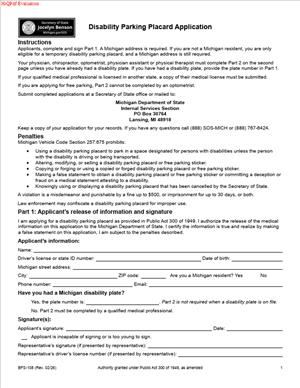
BFS-108 – Disability Parking Placard Application
Fill out nowJurisdiction: Country: United States | Province or State: Michigan
The BFS-108 – Disability Parking Placard Application is the form used in Michigan to request a disability parking placard. This placard allows a vehicle to park in spaces reserved for people with qualifying medical conditions.
If you are about to complete the BFS-108 – Disability Parking Placard Application, you likely need clear guidance on what information is required and how the process works. The form involves both personal details and medical certification.
This document matters because it connects your medical eligibility with a state-issued parking privilege. If the form is incomplete or inaccurate, your request may be delayed or denied.
You may be applying for yourself, for a minor, or on behalf of someone you care for. In each case, the form collects specific details to confirm identity and medical qualification.
Understanding how the form works before you start helps you avoid common mistakes and ensures your submission is complete the first time.
What is BFS-108 – Disability Parking Placard Application?
Clear definition
The BFS-108 – Disability Parking Placard Application is an official Michigan Department of State form used to request a disability parking placard. A disability parking placard is a hanging permit that is displayed from a vehicle’s rearview mirror when parked.
The form serves two main purposes. First, it identifies the person requesting the placard. Second, it verifies that the person meets medical eligibility requirements through certification by a licensed medical professional.
This is not a general request letter or informal statement. It is a structured government document designed to collect standardized information for review and approval.
Who typically uses this form?
You would use this form if you have a qualifying disability that limits your mobility. This often includes conditions that make walking difficult or unsafe without assistance.
Parents or legal guardians may complete the form for a child with a qualifying condition. Caregivers may also assist adults who are unable to complete the form themselves.
Medical professionals use a section of the form to certify the medical condition. This typically includes physicians and certain other licensed healthcare providers authorized to make such certifications under state rules.
Why might you need this form?
You need this form if you want legal access to designated disability parking spaces in Michigan. These spaces are usually located near building entrances to reduce walking distance.
Without an approved placard, parking in a reserved disability space can result in fines. The form is the first step toward obtaining lawful access to those spaces.
You may also need this form if your existing placard has expired and you are seeking renewal. In some cases, updated medical information may be required.
The form is also used when requesting a temporary placard. Temporary placards are often issued for conditions expected to improve, such as recovery from surgery or injury.
Typical real-life scenarios
- You recently had surgery that limits your ability to walk long distances. Your doctor expects recovery to take several months. You may use the form to request a temporary placard during that recovery period.
- You have a chronic condition that affects your lungs or heart and makes walking difficult. You may use the form to apply for a longer-term placard if your condition meets eligibility standards.
- Your child has a medical condition that requires mobility assistance. As a parent, you complete the personal information section and arrange for the child’s healthcare provider to complete the medical certification.
- You are renewing a placard that is about to expire. You complete a new application, ensuring that any required medical certification is updated if necessary.
- You recently moved within Michigan and need to update your contact information while maintaining your placard status. The form may be part of that update process, depending on your situation.
When would you use BFS-108 – Disability Parking Placard Application?
You would use this form whenever you are requesting a disability parking placard for the first time in Michigan. It is also used in many renewal or replacement situations, depending on the circumstances.
If your medical condition has recently changed and now significantly limits your mobility, this form becomes relevant. The document allows you to formally request accommodation through a state-issued placard.
You may also use the form if your previous placard was lost, stolen, or damaged. In those cases, the form helps the state confirm your identity and eligibility before issuing a replacement.
Healthcare providers become involved when medical certification is required. Their role is to complete and sign the medical section verifying that you meet qualifying standards. Without that certification, the application may not move forward.
If you are applying for a temporary placard due to a short-term condition, the form is also used to indicate the expected duration of the disability. The provider’s certification usually specifies whether the condition is temporary or long-term.
Legal characteristics of BFS-108 – Disability Parking Placard Application
The BFS-108 – Disability Parking Placard Application is an official government filing. Its legal effect comes from state law that authorizes the issuance of disability parking placards to qualifying individuals.
For the form to be effective, it generally must be complete, accurate, and signed where required. This includes your signature and, when applicable, the signature and certification of a licensed medical professional.
Common reasons for rejection include missing signatures, incomplete medical information, illegible writing, or inconsistent personal details. If the identifying information does not match state records, processing may be delayed.
The form does not automatically grant parking privileges. Approval by the Michigan Department of State is required before a placard is issued. Until the placard is officially issued and displayed according to instructions, disability parking spaces may not be used lawfully.
Although disability parking programs exist in all U.S. states, specific procedures and eligibility standards can vary. Michigan uses its own designated form and review process, and approvals are based on state-level criteria.
The form also does not create broader legal rights beyond parking privileges. It does not establish disability status for employment, housing, or federal benefit purposes. Its scope is limited to parking access under Michigan rules.
Is it legally binding?
The BFS-108 – Disability Parking Placard Application functions as a formal government application. When you sign it, you are typically certifying that the information provided is true and correct to the best of your knowledge.
The medical professional’s signature also carries significance. By signing, the provider confirms that the medical condition meets qualifying criteria under state standards. False certification could have professional consequences.
While the form itself is not a contract between private parties, it is legally significant. It becomes part of an official state record once submitted and processed.
If approved, the resulting placard grants specific parking privileges under Michigan law. Misuse of the placard, such as allowing someone else to use it improperly, may result in penalties. The legal effect comes from the state’s issuance of the placard, not merely from completing the form.
How to fill out BFS-108 – Disability Parking Placard Application
Step 1 – Review the form sections
Start by reading through the entire form before writing anything. Identify the sections for applicant information, medical certification, and signatures. This overview helps you understand what information you will need and whether a medical appointment is required.
Step 2 – Provide applicant identification details
Enter your full legal name, current address, and any other identifying information requested. Use accurate and up-to-date details. If the application is for a minor or dependent, include the required information for both the individual with the disability and the responsible adult, if applicable.
Step 3 – Indicate the type of placard requested
Select or mark whether you are requesting a temporary or longer-term placard, as indicated on the form. Ensure your selection matches your medical situation. Temporary requests often require an estimated recovery date from the medical provider.
Step 4 – Complete applicant certification and signature
Read the certification statement carefully. This section usually confirms that the information provided is true and that the placard will be used only as allowed by law. Sign and date the form in the designated space. An unsigned application may not be processed.
Step 5 – Obtain medical certification
Take the form to a licensed medical professional authorized to certify disability status. The provider completes the medical section, describing the qualifying condition and indicating whether it is temporary or long term. The provider signs and dates the certification portion.
Step 6 – Review for completeness
Before submission, check that all required fields are filled in and that both you and the medical professional have signed where required. Confirm that handwriting is legible and that no sections have been left blank unintentionally.
Step 7 – Submit the application
Submit the completed form according to the instructions provided with the document. This may involve mailing or delivering it to the appropriate state office. After submission, the application will be reviewed, and if approved, a disability parking placard will be issued.
Legal terms you might encounter in BFS-108 – Disability Parking Placard Application
- Permanent Disability: This refers to a long-term medical condition that substantially limits mobility and is not expected to improve. On this form, a permanent disability usually qualifies you for a longer-term placard. The medical provider must confirm that your condition meets the eligibility standard for permanence.
- Temporary Disability: A temporary disability is a condition expected to improve within a limited time, such as after surgery or an injury. The form will ask your medical provider to indicate the expected duration. This affects how long your placard will be valid.
- Medical Certification: This is the section completed and signed by a licensed healthcare professional. It confirms that you meet the eligibility requirements for a disability parking placard. Without proper medical certification, the application will not be processed.
- Applicant Certification: This is your sworn statement that the information you provided is true and accurate. By signing, you confirm that you understand the rules for using the placard. False statements can lead to denial or penalties.
- Authorized Healthcare Provider: This term refers to the licensed professional permitted to certify your disability. The form typically specifies who qualifies, such as a physician or other recognized medical practitioner. The provider must sign and may need to include license information.
- Placard Expiration Date: This is the date your parking placard will no longer be valid. The expiration depends on whether your disability is permanent or temporary. You are responsible for renewing it before it expires if you still qualify.
- Replacement Placard: If your placard is lost, stolen, or damaged, you may apply for a replacement. The form may require you to indicate the reason for replacement. You may need to certify that the original is no longer in your possession.
- Fraudulent Use: This refers to misuse of a disability placard, such as allowing someone else to use it without you being present. The application warns that improper use can result in fines or revocation. Your signature acknowledges that you understand these restrictions.
- Eligibility Criteria: These are the specific medical conditions or limitations that qualify a person for a disability placard. The form outlines these standards so the medical provider can confirm whether you meet them. Meeting the criteria is essential for approval.
FAQs
Do I need a doctor’s signature for the BFS-108 – Disability Parking Placard Application?
Yes. This document requires medical certification from an authorized healthcare provider. You must have the provider complete and sign the medical section confirming your qualifying condition before submission.
What happens if I leave a section blank on this form?
If required sections are incomplete, the application may be rejected or delayed. Review every field, especially your name, address, type of placard requested, and signatures. Missing medical information is a common reason for denial.
Can I apply for both a temporary and permanent placard at the same time?
No. You must select the option that matches your current medical condition as certified by your provider. The provider determines whether your condition is temporary or permanent based on medical standards.
How do I know if my healthcare provider qualifies to complete the medical certification?
The form specifies which types of licensed professionals are authorized to certify your disability. Check that your provider’s license type fits within those categories and that they include any required license details.
What should I do if my name on this document does not match my identification?
Make sure the name you enter matches your official identification records. If you recently changed your name, you may need to update your identification before submitting this form to avoid processing issues.
Is there a fee to submit this form?
The application instructions will state whether a fee applies, particularly for temporary or replacement placards. Confirm the payment requirement before submission so your request is not delayed.
How will I know if my application has been approved?
After submitting this document, approval is typically confirmed by receiving the placard by mail or at the office where you applied. If there is a problem, you may receive a notice requesting corrections or additional information.
Can someone else submit this form on my behalf?
Yes, another person can usually deliver or mail the completed form for you. However, you must sign the applicant certification yourself unless you have a legally authorized representative who can sign on your behalf.
Checklist: Before, During, and After BFS-108 – Disability Parking Placard Application
Before
- Confirm that your medical condition meets the listed eligibility criteria.
- Schedule an appointment with an authorized healthcare provider if certification is required.
- Gather identification that matches the name you will enter on the form.
- Review whether you need a temporary, permanent, or replacement placard.
- Check if a fee applies and prepare payment if necessary.
- Read the full set of instructions attached to the application.
- Verify your current mailing address for accurate delivery.
During
- Print clearly or type to avoid legibility issues.
- Enter your full legal name exactly as it appears on your identification.
- Provide a complete and accurate mailing address.
- Select only one placard type that matches your eligibility.
- Review the medical certification section with your provider before they sign.
- Ensure all required signatures are included.
- Double-check dates for accuracy and completeness.
After
- Make a copy of the completed application for your records.
- Submit the form using the approved method (mail or in person, as instructed).
- Confirm that any required fee was included.
- Monitor your mail for the placard or follow-up communication.
- Store the placard safely once received.
- Review the expiration date and note it on your calendar.
- Use the placard only when you are present in the vehicle.
Common mistakes to avoid with BFS-108 – Disability Parking Placard Application
- Mistake: Submitting the form without medical certification because you assumed your condition was obvious; this happens when applicants skip the provider section, which leads to automatic rejection, so do not forget the required provider signature and details.
- Mistake: Choosing the wrong placard type due to misunderstanding temporary versus permanent eligibility; this can cause processing delays or issuance of the wrong placard, so do not forget to confirm the correct category with your provider.
- Mistake: Writing a nickname instead of your legal name because it feels more familiar; this creates record mismatches and possible denial, so do not forget to match your identification exactly.
- Mistake: Forgetting to sign the applicant certification because you focused on the medical section; unsigned applications are not valid, so do not forget your signature and the date.
- Mistake: Leaving out payment when a fee applies because you assumed it was free; this results in processing holds, so do not forget to verify fee requirements before submission.
- Mistake: Providing an outdated mailing address because you recently moved; this can delay or prevent delivery of your placard, so do not forget to confirm your current address.
- Mistake: Allowing someone else to use the placard without you present because you wanted to help them; this is considered fraudulent use and may lead to penalties, so do not forget that the placard is for your use only.
What to do after filling out BFS-108 – Disability Parking Placard Application
Once you complete the application, pause and review it one more time. Look at every section with fresh eyes. Small errors cause big delays.
- Step 1: Make a complete copy of the signed application, including the medical certification section. Keep this copy in a safe place with your important documents.
- Step 2: Confirm the submission method. Determine whether you must mail it or submit it in person. Follow the instructions exactly.
- Step 3: If a fee is required, verify that your payment is properly included and correctly prepared.
- Step 4: Submit the application using the approved method. If mailing, ensure the address is accurate and the envelope is properly sealed and stamped.
- Step 5: Note the date you submitted the form. This helps you track processing time.
- Step 6: Monitor your mail regularly for either the placard itself or a notice requesting additional information.
- Step 7: If you receive a correction notice, respond promptly and provide any missing information.
- Step 8: When your placard arrives, review it for accuracy. Check your name and the expiration date.
- Step 9: Hang or display the placard only when parked in a designated space and remove it while driving, if required by the instructions.
- Step 10: Record the expiration date in your calendar so you can begin the renewal process early if you still qualify.
Keep your paperwork organized. If your medical condition changes, or if your placard is lost or stolen, you may need to complete a new application or request a replacement. Staying organized now makes future renewals or updates much easier.
Disclaimer: This guide is provided for informational purposes only and is not intended as legal advice. You should consult a legal professional.