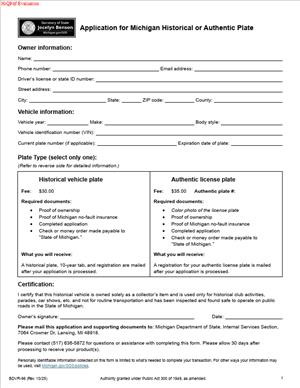
BDVR-96 – Application for Michigan Historic or Authentic Plate
Fill out nowJurisdiction: Country: United States | Province or State: Michigan
BDVR-96 – Application for Michigan Historic or Authentic Plate is a Michigan Department of State vehicle plate application used when an owner wants a historic plate or approval to use an authentic plate for an eligible vehicle. It is connected to vehicle registration, plate assignment, and how the vehicle will be identified in state records.
This form is mainly for owners of older vehicles that meet Michigan’s historic or authentic plate requirements. These vehicles are often collector vehicles, preserved vehicles, restored vehicles, or older vehicles used for limited purposes rather than daily transportation.
The form matters because a historic or authentic plate is not the same as a standard license plate. It may carry different eligibility rules, use limits, and documentation expectations. Completing the form carefully helps the reviewing office match the vehicle, owner, and requested plate type.
You may use this form when applying for a Michigan historic plate or requesting approval to use an authentic Michigan plate from the vehicle’s model year. Before starting, gather details about the vehicle, owner, plate, and any supporting information. Careful preparation can reduce delays, follow-up questions, or rejection.
What is BDVR-96 – Application for Michigan Historic or Authentic Plate?
Clear definition
BDVR-96 – Application for Michigan Historic or Authentic Plate is an application for requesting a Michigan historic vehicle plate or approval to use an authentic plate. A historic plate is generally issued for an eligible older vehicle maintained as a collector or historic vehicle. An authentic plate is commonly an original Michigan license plate from the same year as the vehicle, if it meets the applicable conditions.
The form collects information about the applicant, vehicle, and plate request. It allows the Michigan Department of State to review whether the vehicle and plate request fit the category being requested. It also creates a record of what the owner is asking the state to issue or approve.
This application is tied to registration records and vehicle identification. The vehicle identification number, year, make, body style, and ownership information help confirm that the requested plate category matches the vehicle.
The form may also require the applicant to acknowledge limits or conditions connected to historic vehicle use. These limits can matter because historic plates are often associated with events, exhibitions, parades, club activities, and occasional use rather than regular commuting.
Who typically uses this form?
You typically use this form if you own an older Michigan vehicle and want a historic vehicle plate. The vehicle may be a restored car, preserved truck, antique vehicle, collectible motorcycle, or another eligible vehicle type. The vehicle must fit the category connected to the requested plate.
You may also use this form if you want to display an authentic Michigan plate on an eligible vehicle. In that situation, the plate is usually an original plate from the vehicle’s model year. The plate often must be readable, in suitable condition, and not already assigned in a way that conflicts with state records.
Collectors commonly use this form when they want the vehicle’s plate to match the vehicle’s age, style, or restoration period. Others may use a state-issued historic plate because it is simpler or more practical.
Owners of vehicles used in shows, parades, exhibitions, historical events, or club gatherings may also use this document. A buyer of a qualifying older vehicle may use the form after transferring title or registration into their name. A long-time owner may use it after deciding to change from a standard registration to a historic plate category.
Why might you need this form?
You might need this form because Michigan generally requires an application before issuing or approving a historic or authentic plate. The application gives the state the information needed to evaluate the request and gives you a structured way to identify the vehicle and plate type.
You may need it when a standard license plate does not fit how you use the vehicle. If the vehicle is primarily kept for historical interest, preservation, exhibitions, or occasional use, a historic or authentic plate category may be relevant.
You may also need it if you found an older Michigan plate and want to use it as an authentic plate. The state usually needs to confirm that the plate can be associated with your vehicle. This helps prevent duplicate plate numbers, mismatched years, or unreadable plates from entering the registration system.
The form can affect official vehicle records. Inaccurate information can create problems later if the vehicle is stopped, sold, insured, or inspected. Using the correct form also helps avoid confusion with ordinary registration filings.
Typical real-life scenarios
- You bought a 1960s vehicle that is no longer used for daily driving. You plan to take it to shows, club events, and local parades. You want the registration to reflect that historic use, so you prepare this application before requesting the plate.
- You inherited an older vehicle that has been stored for many years and are returning it to roadworthy condition. Once the title and ownership records are handled, you may use this form to request a historic plate category.
- You restored a vehicle to match its original model year appearance and found a Michigan license plate from that same year. This form helps present the authentic plate request for review.
- You already own a historic vehicle with a regular Michigan plate and decide that a historic plate is a better fit because the vehicle is used only for limited hobby purposes. This form may be part of changing the plate type.
- You purchased an older motorcycle and want the plate to match its collector status. If the motorcycle meets the relevant criteria, this application may be used to request the appropriate historic or authentic plate option.
- You are organizing records for a vehicle collection and want each vehicle’s plate status to match its actual registration category. Reviewing and completing the correct application can help align records and reduce confusion.
When would you use BDVR-96 – Application for Michigan Historic or Authentic Plate?
You would use BDVR-96 – Application for Michigan Historic or Authentic Plate when requesting a Michigan historic plate for an eligible vehicle. This often arises after you buy, restore, inherit, or reclassify an older vehicle.
You may use the document when applying to use an authentic plate rather than a newly issued historic plate. In that case, the plate itself matters. It may need to match the vehicle’s model year, be in acceptable condition, and be available for assignment to that vehicle.
You may use the application during a registration transaction. For example, you might be registering a vehicle in your name and choosing a historic plate type at the same time. The form gives the plate request its own clear record within the larger registration process.
You may also use it when changing the status of a vehicle already registered in Michigan. A vehicle can sometimes move from ordinary plate registration into a historic category if the owner’s use and the vehicle’s characteristics fit the requirements.
Collectors may use this form as part of organizing a collection. Some vehicles may use standard plates, some may qualify for historic plates, and some may be candidates for authentic plates. This application helps separate those choices.
Restorers may use the document near the end of a project. Once the vehicle is ready for road use and ownership records are in order, the plate decision becomes practical. The form can be part of moving the vehicle from project status to registered status.
If you are handling a vehicle for a family member, estate, or shared household, you may encounter this form while sorting out older vehicle paperwork. The applicant information must match the relevant ownership and registration records.
Businesses, museums, clubs, or organizations that own eligible vehicles may also use this form. The person completing the document may need to provide entity information instead of individual details.
Timing can matter. If your vehicle is not titled in your name, the plate request may not be ready for review. If the authentic plate is damaged or hard to read, the application may raise questions. If vehicle information is incomplete, processing may slow down.
You may prepare the application before visiting a branch office or submitting paperwork through an accepted method. Completing it in advance can help you identify missing vehicle data, uncertain ownership details, or questions about the plate type before the transaction begins.
Legal characteristics of BDVR-96 – Application for Michigan Historic or Authentic Plate
BDVR-96 – Application for Michigan Historic or Authentic Plate has legal and administrative importance because it is used to request a state-recognized vehicle plate status. When accepted, the information on the form can affect registration records, plate assignment, and lawful plate display.
The form is effective only when the required information is complete, accurate, and consistent with the vehicle record. A plate application usually depends on the vehicle’s title status, ownership details, identification number, model year, and plate eligibility. If those details conflict, the request may be delayed or denied.
A valid submission generally includes applicant information, vehicle details, the requested plate type, and required statements or certifications. The applicant’s signature confirms that the person is making the request and taking responsibility for the information provided.
The document may be rejected or delayed if the VIN is missing, the model year is wrong, the owner name does not match records, or the plate number is unclear. Problems may also arise if an authentic plate is not readable, does not match the vehicle year, or appears to be assigned elsewhere.
The application is not a way to avoid normal registration requirements for a regular-use vehicle. It is designed for vehicles that fit the special category being requested. It also does not transfer ownership by itself and does not replace a title, bill of sale, lien release, insurance document, or ordinary registration requirement.
The form does not guarantee approval. Submitting it starts or supports the review process. Approval depends on the vehicle, plate, applicant’s records, fees, and any other requirements that apply to the transaction.
Michigan historic plate rules may not match another state’s antique, collector, classic, or year-of-manufacture plate rules. Even within Michigan, details can vary depending on whether you request a historic plate or an authentic plate. A state-issued historic plate focuses on the historic registration category. An authentic plate request adds questions about the physical plate, its year, its number, and its condition.
The document does not create permission to use the vehicle without following other applicable vehicle requirements. Registration status, insurance obligations, safety equipment, equipment standards, and traffic laws are separate from the form itself.
Because the form becomes part of a government registration process, accuracy matters. An incorrect vehicle year, wrong plate number, or mismatched owner name can affect the record and create confusion during renewal, sale, transfer, traffic stops, or future registration changes.
If multiple people own the vehicle, the way names appear can matter. The application information usually needs to align with the title and registration record. If the vehicle is owned by a trust, business, estate, or organization, the applicant section may need careful attention.
The signature area is more than a formality. Leaving it blank, signing with a name that does not match the applicant, or failing to date the document can cause processing issues.
Payment and supporting documents may also affect whether the application is processed. The form itself may not contain every item needed for the full transaction. Title documents, registration paperwork, proof of insurance, identification, or fees may be relevant depending on the situation.
For an authentic plate request, the physical plate can be central to review. The plate number must be clear, and the plate’s year must be appropriate for the vehicle. If the plate is bent, altered, repainted incorrectly, or unreadable, the request may face problems.
The application does not decide the vehicle’s historical value. It does not certify that a restoration is accurate, that the vehicle is rare, or that it has a certain market value. It is focused on registration and plate approval.
Is it legally binding?
The application can be legally significant once you sign and submit it because you are providing information for an official state vehicle record. Your signature generally indicates that the information is true to the best of your knowledge and that you are requesting the specific plate classification.
It is not a private contract. It is an administrative filing. The legal effect comes from the applicant’s statements, the state’s review, and the resulting registration record if the request is accepted.
If approved, the plate status may affect how the vehicle is registered and how the plate may be displayed. The plate category may also carry conditions, such as limited use. Those conditions come from the registration category, not from a negotiated agreement.
The form may not be effective if it is incomplete, unsigned, submitted by someone without a proper connection to the vehicle, or inconsistent with ownership records. Filling out the form alone does not make the plate valid. Displaying a plate generally depends on the registration record and approval of the plate assignment.
If an authentic plate is involved, the physical plate does not become valid for use simply because you own it. Until the request is accepted, the plate may be a collectible item rather than an approved registration plate.
How to fill out BDVR-96 – Application for Michigan Historic or Authentic Plate
Step 1 – Confirm the vehicle fits the purpose of the application
Start by identifying why you are using the form. You are usually applying for a historic plate or asking to use an authentic plate for an eligible older vehicle. Confirm that the vehicle details match the title, registration, and identification records.
Step 2 – Review the plate option you are requesting
Decide whether the request is for a historic plate or an authentic plate. A historic plate is typically issued through the state. An authentic plate usually involves an older Michigan plate connected to the vehicle’s model year.
Step 3 – Enter the applicant name accurately
Write the applicant’s name exactly as it appears or will appear in the ownership record. If an entity owns the vehicle, use the entity’s full legal name.
Step 4 – Provide the applicant address
Enter the requested mailing or residential address. Use a complete address with street number, street name, city, state, and ZIP code.
Step 5 – Add contact information if requested
If the form asks for a phone number or other contact details, provide current information. This can help resolve questions about missing details, unclear plate information, or mismatched records.
Step 6 – Enter the vehicle year
Write the vehicle’s model year carefully. This is especially important for an authentic plate request because the plate year often must relate to the vehicle year.
Step 7 – Enter the vehicle make
Provide the vehicle make as shown on the title or registration record. If the vehicle has been modified or restored, use the official record information.
Step 8 – Enter the vehicle identification number
Copy the VIN exactly from the title, registration, or vehicle identification plate. Check each character carefully.
Step 9 – Enter the body style or vehicle type
If the form asks for body style, use the description that best matches the vehicle record, such as sedan, coupe, convertible, pickup, truck, or motorcycle.
Step 10 – Identify the requested plate category
Mark or complete the section showing whether you are requesting a historic plate or an authentic plate. If the form has separate sections, complete only the portions that apply unless the instructions say otherwise.
Step 11 – Provide authentic plate details if applicable
If requesting an authentic plate, enter the plate number, year, and any other requested plate information. Look at the plate directly while entering the number.
Step 12 – Check the condition of the authentic plate
Review whether the plate is readable and suitable for display. If it is damaged, altered, or hard to read, the request may raise processing concerns.
Step 13 – Match the authentic plate year to the vehicle year
Compare the plate year with the vehicle’s model year. If the years do not match, gather information needed to understand whether the request can still be reviewed.
Step 14 – Enter current plate or registration information if requested
If asked, provide the plate number currently assigned to the vehicle. This helps explain whether you are replacing an existing plate or changing plate type.
Step 15 – Review ownership information for consistency
Compare the applicant name, vehicle information, and registration details against the title or current vehicle record. Correct inconsistencies before signing.
Step 16 – Read any certification language
Before signing, read the certification statement. It may address the vehicle, intended use, plate request, or accuracy of the information.
Step 17 – Sign the application
Sign using the applicant name connected to the vehicle record. If multiple signatures are required, complete all required signature areas.
Step 18 – Date the application
Enter the date you sign the form. Use a clear date format so there is no confusion about the month, day, and year.
Step 19 – Review the full form before submission
Read the completed application from top to bottom. Check names, addresses, vehicle year, VIN, plate number, category, signature, and required blanks.
Step 20 – Gather supporting materials
Collect any documents, plate items, payment, identification, title materials, registration documents, or other information connected to the transaction.
Step 21 – Keep a copy for your records
Before submitting the original application, keep a copy of the completed form and related plate information. This is especially useful when an authentic plate is involved.
Legal terms you might encounter in BDVR-96 – Application for Michigan Historic or Authentic Plate
- Historic plate: A special registration plate for a vehicle that meets Michigan’s age and use requirements for historic vehicle registration.
- Authentic plate: An original Michigan license plate from the same year as the vehicle. This option usually requires the plate to be usable, readable, and appropriate for the vehicle year.
- Vehicle identification number: The VIN is the unique number assigned to the vehicle. It must be entered carefully so the state can match the application to the title and registration record.
- Applicant: The person requesting the historic or authentic plate. The name should match the ownership records.
- Registrant: The person or entity under whose name the vehicle is registered. The applicant and registrant are often the same, but the names should still be checked for consistency.
- Body style: The type of vehicle, such as sedan, coupe, pickup, motorcycle, or another recognized vehicle type.
- Certification: A statement that you are confirming the information in the application is true and complete.
- Plate category: The specific type of plate requested, such as historic or authentic.
- Supporting materials: Documents or items submitted with the form to help prove the request is valid.
- Registration record: The official state record connecting the vehicle, owner, plate, and registration status.
FAQs
Do I need to own the vehicle before I use BDVR-96 – Application for Michigan Historic or Authentic Plate?
You should confirm that the ownership record supports your application before submitting it. The name on the form should match the title or registration record closely enough for the reviewer to connect you to the vehicle. If the vehicle was recently purchased, make sure title or ownership paperwork is in order.
What date should I use when I sign this form?
Use the date you actually sign the document. Do not backdate it to the vehicle purchase date, plate year, or the day you started filling it out. The signature date helps show when you certified the information.
Who should sign if the vehicle has more than one owner?
Check the ownership record and form instructions to see whether one owner or all owners must sign. If the vehicle is jointly owned, make sure the signer has clear authority to request the plate.
What should I check before entering an authentic plate number?
Look at the actual plate. Confirm the plate number, year, condition, and state. If the plate is faded, damaged, altered, or hard to read, the request may face delays.
Does this form change the title to the vehicle?
No. This form is used for the plate request and related registration record. It does not transfer ownership or correct title errors. Title problems may need to be addressed separately.
What attachments should I gather before submitting this document?
Gather ownership documents, current registration information, proof of insurance if required in the process, and details or images related to an authentic plate. Review the application instructions so you do not omit required materials.
How will I know if the filing was accepted?
Acceptance depends on the review process used by the Michigan Department of State. Keep a copy of everything submitted. If you receive a receipt, confirmation, updated registration, or plate assignment, keep it with your vehicle records.
What happens in the public or state record after approval?
If approved, the vehicle registration record may be updated to show the historic or authentic plate connected to the vehicle. Compare any new registration documents against your application to make sure the plate number, VIN, and owner name are correct.
Checklist: Before, During, and After BDVR-96 – Application for Michigan Historic or Authentic Plate
Before
- Confirm the vehicle year and make from the title or registration record.
- Locate the full VIN and compare it against the vehicle and ownership documents.
- Decide whether you are requesting a historic plate or an authentic plate.
- If requesting an authentic plate, inspect it for legibility, damage, and correct year.
- Gather current registration details, if the vehicle is already registered.
- Confirm the applicant name matches the owner or registrant name.
- Review whether supporting documents or fees are needed.
- Make sure you are using the current version of the application.
During
- Print or type the applicant name exactly as it appears in vehicle records.
- Enter the mailing address where you can receive follow-up or registration materials.
- Write the VIN slowly and check each character.
- Use the vehicle year from the title.
- Select the correct plate category and avoid conflicting options.
- Complete authentic plate details only if you are requesting that option.
- Read the certification language before signing.
- Sign in the correct applicant signature area.
- Date the form with the actual signing date.
- Review all entries for blanks and unclear handwriting.
After
- Make a copy or scan of the signed application.
- Keep images or notes about any authentic plate submitted for review.
- Attach all required supporting materials before filing.
- Submit the form through an accepted method.
- Keep any receipt, confirmation, or tracking information.
- Watch for returned mail or correction requests.
- Compare approved registration documents with the information you entered.
- Store the final registration paperwork with your vehicle records.
Common mistakes to avoid with BDVR-96 – Application for Michigan Historic or Authentic Plate
- Mistake: Entering the wrong VIN because you copied it from an old note instead of the title or vehicle. Compare every character before signing.
- Mistake: Using a nickname or shortened applicant name. Use the legal name shown on the title or registration.
- Mistake: Requesting an authentic plate without checking the plate year. The plate year must line up with the vehicle year unless the applicable process allows otherwise.
- Mistake: Leaving the plate category unclear. Choose the category that matches your actual request.
- Mistake: Signing before reviewing the certification language. Your signature confirms the information you provided.
- Mistake: Submitting a damaged or unreadable authentic plate. Inspect condition, readability, and originality before filing.
- Mistake: Forgetting attachments because the form itself looks complete. Include any required supporting materials.
- Mistake: Failing to keep a copy. Save the signed form and proof of submission.
- Mistake: Mixing information from multiple vehicles in a collection. Complete and review one vehicle application at a time.
What to do after filling out BDVR-96 – Application for Michigan Historic or Authentic Plate
Once the form is complete, pause before submitting it. Focus on the items that identify the vehicle and plate request: name, address, VIN, vehicle year, make, body style, plate category, and signature.
- Step 1: Make a clean copy of the completed and signed application for your records.
- Step 2: Copy or scan any supporting materials you plan to submit with it.
- Step 3: If requesting an authentic plate, take clear photos of the plate for your personal file.
- Step 4: Confirm the submission method that applies to your situation.
- Step 5: Place the signed form, required attachments, and any required payment together.
- Step 6: Submit the packet through the accepted filing method.
- Step 7: Keep proof of submission, such as a receipt, tracking number, date-stamped copy, or confirmation.
- Step 8: Watch for agency follow-up, especially if a detail cannot be verified or a document is missing.
- Step 9: Review any approval, registration, or plate assignment documents when you receive them.
- Step 10: Compare the approved record against your copy of the application.
- Step 11: Update your vehicle file, insurance file, maintenance records, and any club or collector records that track plate information.
- Step 12: Store the final registration paperwork where you can find it quickly if asked to confirm the vehicle’s registration status.
If the application is returned or not accepted, read the explanation carefully before resubmitting. Do not guess at the correction. Compare the returned item to your copy and identify the exact problem. Common correction points include a missing signature, unclear VIN, wrong plate year, incomplete authentic plate details, or a name that does not match the ownership record.
If your request is approved, treat the new registration information as the controlling record for the plate assignment. Check the plate number, vehicle year, make, VIN, and owner name. If anything looks wrong, address it promptly while your application materials are easy to locate.
Disclaimer: This guide is provided for informational purposes only and is not intended as legal advice. You should consult a legal professional.