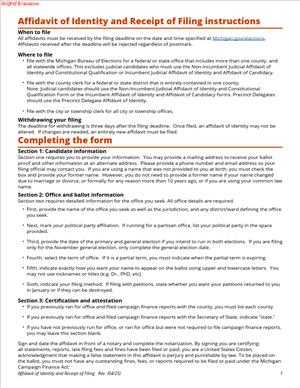
Affidavit of Identity and Receipt of Filing
Fill out nowJurisdiction: Country: United States | Province or State: Michigan
The Affidavit of Identity and Receipt of Filing is a sworn statement used to confirm who you are and to acknowledge that you received or submitted a specific filing. It connects your identity to an official document in a clear, traceable way. When you complete it, you are formally stating that the information you provide is true.
You may encounter this form when dealing with records maintained by the Michigan Department of State. It often appears in situations involving official filings that require identity verification. The document creates a written record that you confirmed your identity and received notice of a particular submission.
If you are filling this out, you are likely trying to correct, confirm, or respond to a filing tied to your name. The form helps prevent fraud and misunderstandings. It also helps the agency document that proper notice or confirmation occurred.
Before you begin, it helps to understand what this affidavit does and what it does not do. Knowing its purpose will make the completion process smoother and reduce the chance of delays.
What is an Affidavit of Identity and Receipt of Filing?
Clear definition
An Affidavit of Identity and Receipt of Filing is a written statement signed under oath. In it, you verify your identity and confirm that you received or are aware of a specific filing. The word “affidavit” means you are swearing that the information is accurate to the best of your knowledge.
This form typically includes your full legal name, contact information, and details about the filing in question. You sign it in the presence of a notary or other authorized official. The notary verifies your identity and witnesses your signature.
The document becomes part of an official record. It links you directly to the filing and shows that you acknowledged it. This written confirmation can help resolve disputes about whether notice was given or whether a filing was connected to the correct person.
Who typically uses this form?
Individuals whose names appear on certain state records often use this form. That may include vehicle owners, business filers, or others connected to state-level filings. If a document is submitted under your name, you may need to confirm your identity in writing.
It is also used by people responding to a notice. For example, if you receive communication stating that a filing was made involving you, this affidavit can serve as your formal acknowledgment.
In some cases, someone correcting inaccurate information may be asked to complete this form. The agency uses it to confirm that the person making the statement is the person whose record is involved.
Why might you need this form?
You might need this form to confirm that you received notice of a filing tied to your name. This creates a clear record that you were informed. It can prevent later confusion about whether you were aware of the submission.
You may also need it to verify your identity when disputing or clarifying a filing. By swearing to your identity, you help the agency ensure that the correct person is responding.
Sometimes, the form supports administrative updates. If records must be corrected or confirmed, the affidavit provides written proof that the individual involved acknowledged the filing.
In other situations, it serves as documentation that a filing was properly delivered or recognized. This can be important if questions arise about timing or responsibility.
Typical real-life scenarios
- You receive notice that a document was filed under your name and need to confirm you are the person identified. Completing the affidavit connects your identity to that filing and confirms receipt.
- You discover a filing that contains inaccurate personal information. The affidavit may be required to confirm your identity before corrections are processed.
- A state record shows a transaction involving you, such as a vehicle or business filing, and you are asked to acknowledge it. The affidavit documents that you received the filing and understand its existence.
- You are responding to an administrative review. The agency may request an affidavit to confirm both your identity and your awareness of the filing before moving forward.
- In each of these situations, the form acts as a bridge between you and the official record. It reduces uncertainty and creates a formal statement that can be relied upon later.
When would you use Affidavit of Identity and Receipt of Filing?
You would use the Affidavit of Identity and Receipt of Filing when an official process requires verified identity and written acknowledgment. This often occurs after a filing has already been made and notice has been issued.
If you receive communication stating that a filing affects your rights or responsibilities, this document may be used to confirm you received that notice. The acknowledgment becomes part of the administrative record.
You might also use it during a correction process. When you claim that a filing contains errors or was made without your authorization, the agency may request this affidavit to confirm that the person making the claim is the person named in the record.
In administrative settings, identity verification is critical. Agencies must ensure they are communicating with the correct individual. This form supports that verification.
It may also be used in response to a dispute. If there is disagreement about whether notice was provided, the affidavit can serve as evidence that you did receive the filing.
Timing matters. The form is generally completed after a filing has occurred but before final resolution of any related issue. It helps move the process forward by confirming your role and awareness.
Legal characteristics of Affidavit of Identity and Receipt of Filing
An affidavit is a sworn statement. That means you declare the contents are true under penalty of perjury. This gives the document legal weight. It is more than a casual acknowledgment.
For the form to be effective, it typically must be complete and properly signed. Missing information, unsigned sections, or incorrect identification details can delay processing. In many cases, notarization is required. Without it, the affidavit may not be accepted.
Clarity is important. Names must match official records. Dates should be accurate. If the affidavit references a specific filing, that filing should be clearly identified. Vague statements can cause confusion and lead to rejection.
Although procedures can vary slightly between agencies, the core requirement is the same: identity must be verified, and acknowledgment must be clear. Differences may involve formatting, supporting documentation, or how the affidavit is submitted.
This document does not create new rights or cancel obligations on its own. It does not automatically correct errors or resolve disputes. Instead, it confirms identity and receipt, which supports other actions within the administrative process.
It also does not replace other required forms. If an agency requires additional documentation, the affidavit serves as one part of a broader submission.
Is it legally binding?
Yes, an affidavit is legally binding in the sense that you are swearing the information is true. Providing false information can carry legal consequences because you are making a statement under oath.
The binding nature comes from the oath and notarization process. When you sign before a notary, the notary verifies your identity and witnesses your signature. This formal step strengthens the document’s reliability.
However, being legally binding does not mean it automatically determines the outcome of a dispute. The affidavit confirms identity and receipt. It may support a decision, but it does not guarantee a specific result.
Its legal effect depends on proper completion and submission. If key elements are missing, the document may not carry the intended weight. Accuracy and completeness are essential.
How to fill out Affidavit of Identity and Receipt of Filing
Step 1 – Review the entire form before writing
Read the full document from beginning to end. Identify what information is requested and what filing is being referenced. Make sure you understand which record or submission the affidavit relates to before you start filling in details.
Step 2 – Enter your full legal name
Write your name exactly as it appears on official records. This usually means your complete legal name, including middle name or suffix if applicable. Consistency helps prevent processing delays.
Step 3 – Provide your contact information
Fill in your current address and any other requested contact details. Use accurate, up-to-date information. This ensures the agency can reach you if clarification is needed.
Step 4 – Identify the specific filing
Clearly state the filing you are acknowledging. Include identifying details such as a reference number, date of filing, or description of the document if the form requests it. The goal is to connect your affidavit to one specific record.
Step 5 – Confirm your identity statement
Read the identity statement carefully. By signing, you are swearing that you are the person named and that the information provided is true. Make sure every detail is accurate before proceeding.
Step 6 – Confirm receipt acknowledgment
Locate the section where you acknowledge receipt of the filing. Ensure the description matches the document you received or are confirming. This ties your acknowledgment directly to that submission.
Step 7 – Check for completeness
Review all fields for missing information. Confirm dates, spellings, and reference numbers. Incomplete forms may be returned without processing.
Step 8 – Sign in the presence of a notary
Do not sign the affidavit until you are in front of a notary or other authorized official, if notarization is required. Bring valid identification. The notary will verify your identity and witness your signature.
Step 9 – Ensure the notary section is completed
After you sign, the notary will complete their portion of the form. This usually includes their signature, seal, and the date. Check that this section is fully completed before leaving.
Step 10 – Submit the completed form as directed
Follow the submission instructions provided with the form. This may involve mailing or delivering the original document. Keep a copy for your records, so you have proof of what you submitted and when.
Legal terms you might encounter in Affidavit of Identity and Receipt of Filing
- Affiant: The affiant is the person making the sworn statements in this document. In this form, that is you. You are declaring that the identity information provided is true and that you have received a specific filing.
- Notary Public: A notary public is an authorized official who verifies your identity and witnesses your signature. The notary completes a separate section confirming that you appeared in person and swore or affirmed the statements. Without the notary’s acknowledgment, the document is not valid.
- Sworn Statement: A sworn statement is a declaration made under oath. By signing, you confirm that the information is true to the best of your knowledge. False statements can lead to penalties, so accuracy matters.
- Acknowledgment: An acknowledgment is the notary’s certification that you signed the document voluntarily and that your identity was verified. It usually includes the notary’s signature, seal, and commission expiration date.
- Receipt of Filing: This phrase refers to your confirmation that you have received a specific filed document. The form records the title or description of that filing and the date it was issued or received.
- Legal Name: Your legal name is the full name recognized by government records. It must match the name shown on your identification and any related filing. Even small differences, such as missing middle names or suffixes, can cause processing issues.
- Commission Expiration Date: This is the date when the notary’s authority ends. The notary must have a valid commission on the date you sign. An expired commission can invalidate the notarization.
- Signature Block: The signature block is the section where you print your name, sign, and date the document. It may also include space for your address or other identifying details. Complete every line in this section.
- Identification Document: An identification document is the government-issued ID you present to the notary. It proves that you are the person named in the affidavit. The notary may record details from your ID in their journal.
- Filing Date: The filing date is the official date the underlying document was accepted by the agency. This date may appear on the document you received. You may need to reference it accurately in this form.
FAQs
Do I need to use my name exactly as it appears on the original filing?
Yes. Your name should match the name shown on the filed document and your identification. If your name has changed or appears differently, review the filing and your ID carefully before completing this form. Even small differences can delay processing or require clarification.
What specific information about the filing do I need to include?
You must identify the document you received with enough detail that it can be clearly recognized. This usually means including the title of the document and the date it was filed or issued. If there is a reference number on the document you received, include it exactly as shown.
When should I sign this document?
You should sign only after reviewing all information and when you are physically present before a notary. Do not sign in advance. The notary must witness your signature and complete their section on the same date.
What happens if I make a small mistake while filling it out?
If you notice an error before notarization, neatly correct it and initial the change if appropriate. If the document has already been notarized, you may need to complete a new form to avoid confusion. Do not use correction fluid or make the text unreadable.
Do I need to attach a copy of the document I received?
Read the instructions carefully. In many cases, you do not attach the document itself, but you must clearly identify it. If attachments are required, make sure they are complete and legible before submission.
Does this form change the contents of the filing I received?
No. This document does not alter the underlying filing. It confirms your identity and that you received a specific document. The Affidavit of Identity and Receipt of Filing serves as a formal acknowledgment, not an amendment.
What if I never received the document listed in the records?
Do not sign this form if you did not actually receive the filing. The purpose of this document is to confirm receipt. Signing without receiving the document would make your sworn statement inaccurate.
Where do I submit the completed Affidavit of Identity and Receipt of Filing?
Follow the submission instructions provided with the form or in the notice you received. Some filings must be returned to a specific office or department. Ensure you keep a copy for your records before sending the original.
Checklist: Before, During, and After Affidavit of Identity and Receipt of Filing
Before
- Read the entire form from start to finish.
- Locate the document you are confirming receipt of.
- Verify the exact title and filing date of that document.
- Check your legal name against your government-issued ID.
- Gather acceptable identification for notarization.
- Review any instructions about attachments.
- Confirm where and how the completed form must be submitted.
During
- Print clearly in black or blue ink if completing by hand.
- Enter your full legal name exactly as it appears on your ID.
- Provide accurate contact information.
- Write the complete title and date of the filing you received.
- Review every line for spelling and number accuracy.
- Do not sign until you are in front of a notary.
- Present valid identification to the notary.
- Watch the notary complete and sign their section.
After
- Make a clear copy of the signed and notarized document.
- Confirm that the notary seal and commission date are visible.
- Attach any required supporting documents.
- Submit the original as instructed.
- Record the date you mailed or delivered the form.
- Keep proof of submission if available.
- Store your copy in a safe and accessible place.
Common mistakes to avoid with Affidavit of Identity and Receipt of Filing
- Mistake: Signing the form before meeting with a notary, which happens when you try to save time, can invalidate the notarization and force you to start over, so do not sign until you are physically in front of the notary.
- Mistake: Using a nickname or shortened version of your name because it feels informal, which can cause mismatches with official records and delays, so do not forget to use your full legal name exactly as shown on your ID.
- Mistake: Listing the wrong filing date due to guessing or misreading the document, which may create confusion about what you received, so do not forget to double-check the date on the actual filing.
- Mistake: Leaving blank spaces in required fields because you assume they are optional, which can result in rejection or requests for correction, so do not forget to complete every required line.
- Mistake: Failing to verify the notary’s seal and commission expiration date, which can make the affidavit unacceptable if the commission has expired, so do not forget to confirm the notary section is fully completed.
- Mistake: Submitting only the original without keeping a copy because you are in a hurry, which leaves you without proof of what you signed, so do not forget to make and store a complete copy first.
- Mistake: Attaching the wrong supporting document due to similar titles or dates, which may delay processing, so do not forget to match the attachment details carefully.
- Mistake: Altering the document after notarization to fix a minor error, which can void the notarization and raise questions about authenticity, so do not forget to prepare a new form if changes are needed.
What to do after filling out Affidavit of Identity and Receipt of Filing
Once you complete and notarize the form, pause and review it one more time. Make sure all names, dates, and descriptions are readable. Confirm that the notary’s seal is clear and that the signature and commission expiration date are present.
Next, organize your paperwork. Place the completed affidavit together with any required supporting documents. Arrange them in the order requested in the instructions.
- Step 1: Make at least one full copy of the signed and notarized document for your records.
- Step 2: If attachments are required, copy those as well and keep the copies with your affidavit copy.
- Step 3: Confirm the correct submission address or office listed in your instructions.
- Step 4: Choose your submission method, such as mail or in-person delivery, based on what is permitted.
- Step 5: If mailing, use a method that provides delivery confirmation so you can track when it arrives.
- Step 6: If delivering in person, request a stamped or dated receipt as proof of submission.
- Step 7: Mark your calendar with the date you submitted the form.
- Step 8: Watch for confirmation that the document has been received or processed.
- Step 9: If you do not receive confirmation within a reasonable time, follow up using the contact information provided in your instructions.
- Step 10: Update your personal records to reflect that you completed and submitted this affidavit.
- Step 11: Store your copy in a secure place where you keep other important documents.
- Step 12: Keep related correspondence together in case you need to reference it later.
Staying organized after submission protects you. If questions arise about whether you confirmed your identity or acknowledged receipt of a filing, you will have clear documentation ready. Careful follow-through ensures the process moves forward without unnecessary delays.
Disclaimer: This guide is provided for informational purposes only and is not intended as legal advice. You should consult a legal professional.