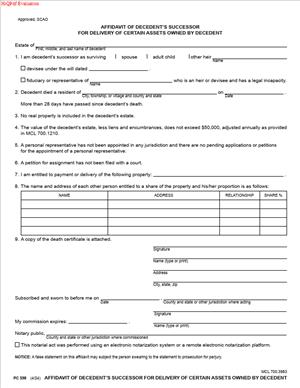
PC 598 – Affidavit of Decedent’s Successor for Delivery of Certain Assets Owned by Decedent
Fill out nowJurisdiction: Country: United States | Province or State: Michigan
When someone dies, their property does not automatically transfer to the next person in line. Banks, financial institutions, and others usually require written proof before releasing assets. The PC 598 – Affidavit of Decedent’s Successor for Delivery of Certain Assets Owned by Decedent is designed for situations where a full probate case may not be necessary.
This document is commonly used when the estate is small and meets certain limits. It allows a person who is legally entitled to inherit to request specific assets without opening a formal probate proceeding. It is often called a “small estate affidavit.”
If you are about to complete this form, you likely want to access a bank account, refund, or other personal property that belonged to the person who died. You may be a spouse, child, or other relative. The form helps you state, under oath, that you are entitled to receive the property.
Understanding how this form works will help you avoid delays. Even small errors can cause an institution to reject your submission. Knowing what each section means makes the completion process more straightforward.
What is PC 598 – Affidavit of Decedent’s Successor for Delivery of Certain Assets Owned by Decedent?
Clear definition
The PC 598 – Affidavit of Decedent’s Successor for Delivery of Certain Assets Owned by Decedent is a sworn written statement. In it, you declare that a person has died, that certain conditions are met, and that you are entitled to receive specific assets.
It is not a court order. It is an affidavit, which means you sign it under oath. By signing, you confirm that the information is true to the best of your knowledge.
This form is generally used to collect personal property. That can include bank accounts, checks payable to the deceased person, or other financial assets. It does not typically transfer real estate.
Who typically uses this form?
This form is commonly used by a surviving spouse. It may also be used by children, parents, or other heirs. In some cases, a person named in a will may use it if the estate qualifies.
The person completing the form is called the successor. A successor is someone legally entitled to the decedent’s property. You do not need to be appointed as a personal representative in a full probate case to use this document if the estate qualifies.
Financial institutions, insurance companies, or others holding the property are usually the recipients of the affidavit. They rely on your sworn statement to release the assets.
Why might you need this form?
You might need this form if the deceased person left only a small amount of personal property. Opening a full probate estate can take time and involve additional filings. This affidavit offers a simpler path in qualifying situations.
You may also need it if there is no will and the property passes under inheritance laws. In that case, the form helps confirm who has the legal right to receive the asset.
Sometimes, there is a will, but no formal probate has been started. If the estate meets the size limits and other conditions, the affidavit may still be used to collect certain assets.
The form can also be useful when the main asset is a single bank account or a small investment account. Instead of going through court administration, you present the affidavit directly to the institution holding the funds.
Typical real-life scenarios
- A common situation involves a surviving spouse whose partner died with a modest bank account in their sole name. The bank requires documentation before releasing the funds. The spouse completes the affidavit and presents it with a death certificate.
- Another scenario involves an adult child whose parent died without a will. The parent had a small checking account and no real estate. The child, as an heir, uses the form to request distribution of the account balance.
- In some cases, a person dies with a final paycheck or tax refund owed to them. The employer or agency may require an affidavit before issuing payment to a family member.
- You may also see this form used when several heirs agree that one person will collect the funds and distribute them according to inheritance rules. The affidavit identifies the successors and confirms the legal basis for receiving the property.
When would you use PC 598 – Affidavit of Decedent’s Successor for Delivery of Certain Assets Owned by Decedent?
You would use this form when the estate qualifies as a small estate under Michigan law. That generally means the value of the personal property, after certain deductions, falls under a specific statutory limit. The limit can change over time.
The form is typically used when no probate case has been opened. If a personal representative has already been appointed by a court, that person usually has the authority to collect assets without using this affidavit.
You might also use this document when you need access to funds to pay final expenses. These may include funeral costs, medical bills, or other debts of the decedent. The affidavit provides a way to access assets for these purposes when allowed.
This form is not usually used for real estate transfers. Real property often requires different procedures. The affidavit focuses on personal property, such as money, securities, or tangible items.
In many cases, the institution holding the asset will ask whether probate has been started. If it has not, and the estate meets the small estate requirements, the affidavit may be presented instead of letters of authority from a court.
Legal characteristics of PC 598 – Affidavit of Decedent’s Successor for Delivery of Certain Assets Owned by Decedent
This document is a sworn affidavit. That means you sign it under oath, typically before a notary public. Your signature confirms that the statements in the form are true.
For the affidavit to be effective, it generally must include accurate information about the decedent, the date of death, and the value of the estate. It must also state that the statutory waiting period has passed. In Michigan, there is typically a required number of days after death before you can use the form.
The affidavit often requires you to list the names of other heirs or successors. You may need to confirm that you are entitled to receive the property under a will or under inheritance laws. Clear and complete information reduces the chance of rejection.
Common problems include incorrect asset values, missing signatures, or failure to meet the estate value limit. Financial institutions may also require a certified copy of the death certificate. If the form is incomplete, they may refuse to release the property.
High-level differences can exist between states. Small estate limits and procedures vary. This specific form is tailored to Michigan and reflects its statutory framework.
It is important to understand what this form does not do. It does not appoint you as a personal representative. It does not resolve disputes between heirs. It does not automatically protect you from liability if the statements are incorrect.
Is it legally binding?
Yes, an affidavit is legally binding because it is made under oath. When you sign, you are making sworn statements of fact. Providing false information can have legal consequences.
The binding effect applies to you as the person signing. Institutions rely on your sworn statement to release property. If the information is accurate and the legal conditions are met, the affidavit serves as a valid basis for transferring the listed assets.
However, it does not prevent others from challenging the distribution later. If another heir believes the affidavit was incorrect, disputes may still arise. The affidavit does not replace a court judgment or eliminate potential claims.
How to fill out PC 598 – Affidavit of Decedent’s Successor for Delivery of Certain Assets Owned by Decedent
Step 1 – Identify the decedent
Enter the full legal name of the person who died. Include the date of death exactly as it appears on the death certificate. Accuracy here is critical because institutions compare this information with their records.
Step 2 – Confirm the waiting period
State that the required number of days has passed since the date of death. The form includes language confirming that enough time has elapsed to use the affidavit procedure. Make sure the timeline matches the actual date of death.
Step 3 – State the estate value
Provide the total value of the decedent’s personal property, after allowed deductions such as liens or encumbrances. The amount must fall within the statutory limit for a small estate. Use reasonable and supportable estimates if exact figures are not available.
Step 4 – Identify your legal right to the property
Indicate whether you are entitled to the asset as a surviving spouse, heir, or devisee under a will. If there is a will, confirm that it grants you the relevant interest. If there is no will, reflect the applicable order of inheritance.
Step 5 – List other successors
Include the names of other individuals who may share in the estate. The form may require you to confirm that you are acting on behalf of all successors or that you will distribute shares appropriately. Provide complete names to avoid confusion.
Step 6 – Describe the property to be delivered
Clearly identify the specific asset you are requesting. This may include a bank account number, the name of the financial institution, or a description of other personal property. Be precise so the holder of the asset can match it to their records.
Step 7 – Acknowledge obligations and statements under oath
Read the sworn statements carefully. The form includes declarations that the information is true and that you understand your responsibilities. Make sure you understand each statement before signing.
Step 8 – Sign before a notary
Do not sign the affidavit until you are in front of a notary public. Bring valid identification. The notary will witness your signature and complete the notarial section, making the document ready for submission to the asset holder.
Legal terms you might encounter in PC 598 – Affidavit of Decedent’s Successor for Delivery of Certain Assets Owned by Decedent
- Decedent: The person who has died. This document requires you to enter the decedent’s full legal name exactly as it appeared on official records. You may also need to provide the date of death and last known address. Accuracy here is critical because asset holders will compare this information to their records.
- Successor: A person legally entitled to receive the decedent’s property. On this form, you are stating that you qualify as a successor under the law. You must confirm your relationship to the decedent or your right under a will, if one exists.
- Affidavit: A written statement made under oath. When you sign this document before a notary, you are swearing that everything you wrote is true. False statements can lead to legal consequences.
- Small estate: An estate that falls below a certain value limit set by law. This form is typically used when the total value of the decedent’s probate assets does not exceed that limit. You must calculate and confirm that the estate qualifies before using this process.
- Probate estate: The property that would normally pass through court supervision after death. This form applies only to certain assets that qualify for transfer without full probate. You must understand which assets are included and which are not.
- Intestate: When someone dies without a valid will. If the decedent was intestate, the law determines who the successors are. You must state whether there was a will and confirm your entitlement accordingly.
- Personal representative: A person appointed by a court to manage the estate. This form is generally used when no personal representative has been appointed. You must confirm that no court proceeding is pending or active for the estate.
- Notarization: The act of signing the affidavit in front of a notary public. The notary verifies your identity and witnesses your signature. Without proper notarization, many institutions will reject the document.
- Delivery of assets: The act of transferring property from the current holder to you as successor. The affidavit serves as your formal request and legal certification. The asset holder relies on your sworn statements to release the property.
FAQs
Can I use PC 598 – Affidavit of Decedent’s Successor for Delivery of Certain Assets Owned by Decedent if probate has already been started?
No. This document is generally used when no personal representative has been appointed, and no probate proceeding is active. If a court has already opened an estate and appointed someone, that person has the authority to collect assets. You should confirm the estate’s status before completing this form because institutions may check court records.
What exact date should I use as the effective date?
You must use the decedent’s official date of death as shown on the death certificate. This date determines whether any required waiting period has passed. Asset holders will compare the date on this document to the death certificate you provide.
Do I need to attach the death certificate?
Most institutions will require a certified copy of the death certificate. This document confirms the decedent’s identity and date of death. If you do not include it when requested, your affidavit may be rejected or delayed.
How do I confirm I am legally entitled to the property?
You must review whether the decedent had a valid will or died without one. If there is a will, confirm that it names you as a beneficiary of the asset in question. If there is no will, you must determine your relationship to the decedent and ensure you qualify under the order of inheritance before signing this form.
What happens if there are multiple successors?
You must disclose other individuals who have equal or higher priority rights to the property. In some cases, all successors must sign the document. If you fail to identify others, the asset holder may refuse delivery or require additional documentation.
Will this document change the public record of ownership?
This document itself does not automatically update public records. It authorizes the asset holder to transfer property to you. After delivery, the institution may update its internal records, and you may need to complete additional paperwork to reflect new ownership.
What if the name on the asset account is slightly different from the name on the death certificate?
You should review all documents carefully before signing. If there are spelling differences, missing middle names, or suffix variations, you may need to provide additional identification documents. Inconsistent names can cause delays because the institution must confirm they are releasing the correct asset.
How many copies of this form should I prepare?
Prepare at least one original, signed, and notarized copy for each institution holding property. Many organizations require their own copy for their records. Keeping extra certified copies of the death certificate will also help you avoid delays when multiple assets are involved.
Checklist: Before, During, and After PC 598 – Affidavit of Decedent’s Successor for Delivery of Certain Assets Owned by Decedent
Before
- Confirm the estate qualifies as a small estate under the value limit.
- Verify that no probate case has been opened and no personal representative has been appointed.
- Obtain certified copies of the death certificate.
- Review any will to confirm your status as successor.
- Identify all assets you plan to collect using this affidavit.
- Calculate the total value of the decedent’s probate assets.
- Gather identification documents that match the decedent’s name exactly.
- Identify any other successors who may need to sign or consent.
During
- Enter the decedent’s full legal name exactly as shown on official records.
- Provide the correct date of death.
- State the total estate value accurately and honestly.
- Clearly describe each asset you are requesting to receive.
- Disclose all other successors and their relationship to the decedent.
- Read each sworn statement carefully before signing.
- Sign only in the presence of a notary.
- Confirm the notary completes all required sections, including the seal and date.
After
- Make copies of the signed and notarized affidavit for your records.
- Attach required supporting documents, such as the death certificate.
- Deliver the affidavit to the institution holding the asset.
- Request written confirmation that your documents were received.
- Follow up if you do not receive a response within a reasonable time.
- Deposit or retitle assets in your name once delivered.
- Keep detailed records of all assets collected.
- Store the original documents in a safe place.
Common mistakes to avoid with PC 598 – Affidavit of Decedent’s Successor for Delivery of Certain Assets Owned by Decedent
- Mistake: Using the form when the estate exceeds the allowed value limit, which happens when people forget to include all probate assets; this can invalidate the affidavit and delay transfers, so do not forget to calculate the full estate value carefully.
- Mistake: Failing to confirm that no probate case is open, often because you assume no one filed anything; this can lead to rejection by the institution, so do not forget to check court records before signing.
- Mistake: Listing assets vaguely, such as “bank account,” which happens when you lack account details; this may cause the institution to refuse release, so do not forget to provide specific identifying information.
- Mistake: Leaving out other successors, usually because of family tension or misunderstanding of inheritance order; this can create disputes and legal risk, so do not forget to disclose all individuals with equal or higher rights.
- Mistake: Signing the affidavit before meeting with a notary, which often happens out of convenience; this invalidates the notarization, so do not forget to wait and sign only in the notary’s presence.
- Mistake: Providing inconsistent names or dates, often due to copying errors; this can delay processing, so do not forget to double-check spelling, dates, and identifying details against official documents.
- Mistake: Forgetting to attach required documents, which happens when you assume the affidavit alone is enough; this can result in immediate rejection, so do not forget to confirm what supporting paperwork is needed.
- Mistake: Keeping no records of what you submitted, often because the process feels informal; this makes it harder to prove delivery or resolve disputes, so do not forget to keep copies and proof of submission.
What to do after filling out PC 598 – Affidavit of Decedent’s Successor for Delivery of Certain Assets Owned by Decedent
Once you complete and notarize the document, your next steps focus on proper delivery and recordkeeping. The form does not transfer assets by itself. You must present it to the institution or person holding the property.
- Step 1: Make several copies of the signed and notarized affidavit for your personal records.
- Step 2: Attach a certified copy of the death certificate and any other documents required by the asset holder.
- Step 3: Contact the institution in advance to confirm how they accept affidavits, whether in person or by mail.
- Step 4: Submit the documents according to their stated process and keep proof of delivery.
- Step 5: Ask for written confirmation that your affidavit has been accepted and is being processed.
- Step 6: Respond promptly if the institution requests additional information or clarification.
- Step 7: Once the asset is released, confirm that ownership has been properly transferred into your name.
- Step 8: Deposit funds into an account titled correctly, if applicable, and avoid mixing estate funds with unrelated funds until you are sure of your rights.
- Step 9: Keep a written log of the date you received each asset and its value.
- Step 10: Store the original affidavit and all related correspondence in a secure place in case questions arise later.
If multiple assets are involved, repeat this process for each institution. Stay organized. Keep copies of everything you send and receive. Clear documentation protects you if another successor questions the transfer or if an institution later asks for proof.
Disclaimer: This guide is provided for informational purposes only and is not intended as legal advice. You should consult a legal professional.