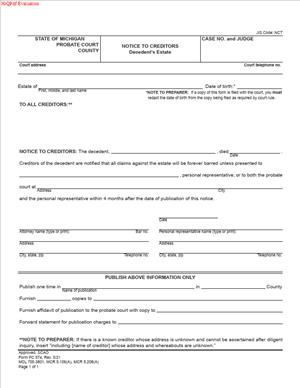
PC 574 – Notice to Creditors – Decedent’s Estate
Fill out nowJurisdiction: Country: United States | Province or State: Michigan
When someone dies, and a probate estate is opened, creditors need a formal way to learn about it. The PC 574 – Notice to Creditors – Decedent’s Estate is the document used to give that notice. It tells creditors that the estate has been opened and sets a deadline for submitting claims.
If you are serving as a personal representative, this form is part of your early responsibilities. It helps you move the estate forward in an organized way. Without proper notice, creditor issues can delay the process.
This document is not about distributing property. It focuses on debts. It creates a clear timeline so the estate can identify, review, and resolve claims.
If you are about to complete this form, you likely want to know what information belongs on it, how it works, and what happens after it is issued. The sections below walk through those points in plain language.
What is PC 574 – Notice to Creditors – Decedent’s Estate?
Clear definition
PC 574 – Notice to Creditors – Decedent’s Estate is a probate court form used to notify creditors that a person has died and that an estate proceeding has started. It provides essential case information and states the deadline for creditors to file claims against the estate.
The document is typically filed in the probate court handling the estate. It may also be published in a newspaper or otherwise distributed, depending on the situation. The goal is to give public notice and, in some cases, direct notice to known creditors.
This form creates an official record that creditors were informed of the estate and given a limited period to act. It marks the beginning of the creditor claim period.
Who typically uses this form?
The personal representative of the estate usually completes and submits this form. This may be an executor named in a will or an administrator appointed by the court when there is no will.
In some situations, a probate attorney prepares the document, but the personal representative remains responsible for its accuracy and proper filing. If you are handling the estate without a lawyer, you may be the one filling it out yourself.
Court staff processes the form once it is submitted. Creditors, financial institutions, and collection agencies are the parties who rely on it for notice of the estate proceeding.
Why might you need this form?
An estate often includes unpaid bills, loans, medical expenses, or credit card balances. Before assets can be distributed to heirs, the estate must address valid debts.
This form sets a clear deadline for creditors to come forward. Without that deadline, the estate could remain open longer than necessary due to uncertainty about possible claims.
It also protects the estate process. When notice is properly given, creditors who fail to act within the allowed time may lose the ability to collect from the estate. This creates finality and helps close the estate in a timely way.
Typical real-life scenarios
- A person dies owning a home, a vehicle, and several bank accounts. There are known credit card balances and medical bills. The personal representative opens a probate case and uses this form to notify all potential creditors so that those debts can be addressed.
- An individual dies with a will naming a family member as executor. The executor files for probate and discovers a personal loan that may not be fully documented. The notice ensures that any lender with a claim has an opportunity to submit it formally.
- Someone passes away without a will. The court appoints an administrator. The administrator is unsure whether there are outstanding business debts. Issuing the notice allows any business creditors to come forward within a defined period.
- An estate includes rental property. The personal representative does not know if there are unpaid contractor invoices related to recent repairs. The notice provides a structured way for those potential creditors to present their claims.
When would you use PC 574 – Notice to Creditors – Decedent’s Estate?
You use this form after a probate estate has been opened with the court. It generally comes early in the administration process, once a personal representative has been appointed and the case number has been assigned.
The form is part of the formal probate process. If no probate case is opened, this notice is typically not used. Smaller estates handled outside of full probate may follow different procedures.
You would also use this document when the estate has potential debts that must be resolved before distribution. Even if you believe the estate has no debts, formal notice may still be required as part of the probate process.
The personal representative is the central figure in this step. In some cases, a successor personal representative may issue a new notice if the original representative is replaced and the claim period needs to be addressed again.
Timing matters. The creditor claim period generally begins after the notice is published or otherwise issued. That timing affects when the estate can move toward closing.
Legal characteristics of PC 574 – Notice to Creditors – Decedent’s Estate
This form functions as a formal legal notice. Its effectiveness depends on accurate information and proper filing or publication according to court procedures.
For the notice to be valid, it usually must include correct details such as the decedent’s name, the probate court, the case number, and the personal representative’s contact information. Errors in these details can cause confusion or disputes.
The document typically states a deadline by which creditors must file claims. If the deadline is calculated incorrectly or not clearly stated, it may create procedural problems and delay the estate.
Proper publication or delivery is also important. If the required publication is not completed or proof of publication is missing, the court may not recognize that creditors were properly notified.
This form does not determine whether a debt is valid. It only gives creditors the opportunity to submit claims. The estate still has the right to review and, if appropriate, dispute claims through the probate process.
State laws vary in how creditor claim periods work and how notice must be given. While the general purpose of creditor notice is similar across jurisdictions, the timing rules and publication requirements can differ.
Is it legally binding?
The notice itself is not a contract. It does not create new debts or eliminate existing ones. Its legal effect comes from the probate process and the statutes that govern creditor claims.
Once properly issued, the notice can limit the time creditors have to file claims. If a creditor misses the deadline, the claim may be barred. That deadline gives the notice its practical legal force.
For the personal representative, issuing the notice is often a required procedural step. Failing to complete it correctly can expose the estate to extended liability or procedural challenges.
The binding aspect lies in the deadlines and the court’s recognition of the notice. When the court accepts that proper notice was given, it may enforce the consequences tied to that notice, including barring late claims in many situations.
How to fill out PC 574 – Notice to Creditors – Decedent’s Estate
Step 1 – Enter the court information
At the top of the form, provide the name of the probate court and the county where the estate is being administered. This information must match the court where the estate case was opened. Include the assigned case number exactly as it appears on other probate documents.
Step 2 – Identify the decedent
Fill in the full legal name of the deceased person. Use the name as it appears on the probate petition and court order appointing the personal representative. Consistency across all filings helps prevent processing delays.
Step 3 – Provide the personal representative’s details
Enter the name and address of the personal representative. This is the person authorized to act on behalf of the estate. Include complete contact information as required by the form so creditors know where to send claims.
Step 4 – State the deadline for creditor claims
Insert the deadline by which creditors must file their claims. This date is typically calculated based on the date of publication or other statutory timeframes. Ensure the date is written clearly and in the correct format.
Step 5 – Review notice language about filing claims
The form contains standard language explaining how and where creditors must file their claims. Read this section carefully before finalizing the document. Confirm that it matches the case information and that no required fields are left blank.
Step 6 – Sign and date the form
Sign the form in the space provided, using your name as personal representative. Add the date of signing. Your signature confirms that the information is accurate to the best of your knowledge.
Step 7 – File and arrange for publication if required
Submit the completed form to the probate court handling the estate. If publication is required, coordinate with the appropriate publication source and ensure proof of publication is obtained and filed with the court as part of the estate record.
Legal terms you might encounter in PC 574 – Notice to Creditors – Decedent’s Estate
- Decedent: The person who has died. On this document, you must enter the decedent’s full legal name exactly as it appears in the court file. Any mismatch can cause confusion in the public record and with creditors reviewing the notice.
- Personal Representative: The individual appointed to manage the estate. This is the person responsible for signing and issuing the notice. The form identifies this person by name and address so creditors know who is handling claims.
- Estate: All property, assets, and debts left behind by the decedent. This notice concerns claims against the estate, not against family members personally. The estate is treated as a separate legal entity for purposes of paying debts.
- Creditor: A person or business that claims the decedent owed them money. The entire purpose of this document is to formally notify creditors that they must submit claims by a certain deadline.
- Claim: A written demand for payment from the estate. The notice tells creditors how and when to file their claim. If they miss the deadline stated in the notice, their claim may be barred.
- Publication: The act of publishing the notice in an approved newspaper or similar outlet. Publication creates public notice to unknown creditors. The date of publication is critical because it usually starts the clock for claim deadlines.
- Proof of Publication: Written confirmation from the publisher that the notice was published. This proof is typically filed with the court to show that proper notice was given.
- Bar Date: The final deadline for creditors to submit claims. The form includes language explaining that claims not presented by this date may not be enforceable.
- Interested Person: Anyone with a legal interest in the estate, such as heirs or beneficiaries. While this notice is directed to creditors, interested persons may review it to track deadlines and estate administration progress.
- Court File Number: The unique number assigned to the probate case. You must include this number on the notice so it is correctly connected to the estate proceeding.
FAQs
Do I need to publish this document in a newspaper?
In most cases, yes. This form is designed to give notice to unknown creditors through publication. You must arrange publication in an approved publication source and make sure the publication date is documented, because the claim deadline usually runs from that date.
When does the creditor deadline start?
The deadline typically begins on the date the notice is first published. You must confirm the exact publication date and calculate the deadline correctly before distributing or filing proof. Always double-check the printed date in the published notice.
Do I have to send this document directly to known creditors?
If you know of specific creditors, you are generally expected to provide direct notice to them in addition to publication. That means mailing a copy and keeping proof that you sent it. The published notice alone may not be enough for creditors you already know about.
What information must match the court record exactly?
The decedent’s full legal name and the court file number must match the probate court record exactly. Even small differences, such as missing middle initials or incorrect spelling, can cause confusion and delay. Check your appointment paperwork before finalizing the notice.
Who is allowed to sign PC 574 – Notice to Creditors – Decedent’s Estate?
Only the appointed personal representative, or someone legally authorized to act on their behalf, should sign it. Before signing, confirm that your appointment is officially recorded and active in the court file. If your authority is limited or temporary, make sure the notice reflects your current authority.
What happens if a creditor files a claim after the deadline?
Late claims are often barred, meaning the estate may not be required to pay them. However, you still need to document when the claim was received and compare it to the stated deadline. Keep copies of envelopes or timestamps to show when the claim arrived.
Do I file this document with the court before or after publication?
Typically, you file it with the court and then complete publication, though procedures can vary. What matters is that the court record shows both the notice and proof that publication occurred. Confirm that the court accepts and records both items in the case file.
Does filing this form close the estate?
No. This document only starts the creditor claim period. The estate remains open while you gather assets, evaluate claims, and complete distributions. The notice is just one step in the larger administration process.
Checklist: Before, During, and After PC 574 – Notice to Creditors – Decedent’s Estate
Before
- Confirm you have been officially appointed as personal representative.
- Verify the decedent’s full legal name as listed in the court file.
- Locate the correct court file number.
- Identify all known creditors from bills, statements, and records.
- Confirm the correct court address and case information.
- Review deadlines for creditor claims in your jurisdiction.
- Gather your contact information exactly as it should appear.
- Check whether publication is required in your case.
During
- Enter the court name and file number exactly as assigned.
- Print the decedent’s name without spelling errors.
- List your name and mailing address clearly.
- Confirm the deadline language is complete and accurate.
- Review all text for missing dates or blank spaces.
- Sign the document using your legal name as appointed.
- Make copies before submitting or publishing.
- Arrange for publication promptly after filing, if required.
After
- Obtain proof of publication from the publisher.
- File proof of publication with the court.
- Mail copies to known creditors if required.
- Track the creditor claim deadline on your calendar.
- Log every claim received with date and method of delivery.
- Store copies of all correspondence with creditors.
- Monitor the court docket to confirm filings are recorded.
- Keep organized records for final estate accounting.
Common mistakes to avoid with PC 574 – Notice to Creditors – Decedent’s Estate
- Mistake: Misspelling the decedent’s name because you rely on memory instead of the official court record, which can cause confusion in the probate file and with creditors, so do not forget to copy the name exactly as it appears on your appointment documents.
- Mistake: Listing the wrong court file number due to mixing up paperwork from another case, which may result in rejection or misfiling, so do not forget to verify the number before signing.
- Mistake: Failing to arrange timely publication because you assume filing alone is enough, which can delay the creditor period and estate closing, so do not forget to schedule publication immediately.
- Mistake: Miscalculating the claim deadline because you estimate instead of counting from the actual publication date, which can create disputes over late claims. Do not forget to confirm the printed publication date.
- Mistake: Forgetting to send notice to known creditors because you think publication covers everyone, which may leave the estate exposed to later challenges, so do not forget to review financial records carefully.
- Mistake: Signing before your appointment is officially effective because you are trying to move quickly, which can invalidate the notice, so do not forget to confirm your authority is active.
- Mistake: Leaving blanks or incomplete sections because the form looks straightforward, which can cause rejection or delay, so do not forget to review every line before filing.
- Mistake: Failing to keep proof of mailing or publication because you assume the publisher or court keeps it, which can create problems if challenged, so do not forget to store copies in your estate records.
What to do after filling out PC 574 – Notice to Creditors – Decedent’s Estate
Once you complete the form, your job shifts from drafting to documenting and tracking. You must make sure the notice becomes part of the official court record and that publication is handled correctly.
Start by making several copies. Keep one for your working estate file. You will need copies for publication, mailing to known creditors, and possibly for your own accounting records.
- Step 1: Make at least three complete copies of the signed document.
- Step 2: File the original with the probate court, following the court’s accepted filing method.
- Step 3: Confirm the court has accepted and recorded the filing in the case docket.
- Step 4: Arrange for publication with an approved publication source and provide them with an exact copy.
- Step 5: Obtain written proof showing the date the notice was first published.
- Step 6: File the proof of publication with the court promptly.
- Step 7: Mail copies to all known creditors and document the date and method of mailing.
- Step 8: Create a claim tracking log that lists each creditor, the date notice was sent, and the deadline.
- Step 9: Calendar the final claim deadline and set reminders in advance.
- Step 10: Store all documents together with your letters of authority and estate records.
As claims begin to arrive, date-stamp them immediately. Compare each claim’s arrival date with the published deadline. Keep envelopes or electronic delivery confirmations if relevant. Organized records protect you if a dispute arises.
Continue monitoring the case docket. Make sure both the notice and proof of publication are visible in the file. If something does not appear, follow up promptly.
Finally, update your internal estate accounting system. Note the start and end of the creditor claim period. This timeline affects when you can safely distribute assets. Careful follow-through now prevents problems later in the administration process.
Disclaimer: This guide is provided for informational purposes only and is not intended as legal advice. You should consult a legal professional.