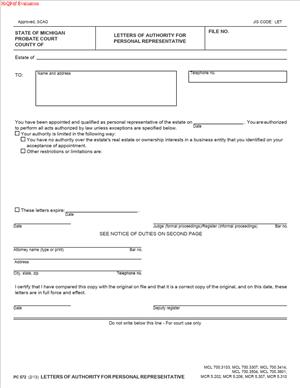
PC 572 – Letters of Authority for Personal Representative
Fill out nowJurisdiction: Country: United States | Province or State: Michigan
PC 572 – Letters of Authority for Personal Representative is a court-issued document that confirms you have authority to act on behalf of a deceased person’s estate. It is not a private agreement. It is an official document issued by a probate court.
If you are serving as a personal representative, this form is central to your role. Banks, title companies, and other institutions often ask to see it before they allow you to access accounts or transfer property. Without it, many estate tasks cannot move forward.
You do not create this document on your own. The court prepares and signs it after appointing you. Your role is to apply for an appointment and complete the required steps so the court can issue the Letters of Authority.
Understanding how PC 572 – Letters of Authority for Personal Representative works will help you avoid delays. It also helps you explain your authority to others when managing estate property, paying debts, and distributing assets.
What is PC 572 – Letters of Authority for Personal Representative?
Clear definition
PC 572 – Letters of Authority for Personal Representative is a formal document issued by a Michigan probate court. It confirms that a specific person has been appointed as the personal representative of a deceased person’s estate.
The document identifies the estate, the personal representative, and the scope of authority granted. It often states whether the appointment is informal or formal and may note any limits on authority.
This form acts as proof of your legal status. It shows that the court has authorized you to act for the estate. Third parties rely on it before releasing funds or recognizing your decisions.
Who typically uses this form?
The primary user is the personal representative. This may be someone named in a will or someone appointed by the court if there is no will.
Family members often serve in this role. A spouse, adult child, sibling, or other relative may be appointed. In some cases, a professional fiduciary or attorney may serve instead.
Financial institutions, buyers of estate property, and government agencies also rely on this document. They use it to confirm they are dealing with the correct authorized person.
Why might you need this form?
You need this document to carry out estate administration tasks. Most institutions will not accept your signature without proof of authority.
For example, if you need to close a bank account in the decedent’s name, the bank typically requires a certified copy of the Letters of Authority. The same applies to selling real estate owned solely by the decedent.
It also helps establish your authority when collecting debts owed to the estate or handling tax matters. Without it, you may be blocked from accessing information or completing transactions.
Typical real-life scenarios
- A parent passes away with a checking account in their sole name. You are named in the will as personal representative. The bank requests court-issued proof before releasing funds. You provide the Letters of Authority to show you are authorized.
- A decedent owned a home that must be sold to pay debts. The title company requires confirmation that you can sign the deed on behalf of the estate. The Letters of Authority provide that confirmation.
- There is no will, and several family members want to handle the estate. The court appoints one person as personal representative. The document clarifies who has legal authority to act and avoids confusion.
- An insurance company needs proof before issuing a payout to the estate. The Letters of Authority show that you are the correct person to receive and manage those funds.
When would you use PC 572 – Letters of Authority for Personal Representative?
You use this document after the probate court appoints you as personal representative. It becomes relevant at the point where you need to interact with third parties on behalf of the estate.
In practical terms, you present it when accessing financial accounts, transferring vehicle titles, selling real property, managing investments, or resolving claims. Many institutions will ask for a certified copy rather than a plain copy.
The form is used throughout the estate administration process. You may need to show it multiple times, especially early in the process when you are identifying and gathering assets.
Your authority under this document typically continues until the estate is settled and the court discharges you. If the court limits your authority, the document may reflect those limits.
If you are a successor personal representative, meaning you replaced someone else, a new version of this document is generally issued in your name. The prior authority does not automatically transfer without court action.
Legal characteristics of PC 572 – Letters of Authority for Personal Representative
This document is effective because it is issued and signed by a probate court. It carries the court’s seal or certification, which gives it legal weight.
Its validity depends on proper appointment. Before the court issues it, certain procedural steps must occur. These often include filing an application or petition, providing notice where required, and taking any required oath.
If information in the underlying probate filings is incorrect, that can delay issuance. Common issues include misspelled names, inconsistent dates of death, or incomplete identification of the estate.
Another frequent problem is failing to meet procedural requirements before requesting issuance. If required notices are not properly handled or required forms are missing, the court may not issue the document.
In some cases, the court may restrict authority. The document might state that the personal representative has limited powers. This can affect your ability to act independently in certain transactions.
It is important to understand what this document does not do. It does not transfer ownership of estate property to you personally. It does not eliminate debts. It does not guarantee that your decisions cannot be challenged. It simply confirms your authority to act on behalf of the estate under court supervision.
Is it legally binding?
Yes, it is legally binding in the sense that it reflects a court order appointing you as personal representative. Third parties are generally entitled to rely on it as proof of your authority.
Its binding effect comes from the probate court’s appointment. Once issued, it authorizes you to perform duties allowed by law and any limitations stated in the document.
However, your authority is not unlimited. You are expected to act in the best interests of the estate and its beneficiaries. If you act outside your authority or misuse estate property, your actions can be reviewed by the court.
The document remains legally effective until it expires, is revoked, or you are discharged. If the court removes you, your authority under the Letters of Authority ends.
How to fill out PC 572 – Letters of Authority for Personal Representative
Step 1 – Confirm appointment by the probate court
Before this document is issued, the court must appoint you as personal representative. This usually follows the filing of an application or petition and any required notices. The judge or probate register formally approves your appointment.
Step 2 – Complete any required acceptance or oath
Courts often require you to accept the appointment and, in some cases, take an oath. This confirms that you agree to carry out your duties. The court will not issue the Letters of Authority until these requirements are satisfied.
Step 3 – Address bond requirements, if applicable
In some estates, the court may require a bond. A bond is a type of financial protection for the estate. If a bond is required, it must generally be filed and approved before the document is issued.
Step 4 – Verify estate and personal information
The court prepares the document using information from the probate filings. This includes the decedent’s name, date of death, and the personal representative’s name and address. Carefully review these details for accuracy once the document is available.
Step 5 – Obtain certified copies from the court
After issuance, request certified copies from the probate court. Institutions typically require certified copies rather than regular photocopies. You will use these copies when dealing with banks, buyers, and other third parties.
Step 6 – Present the document when acting for the estate
When you begin estate administration tasks, provide a certified copy as proof of your authority. Keep track of where you submit copies. You may need additional certified copies as you move through the estate settlement process.
Legal terms you might encounter in PC 572 – Letters of Authority for Personal Representative
- Personal Representative: This is the person legally appointed to manage the estate. In this document, your name appears exactly as approved by the court. You cannot act for the estate until this role is formally granted and reflected in the letters.
- Decedent: The decedent is the person who died and whose estate is being administered. Their full legal name must match the name used in the probate case. Even small spelling differences can cause delays when you present the letters to banks or other institutions.
- Estate: The estate includes all property, accounts, debts, and obligations the decedent owned at death. The letters confirm you have the authority to act on behalf of this legal entity. You are not acting in your personal capacity but as a fiduciary for the estate.
- Letters of Authority: This is the official court-issued proof of your appointment. The document shows that the probate court has granted you authority. Third parties rely on these letters before allowing you to access or transfer estate assets.
- Bond: A bond is a type of financial protection that may be required before your authority becomes effective. It protects beneficiaries and creditors if you misuse estate funds. If a bond is required, the letters may state that your authority is subject to the filing and approval of that bond.
- Limited Authority: In some cases, the court restricts what you can do without additional approval. The letters will specify if your authority is limited. For example, you may need separate court permission before selling real estate.
- Full Authority: This means you can act broadly on behalf of the estate without seeking additional court orders for routine transactions. The letters will indicate whether your authority is full. Even with full authority, you must still follow probate law and your fiduciary duties.
- Testate: This term means the decedent left a valid will. If the estate is testate, your authority is tied to administering the estate according to that will. The letters may reference that a will was admitted to probate.
- Intestate: This means the decedent did not leave a valid will. In that case, estate distribution follows state law. The letters reflect your appointment to administer the estate under intestacy rules.
- Certified Copy: A certified copy is an official copy issued by the court with a seal or stamp. Many financial institutions require a certified copy before honoring your authority. Regular photocopies are often not accepted.
FAQs
When does my authority officially begin?
Your authority begins on the effective date shown on the court-issued letters. That date appears directly on the document and reflects when the court signed and issued it. You cannot act for the estate before that date, even if the hearing has already taken place.
Do I need to file PC 572 – Letters of Authority for Personal Representative with banks myself?
You do not file this document with the court after it is issued, but you must present certified copies to banks and other institutions. Each institution will review the document to confirm your name, the decedent’s name, and whether your authority is limited or full. Some may keep a copy for their records before giving you access to accounts.
What if my name is spelled differently on my ID than on this document?
The name on your identification should match the name printed on the letters. If there is a difference, institutions may refuse to honor your authority. You may need to show additional documentation or request a correction from the court so the record matches your legal identification.
Does this document expire?
In many cases, the letters remain valid until the estate is closed or the court removes you. However, some institutions will not accept letters that appear outdated. If yours were issued long ago, you may need to request updated certified copies to show that your authority is still active.
What happens if the court requires a bond?
If a bond is required, your authority may not be effective until the bond is filed and approved. The document may state that the authority is subject to a bond. Always confirm that the bond requirement has been satisfied before attempting to act on behalf of the estate.
Can I use this document to sell real estate immediately?
You must first confirm whether your authority is full or limited. If the letters show limited authority, you may need a separate court order before selling property. The wording on the document tells you whether additional approval is required.
What if information on PC 572 – Letters of Authority for Personal Representative is incorrect?
If you notice an error in the decedent’s name, your name, or the case number, contact the probate court promptly. Errors in PC 572 – Letters of Authority for Personal Representative can cause banks or title companies to reject it. Corrections usually require court action, so address mistakes early.
Does this document change the public record?
Yes. Once issued, your appointment as personal representative becomes part of the court’s official file. Anyone searching the probate case can see that you were appointed. This public record confirms that you have legal authority to act for the estate.
Checklist: Before, During, and After PC 572 – Letters of Authority for Personal Representative
Before
- Confirm that the probate court has formally appointed you as personal representative.
- Review the court order approving your appointment.
- Verify whether a bond is required and, if so, the amount.
- Ensure your legal name matches your government-issued identification.
- Double-check the correct spelling of the decedent’s full legal name.
- Confirm the case number assigned to the estate.
- Determine whether your authority will be full or limited.
- Prepare funds to pay for certified copies if required.
During
- Review the issued letters carefully for accuracy.
- Check the effective date printed on the document.
- Confirm that any bond requirement is clearly addressed.
- Verify whether restrictions or limitations are listed.
- Request multiple certified copies from the court clerk.
- Ask the clerk how long the letters remain valid.
- Keep the original certified copies secure and flat to preserve the seal.
After
- Provide certified copies to banks and financial institutions.
- Present the letters to insurance companies as needed.
- Use the letters to obtain an estate tax identification number if required.
- Open a separate estate bank account.
- Notify beneficiaries that you have been formally appointed.
- Keep a log of where you provide certified copies.
- Store unused certified copies in a secure location.
- Monitor whether institutions require updated copies over time.
Common mistakes to avoid with PC 572 – Letters of Authority for Personal Representative
- Mistake: Assuming you can act before the letters are issued, which happens when people confuse a court hearing with official authority; this can lead to rejected transactions and personal liability, so do not act until you have certified letters in hand.
- Mistake: Overlooking a bond requirement because you assume it was waived; this delays your authority from becoming effective and prevents access to estate assets, so do not forget to confirm bond approval.
- Mistake: Failing to check for spelling errors in names or the case number, often due to rushing; this causes banks or title companies to reject the document, so do not forget to review every detail carefully.
- Mistake: Using photocopies instead of certified copies because it seems faster; many institutions will refuse them, causing delays, so do not forget to request certified copies with the court seal.
- Mistake: Ignoring limitations stated in the letters because you assume all authority is full; this can invalidate transactions like property sales, so do not forget to read the scope of authority line by line.
- Mistake: Mixing estate funds with personal funds out of convenience; this can create accounting problems and potential court issues, so do not forget to open and use a separate estate account.
- Mistake: Failing to track where you submitted certified copies, which happens when managing multiple accounts; this makes it hard to update institutions later, so do not forget to keep a distribution log.
- Mistake: Letting the letters become outdated without checking institutional requirements; some organizations require recently issued copies, so do not forget to request updated certified copies if needed.
What to do after filling out PC 572 – Letters of Authority for Personal Representative
Once the court issues your letters, your role shifts from applicant to acting personal representative. Now you must use the document properly and protect the estate.
Start by organizing your paperwork. Keep the certified copies in a secure folder. Do not remove staples or damage the court seal. Institutions may reject altered documents.
- Step 1: Confirm the effective date shown on the letters and ensure any bond requirement has been satisfied.
- Step 2: Order multiple certified copies from the probate court so you do not have to reuse the same one repeatedly.
- Step 3: Open a separate bank account in the name of the estate using your certified letters.
- Step 4: Present certified copies to banks, investment companies, and other asset holders to gain access to accounts.
- Step 5: Notify government agencies, insurers, and benefit providers of your appointment.
- Step 6: Record every place where you submit a certified copy and note the date.
- Step 7: Safeguard estate property and begin identifying all assets and debts.
- Step 8: Communicate with beneficiaries to confirm that you have authority and outline next steps.
- Step 9: Keep detailed financial records from the first day you act under your authority.
- Step 10: Monitor whether institutions require updated certified copies and request them if necessary.
You are responsible for acting in the estate’s best interest at all times. That includes careful recordkeeping and clear communication. The letters give you authority, but they also signal accountability.
As you move forward, treat the document as your proof of power. Present it when required. Protect it from damage. Replace certified copies when needed. Staying organized from the beginning will make the estate administration smoother and reduce disputes later.
Disclaimer: This guide is provided for informational purposes only and is not intended as legal advice. You should consult a legal professional.