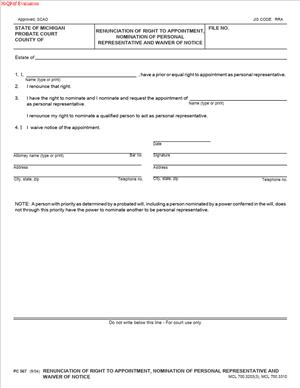
PC 567 – Renunciation of Right to Appointment, Nomination of Personal Representative and Waiver of Notice
Fill out nowJurisdiction: Country: United States | Province or State: Michigan
When someone dies, and an estate needs to be opened, certain people have priority to act as personal representative. PC 567 – Renunciation of Right to Appointment, Nomination of Personal Representative, and Waiver of Notice is the form used in Michigan probate cases when a person with that priority chooses not to serve.
This document allows you to formally give up your right to be appointed. It also lets you support someone else’s appointment and agree not to receive notice of certain probate proceedings.
You may come across this form if you are a surviving spouse, adult child, or other interested person. If you are about to sign it, you need to understand what rights you are giving up and what you are agreeing to.
This form does not transfer property. It does not close an estate. It is focused on who will manage the estate and how the court will notify you.
What is PC 567 – Renunciation of Right to Appointment, Nomination of Personal Representative, and Waiver of Notice?
Clear definition
PC 567 – Renunciation of Right to Appointment, Nomination of Personal Representative, and Waiver of Notice is a Michigan probate court form. It is used in estate administration cases.
The form serves three related purposes. First, it allows you to renounce, or give up, your right to be appointed as personal representative. Second, it allows you to nominate another person for that role. Third, it allows you to waive notice of certain hearings or filings in the estate.
By signing it, you are making a written statement to the court. You are telling the court that you do not want to act as personal representative and that you agree to someone else serving instead.
Who typically uses this form?
This form is commonly used by people who have legal priority to serve as a personal representative but do not want the responsibility.
You might use it if you are the surviving spouse of the deceased. You might also use it if you are an adult child, heir, or beneficiary named in a will. Sometimes multiple family members sign separate copies of the same form.
It is also used when there is no will and state law determines who has priority to serve. In those cases, people with higher priority may sign this form to allow someone else to be appointed.
Why might you need this form?
Probate courts often require written proof that people with priority either consent to the appointment or formally give up their right. This form provides that proof.
If you do not want to handle the estate’s debts, paperwork, and court filings, signing this form makes that clear. It helps avoid delays in opening the estate.
It also reduces the need for a formal notice to you later in the process. By waiving notice, you are agreeing that the court does not have to send you certain documents or hearing notices.
Typical real-life scenarios
- A surviving spouse may not feel comfortable managing financial matters. An adult child who lives nearby may be better positioned to handle the estate. The spouse signs the form to allow the child to serve.
- In another situation, several adult children are equal in priority to serve. One child takes the lead. The others sign the form to step aside and show their support.
- Sometimes a will names a personal representative, but that person does not want to serve. Another interested person may seek an appointment. Those with priority may sign this form to support that appointment.
- In estates with minimal assets, family members may want a simple and efficient process. Signing this form can streamline the appointment and reduce procedural steps.
When would you use PC 567 – Renunciation of Right to Appointment, Nomination of Personal Representative, and Waiver of Notice?
You use this form during the early stage of a probate case. It is typically filed when someone is petitioning the court to be appointed as a personal representative.
If you have equal or higher priority than the person seeking appointment, the court may require your written consent or renunciation. This form meets that requirement.
You may also use it when there is disagreement about who should serve, but you decide not to contest the issue. By signing, you remove yourself from consideration and support a specific nominee.
In intestate estates, where there is no will, priority is determined by statute. If you fall into a category with priority and choose not to act, this form documents that choice.
In testate estates, where there is a will, the nominated personal representative may need additional support from heirs. Signing this form can signal cooperation and reduce the chance of objections.
Legal characteristics of PC 567 – Renunciation of Right to Appointment, Nomination of Personal Representative, and Waiver of Notice
This form becomes effective when it is properly completed, signed, and filed with the probate court in the estate case. It is part of the official court record.
It must clearly identify the deceased person and the probate case. It also must identify you as the person renouncing and nominating another individual.
If information is incomplete or inconsistent with the petition for appointment, the court may question it. Missing signatures or incorrect case numbers are common reasons for delay.
The form does not appoint the personal representative by itself. The court still issues an order of appointment. Your filing supports that appointment but does not replace the court’s decision.
It also does not waive all rights you may have in the estate. Waiving notice generally applies to specific probate proceedings. It does not mean you give up your inheritance or other legal interests.
Procedures can vary slightly depending on whether the estate is supervised or unsupervised. In some cases, additional documents may be required along with this form.
Is it legally binding?
Yes, once signed and filed, this document is generally treated as a binding statement to the court.
By signing, you are formally renouncing your right to appointment. This is not an informal conversation. It is a written declaration in a court case.
Courts rely on these filings when deciding whether to appoint someone. If you later change your mind, it may be difficult to undo the effect of your renunciation after the appointment has been made.
The waiver of notice is also taken seriously. If you waive notice, you may not receive future court notices related to certain matters in the estate. The court can proceed without notifying you, based on your written waiver.
Because it becomes part of the court file, it has legal weight. It reflects your stated position at the time of signing.
How to fill out PC 567 – Renunciation of Right to Appointment, Nomination of Personal Representative, and Waiver of Notice
Step 1 – Identify the court and case information
At the top of the form, fill in the name of the probate court and the county. Enter the case number if one has already been assigned. Make sure the name of the deceased person matches the name used in the petition and other court documents.
Step 2 – Provide your personal information
Enter your full legal name as the person signing the renunciation. Include your address and any other contact information requested. This identifies you as an interested person in the estate.
Step 3 – State your relationship to the deceased
Indicate your relationship, such as surviving spouse, child, heir, or other interested person. This shows the court why you have priority or an interest in the appointment.
Step 4 – Renounce your right to appointment
Read the renunciation language carefully. By signing this section, you are stating that you give up your right to be appointed as personal representative. Confirm that the name of the proposed personal representative is correct.
Step 5 – Nominate the proposed personal representative
If the form includes a nomination section, write the full name of the person you are supporting. Ensure that this name matches the name in the petition for appointment. This avoids confusion in the court record.
Step 6 – Waive notice of proceedings
Review the waiver of notice language. This section states that you agree not to receive certain notices in the probate case. Make sure you understand that the court may proceed without sending you additional updates covered by the waiver.
Step 7 – Sign and date the form
Sign your name exactly as it appears in the form. Add the date of signing. If the form requires notarization or a witness, complete that step as directed on the document before submission to the court.
Legal terms you might encounter in PC 567 – Renunciation of Right to Appointment, Nomination of Personal Representative, and Waiver of Notice
- Renunciation: A formal statement that you are giving up a legal right. In this document, you are giving up your priority right to be appointed as personal representative of the estate. Once filed, the court treats your right as waived for that proceeding.
- Right to Appointment: The legal priority you may have to serve as personal representative. This right usually comes from your relationship to the deceased or from being named in a will. This form records that you are choosing not to exercise that priority.
- Nomination: Your written designation of another person to serve as personal representative. You are telling the court who you support for the role. The court considers your nomination when deciding whom to appoint.
- Personal Representative: The person appointed by the court to manage the estate. This person gathers assets, pays debts, and distributes property. Your document supports a specific individual for this responsibility.
- Waiver of Notice: Your agreement not to receive formal notice of certain probate proceedings. By signing, you are saying you do not require advance notice of hearings related to your appointment. This can speed up the court process.
- Interested Person: Someone who has a financial or legal interest in the estate. This may include heirs, beneficiaries, creditors, or others affected by probate. You sign this document in your capacity as an interested person.
- Intestate: A situation where the deceased did not leave a valid will. If the estate is intestate, priority for appointment follows statutory order. Your renunciation affects that priority order.
- Testate: A situation where the deceased left a valid will. The will may name a personal representative. If you were named but do not wish to serve, this document records that decision.
- Letters of Authority: The official court document that authorizes a personal representative to act on behalf of the estate. Your renunciation and nomination support the issuance of these letters to someone else.
- Priority: The order in which individuals have the right to serve as personal representatives. This order is set by law or by will. By signing, you are stepping aside in that priority sequence.
FAQs
Do I have to use PC 567 – Renunciation of Right to Appointment, Nomination of Personal Representative, and Waiver of Notice if I do not want to serve?
You use this document when you have priority to serve but choose not to. Filing it creates a clear court record that you are stepping aside. Without it, the court may require your written consent or set a hearing to address your priority.
What exactly am I giving up by signing this form?
You are giving up your right to ask the court to appoint you as personal representative in this estate. You are not giving up your inheritance or other rights as an heir or beneficiary. The document only addresses the appointment and notice related to that appointment.
Does waiving notice mean I will not receive any information about the estate?
You are waiving formal notice of proceedings related to the appointment. You may still receive information in other ways, especially if you remain an heir or beneficiary. This document records that the court does not need to send you advance notice before appointing the nominated person.
Can I change my mind after filing this document?
If the court has not yet appointed someone, you may be able to file a new document asking to withdraw your renunciation. Once the court appoints a personal representative and issues letters of authority, reversing your decision becomes more difficult. The court record created by this form shows your prior consent.
Do I need to explain why I am renouncing my right?
No detailed explanation is usually required. The document focuses on your decision, not your reasons. You only need to complete the required information and clearly state your renunciation and nomination.
What if there are multiple people with equal priority?
Each person with equal priority can file this document to support one nominee. The court reviews all filed renunciations and nominations before making an appointment. Clear, consistent filings reduce delays.
Does this document affect my share of the estate?
No. This form only concerns who will administer the estate and whether you require notice of appointment proceedings. Your inheritance rights are determined by the will or by intestacy law, not by this filing.
How do I know the court accepted my filing?
After submission, the court clerk typically stamps or records the document in the case file. You should confirm that it appears in the case docket or obtain a filed copy. This ensures your renunciation and nomination are officially part of the record.
Checklist: Before, During, and After PC 567 – Renunciation of Right to Appointment, Nomination of Personal Representative, and Waiver of Notice
Before
- Confirm that you have priority to serve as a personal representative.
- Review the will, if one exists, to understand any nomination already made.
- Verify the full legal name of the deceased as it appears in court filings.
- Confirm the case number and court location.
- Decide whom you want to nominate and confirm their willingness to serve.
- Check your legal name as it appears on identification.
- Determine whether your signature must be notarized or witnessed.
- Gather any prior probate documents for reference.
During
- Enter the court name exactly as shown on other probate filings.
- Fill in the case number without transposing digits.
- Print your full legal name clearly and consistently.
- State your relationship to the deceased accurately.
- Clearly mark or state your renunciation of the right to appointment.
- Provide the complete legal name of the person you are nominating.
- Read the waiver of notice language before signing.
- Sign and date the document in the required format.
After
- Make at least two copies of the signed document.
- File the original with the appropriate probate court.
- Obtain a stamped or filed copy for your records.
- Provide a copy to the nominated personal representative.
- Check the case docket to confirm the document was entered.
- Calendar any future probate dates, even if notice is waived.
- Store your copy with other estate-related documents.
- Update your personal records to reflect that you declined the appointment.
Common mistakes to avoid with PC 567 – Renunciation of Right to Appointment, Nomination of Personal Representative, and Waiver of Notice
- Mistake: Assuming you are giving up your inheritance when you renounce appointment, which happens because the language sounds formal, leading to unnecessary fear and delay; do not forget that this document only affects who administers the estate.
- Mistake: Misspelling the deceased’s name or using a nickname, which often happens when copying from memory, causing filing rejection or confusion; do not forget to match the name exactly as it appears on the court petition.
- Mistake: Nominating someone without confirming they agree to serve, which happens due to assumptions, leading to further renunciations and delays; do not forget to speak with the nominee first.
- Mistake: Forgetting to include the case number, which occurs when completing the form before a case is opened, resulting in misfiling; do not forget to verify the number from the official petition.
- Mistake: Signing without understanding the waiver of notice section, which happens when rushing, leading to missed court updates; do not forget to read each clause before signing.
- Mistake: Failing to keep a filed copy, which often happens when relying on the court to maintain records, creating problems if proof is needed later; do not forget to request and store a stamped copy.
What to do after filling out PC 567 – Renunciation of Right to Appointment, Nomination of Personal Representative, and Waiver of Notice
Once you complete the document, your next focus is proper filing and documentation. The form does not take effect until it is officially submitted in the probate case file.
- Step 1: Review the entire document for accuracy. Check spelling, dates, and names one more time.
- Step 2: Confirm that you signed and dated the document in the correct place. Make sure any required notarization or witnessing is complete.
- Step 3: Make copies before filing. Keep at least one copy for yourself and one for the nominated personal representative.
- Step 4: Submit the original to the probate court handling the estate. This may be done in person, by mail, or through an approved electronic filing system if available.
- Step 5: Obtain confirmation of filing. Ask for a stamped copy or verify through the court’s case record that the document has been entered.
- Step 6: Provide a copy to the nominated personal representative so they can include it with their appointment materials.
- Step 7: Monitor the case status. Even though you waived notice of certain proceedings, you may still want to check the docket periodically.
- Step 8: Update your personal files. Place your copy with any estate correspondence and note the date you filed.
- Step 9: Communicate with other interested persons if appropriate. Let them know you have renounced and nominated someone, especially if coordination is needed.
- Step 10: Keep your contact information current with the court if you remain involved in the estate in another capacity. This helps avoid confusion later.
By following these steps, you ensure that your decision is clearly documented, properly recorded, and easy to verify if questions arise in the future.
Disclaimer: This guide is provided for informational purposes only and is not intended as legal advice. You should consult a legal professional.